Buntport Theater

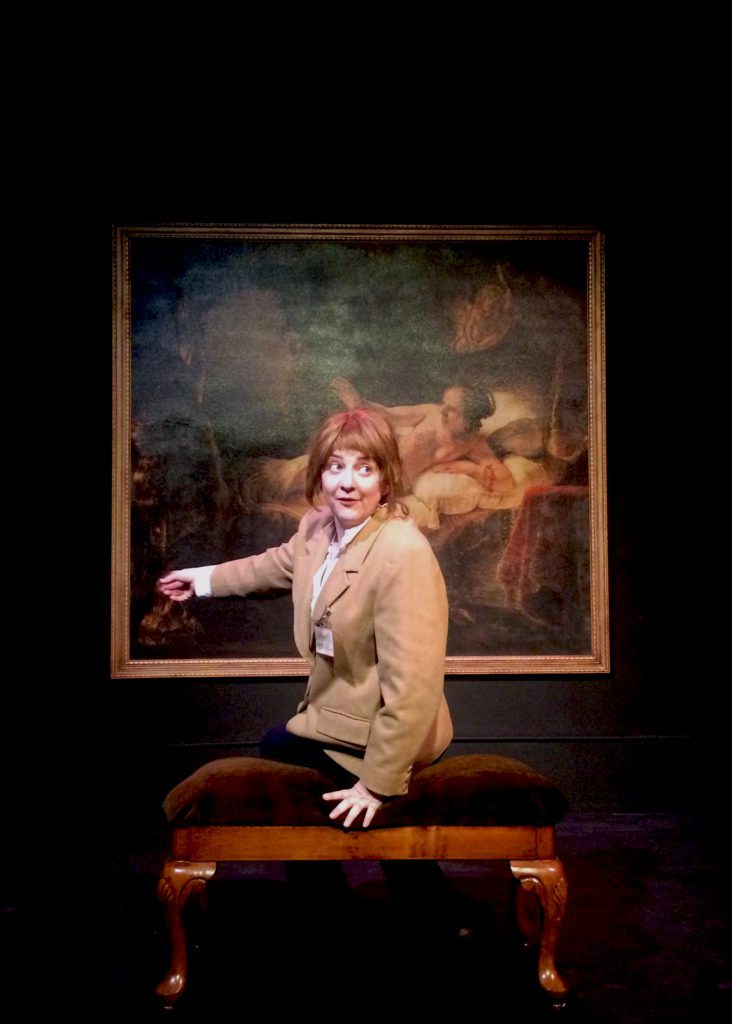
A female art museum security guard sits on an upholstered bench in front of a life size nude painting of Danae (the mother of Perseus) by Rembrandt. She’s speaking out and gesturing back to the painting.

Colorado Drama- The Rembrandt Room

The collection, which began with massive purchases by Catherine the Great in the 18th century, counts among its many treasures one of Rembrandt’s greatest works, which depicts Danaë welcoming Zeus, in the form of a shower of gold, to her bed. A reproduction now hangs on Buntport’s stage, where it is guarded by an introspective woman (Erin Rollman) of curious mind. At the Hermitage Museum (St. Petersburg, Russia), which houses the world’s largest collection of paintings, the guards are generally older women, who wear their own clothes and sit near the masterpieces. Occasionally, they interact with the public, providing historical background and general information.

Rollman’s character, Anna, has, in essence, made the painting her life’s meditation. As we learn, her contemplation goes far beyond the Greek myth depicted on the impressive eight by ten foot canvas of the original, and includes the details of Rembrandt’s life, the history of the models, and the journey of the painting itself. All this is set off by Anna’s insights and opinions on all the matters.

Rollman’s dramatic and comedic range, unlimited in all directions, serves as wonderful springboard for 82 minutes of hilarity, pathos, and opinionated hyperbole.

Imagine, for a moment, the multi-faceted directions your consciousness might take if you spent days, weeks, and years sitting with a master’s painting. At some point, it all becomes personal, as Anna’s stream-of-consciousness monologue increasingly reveals, culminating with life imitating art.

-Bob Bows, April, 10, 2016 ColoradoDrama.com

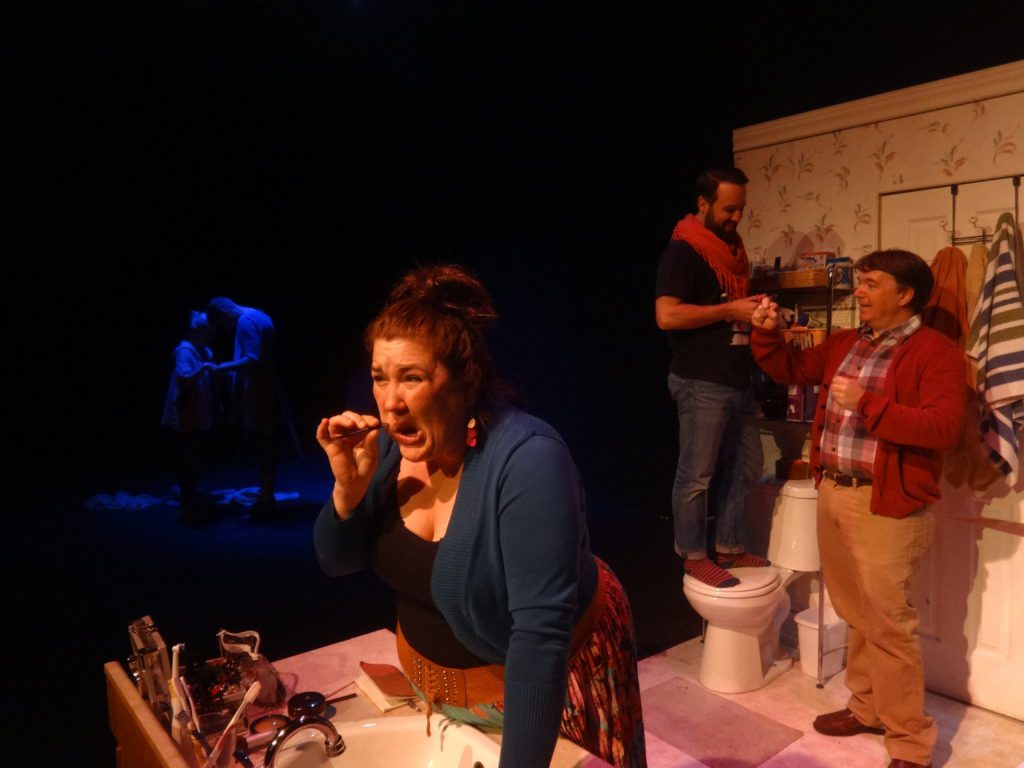
A person plucks hair off their lip at the bathroom sink. Two people stand in the background. One stands on a toilet.

ColoradoDrama.com- 10 Myths on the Proper Application of Beauty Products

Based on Miriam Suzanne’s novel, Riding Side-Saddle‐written on 250 notecards (which are posted in Buntport’s lobby) designed to be read in any order‐the story revolves around a group of friends that share a common bathroom (along with the band, Teacup Gorilla, including Suzanne on bass, who reside in the bathtub). For their 40th home-grown world premiere production in the company’s 16 years, the Buntporters and a few guest artists have bravely gone where few have dared tread, the communal bathroom, to teach us about the proper application of beauty products, the Greeks, and the meaning of life.

To the novel, the ensemble has added their own dialogue and character development. Sam (Diana Dresser) and Herman (Erik Edborg) are in a relationship in which they literally conjoin. The “Narrator” (Brian Colonna) provides the background to the asynchronous storyline, which, in short order, begins to reveal the sophisticated layering that the ensemble has created in their script, improvisational updates, and hilarious details.

As always, character development is the hook to Buntport’s legendary zaniness: Hannah Duggan’s (Jenny) subtle waking dream-state imagery; Michael Morgan’s (Edward) laugh-out-loud funny OCD riffs; Erin Rollman’s (Jolene) gender-bending enigma; Colonna’s sublime psychological observations; and, finally, Dresser and Edborg’s phenomenal symbiotic dynamics and unique love story, based on the myth of Salmacis and Hermaphroditus.

Consider the usual time span involved in writing a play, reading it, making adjustments, repeating the process X times, and then producing it. Now think about what you would learn and hone if you accelerated the process and did this two to three times a year for 16 years with your adult productions, and even more often with your children’s productions. The answer is before us: Nuances that normally take years‐foreshadowing, time-bending, catharsis‐can be achieved in months, and voilà, an hour and forty minutes of non-stop action later, we are ready to talk for hours about our experience

-Bob Bows, March, 8, 2016 ColoradoDrama.com

Four motley people squeeze their faces into the frame. Behind them is a road sign for Guaranty Bank

Colorado Drama- Peggy Jo and the Desolate Nothing

The bearded bank robber in the cowboy hat was a pro. He would walk calmly into a bank, hand the teller a note, wait for his bag to be filled from the cash drawer, walk out, and disappear, without ever brandishing a weapon. For years, the FBI couldn’t track him down. Then, one day, “Cowboy Bob,” as the agents called him, changed his modus operandi and, lo and behold, he turned out to be a she.

So goes the true story of Peggy Jo Tallas, a polite, fun-loving dame from the suburbs of Dallas, who spent much of her adult life working odd jobs and taking care of her mother, who suffered from a degenerative bone disease. When Peggy Jo got caught the first time, none of her family or friends could believe she was robbing banks.

In its 35th original production in 13 years, Buntport Theater Company, in conjunction with Square Product Theatre, pulls another wild hare out of their collective magicians’ hats, splitting the different faces of Peggy Jo between Emily K. Harrision, Hannah Duggan, Erin Rollman, and Brian Colonna, while Erik Edborg weighs in as FBI Agent Steve Powell, Peggy Jo’s relentless, but good-natured, pursuer.

Like a Greek drama performed in masks with a time-lapse twist, each of the faces of Peggy Jo represents a different moment in her journey, with Harrison, Duggan, and Rollman as her 40, 50, and 60 something year-old self, and Colonna as her Cowboy Bob alter ego; yet, they are all there at once, in the present; and like the Greeks, we know what’s going to happen, yet that does not diminish the humor or the catharsis.

The Buntporters and Harrison, each in their own inimitable fashion, bring out the weird convolutions of Peggy Jo’s mind, which she insisted, not without good reason, were normal. I mean, lots of people have watched Butch Cassidy and the Sundance Kid multiple times, and some of them have even read Ferlinghetti’s A Coney Island of the Mind. That one such person would take these artistic achievements to heart and put his or her life on the line for such a way of being is to be expected, isn’t it?

Taken together, the performances define a fascinating woman who understood what it was to live and not let the banksters get in the way of having a good time.

-Bob Bows, June 5, 2014, ColoradoDrama.com

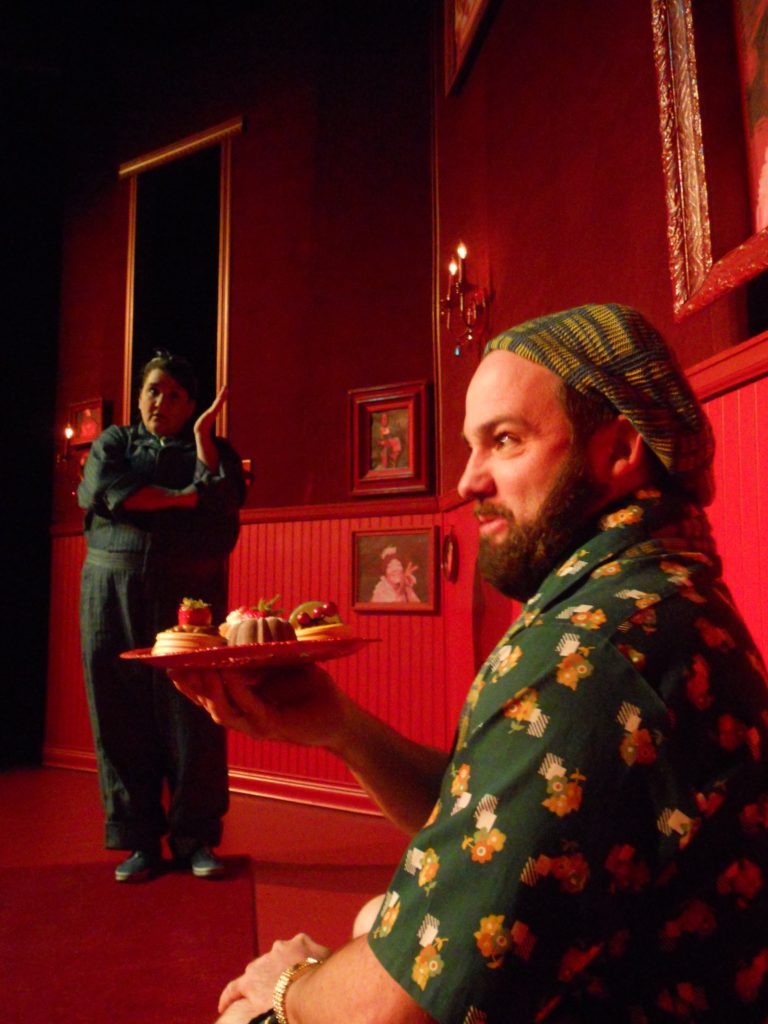
In the foreground a man contemplates a plate of pastries. A woman dressed in work coveralls looms in the background. The room is well decorated and entirely red.

ColoradoDrama.com- Sweet Tooth

Having introduced us to their own school of opera last spring, with Tommy Lee Jones goes to the opera alone, the inimitable ensemble follows up with an intriguing confection, Sweet Tooth, a Buntportesque operetta (music and lyrics by Adam Stone, additional lyrics by Chessy Normile, book by the ensemble), the company’s 32nd world premiere.

Opera buffo was never like this! The queen of theatrical voguing, Erin Rollman stars as George, a reclusive and eccentric patron of the arts. Much like the Archduke Ferdinand purportedly said of Mozart’s eternal celestial compositions — “… too many notes!” — George has it in for Charles Dickens’ plethora of words (written in serial form, to maximize commercial sales), because his touchstone novels keep her from being the chronicler of her own life, in the moment, every moment.

George has a point, that life can be art, much like Zen, we suggest, which practices mindfulness in many forms — just sitting (Zazen), flower arranging, gardening, baking, archery, tea, etc. — with the goal of expanding these meditative states to all waking and dreaming consciousness.

Only, in this case, George’s art has taken a fatalistic turn, like Jehovah’s Witnesses who watch their children die rather than allow emergency medical care. But George has her reasons, and a penchant for being the observer, not the subject, begging the question: If the highest erudition of life is metaphor, what place do our instincts (including those related to survival) have in such a cerebral universe?

Unlike the Jehovah’s Witnesses, George is imposing restrictions only on herself — and, to a degree, on her personal assistant, Hortense (Hannah Duggan) and her kept man, Mister (Brian Colonna), a painter, who humor their compelling, independently wealthy sponsor.

Duggan shines as the gatekeeper to George’s red-saturated world. Perhaps this is all a dream engendered by some indigestive experience of Mark Rothko — while listening to opera as he painted — though the clashing green patterns worn by Mister argue for an alternate interpretation involving Matisse. Who knows what free-associations pass through Buntport’s gray matter?

If there is a surrogate for middle-of-the-road bourgeois sensibilities in this alternate universe, it is Dr. Manette (a circumspect and then delightfully transformed Erik Edborg), a dentist contracted (by George!) to provide a visceral, yet third-person, experience of what to expect when dealing with a problematic sweet tooth.Colonna’s eclectic affectations as Mister are a send up from a newly discovered dimension lying somewhere between naughty British humor and the flamboyant excesses of the French court before its abused subjects made the guillotine famous.

While Hortense takes the hit for George, and George begins her passage to another world, we are left examining the nature of this self-described “dark musical comedy,” in this case a genre-bending brew of sophisticated intellectual jokes and commentary wrapped in a post-modern series of settings and arias that recall the psychological introspections of Brecht/Weil and Sondheim more than the tragic and comedic portraits of Verdi or Rossini.

Within such a world, one wonders, sometimes, where the cathartic experience takes place. This was one of those “sometimes.” As Aristotle noted, catharsis is de rigueur in tragedy, though we can only extrapolate what the great philosopher might have said about comedy (the manuscripts having been lost). We assume he would concur that “laughter is the best medicine.”

Where that leaves us with Sweet Tooth is digging deeper for a cathartic thread. If we wrap all of the musical’s multifaceted genre elements within a larger envelope of “theatre of ideas,” we find an intellectual catharsis somewhere in the sparsely populated aethers, among overlapping subsets of various Platonic forms. Shaw was the master of this, of course, but he was able translate philosophical idealism into characters with whom theatregoers could identify, and thus share in the transformative moments (his introductory essays to his plays provided an excellent means of defining topics from which he created character relationships in which topical discussions found natural expression).

Applying this Shavian approach to George, we land in Limbo — not an unfamiliar place for the human race. If you’ve seen The Three Penny Opera (an excellent rendition at Miners Alley Playhouse closed on October 21st), you may recall that Brecht inserted a “substitute ending” to send the audience home on a high note after deftly mocking and eviscerating the state of civilization. Isn’t this ambiguity in The Three Penny Opera‘s finale much like the coma in Sweet Tooth‘s coda? Perhaps, though Sweet Tooth‘s tenuously extended intellectual themes would likely reveal more harmonics by reading the script — of which, ironically, Dickens would approve — rather than hearing it pass quickly in dialogue a number of decibels below the soundtrack.

-Bob Bows, October 25, 2012, coloradodrama.com
ColoradoDrama.com- Tommy Lee Jones goes to opera alone

Once again, we are taken by the infinitely fertile minds of the Buntport ensemble, where a real life chance encounter seeing Tommy Lee Jones alone in line at a Santa Fe Opera production of La Bohème turns into an astounding and heartwarming piece of theatre.

A near life-size puppet of Tommy Lee sits, lifelessly, at a table in a diner, we assume to be in San Saba, Texas, near one of his ranches, not far from where the actor was born. Across from him sits a mysterious figure, in a black jump suit with a hood that includes screening over the face. The lights dim, an operatic overture fills the theatre, and, one by one, enter the actors who will animate Tommy Lee’s Left Hand (Erin Rollman), Right Hand (Evan Weissman), and, to great fanfare, his Head (Brian Colonna), wearing matching black jump suits, just like that of the mysterious figure, who turns out to be the Voice (Erik Edborg).

This is no ordinary puppet. The hands were carved by Kagen Schaefer, a Denver wood artist extraordinaire, and mechanized by Corey Milner, a talented local robotics teacher. The head was a group effort detailed by Rollman. The coordination of Tommy Lee’s gestures and actions – including opening and closing a musical pocket watch that plays arias, plus eating a piece of pie and drinking coffee, rolling his eyes, walking, etc. – is reminiscent of the equines in War Horse, which required three people to bring each of them to life.

Jones’ fourth-wall monologue – astounding in scope and maturity, and genuinely humorous – covering everything from the pie and philosophic musings on life to the finer points of Puccini’s operas, is interrupted by occasional forays back to three-wall artifice, where he and the waitress, Jane (Hannah Duggan), trade small talk as well as high-brow speculation on possible endings for Turandot, which Puccini famously never finished. Edborg’s does great emotive work as the Voice, well nuanced, with just a twinge of Texas twang.

Despite his rapture over Rudolpho’s arias and the adaptations of melodies from La bohème into hit songs in the ’50’s (great pantomime by Duggan on “Don’t You Know?,” a big hit for Della Reese in 1959), Tommy Lee is most fond of Turandot, since it has the most potential to be different every night, which is a clue that the ending of this piece is going to be a total surprise.

As usual, the Buntport players find wonderful low-tech solutions to enthrall and surprise us; for example, Jane explains in detail the plot of Turandot using the silverware and the condiments at Tommy Lee’s table. We’ll avoid a spoiler alert and let you try to imagine how this might go.

As Tommy Lee Jones points out, there are three types when it comes to opera: those who consider it the “o” word, and assiduously avoid it; those who have never thought about it; and opera snobs, who have no time for Puccini. Granted, Puccini can be seen as cloying and manipulative, as Tommy Lee points out, but he also wisely notes that if you can’t handle it, you’ve probably never been in love. As an example, the play offers us clips from Jussi Bjõrling singing one of the most cherished arias of all time, “Nissun dorma,” from Turandot. Who is Jussi Bjõrling? The late great Luciano Pavarotti once remarked, when someone compared him to Björling, “Please, I’m only mortal!” Listen to this rendition (wait a few moments for it to start). Be sure to catch the ending. Have you ever hear a tenor reach these heights? And this is an old, low-quality recording. There are some recordings that include the chorus, but …

-Bob Bows, March 20, 2012, ColoradoDrama.com

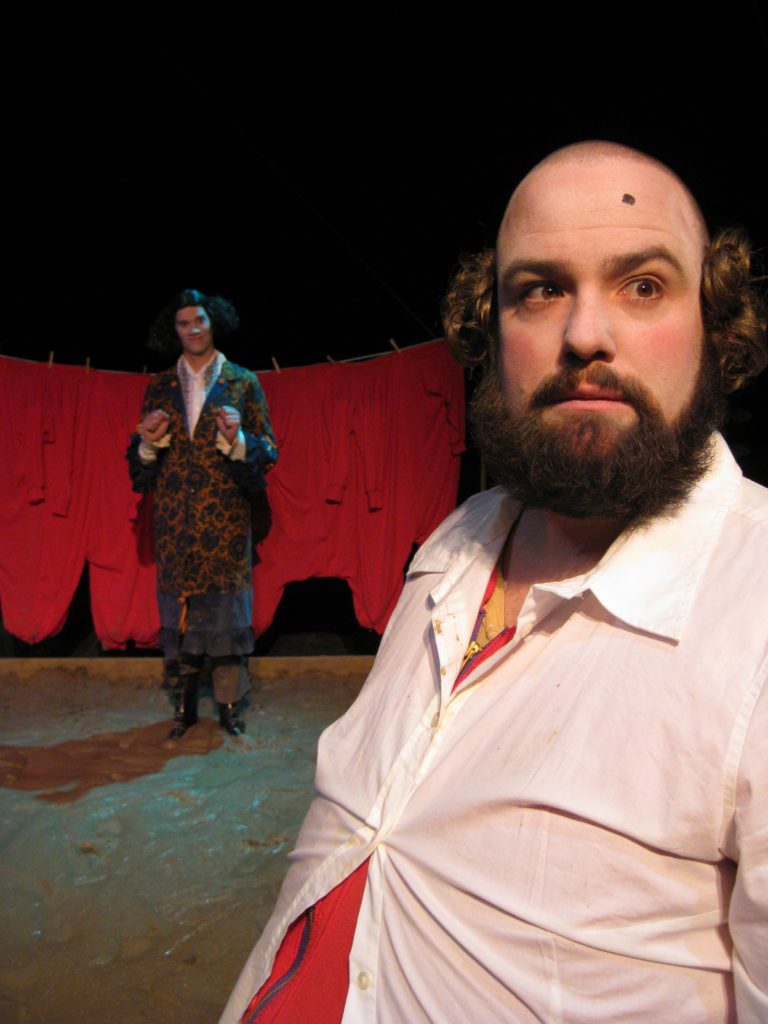
In the foreground, a large bald man with a big beard and beauty mark on his forehead stares out. Behind him, a man in a colorful jacket stands in a shallow mud pit with a laundry line of red long johns behind him.

ColoradoDrama.com- The Squabble

Finding the humor in such behavior comes naturally to Russia’s impressive stable of scribes, but its basis is not always apparent to outsiders, as we so often see in angst-ridden, hand-wringing productions of Chekhov. But the creative font of theatrical talent that calls itself Buntport Theatre has no such difficulties in mining the comic and, at times, absurd from the Nikolai Gogol tale they have adapted into a barnyard allegory.The Russian temperament is as enigmatic as the country from which it arises, an unpredictable roller coaster of joy and melancholy, charity and self-interest, that somehow provides the temerity to see its hardy stock through the harshest winters with a ferocity that is willing ultimately to destroy its own resources to outlast the likes of Napoleon and Hitler.

Smack dab in the middle of the company’s flexible space sits approximately 500 square feet of mud held in check by a sturdy frame of two-by-eights – within which most of the action takes place, with the actors wearing rubber boots to navigate the slop – which along with clotheslines and picket fences that demarcate settings, serves as two abodes, surrounding yards, a courtroom, and the town square.

“Wallowing in the mire” and “airing dirty laundry” are two metaphors that come to literal fruition as the plot unfolds: two good friends start feuding for the slimmest of reasons and refuse to forgive each other, even as death approaches.

As always, the company’s characterizations are a hoot, beginning with the main adversaries: Erik Edborg as the well-mannered but easily offended, willowy Bob Boxinoxingworth and Brian Colonna as the ill-bred and blunt, torpid Bob Luggalollinstop. The intriguing question of how these fellows ever got to be friends in the first place is quickly marginalized as we watch Bob B and Bob L project their worst fears on each other.

The Bobs are enabled in their maledictions and reprehensible behavior by Wanda Wickerstickly, a delightfully eccentric and abrasive Erin Rollman, who encourages Bob L and infuriates Bob B. Rollman then turns state’s witness, reappearing as Peter Apropopanoosh, who along with Hannah Duggan’s equitable Alfred Fredfredfredful, the local judge and owner of the town’s largest house, attempt to leverage the law to ameliorate the situation.

Duggan’s alter ego, the delightful simpleton Tony Tumblestumpington, is the harmless, homeless flip side of the judge, who spreads her requests for evening shelter relatively equally between the Bobs. Evan Weissman, as Pig and as One-eyed Bob B stands inside and outside the story, mocking the sad state of affairs to which he is both a partner and an observer.

In the program, the company notes that Gogol’s unique blend of humor and fun resonates with their own work, which is certainly evident in the production. There is one other striking similarity to many of Buntport’s dramas or allegories: the lack of catharsis. In comedy, a series of good laughs is sufficient to provide a transformational catalyst, but The Squabble is not a comedy in structure or tone. It could be argued that this was Gogel’s intention – to let the unresolved issues fester without tragedy or redemption – and perhaps the Russian temperament finds succor in such a point-of-view, but this side of the Cyrillic alphabet, an emotional Rosetta stone is required.

-Bob Bows, May 22, 2009, ColoradoDrama.com

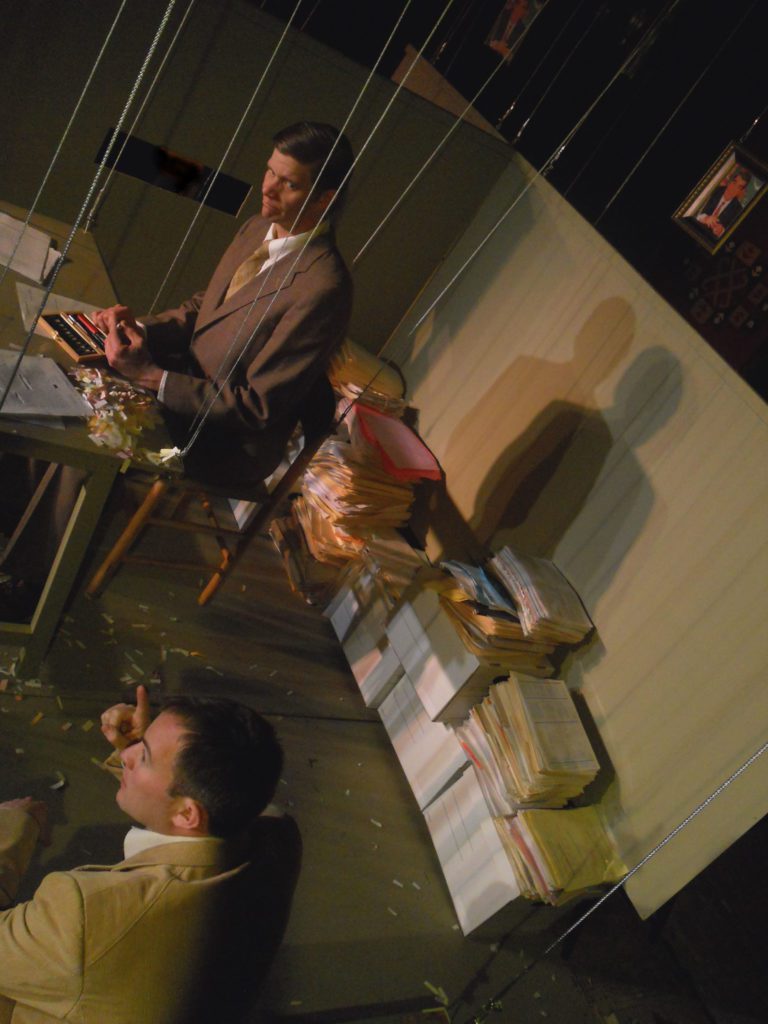
A down-shot of a room with several large stacks of paper piled up on the floor. A man in a brown suit, sitting at an awkwardly small desk that is suspended above the floor by wires, is holding a cutting blade. The man in the suit is looking concerned at another man in the foreground in a tan jacket and light green shirt who is speaking.

coloradodrama- The 30th of Baydak

Though it may not seem so to the average American, these are desperate times. 57,000 people are disenfranchised in Florida before the 2000 election, yet the follow-up stories appear only in the European press; fact-finding for the investigation of 9-11 is suppressed by the Bush-Cheney junta, yet the Congress passes the Patriot Act and creates a Homeland Security Department to remedy “terrorism”; finally, our “leaders” manufacture evidence to justify the invasion of two countries vital to our un-checked oil consumption, yet opposing nations cave in to our take-over, as long as we promise them some construction contracts and a share of the booty.

While Americans insist that they are free and continue to believe in the “facts” they are served by the ever-consolidating corporate media, any minimally trained political scientist can see that we are treated as nothing more than another glorified banana republic by the ruling families who control our major corporations and the government that runs interference for them. Such observations are also inescapable in Buntport Theatre Company’s current original collaboration, The 30th of Baydak.

Set in modern Turkmenistan, where the supreme ruler willy-nilly changes the names of the months and anything else that suits him, The 30th of Baydak lays bare a society in which the safe route to survival is to keep your head down and don’t ask any questions. Erik Edborg is Yousef, a bureaucrat who cuts out words from government documents. Not knowing what to do with the banished nomenclature, Yousef takes the slips of paper home and puts them in soon-to-be-forgotten boxes, relegating these once-living thoughts to the dustbin of history, much in the same manner as Winston Smith assigned pieces of the historical record to the terminal obscurity of the memory tubes in 1984. Edborg’s downcast gaze, slumping posture, small steps, and mushy compliance makes Yousef the ubiquitous Orwellian yes-man that is the glue of totalitarian societies.

Yousef’s is a shifting world where everything literally hangs by a thread: the entire set, including desks, chairs, cubicle dividers, beds, dresser, and walkways, is suspended from the ceiling by airline cable.

Yousef’s supervisor, Ogul, long-ago having been stripped of her own keywords, is, in Hannah Duggan’s characterization, an impossible, unending string of clichés and platitudes, who strews a surfeit of paperwork everywhere she walks.

In the cube behind Yousef sits Farzad, the only office worker who turns away from the omnipresent posters and pictures of the supreme ruler. Evan Weissman draws Farzad as pesky, insistent naysayer, who, when no one else is around, raises his fist, questions government policy, and attempts to goad Yousef into joining his revolutionary cell.

Into this bleak existence comes Meret, who takes over the long-abandoned cube next to Yousef and attempts to break through his insularity. Sunny and curious, Erin Rollman’s Meret engages Yousef in a gradually expanding dialogue that briefly seems to offer some hope of expression for his long suppressed feelings.

Yousef’s only friend is his imaginary roommate Ismail, a camel dressed as a man, who appears one evening and begins to question Yousef’s routine. Mixing patient, fatherly advice with subtle mask positionings, Brian Colonna becomes the deus ex machina that provides Yousef with a potential path to redemption. Ismail tells Yousef, “You have a choice how you act.”

In The 30th of Baydak, the noble ensemble of Buntport once again creates a strangely familiar yet magical world that asks difficult questions about our complacent acceptance of business as usual. It runs through June 15th.

-Bob Bows, June 2003, coloradodrama.com