Buntport Theater

A man in stark lighting holds a briefcase while looking out of a windowpane.

Westword- Cutting-Edge • Comedy Buntport’s Kafka on Ice slices up the melancholy author’s life

The parking lot is full, and cars line the curb on both sides of the street. Inside, people throng the lobby. A couple is being turned away at the front desk: “I’m sorry. We’re all sold out.” When I first visited this place a few years ago, there were seven or eight people in attendance, including myself and my friend. Now word must be out that this is the place to be on Saturday night: Buntport Theater, the opening of Kafka on Ice.

We find seats and settle in to clip-cloppy, ’30s-style music that sounds like the Charleston. We’re going to be close enough to the action to see the sweat shine on the actors’ faces. There are rows of chairs on all four sides of a green square of artificial ice – not gleaming ice-rink stuff, but something that looks like ancient linoleum, scratched and scuffed.

What on earth do these people at Buntport think they’re doing? Franz Kafka is a melancholy figure, a Prague-dwelling German Czech, steeped in the history of his time, the creator of a dwindling, despairing art. Not noisily or grandly despairing, but art that’s a kind of falling away, a hopeless whispering, the toneless song of Josephine the Mouse Singer, the silent melting of flesh from bone in The Hunger Artist, an art of terror, self-loathing and wordless longing for what can never be attained – and all of it limned in that precise bureaucrat’s prose. Kafka’s best-known works include a novel about a man tried for an act he doesn’t even know has been committed – let alone by him – and ultimately executed. Another describes a castle from which it’s impossible to escape. And then there’s the long short story called The Metamorphosis, which almost every high school student knows and which begins, “As Gregor Samsa awoke one morning from uneasy dreams he found himself transformed in his bed into a gigantic insect.”

But all of these cheerful Saturday-night people haven’t come here to explore the sorrows of old Europe. They’ve come for a good time. And the Buntporters aren’t exactly known for their worshipful treatment of the classics. But then, they’re not known for denigrating or nullifying or being plain dumb about literature, either. So what are we going to see?

The bouncy music stops. In the darkness that follows, we hear the scritching of a pen on paper, like the sounds of a skate blade on ice. Under the sudden illumination of a single, bare lightbulb, we see Kafka, played by Gary Culig, writing at a desk. Within minutes, the rest of the cast has skated on in impressive unison – yes, wearing real skates – and the show takes off.

Kafka on Ice is part biography. It tells Kafka’s story, about his fear of his overbearing father, his unhappy love life, his friendship with Max Brod, the way in which Gregor Samsa’s predicament represents his own. But it also deals with the way a work like The Metamorphosis changes over time, as it passes through the minds of friends, readers, critics, fellow writers, teachers and tricksters like the Buntport gang. So at one point you have the great novelist Vladimir Nabokov (played by Erik Edborg) arguing that, contrary to some critical opinion, the insect in The Metamorphosis is clearly a beetle, not a cockroach. Then there’s a teacher (a hilarious performance by Erin Rollman) trying to communicate the idea of symbolism to her bored class while peeping periodically at her own cheat notes. The lights go out, and a voice reads a passage aloud in the darkness, bringing clarity and focus to the words. When the lights return, we watch a schoolboy cross the stage with his satchel on his back, reading as he walks.

The Metamorphosis goes through several transmutations: It’s played as farce, as an experiment with objects, as grinning, dancing musical comedy.

Buntport has its own way of dealing with Kafka’s life story. The writer’s meeting with his first love, Felice, is shown as a scene in a silent movie. She falls cutely about on the ice, while he, Chaplin-like, attempts to rescue her – all to the accompaniment of a plinking piano.

This show is anything but Kafkaesque. It’s lighthearted, giddy and goofy. As written, the climax of The Metamorphosis begins with a heartbreaking scene in which Gregor is drawn from his seclusion by the haunting sound of his sister playing the violin. In Kafka on Ice – which has earlier referred to Kafka’s thoughts on his own Jewishness – he hears the violin solo from Fiddler on the Roof.

Buntport creates an Alice in Wonderland world where objects take on their own life and shrink and grow at will. The city of Prague is represented by a pop-up in a book. Gregor Samsa is at one point a glove puppet, seconds later a remote-controlled mechanical toy, and finally, a costumed actor.

There are some really beautiful moments. Kafka sends Felice one of his stories to read; in her hands, it unfurls into the paper figure of a man, and she dances with it. “The writing does quite well with her,” observes Kafka. When Kafka proposes to another love, Milena, his words are made of light, flowing over the rows of audience members, across the ersatz ice and away up the walls. Her response is a calligraphic “Yes.”

I have a couple of quibbles. Every now and then, the script is repetitive. Culig is a good actor, but he has an endearing, vulnerable quality that doesn’t feel quite right for Kafka. Brian Colonna’s Max Brod is pinch-faced, squeaky-voiced and very amusing, but too much of a caricature – both as performed and as conceived. The real Max Brod was far more than a leech who took advantage of Kafka’s fame; he was also the author’s longtime friend and loyal advocate. But all six actors do well. Erik Edborg has to stifle his insanely anarchic instincts to play Kafka’s heavy-handed father, and it works. Evan Weissman’s turn as the charlady (in a uniform that’s pure French maid) is a hoot, as is Hannah Duggan’s determined yet perplexed expression every time she skates across the stage with a flour sack in her mouth (don’t ask). As for Erin Rollman, I don’t have words to describe her performance. She’s a brilliant comic universe unto herself.

All of which explains the crowd in the lobby. It’s safe to say that no one else – anywhere – is doing theater like this.

-Juliet Wittman, October 14, 2004, Westword
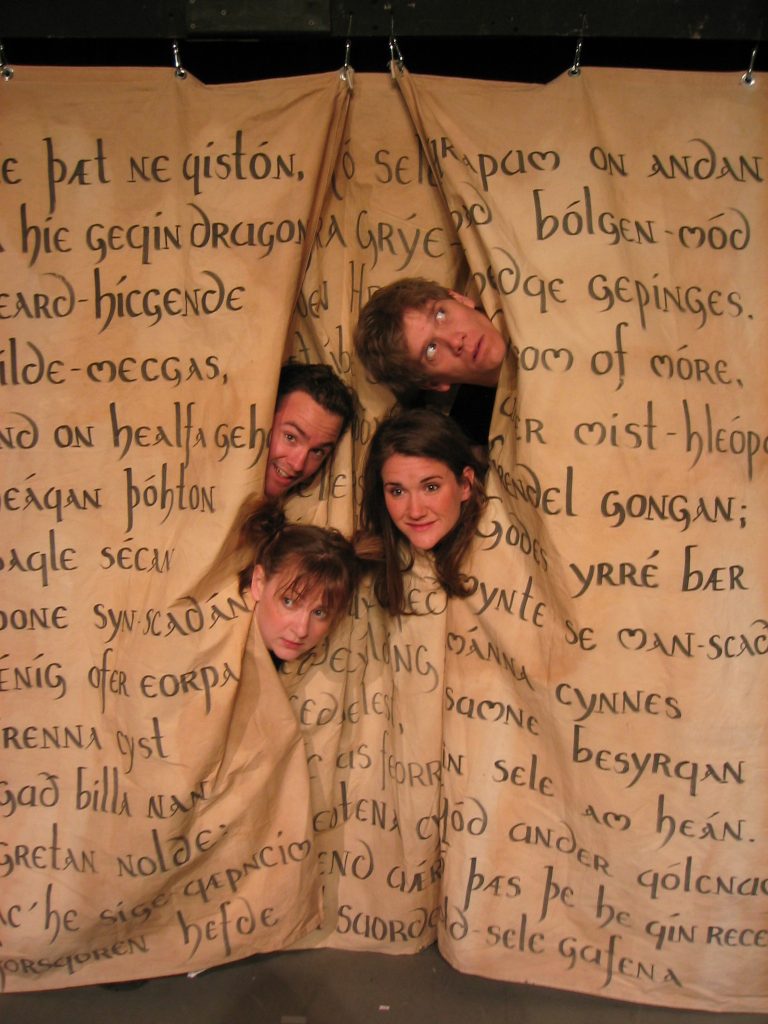
Four people poking their heads through the backdrop with the Old English Poem Beowulf written on it.

Westword- Cutting Edge

Buntport Theater has fun with one-acts and paper props

Now that Buntport Theater has come of age and is attracting reliably positive reviews and large, enthusiastic audiences, the six company members have revived one of their earlier works, an evening of one-acts titled 2 in 1. The first piece, “This is My Significant Bother,” is a dramatization of nine stories by James Thurber; the second is an explication of the Cliffs Notes explication of Beowulf (it makes sense when you see it — sort of). These are both slight pieces, but they’re clever and entertaining, and the sets and costumes are as inventive as ever. It’s pretty much impossible not to have a good time at Buntport.

As the evening begins, four actors — Brian Colonna, Erik Edborg, Hannah Duggan and Erin Rollman — are lying on a large bed, their left arms in perfect alignment on the coverlet, their hands conspicuously wedding-ringed. They manage to stay absolutely still as the audience arrives and settles in. Perhaps they’re asleep. One of the evening’s pleasures is the way the actors manage to move swiftly and soundlessly during blackouts, so that we’re always slightly surprised at where they’re each standing or sitting when the lights come on.

Although he apparently labored over their composition, Thurber’s stories are sketches rather than fully developed character studies or descriptions of events. They have the wistful, unfinished quality of his New Yorker cartoons, along with a misogyny so self-deprecating that it almost seems forgivable. If his women are all-powerful, soulless harridans, well, his men are pretty silly, too, and sometimes downright irritating. (Although, in a fable Buntport doesn’t attempt, it’s only the male of the species who’s capable of seeing a unicorn in the back garden.)

“Significant Bother” is not intended to be laugh-out-loud funny. It’s a sincere and gently humorous homage to Thurber.

A husband manfully protects his wife from a spider but cowers under the bedclothes when he hears a bat. A woman stands up in court and insists she deserves a divorce because of her husband’s habit of holding his breath. In one of the most absurd and amusing pieces, a police officer finds a woman seated in a car while a man crawls on the ground in front of the vehicle; they are trying to ascertain whether a human being’s eyes will glow in the headlights as a cat’s or dog’s would. In another car scene, this time inside the car, a couple fights over whether Greta Garbo is a more important cultural icon than Donald Duck and bickers about where to stop for a hamburger, the wife insisting that the eatery must be a cute one. Meanwhile, the car is emitting a threatening and unidentifiable noise. Yet another husband orders his wife into the basement so that he can kill her and make off with his stenographer. Wise to his plan, she gives him orders on how to accomplish the deed. All of this is interspersed with interesting renditions of such ’30s songs as “Makin’ Whoopee” and “Happy Days Are Here Again.” And the bed that anchors the play (in the very last scene, a man painstakingly smooths the sheets while his ex-wife discusses his failings with his wife-to-be) is manipulated by the Buntporters with their usual sangfroid, becoming by turns a car, a platform, even a cellar.

Perhaps the most interesting and unexpected piece is a mood story about a doomed love affair called “Evening’s at Seven,” which is told through a series of lighted tableaux separated by patches of darkness. It’s touching, original and sophisticated.

For the second play, the cast appears in front of a backdrop of text wearing dark-blue maintenance men’s outfits and tool belts that hold an arsenal of paper props. They proceed to act out the story of Beowulf, interspersing the action with textual commentary — and their own acerbic comments. In case you’ve forgotten, this Old English poem concerns the predations of a monster, the monster’s dam (or, as the Buntporters have it, “dam mother”) and a dragon. As always, the props are inventive; in this instance, they’re made entirely of paper. Beowulf’s army consists of a string of paper cutouts worn across Edborg’s chest like a bandolier; streams of paper representing blood from a wound are helpfully and multiply labeled “blood,” just as the paper crown bears the legend “crown.” The paper dragon is a thing of wonder. Periodically, we hear a voice reading from Beowulf itself and — though you’d need to know Old English to understand the words — the power and beauty of the text makes itself felt through all the loony shenanigans.

The acting is terrific, as always, though it concerns me a little that both Colonna and Edborg act so much from the neck upward. I’d like to see their voices and impulses coming from deeper in the body. In addition to the cast, Matt Petraglia, SamAnTha Schmitz and Evan Weissman helped create 2 in 1.

I’m getting tired of saying this, but if you haven’t attended a show at Buntport yet, you should. You won’t see anything like it anywhere else.

-Juliet Wittman, May 6, 2004, Westword


Westword- Detecting Noir • Buntport stalks laughter

McGuinn and Murry is a spoof of those ’40s detective movies in which the men wore fedoras and the women had gams. It’s a lighthearted, skimming take on the genre that’s neither cliche-ridden nor weighted by scholarship. The helium that keeps this smart, entertaining trifle aloft is Buntport Theater Company’s irrepressible inventiveness.

A pair of washed-up detectives slump around their dusty office. The phone never rings. No shadowed, mysterious, cigarette-holder-wielding blonde ever appears at the door. McGuinn is a onetime prizefighter who disgraced himself by throwing a match. Murry is a tough broad, given to barking out orders. To pass the time and keep their wits sharp, the two P.I.s try to stump each other with hypothetical cases. Murry sets McGuinn a puzzler that involves a letter sent to his home, but the letter gets into the wrong hands; soon McGuinn is frantically pursuing what he believes to be a real case — in which he is somehow the suspect — while Murry applauds the veracity of what she perceives as his performance.

Obviously, there’s a lot of playing with frames of reality here, and transformation rules. Brian Colonna and Erin Rollman, who play McGuinn and Murry, respectively, take on many additional personae, signaling the changes through adjustments in voice and posture, or with props that serve as a kind of shorthand. Colonna assumes a black eye patch and becomes the lover of McGuinn’s wife, Budgie. It takes only a change of footwear, a fluffing of her blouse and a shuffling off of Murry’s severe jacket for Rollman to metamorphose into the breathy adulteress. The set is transformed with the same economy and dexterity. Everything evolves from the office’s hefty desk and its two chairs. Panels slide aside; boxes are opened and props tossed in or whisked out of them. The desk becomes the kitchen of McGuinn’s home, complete with stove, cabinets and a clothesline sporting a tabbed rubber girdle. With a little more manipulation, the desk is a bar, a cityscape, a park bench, the lair of a fat, wheezing Mafia reprobate apparently based on Marlon Brando. Much of the evening’s entertainment stems from the surprising and creative shifts in character and set.

Conventions are created, then casually broken. For example, the one door on the set is raised and appears to open onto the top of the investigators’ desk or, in the household scene, the kitchen counter. I’d guess this was the only way Buntport could make the desk-becomes-everything-else concept work structurally. When the door first opens, we’re surprised momentarily, but the two actors play it straight, and we come to accept the anomaly. No sooner have we done so than Budgie snaps at her husband to stop walking on the countertop.

There’s a knowingness to all of this, a self-referential quality. At one point, parodying Lana Turner’s famous line about whistling from To Have and Have Not, Rollman explains to Colonna how to exit: “You just put your hand on the knob, and you walk out…the door.” The peculiarities of the door in question only underline the humor. If there’s a misstep, Rollman and Colonna treat it as if it were intentional, and somehow their skill and assurance, along with the mocking quality of the entire show, make the moment doubly funny.

Props take on a life of their own, and scale becomes meaningless. When all of the characters need to meet at the park, they arrive in a succession of toy cars, which are guided over the surface of a kind of relief map by the actors.

The only problem is that the set changes, while fun to watch, take too long. The dialogue is witty and bright, but it’s not so deep that we want to contemplate a scene’s final lines for several minutes. A piece like this demands speed.

Both actors are talented, but it’s really Rollman, with her elastic face and ability to morph from character to character, who carries the show. She gives life and spirit to each of her characters: mannish Murry, flirty Budgie, the creepily disembodied-seeming fat man. There’s something unformed about her stage persona, as if she were just waiting to flow into one role or another. The characters she creates can be hard-edged and defined or oddly amorphous. She can make you laugh by raising an eyebrow, and she seems to know instinctively just how long to hold the expression for maximum effect without milking it. Sometimes she appears to have the unfinished, partially defined quality of a James Thurber cartoon. Colonna, too, has wonderful moments — particularly the flashback during which he re-creates the thrown fight, striving mightily to help McGuinn’s wimpy opponent score a hit.

Like all of Buntport’s scripts, this one was created (through both writing and improvisation) by the entire group — Hannah Duggan, Erik Edborg, Matt Petraglia, SamAnTha Schmitz and Evan Weissman — in addition to Rollman and Colonna. And, like all their work, it has inspired moments along with a few that are less inspired.

The first time I visited the Buntport Theater, there were six people in the audience. Every time I return, I see that the numbers have grown. And this is a crowd you can’t pigeonhole: children, teenagers, young adults and their parents, entire families that have arrived together, people who look like students, businessfolk, bus drivers, intellectuals, bums or bohemians. Buntport is attracting a following not because everything they do is completely successful, but because their work is sophisticated, welcoming, unpretentious and, above all, original.

-Juliet Wittman, January 7, 2004, Westword

Close up on a dorky looking lady.

Westword- Fairy Amusing • Buntport’s clever Idiot Box shows the tiny rubes behind the tube

Speaking as someone who was terrified of the telephone when I was a child because I couldn’t understand how the voices of people I knew could get trapped in this black plastic thing, I am very grateful to Buntport Theater Company for explaining how a television works: Little fairy people are trapped inside the box and act out all the shows and commercials.

In Idiot Box: An Evening of Sketch Comedy, five Buntporters illustrate this theory with a series of sketches. There’s a lot of danger in the premise. To begin with, it could lead to a show that’s unbearably cute. And skits featuring game shows and other standard television fare have been done. And done and done. Apparently every time a Saturday Night Live writer runs out of ideas — clearly a frequent occurrence — he comes up with such a scnenario. It’s inevitably lame, because there’s no way of mocking a genre that comes across like a parody of itself in the first place. But Erik Edborg, Hannah Duggan, Erin Rollman, Evan Weissman and Brian Colonna, who (with SamAnTha Schmitz and Matt Petraglia) created Idiot Box and also perform it, avoid these traps. They’re very good actors and deft, witty writers. No skit goes exactly where you think it’s going; no flight of lunatic fantasy is too ridiculous to be undertaken; no joke gets belabored past the point of funniness. The whole evening is light and stylish, and the group is smart enough to stop the entire proceeding while you’re still rocking with laughter and wanting more.

There are, of course, takeoffs on standard TV fare: a cop drama, a game show, a reality series, the Food Network. These are punctuated by scenes in which we see the fairies — only their silhouettes are visible behind a transparent white screen — warming up, arguing, making shadow puppets and discussing whether work in the microwave business wouldn’t be less stressful and more satisfying. Then there’s the sound of someone channel surfing — the idiotic bursts of dialogue, laughter, music and impassioned selling we’re all so familiar with — and another skit begins.

In a dating-game show,

a horrified Evan Weissman is paired with a sluttily oozing and squeakily singing Erin Rollman as “another couple you can look down on.” Edborg gets in shots at arrogant chefs, along with some cogent allusions to current events, in “Cooking With Stalin.” There’s a takeoff on nature shows featuring daring Australians handling snakes and alligators, only here the two Australians are terrified of anything resembling untrammeled wildlife. “Birds,” says one of them. “You can’t trust them.” In a Sesame Street-style show, song, metaphor and action are used to teach kids how you find a clitoris.

Where the lines aren’t that strong, the characterizations are. When the characterizations flag, a clever or audacious comment comes to the rescue. Duggan shines as the female half of a cop team and as the gum-chewing girlfriend of the pathetic, mindlessly violent host of The Bully Show. Evan Weissman is a convincing straight man with a hilarious repertoire of hapless expressions. Brian Colonna is so filled with delight at his (or perhaps it’s her) own cleverness in the game show that he can’t stop patting himself on the back — and we can’t stop chortling every time he does it. As comedians, Edborg and Rollman take things right to the edge and then over it. Why is Edborg imitating a chicken behind that scrim, and is he really going to lay an egg? How does Rollman come up with these insane characters? All her bits are funny, but one of them takes the cake: a monstrous adolescent who’s just won a science fair with her world-conquering board game, Monopolize Your Risk. This girl is such a bullying, self-satisfied, evil, lisping little megalomaniac that you don’t know whether to laugh or cry, but you do know you can’t take your eyes off of her.

-Juliet Wittman, December 18, 2003, Westword

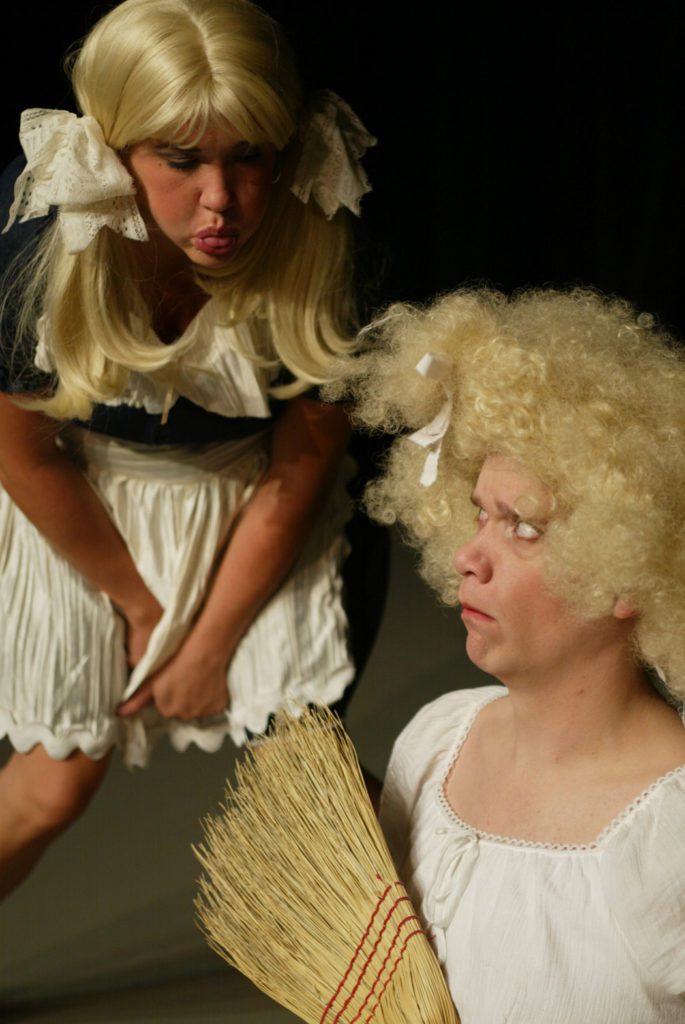
A woman in blond pigtails leans over blowing a raspberry in the face of Cinderella, who looks upset and holds a broom.

Westword- Major Props • Buntport dazzles with silly yet serious inventiveness

In Elevator, the first of Buntport Theater’s two original one-acts presented under the title Misc. , three people stand in an elevator, pretty much unmoving. We’re treated to several silent minutes, during which we study the actors’ expressions. A fourth person gets into the elevator, then gets off. There’s a blackout. Then the exact same scene is replayed, except this time you can hear the characters’ thoughts. The tall, skinny guy (Erik Edborg), who seems so convinced he’s fat that he has somehow persuaded the other characters of that fact, is a hugely talented and successful author who’s completely at a loss about how to begin his next book. He’s on the way to pitch this shaky project to his new editor. Unbeknownst to him, the new editor (Erin Rollman) is standing right beside him. She’s a smartly dressed woman clasping her briefcase in front of her, and she’s alternating between exultation at being handed so eminent an author and the conviction that she herself is an imposter. The third rider (Evan Weissman) is on his way to the top floor to commit suicide. As for the fourth insouciant player (Hannah Duggan), you’ll have to find out her motivations for yourself.

The dialogue begins with musings — some of them very funny — about butter, umbrellas and untucked shirts, but it becomes deeper and more complex as the piece progresses. People’s thoughts and words overlap. Sometimes the characters seem to hear each other. At least once, they clearly do. But each rider’s individual solitude is never entirely broken.

Something serious is being explored here, although with a light touch. We’re reminded that an elevator is an essentially liminal, almost timeless space. Ideas about time, language and memory surface again and again. The characters ponder the power of narrative and the way all of us create a coherent life story for ourselves. The editor remembers having once kissed the Blarney Stone in Ireland and wonders if she’s too facile with words. Foreshadowing the ubiquitous dualism of the second play of the evening, <Cinderella, she wonders if it wouldn’t have been better to kiss the back of the stone instead and lose her verbosity.

Elevator is pleasant and amusing, but it needs some trimming and tightening.

The second piece bubbles with cheerful invention as the same four actors play out the story of Cinderella, using movement, nonsense syllables, props, masks, many kinds of music and semi coherent sentences that seem to have been distorted by helium. Erik Edborg is a wistful Cinderella who consoles himself in his solitude by making a puppet of his left hand and having it serenade him. Erin Rollman plays both the good mother and the wicked stepmother; for the latter, she simply turns, revealing a mask on the back of her head. Of course this requires moving, even dancing, backward for the rest of the evening, and the result is scuttling and grotesque and hilariously funny. Duggan, also appropriately bifurcated, plays both ugly sisters. And, red-lipped and wearing a platinum wig, Weissman serves as the impresario, uttering frantic nonsense syllables as he tries to make himself understood.

Masks, puppets and doubles abound as Edborg morphs into a plastic doll and back into Cinderella again and Weissman dutifully puffs out his pants to impersonate the prince. The only character who remains resolutely herself throughout is the Fairy Godmother, played as a helmet-haired teenager by a silently exasperated Rollman.

Buntport is made up of several onetime students from Colorado College who studied Eastern European theater together. (Surely no one who hadn’t would come up with the pronunciation “pranshay” for “prince.”) These folks can do astonishing things with objects, and their inventiveness is amazing. They push boundaries and sometimes touch on the profound, but it’s all done with lightness and a fizzing good humor.

-Juliet Wittman, October 2, 2003, Westword

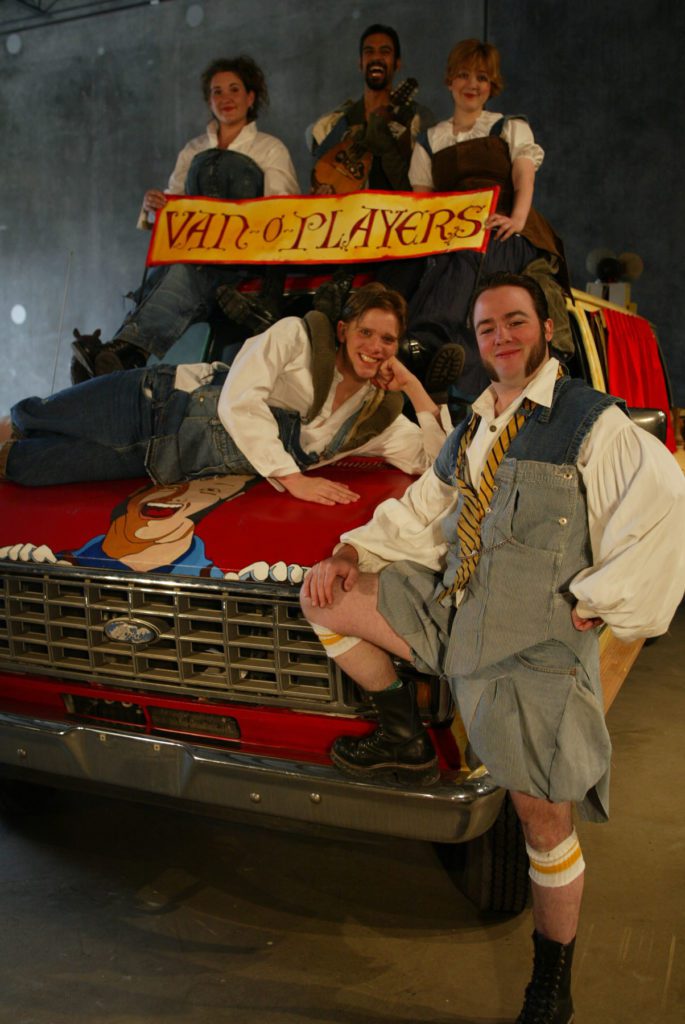
Five people are draped on and around a painted van. They all wear makeshift Shakespearean clothing. In front is a smiling man with his leg up on the bumper. The hood of the van has a large smiling portrait of him. One smiling man is draped across the hood. Sitting on top of the van are three more people holding a banner that says “van-o-players”.

Westword- Titus All Rightus!

Buntport’s version of Shakespeare’s forgotten yarn strikes a bloody good note

Titus Andronicus has always bothered Shakespeare scholars, some of whom simply refused to believe that the great man actually wrote the blood-drenched monstrosity. In his famous Tales From Shakespeare, Charles Lamb noted that Titus was “not acknowledged” by the critics whose assessment of dates he used, “nor indeed by any author of credit.” Later thinkers reluctantly acknowledged Shakespeare’s authorship but have suggested that Titus was a rewrite of an older and much worse play. Others, defending the tragedy, pointed out that there are lots of corpses in Hamlet and King Lear, as well as spurious gore, and that Greek tragedy is full of rape, murder and cannibalism. Harold Bloom, on the other hand, believes that the play is an intentional parody, a Shakespearean sendup of rival playwright Christopher Marlowe. In any case, almost nobody stages Titus these days. Audiences are too apt to titter at the forgettable merry-go-round of posturing, declaiming characters, betrayals and counter-betrayals, and the cascade of murders and mutilations.

But the folks at Buntport Theater have figured it out. They’re presenting Titus Andronicus as Titus Andronicus! The Musical. Why has no one ever thought of this before? It means that when Titus is told he can save the lives of two of his sons by chopping off his hand (don’t ask — it wouldn’t make sense even if I gave you more context), we get a stirring masculine trio as he, his brother and another (currently unendangered) son compete for the honor of self-mutilation, complete with stirring choruses and natty little rhythmic steps. “Nay, come, agree whose hand shall go along,” says evil Aaron, who has set this all up, “for fear they die before their pardon come.” And when Titus, having killed the wicked Tamora’s wicked sons, makes plans to bake their heads and serve them in pastry to their mother, he flourishes a knife in his remaining hand and musically debates the recipe in a zesty French accent.

This is Titus Andronicus as staged by Professor P.S. Goldstien — aka Brian Colonna — and four actors, out of the back of a van that occupies Buntport Theater’s cavernous and otherwise empty playing area. Each actor plays more than one of Titus‘s several dozen roles, and there’s a helpful placard with pictures, names and lightbulbs that get turned on and off during the action so you can figure out who’s playing whom at any given moment. There’s also a chalkboard to track the corpses. This doesn’t mean you can actually follow the twists and turns of the plot — it’s hard to do that in any production — but it does give you a broad idea of what’s happening, which is all you really need.

The van is tricked out with immense ingenuity. One side is painted like a forest, the other like a building. Canvases slide up and down inside the door, platforms are pulled from the side and back. Periodically, the entire cast gets together to push the vehicle from one place to another. They do this with energy, élan and high good humor, so that a fall or mishap becomes part of the performance.  It isn’t just that Buntport’s is an interpretation of an inexplicable piece of our literary inheritance (and for all its lunacy, it is an interpretation). It’s that the approach to the work — the collaboration and improvisation with which it began — is valid theater in itself. You see the way the group has chosen to present a particular speech, but you also see how the actor speaking it stumbled (or strolled) into his interpretation and what he now feels about it. There’s Shakespeare’s text, and there’s also Buntport’s commentary — overt or implied — on that text.

Objects take on a life of their own. In the night scenes, a stuffed owl perches on the van’s rearview mirror. When someone comments that “the leaves are green,” several skeletal umbrellas, their spokes covered with leaves, unfurl. Blood spurts, dribbles and pools. Tamora’s sons, Demetrius and Chiron, are represented by a gasoline can and a car radio; their speech comes courtesy of Erik Edborg, who acts as their puppeteer. Later, the human-flesh pies speak, too.

Buntport Theater is the creation of several graduates of Colorado College — Brian Colonna, Erik Edborg, Hannah Duggan, Erin Rollman, Matt Petraglia and Samantha Schmitz — who create their theater pieces collaboratively. Colonna, Edborg, Duggan and Rollman are the performers in Titus, along with Muni Kulasinghe. You want to see them at work, because this production is clever, inventive, and one of the funniest evenings of theater around. It’s also definitive. Which means you’ll never have to go see Titus Andronicus again.

-Juliet Wittman, February 13, 2003, Westword