Buntport Theater

Highlands Ranch Herald- Play floats Indiana memories

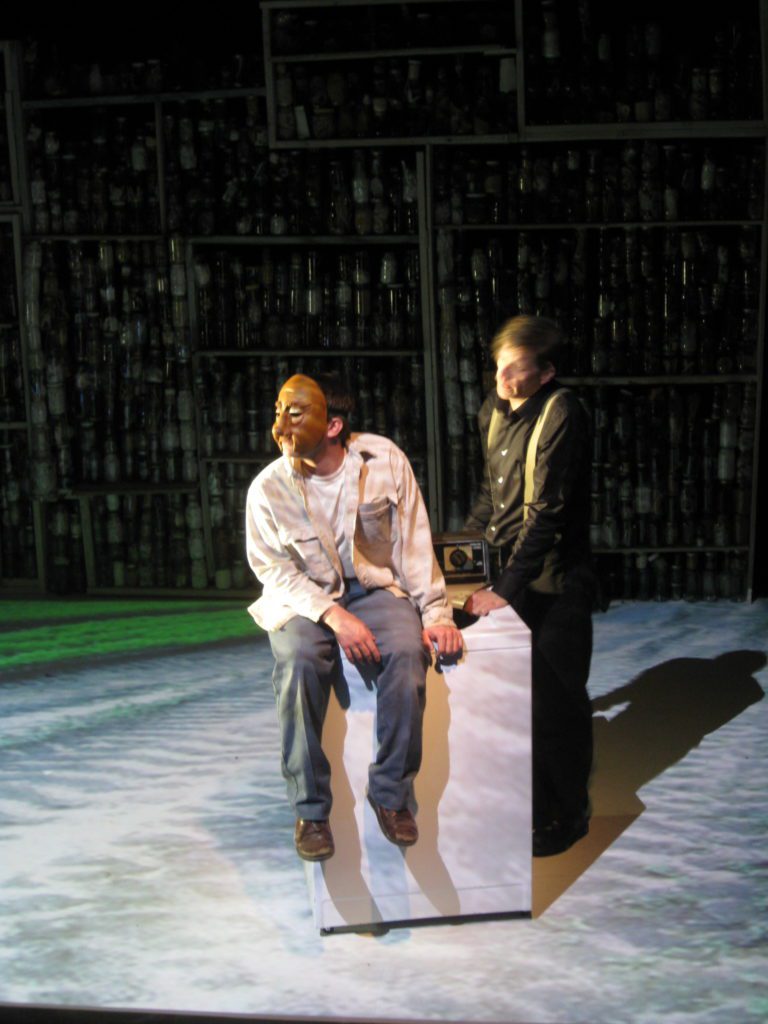
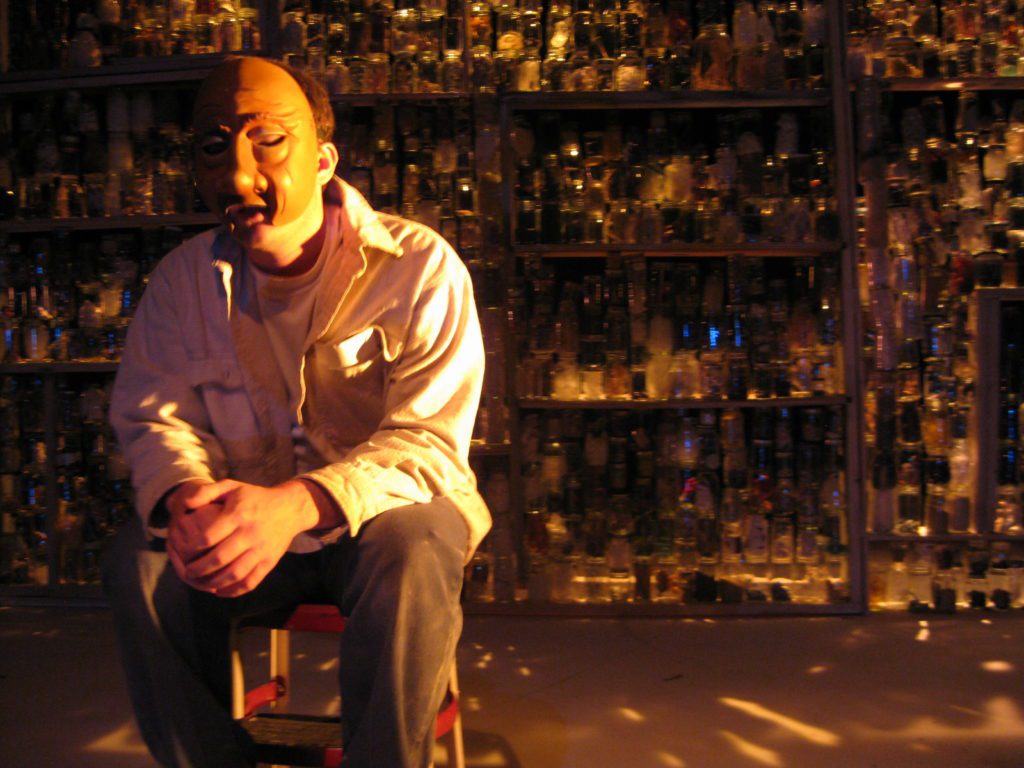
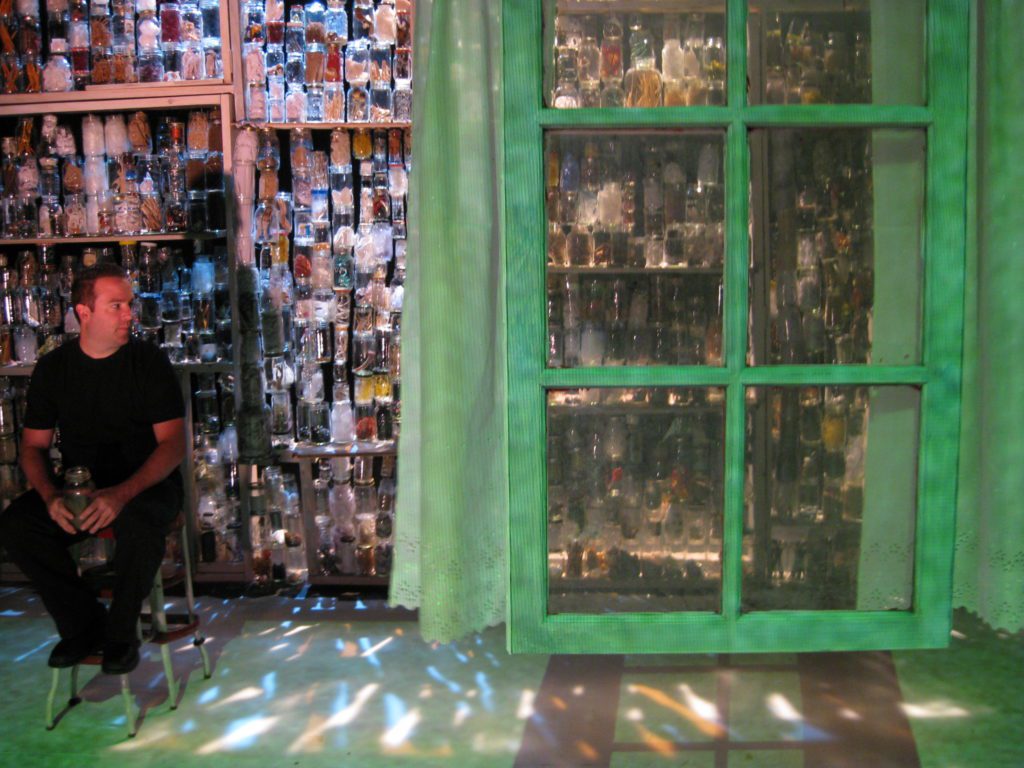
A glowing back wall of shelves, lined with quart-sized glass jars full of assorted objects seems to set the mood for a curious, poetic, magical interpretation of “Indiana, Indiana,” adapted from a novel by DU Professor Laird Hunt, who teaches creative writing.

It plays through Oct. 3 at Buntport Theater, where Buntport’s clever ensemble is known for its often biting and funny take on various literary classics, but has not before worked with a living writer. The group of six writes together and develops ingenious staging within a limited budget.

The book begins: “In the center of the county in the center of Indiana in the heart of the country, down a long, dark hallway, Noah Summers, a simple man who has led a far from simple life, sits in front of a flickering fire, drifting in and out of sleep. On this dark and lovely night, he sifts through the shards of his memories trying to make sense of a lifetime of psychic visions and his family’s tumultuous life on an Indiana farmstead.” After a beginning like this, “Once upon a time” will not suffice anytime soon!

Focused on a character named Noah, the non-linear script pulls closely from Laird’s language as it floats through periods in the rural man’s life, especially before and after Opal, but not necessarily in chronological order. The love of Noah’s life was mentally ill and lived most of her life in a hospital after she set their home on fire. Her letters to Noah, mostly removed from reality but filled with lovely words and images, pop up frequently through the book and play, as it takes Noah from young, just-married man to an elderly man, looked after by his son, Max.

Laird Hunt generously gave the creative group permission to develop a theater piece, not knowing what would evolve. Evolve it has, into a spellbinding 90 minutes of theater.

Evan Weissman plays the part of Noah, aging with a mask and body language.

Hannah Duggan, who observed on opening weekend that the group felt really happy with the results, plays Noah’s Bible-quoting mother Ruby, as well as the young Opal and three other roles, making the switch effortlessly, it seems.

Erik Edborg plays the scholarly father Virgil, who quotes from the classics, while dealing with practicalities of running a farm. Edborg also plays Mr. Thompson and an itinerant saw player, who trades Noah music for tomatoes.

Noah, who has trouble with reading and writing, is a clairvoyant, who sees things no one else can. He helps the sheriff solve crimes and predicts happenings– which affects his perceptions of reality at times.

Brian Colonna, the fourth cast member, portrays Max, Noah’s son, born after Opal is hospitalized; the sheriff; postmaster and minister.

The other two company members collaborated in writing and handle the technical side of this show, although Erin Rollman usually is onstage with the others and SamAnTha Schmitz regularly deals with technical effects and business. Projection is more complex than usual with fires, weather and other special effects, and some props appear from above on cue when needed.

Hunt’s book is described by the company as “a beautiful and surreal tale of love and loss in America’s heartland.” It is for sale at the box office for those inspired to get acquainted with the author following the performance.

-Sonya Ellingboe, September 15, 2009, Highlands Ranch Herald

A man with glasses examines a letter. Behind him an image is projected on a white door.

North Denver Tribune- Buntport’s Beautiful Indiana Indiana a Gem

Buntport Theater continues to challenge themselves and their audiences, moving into a new realm with Indiana Indiana, an adaptation of Laird Hunt’s novel. Buntport has proven again and again that they can do many things well, particularly excellent comedy, but this production takes things in a much more serious, thoughtful, and even surreal direction, doing so beautifully. The production also integrates all aspects of the production brilliantly, with scenery, lighting, and projection all in tune to enhance the world of the play.

This play is a series of scenes that tell a story, but not in a conventional, linear sense. It is the story of the life of Noah Summers, told through his memories, which individually supply incomplete pictures of what has happened. We learn he was married, briefly – maybe. We meet his parents. We know and accept that “he just knows things that the rest of us don’t know,– and we get a visceral sense of the anguish he is feeling. Through the combination of all of these snippets of memory, we connect with him, even though his experiences are very unlike our own.

In spite of the nonlinearity of the story, the scenes are remarkably consistent in style and tone. As the focal point of the story, Noah wears a mask which sets him apart from the other characters. Scenes are staged creatively and diversely, helping to keep the audience in rapt attention throughout.

Evan Weissman is wonderfully understated and complex as Noah. He drifts through the show, onstage throughout, paradoxically anchoring things as they flow in all directions. His anguish is palpable, made the more remarkable as it comes and goes in the nonsequential scenes. All other characters are played by Erik Edborg, Hannah Duggan, and Brian Colonna, distinguishing the different roles through minor costume variation, vocal changes, and physical adjustments. Edborg is quirky, remorseful, and at times menacing as Virgil, Noah’s father. Colonna shows great range, first as the sympathetic and helpful Max, later as the Minister, a role with complexity and strength, and also as the Sheriff, nonjudgmentally looking to Noah for insights into unsolved cases. Duggan is appropriately maternal as Ruby, Noah’s mother, and efficient and by-the-book as the Nurse. Near the end she appears as Opal, delivering a very complex character that is both sympathetic and disturbing.

Normally, I separately describe the scenery and lighting, and credit the designers. Here, however, the Buntport ensemble has created an exquisite integrated visual collage that includes set, lighting, sound, and projections. The visual impact of the dramatic wall of jars is amazing. Bits and pieces of the set move on and off from all directions, with projections appearing and disappearing on any and all available surfaces. I can honestly say that I have never seen these technical aspects of a production integrated so completely and creatively into the action onstage as well as they are in Indiana Indiana. Without this tight integration, the impact of the show would have been less. Even the costumes, though somewhat neutral in tone, fit with everything else.

In the course of only about 80 minutes, Indiana Indiana gives the audience both an emotional and an intellectual understanding of the tragic, beautiful, and real life of Noah. Neither type of understanding is complete without the other, but combined, the whole person that we are connects with this character in a much more complete way. In the past, I’ve always left Buntport entertained, with a broad smile on my face. After Indiana Indiana, I was smiling, yes, but also thinking, feeling, pondering, and basking in the glow of a wonderful experience.

-Craig Williamson, September 15, 2009, North Denver Tribune

Light shines through a wall made of many glass jars. A man wearing a half mask sits in the foreground.

dscriber.com- Forget New York and LA – Colorado theater kicks serious ass

Nobody gives a damn about the arts.

Too bad.

Likewise, unless it involves killings, multiple births, rich people, cults, meth labs or big boobs, nothing that happens between New York and L.A. matters.

Wrong.

Denver’s Buntport Theater opened its ninth season two weekends ago with their version of a novel, “Indiana, Indiana,” by Boulder writer Laird Hunt. What happens onstage is miraculous. I’ll tell you why.

First, a disclaimer. Usually, a reviewer is like a food taster. He or she checks out the product, chews it over, masticates it into a 500-words-or-less paste, regurgitates it. Signals whether it’s safe to consume or not.

This isn’t that. I’m a fan, a partisan, a booster. I’ve watched them for nine years, seen nearly all of their two-dozen-plus productions, and I’ve never had a negative experience. I’ve always been glad I attended.

Why is that important? It’s the definition of good art – something that not only entertains you, but sticks with you and expands your sensibilities. This is what Buntport does. As I’ve written many times before, for many different publications and websites, they are a group of six who work together as performers, designers, writers, technicians, ticket-takers, whatever needs to get done to make it happen. They are Brian Colonna, Hannah Duggan, Erik Edborg, Erin Rollman, SamAnTha Schmitz and Evan Weissman.

To this point, they’ve been focused primarily on comic extrapolations of classic texts, leading to hilarious results in works such as “Titus Andronicus! The Musical,” “Moby Dick Unread” and “Kafka on Ice.” (I mention the catchiest titles, to whet your appetite.)

This time, they’ve taken the work of a living writer and translated it onto the stage. It’s serious, but not somber. It provokes feeling, but it doesn’t make a play for your emotions. It is what it is, and it’s fascinating and delicious.

A blank white rectangle on the floor is the playing space, often overlaid with transparencies that move us through fields, onto roads, into the rain. This barren space is backed with a wall of glass jars, containing objects, memories, properties. The wall’s panels unhinge to make doorways, windows, hatches. A few pieces of furniture fly down, across or roll onto and off the set.

The story’s told without a break. It’s Noah’s story. He’s the only constant, played by Weissman, half-masked as an old man tumbling through his fragmented memories. He’s slow, or gifted, or both; a farm boy in the Midwest dominated by his brief experience of marriage to the similarly minded Opal, who’s taken from him.

The other players (Colonna, Duggan, Edborg) drift in and out around him, playing wife, mother, father, preacher, sheriff, townsfolk. Flashes from Noah’s mind, projections, fall onto blank surfaces periodically and play themselves out cryptically (Rollman and Schmitz work off stage this time).

So what is so miraculous about this? For all its fragmentation, “Indiana, Indiana” coheres. It’s fluid and eloquent, there’s no wasted movement to it, no moments of awkwardness. The years of work this group has done together gives them an unmatched ability to communicate clearly and deeply.

It’s not an adaptation into play form. No other group will ever be able to pick up and recreate what they do. That’s what makes “Indiana, Indiana” worth getting up and going to. When its run is done, you’ll never see it again. It will never move to Broadway. It will never be on TV.

Here’s a statement that can be found in every Buntport program: “At Buntport, we strongly believe that Denver is NOT a staging area on the way to ‘bigger’ and ‘better’ things. Wonderful, vibrant Art is happening right here and now! . . . We strive to provide a wide variety of high quality programming that cannot be found anywhere else.”

I don’t really know how they do it. I don’t think I want to penetrate that mystery. I’m happy they’re here. I will hijack their achievement to help make my own assertion that there are no more excuses for overlooking what good art can do for us, for ignoring anything of value that sprouts up outside the spotlight’s scope. Which is why I will keep on about them until they selling out every show.

When the lights came up and the bows were taken, the person next to me was too moved to get up. For a minute, too changed. That’s what good art does. That’s why you should see it.

-Brad Weismann, September 15, 2009, www.dscriber.com

A man with glasses examines a letter. Behind him an image is projected on a white door.

Denver Post- Buntport arrives at a state of grace in ‘Indiana’

Buntport Theater is always up for a new challenge. With “Indiana, Indiana,” the endlessly witty collective takes on acting. Real, character-driven acting – while telling an uncharacteristically melancholy family tragedy.

It’s a departure for this proven team known more for awing audiences and its unique brand of smart, irreverent humor.

“Indiana, Indiana” is something else indeed. Something dark and lovely. Sad and wonderful.

At the same time, “Indiana” marks a welcome return to Buntport’s presentational roots, every few moments conjuring another bit of its simple, signature stage magic.

Based on Laird Hunt’s elegiac, nonlinear novel, “Indiana” is about a simple old man named Noah who spends his late years drifting through his memories. There are those before Opal, and those after Opal. The sad circumstances of his detachment from a wife with an affinity for flames are worthy of John Irving.

What makes “Indiana” so intriguing is its approach to the chaos of memory, and Buntport’s approach to staging it.

The set is initially draped in a white sheet. Grainy, mood-establishing home movies play not on the wall but more askew: on the floor. The sheet is pulled to reveal an entire wall of stacked Mason jars, as if lining a Midwestern general store. Each jar is randomly filled – with straw, buttons, love letters and even bones. Each represents a memory from Noah’s life. Accessing a needed one here after so many decades looks akin to finding a needle in a haystack.

We see Noah’s story in bits, just as this old-man mind remembers them – hazy, incomplete, fragmented and unreliable. We’re in the land of “50-percent clarity,” we’re told – Noah remembers half the story, and we get only half its meaning.

He’s played with sad sobriety by Evan Weissman. Coaxed into talking by caring neighbor Max (Brian Colonna), we go back and forth in time to meet his teacher father (Erik Edborg) and devout mother (Hannah Duggan). With Noah’s eyesight failing, Max also reads aloud old letters from his beloved, Opal. These letters come with corresponding home movies, cleverly projected on everything from a woman’s apron to the back of an umbrella to the side of a washing machine.

In these murky journeys into the past, we discover Noah is a seer, a gift he’s reluctantly used to help cops solve crimes but has never been of any use to himself. His flashes come with crackling sounds and bursts of light, like a synapse not so much firing but short-circuiting.

The unfolding mystery of Noah’s current solitude culminates with a visit to his wedding, during which two glowing Mason jars, one blue and one red, swing from attached cables.

It’s an ambiguous but strangely moving effect.

“Indiana, Indiana” is in league with the Denver Center’s “Plainsong” and its coming sequel, “Eventide” – both based on novels that are as much read to an audience as performed. But Buntport’s creation shows just how beautifully real theatricality can be intermingled into such storytelling.

This brief journey is much to process at once, but it’s all captivatingly staged, and the story arcs satisfyingly.

While it might help to have read the novel, “Indiana” succeeds on it its own theatrical terms. Yes, it’s strange. Some might think there’s not much sense to it.

But, as we’re told along the way, “There might be!”

-John Moore, September 12, 2009, Denver Post

A man dressed in black sits on a stool holding a jar. Behind him light shines through a wall made of jars filled with sundry objects. In the foreground a window with curtains, bathed in green light, hangs in the air.

ARTICLE Denver Post- With “Indiana,” inventive Buntport troupe evolves its approach

There’s a word for the adroit, unpredictable symbiosis that turns a Ukrainian short story into a theatrical mud bath, adapts a confusing Shakespeare tragedy into a musical comedy or propels an episodic Colorado novel into the Twilight Zone.

“Many times, the act of ‘Buntporting’ the show happens after we’ve made the choice to deal with certain material,” says Buntport Theater actor Brian Colonna, reflecting on “Indiana, Indiana,” the singular novel that inspired the latest Buntport collaboration. It opens on Friday.

“We’ll say, ‘You gotta put some Buntport in.’ This novel is so beautiful and strange already. The nonlinear story line begs for some Buntporting, as well.”

Buntport: It’s a verb and a noun. In the Buntport Theater’s eccentric stagings, the actors have slogged sloppily through a mud pit, offered a goldfish playing Ophelia in “Hamlet” and staged an Ice Capades-inspired interpretation of some particularly bleak Franz Kafka material.

Their latest challenge is translating University of Denver professor Laird Hunt’s dark, poetic novel “Indiana, Indiana” into a theatrical drama.

The novel maps the fitful interior and exterior landscapes of protagonist Noah. Its deliberately cryptic content – Noah’s memories focus heavily on what his father calls “fifty percent stories” that omit half of the tale – and nonlinear structure could have been written specifically to be Buntported.

“When you’re reading, you can sit on it for a second while you put the puzzle pieces together, so the challenge was how to put it on stage without making it too artsy,” said ensemble member Hannah Duggan.

“We don’t want people going ‘Wha . . . what?’ We’ve tried to stay true to the book.”

“Plus we thought it would be nice to actually meet a living author,” said actor Evan Weissman.

“People like to hear songs they know, set to different words. That’s a given,” said Duggan. “And when it comes with really bad dancing and colorful costumes, you just can’t beat it.”

That’s a wry reference to Buntport’s longtime reliance on public-domain works, a dictate of the company’s lean budget. (It also avoids possible rows with authors surprised by particularly elastic translations of their work.)
The innovative, collaborative Buntport Theater company dates back to 1998. Then, seven Colorado College alums – Colonna, Erin Rollman, Erik Edborg, Duggan, Matt Petraglia, SamAnTha Schmitz and Weissman – began creating what Denver theater critic John Moore once called “the most quirky, creative and thought-provoking new material in Denver.”

Thanks largely to the runaway success of “Titus Andronicus! The Musical!” – which was staged four times with long and often sold-out performances before the company retired the hit in 2007 – Buntport earned a reputation for edgy comedy. That’s a mixed blessing because its productions aren’t always cheeky and blithe.

The company’s adaptation of “Indiana, Indiana” steps outside Buntport’s unique mixture of intelligence and silliness and incorporates multimedia elements.

“There may be a moment or two of levity, but it’s generally a dramatic show,” Weissman said.

“I don’t think it’s the type that will have people laughing out loud,” Rollman said.

“Indiana, Indiana” maintains Buntport’s tradition of collaborative theater. Although most members of the company have met Hunt, the novelist wasn’t involved in translating his novel from paper to proscenium. Opening night will be as surprising to Hunt as it will be to people who never heard of his book.

“The adaptation takes on a life of its own, and we have to respect that, while always making sure that we’ve maintained the feeling of the original,” Rollman said.

“Anything can be Buntported. You just have to figure out how.”

August 30, 2009, Claire Martin

Denver Post- Dirty fable well told, with a dollop of mud

Some might be a bit off-put to read that a theater company is adapting an absurd 1835 Ukrainian short story that scholars have classified as “grotesque realism.”

Don’t be frightened … It’s Buntport!

That means it’ll be inventive, accessible and, yes, even fun.

“The Squabble” typifies all the qualities that make Buntport a singular company. It unearths an obscure source story and transforms it with intelligence and affability, using mind-expanding storytelling techniques along the way.

The Buntport ensemble has told its many original stories on fake ice, suspended above the stage and even upside down …

“The Squabble” is performed in a 12-foot-by-19-foot mud pit.

Yep, 5 cubic yards of wet, sloppy mud. Sure, it’s a gimmick – with a purpose. Just hearing the players trudge through their trough creates sounds that add real, visceral pleasure to the tale.

“The Squabble” is based on Nikolai Gogol’s fable, “The Tale of How Ivan Ivanovich Quarreled with Ivan Nikiforovich.” Our setting is a village called “World Town” – think of it as Ukraine’s “Our Town.”

Gogol wrote bizarre tales, like the one about a nose that detaches itself from a soldier’s face, intent on living an independent life. Here, he gives us villagers who are content to live in what they call “a magnificent puddle.”

World Town, populated with names like Wanda Wickerstickly, is a harmonious place with no theft or acrimony. That is, until a great friendship between two neighbors is torn asunder when one casually calls the other a “goose.” This innocuous epithet builds, like the butterfly effect, into a sad storm of acrimony that draws the whole town into their down and dirty mess.

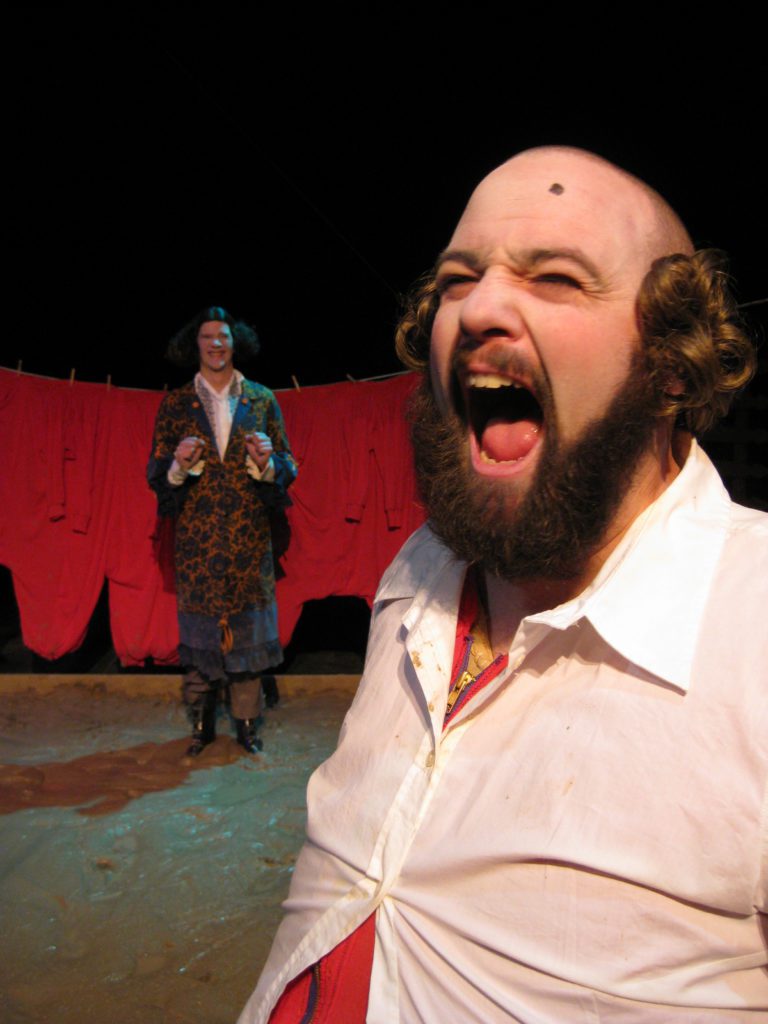
Bob Boxinoxingworth (Erik Edborg) and Bob Luggalollinstop (Brian Colonna) are opposite halves of a whole. One’s lanky, clean and proper. The other’s rotund, blunt and kind of gross.

Their tale is told in Brechtian style, so our narrator (a well-spoken pig played by Evan Weissman) and other ensemble characters (played by Hannah Duggan and Erin Rollman) watch along with us in plain view with props and costumes.

The mud pit is more than a visual and auditory novelty. But don’t come looking for wrestling. It’s not a playpen, but a character unto itself.

This is not terribly deep terrain (the pit or the story), but it’s always a pleasure to sit back and watch what grows whenever Buntport simply … adds water.

Here we meet endearingly bizarre characters like Duggan’s Monty Python-worthy judge, Alfred Fredfredfredful. We see Wanda dronishly pin dirty rags to clotheslines hung along both rows of seats, furthering the idea that life here is simply impossible to keep clean.

Still, chins are up.

You won’t understand everything Buntport puts before you. (Who ever does?) But when you combine these delightfully feuding neighbors with the players’ whimsical storytelling style and there’s just something very “Fantasticks” about the whole, brief evening.

And fantastic.

-John Moore, May 22, 2009, Denver Post

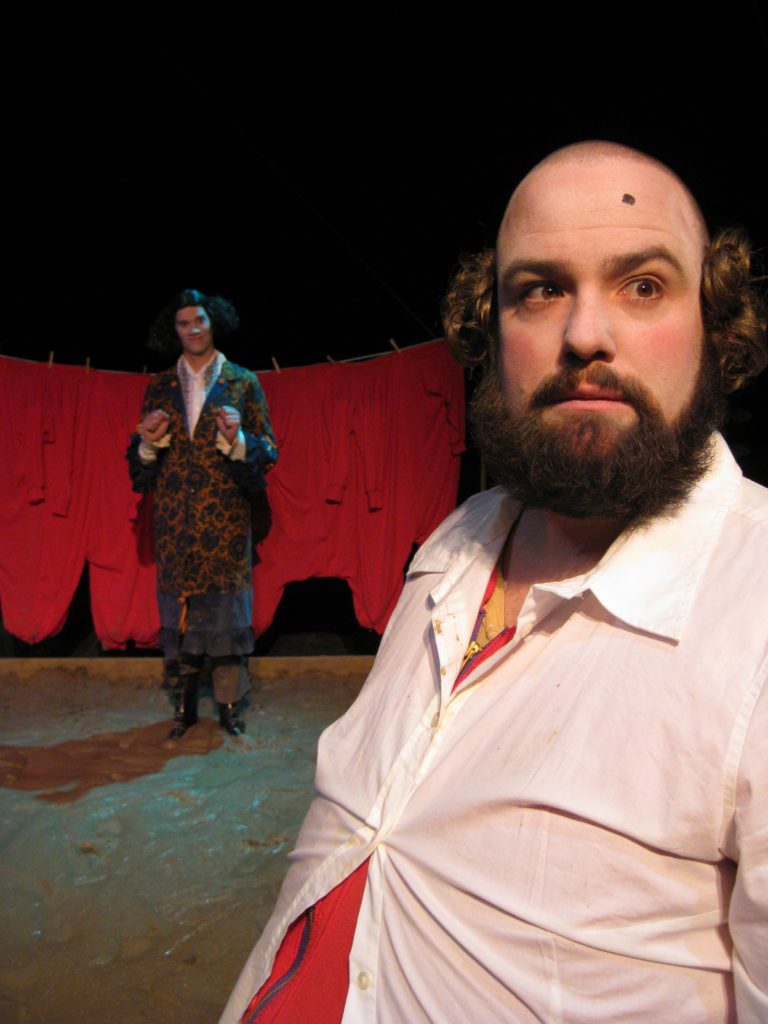
In the foreground, a bald man with a big beard and a beauty mark on his forehead is yelling. In the background, a man in a patterned jacket stands in a shallow mud pit, smiling. A clothing line of red long underwear hangs behind.

Blogspot.com- CULTURAMA: Buntport’s ‘Swabble’: Tale of enmity triggers laughs

Denver’s Buntport Theater produces interesting, entertaining work. That may sound simple, but it’s an objective few artists or arts groups ever achieve. They achieve it again with the final play of their eighth season, “The Squabble,” with an unmistakable and unstale Buntportian approach. If you want to enjoy yourself at the theater, this is the one you should be attending.

Here are more remarkable facts about Buntport. They do good work consistently. They are without pretense. They are committed to working here. They work collaboratively.

They are a little tiny Utopian island for me, really, floating in a sea of self-indulgence, bad choices and egomaniacal hobbyism. Which is why I am so biased in their favor. Caveat lector.

The creative sextet – Erik Edborg, Brian Colonna, Evan Weissman, Hannah Duggan, Erin Rollman, and SamAnTha Schmitz – have produced 26 shows together to date, by their count. They have staged unusual fare such as “Kafka on Ice,” Moby Dick Unread,” and “The Odyssey: A Walking Tour.” You could say it’s a little gimmicky – or you could say it’s no-holds-barred. The group is unafraid and unashamed to use whatever techniques help them reach the audience.

The physical setup for “The Squabble” resembles nothing so much as the ring for a messy wrestling match. It’s a rectangular box containing several cubic yards of mud. The ensemble (save for SamAnTha, who handles the offstage functions) treads through the muck, acting out an adaptation of the source material, a short story by Gogol.

The mud is an obvious metaphor for the conflict the protagonists, here named Bob Boxinoxingworth (Edborg) and Bob Luggalollinstop (Colonna), find themselves, er, mired in. It also gives the troupe plenty of dirty laundry to hang out on the clothesline framework that lines the perimeter of the action and extends up into the seats.

It reflects the identifying imagery that places the story in a jerkwater town in Imperial Russia – a “lake” that is a Main Street puddle, a town that’s proud of the evenness of its roofline, and a populace of supercilious idiots that are conscientious mainly of the freshness of their breaths.

Rising from this background like cardboard cutouts are the two Bobs, who share pedantic obsessions and spasms of covetousness, and who finally clash over Bob L.’s use of the pejorative term “goose.” Bob B pivots and fidgets himself into a frenzy, while Bob L (Colonna doesn’t take the low road in his fat suit), sways menacingly, to hilarious effect.

The fable of their feud, which ripples outward in effect until the entire village is temporarily consumed by it, is narrated by a rather well-spoken pig (Weissman) who is clever enough to both make witty observations and avoid being turned into sausage. Weissman’s turn as the identically-named but one-eyed simpleton Bob Boxinoxingworth is equally pleasing.

Rollman plays out an unrequited romance with herself. She’s both the contentious, ever-ironing Wanda Wickerstickly and the chief of police, Peter Apropopanoosh, complete with Pythonesque walk and accent, that Wanda seems to favor . . . when she’s not shrieking the overture to “Carmen” (everyone seems to have his or her classic theme, which murmurs out of their mouths add odd times). Duggan has cartoony fun with the characters of town nudnik Tony Tumblestumpington and magistrate Alfred Fredfredfredful.

Anyone who might object to wacky and surreal nature of the proceedings doesn’t know how to take a spat with a grain of salt. The former friends spurn reconciliation, and their bickering moves into the realm of actual litigation. Anyone familiar with the world of legal machinations will recognize how that kind of thing throws even the best-intentioned lust of vengeance into a flaccid torpor.

The bickering ossifies into a dimly remembered grudge. The search for legal satisfaction becomes a quasi-religious hope for deliverance. The rain keeps falling; the town rots away in the mud.

That Buntport can make us laugh so heartily while keeping the edge of melancholy keen keeps the larger perspective about childish behavior with us. Seeing “The Squabble” won’t solve the world’s problems, but it sure casts a fresh light on our roles in perpetuating them.

-Brad Weismann, May 26, 2009, bradweismann.blogspot.com

In the foreground, a large bald man with a big beard and beauty mark on his forehead stares out. Behind him, a man in a colorful jacket stands in a shallow mud pit with a laundry line of red long johns behind him.

ColoradoDrama.com- The Squabble

Finding the humor in such behavior comes naturally to Russia’s impressive stable of scribes, but its basis is not always apparent to outsiders, as we so often see in angst-ridden, hand-wringing productions of Chekhov. But the creative font of theatrical talent that calls itself Buntport Theatre has no such difficulties in mining the comic and, at times, absurd from the Nikolai Gogol tale they have adapted into a barnyard allegory.The Russian temperament is as enigmatic as the country from which it arises, an unpredictable roller coaster of joy and melancholy, charity and self-interest, that somehow provides the temerity to see its hardy stock through the harshest winters with a ferocity that is willing ultimately to destroy its own resources to outlast the likes of Napoleon and Hitler.

Smack dab in the middle of the company’s flexible space sits approximately 500 square feet of mud held in check by a sturdy frame of two-by-eights – within which most of the action takes place, with the actors wearing rubber boots to navigate the slop – which along with clotheslines and picket fences that demarcate settings, serves as two abodes, surrounding yards, a courtroom, and the town square.

“Wallowing in the mire” and “airing dirty laundry” are two metaphors that come to literal fruition as the plot unfolds: two good friends start feuding for the slimmest of reasons and refuse to forgive each other, even as death approaches.

As always, the company’s characterizations are a hoot, beginning with the main adversaries: Erik Edborg as the well-mannered but easily offended, willowy Bob Boxinoxingworth and Brian Colonna as the ill-bred and blunt, torpid Bob Luggalollinstop. The intriguing question of how these fellows ever got to be friends in the first place is quickly marginalized as we watch Bob B and Bob L project their worst fears on each other.

The Bobs are enabled in their maledictions and reprehensible behavior by Wanda Wickerstickly, a delightfully eccentric and abrasive Erin Rollman, who encourages Bob L and infuriates Bob B. Rollman then turns state’s witness, reappearing as Peter Apropopanoosh, who along with Hannah Duggan’s equitable Alfred Fredfredfredful, the local judge and owner of the town’s largest house, attempt to leverage the law to ameliorate the situation.

Duggan’s alter ego, the delightful simpleton Tony Tumblestumpington, is the harmless, homeless flip side of the judge, who spreads her requests for evening shelter relatively equally between the Bobs. Evan Weissman, as Pig and as One-eyed Bob B stands inside and outside the story, mocking the sad state of affairs to which he is both a partner and an observer.

In the program, the company notes that Gogol’s unique blend of humor and fun resonates with their own work, which is certainly evident in the production. There is one other striking similarity to many of Buntport’s dramas or allegories: the lack of catharsis. In comedy, a series of good laughs is sufficient to provide a transformational catalyst, but The Squabble is not a comedy in structure or tone. It could be argued that this was Gogel’s intention – to let the unresolved issues fester without tragedy or redemption – and perhaps the Russian temperament finds succor in such a point-of-view, but this side of the Cyrillic alphabet, an emotional Rosetta stone is required.

-Bob Bows, May 22, 2009, ColoradoDrama.com

Westword- Gogol is a no-go at Buntport

Partway through The Squabble, I did something I’ve never done before in all my years of faithful and happy attendance at Buntport: I glanced at my watch to see how much longer we had to go.


Reading Gogol takes an imaginative effort: You have to try to transport yourself into his time and place, guess at the manners, politics and culture he’s mocking and adjust to his humor. (Someone once said that reading literature in translation is like making love through a blanket; I think this is particularly true of jokes.) Instead, Buntport has transported the action to some fictive and unnamed place that feels as if it’s halfway between the United States and nineteenth-century Europe. The Ivans have become Bob Boxinoxingworth and Bob Luggalollinstop; narration is provided in part by the former’s pig. But this effort only occasionally captures the flavor of the original, and the updated humor that the company’s inserted – the names, for example; jokes about mints and bad breath substituted for observations about snuff – aren’t that funny. In a concept that could have been inspired, all the action takes place in a huge trough of real mud – Buntport’s version of Gogol’s “truly magnificent puddle” – on which the actors tromp, shove each other and sometimes skid. They wipe their boots continually on squares of cloth, which then get pinned onto moving clotheslines. You can see what the company is going for: a representation of the mean, mud-bound spirit of the little town where pigs and chickens wander the streets, and also of the mud-wrestling between the protagonists. But though the mud provides some good bits of business, particularly for the fastidious Boxinoxingworth, it’s not really integrated with the action. Nor is your very natural desire to see everyone finally scrambling and wrestling in it ever satisfied. Even though there’s no mud fight in the original story and it would be hell on costumes, why provide such a tempting, squishy mess if you’re not going to go all the way?
Based on Nikolai Gogol’s “The Tale of How Ivan Ivanovich Quarreled with Ivan Nikiforovich,” The Squabble tells the story of two neighbors in a Ukrainian village who begin as inseparable companions and become deadly enemies over a meaningless epithet flung by one at the other. The original is grotesque, odd and almost surreal, poking fun at rural society, legalism, bureaucracy and human nature. There’s a nod to Romanticism, including a narrator who apologizes periodically for not being more poetic, and the characters are broadly and absurdly sketched.

Erik Edborg and Brian Colonna certainly go all the way in the main roles. These two actors create characters that are fully articulated and insanely funny. Colonna, hugely padded, is a man almost immobilized by his own girth, but makes up for it with a booming voice and an almost desperate air of authority. (Colonna usually gives his characters high, heady voices, so this is an interesting change.) And I can safely say you’ll never see anyone in life or again on stage who even faintly resembles Edborg’s Bob Boxinoxingworth. Wearing a girlish curly wig and absurdly decorated coat, as thin as Luggalollinstop is fat, he’s epicene without being effeminate in any of the usual ways, and his crazed and precise mannerisms are an astonishment. While these two are engaged in their quarrel, you’re riveted.

No one else has created a character this specific, however, and Evan Weissman, Erin Rollman and Hannah Duggan, each playing two roles, end up scuttling around the stage, making faces, using funny voices, gesticulating and wearing silly wigs. Rollman, in particular, seems to be utilizing sketch-comedy characterizations: Both the people she portrays have irritatingly shrill voices; neither speaks as if thinking the words before saying them. The Buntporters are hugely talented, among the most hilarious performers around. Surely they know that nothing kills comedy as fast as trying to be funny.

It’s very possible that Gogol is unstageable; in any case, mixing the nineteenth-century Russian writer with Buntport’s comic sensibilities simply never jells. A satire, the story has no forward momentum – and on stage, as with the original – it grinds to a sad, inevitable halt. Just not soon enough for me.

-Juliet Wittman, May 27, 2009, Westword

Close up of a woman in a brightly colored tracksuit, her mouth agape. She stands in front of a flowered wallpaper, holding a sucker.

North Denver Tribune- Seal. Stamp. Send. Bang. Fun. Clever. See it.

The talented folks at Buntport Theater have set their sights on musical theatre, creating their first all-original musical (their now legendary musical version of Titus Andronicus was based on Shakespeare, after all). They have taken the U.S. Postal Service as their “central metaphor for interconnectedness,” and built Seal. Stamp. Send. Bang. The result is a fun, funny, clever, unpredictable, and entertaining musical.

Seal. Stamp. Send. Bang. is the story of how the lives of eight characters intertwine. Several of them work for the Postal Service, and the mail plays a pivotal role in most of the surprising twists and turns the story takes. While there is a plot, this production is more about characters and relationships than storyline. Each new revealed connection between characters completes a piece of the story, until everything comes together by the end.

The script is what we expect from Buntport – an interesting story with diverse and well-developed characters that create unexpected situations and outcomes. Adam Stone has injected clever lyrics and synth-pop music that fit the story and the characters singing them well. The funniest number involves a singing and dancing package.

The production is well directed, though as with everything Buntport, direction is a collaborative effort. The timing is tight, perfect for quick comedy, and the constant details and small creative bursts seem limitless. The songs are integrated into the action on stage well, without any pretentious buildup or false theatricality.

Erin Rollman anchors the show as Susan, a cheerful, exuberant, optimistic mail carrier. The unlikely corner of a love triangle based on misunderstandings, she is happily oblivious to much of what goes on around her. Jason, played by Erik Edborg, is compulsive and voyeuristic as he deals with “dead letters” that can’t be delivered. Edborg captures the essence of someone trapped inside an office, constantly looking at other people’s mail, but officially only enough to get a delivery address. Brian Colonna is Richard, the sadistic yet mousy security enforcer, always looking to catch someone doing something wrong. Daphne, played psychotically by Hannah Duggan, is a woman on the edge. She is seething with anger, but the expression of that anger is annoying and, well, just weird – but hilariously so. Rounding out things on stage is Evan Weissman, playing all the other roles needed. As Ethan, he is sheepish and infatuated, but unable to express his love directly. But he transforms himself completely into several other characters as well.

The set is modular and integrated well into the show, with several different homes transforming into offices, interiors, or mail trucks when needed. The lighting is clever, much more of an element than in past Buntport shows. I particularly liked the creative follow spot use, run deftly from the booth by SamAnTha Schmitz. The costumes were appropriate, with each helping to reinforce the character wearing it. This show also called for a higher level of sound integration, which worked well for the most part. The transition in mid-song from full reinforcement to a simulated Walkman sound was very clever.

Seal. Stamp. Send. Bang. is just plain fun. The music is interesting and enjoyable, the choreography is silly and a wonderful parody of musical theatre, and the hilarious story twists will catch you off guard. The play is about interconnections and misconnections, and while there may not be as much depth or insight as in recent Buntport offerings, that doesn’t matter. This show is about fun, comedy, and entertainment, and it hits that target squarely on the bulls-eye.

—Craig Williamson, March 19, 2009, North Denver Tribune