Buntport Theater

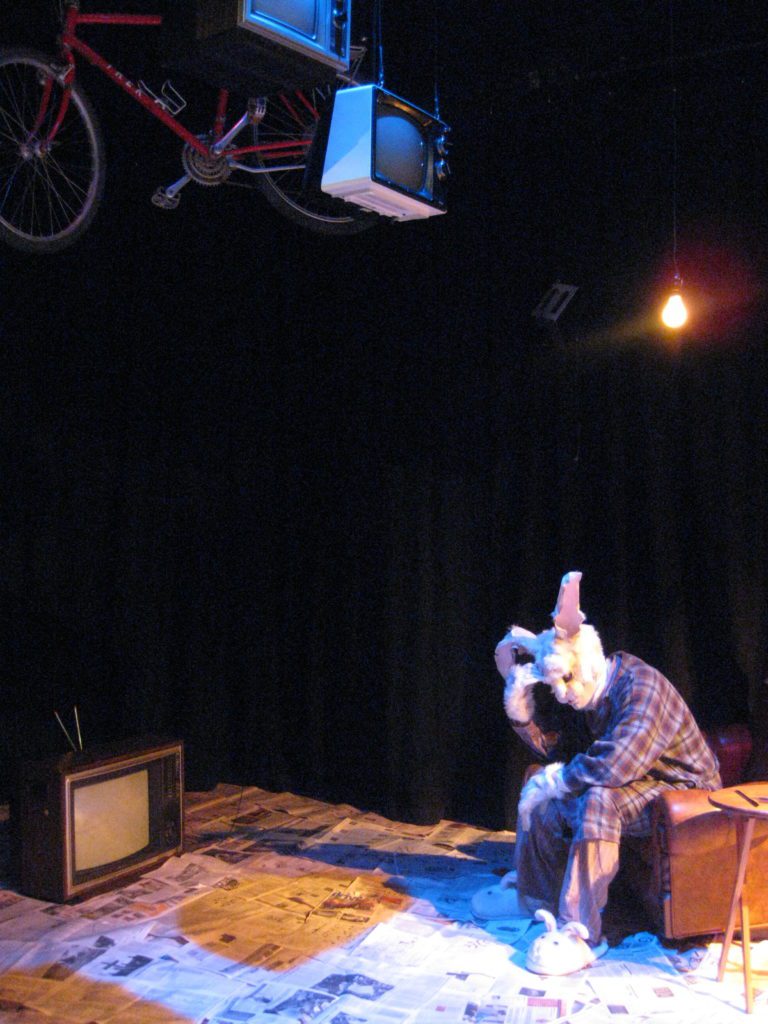
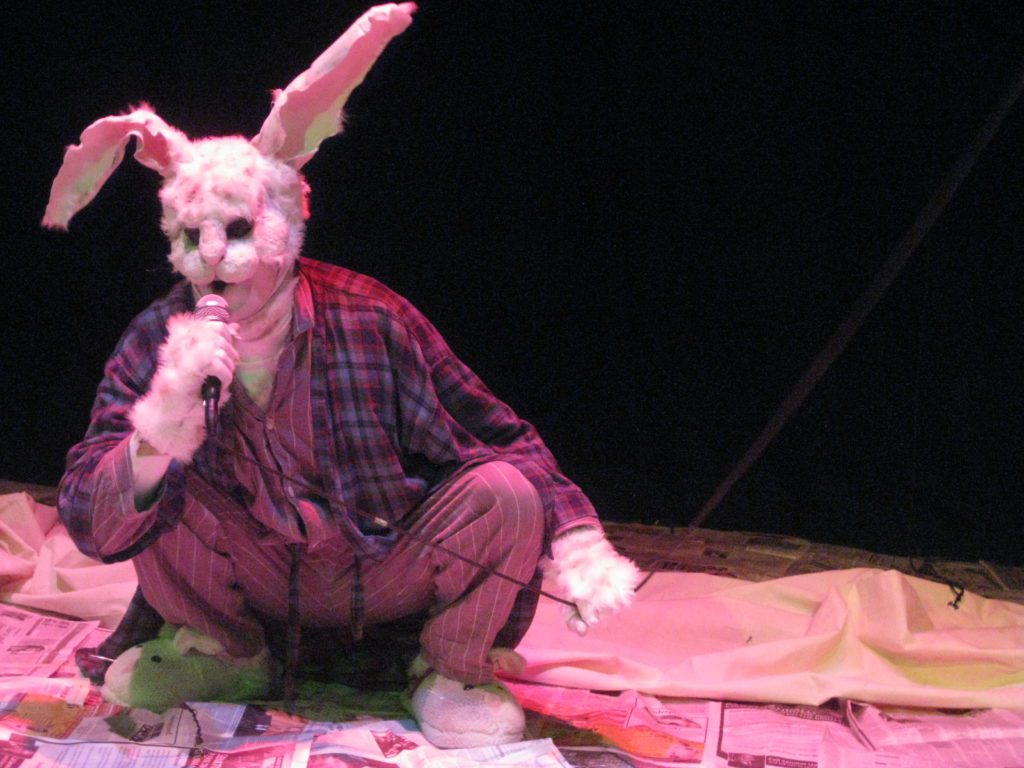
A large rabbit wearing a ratty robe and bunny slippers squats on a floor covered with newspapers. The rabbit holds a microphone and sings.

North Denver Tribune- Buntport’s second musical dark, hilarious, and brilliant

It almost seems unfair – each time I go to Buntport Theater, I expect something unique, unexpected, clever, hilarious, thoughtful, challenging – in short, I expect brilliance. This would be unfair, except that I have yet to be disappointed. Somehow, the six Buntporters are constantly able to expand what they do – they rarely go in the same direction twice. And their works are not just thrown together – they are complete, well-developed and structured stories that are engaging and insightful. Their latest creation, a musical called Jugged Rabbit Stew, is dark, funny, bizarre, thought-provoking, and edgy.

Jugged Rabbit Stew is about Snowball, a rabbit that is pulled out of a magician’s hat. The twist is that snowball has real magical powers. This makes the shows he does with Alec the Amazing and All-Powerful magician popular and successful – until something goes very wrong. Snowball is not a happy, cute bunny – he is angry, cynical, and mean. He has a bizarre collection of things, which exists as a result of his efforts to make others unhappy. He randomly rearranges body parts on several other characters for the same reason. But when he “collects” a fan of the magic show, he is frustrated that she refuses to be unhappy.

This is a musical, and composer, lyricist, and music director Adam Stone has written a nice variety of songs that fit into the story well. The music is prerecorded, and the quality of the singing is somewhat variable, but certainly good enough for the intent of the show. It also allowed for some very creative and funny ways of using microphones. And as with any good musical, the songs add another layer of emotion and context to the story. Buntport’s collaborative directing is excellent. The formal layout of the action on stage reinforces the interplay between the characters and provides an interesting and constantly changing visual image. The six members of the company are all involved throughout the development, so they understand the story perfectly and can integrate all aspects of the show completely. The pacing is spot-on, the musical numbers are integrated seamlessly and cleverly, and everything operates as a cohesive whole.

The acting is strong, with the story adding challenges that the company rises to. Eric Edborg is Snowball, and performs with a rabbit mask that covers part of his face. He more than makes up for this by using his voice and the rest of his body to communicate. He is angry and bitter, but also captures just enough of the essence of being a rabbit to make the character work without overdoing it. Hannah Duggan is Mystical Marla, the beautiful assistant with misplaced body part problems. Duggan’s movement convinces us that her body is not all her own – resulting in great physical comedy. Evan Weissman is the magician Alec – less his right arm. Weissman is the consummate showman, falling naturally into a presentational announcer’s voice frequently. Brian Colonna is Alec’s Right Arm (don’t try and figure it out – just know that it works). The two work together well, and get into some very funny arguments. Both also handle the restrictions on their movement and expressiveness very well. As the Woman, Erin Rollman is bubbly, enthusiastic, happy, and romantic, but also has more. She adeptly becomes serious as things progress.

As with all aspects of their shows, the six (the five actors listed above and SamAnTha Schmitz “off stage”) design the set, lighting, and costumes. The set, nicely framed by a proscenium of drapes, includes all sorts of things hanging suspended from above, and a floor covered in newspapers. The lighting provides good illumination, and includes some nice effects for some of the songs. The costumes are notable as well; especially Snowball’s mask, and the integrated costumes of Alec and his Arm. In Jugged Rabbit Stew, Buntport creates a sort of alternative universe, which is a lot like our own, but with a few important differences. But while the story exists in a different world, it is true to that world – and the feelings, relationships, and situations are authentic and relate to our world. While this may sound impossible (if you have never been to Buntport), it works flawlessly. The show is about fate and how we deal with what life gives us, and asks the question of whether we can control our destiny – or maybe suggests we can only control it by fulfilling it. It is funny, edgy, deep, unpredictable, and in the end, meaningful – and certainly worth seeing.

-Craig Williamson, June 3, 2010, North Denver Tribune

A large rabbit wearing a ratty robe and bunny slippers squats on a floor covered with newspapers. The rabbit holds a microphone and sings.

Denver Post- Waiter! There’s a Grinch in my “Jugged Rabbit Stew”

The Buntport Theater ensemble has taken audiences down the rabbit hole before, but never to the nether regions of “Jugged Rabbit Stew,” its wonderfully weird if ideologically troubling new musical, written in collaboration with impressive young pop songwriter Adam Stone.

The premise is precocious: A magician’s rabbit has quit the act because he’s depressed. He’s a guy dressed in a bunny suit, down to his cute little floppy-eared slippers. And he’s named Snowball. Cute, right? But in many ways, this ambitious piece culminating Buntport’s ninth season of all-original works is its most disturbing to date.

Imagine, if you will, a man who’s grown so fatalistic that the only joy he gets in life comes from stealing and hoarding items precious to others. Only he’s a bunny. And not some pwetty widdle wabbit, either; he’s the most surly, hateful hare since “Monty Python and the Holy Grail.” Think the Grinch meets Harvey. If Pee-wee had a big adventure in a Kafka nightmare, it would be “Jugged Rabbit Stew.”

The setting, based on the newspapers lining the floor, must be Snowball’s cage. The drunken and cantankerous master of this house, free-range yet clearly trapped, wiles away his days watching home movies of his dead rabbit parents. It’s Erik Edborg in a masterful performance that unnervingly parallels his most recent role as a sotted Eugene O’Neill – only here, he occasionally breaks into song.

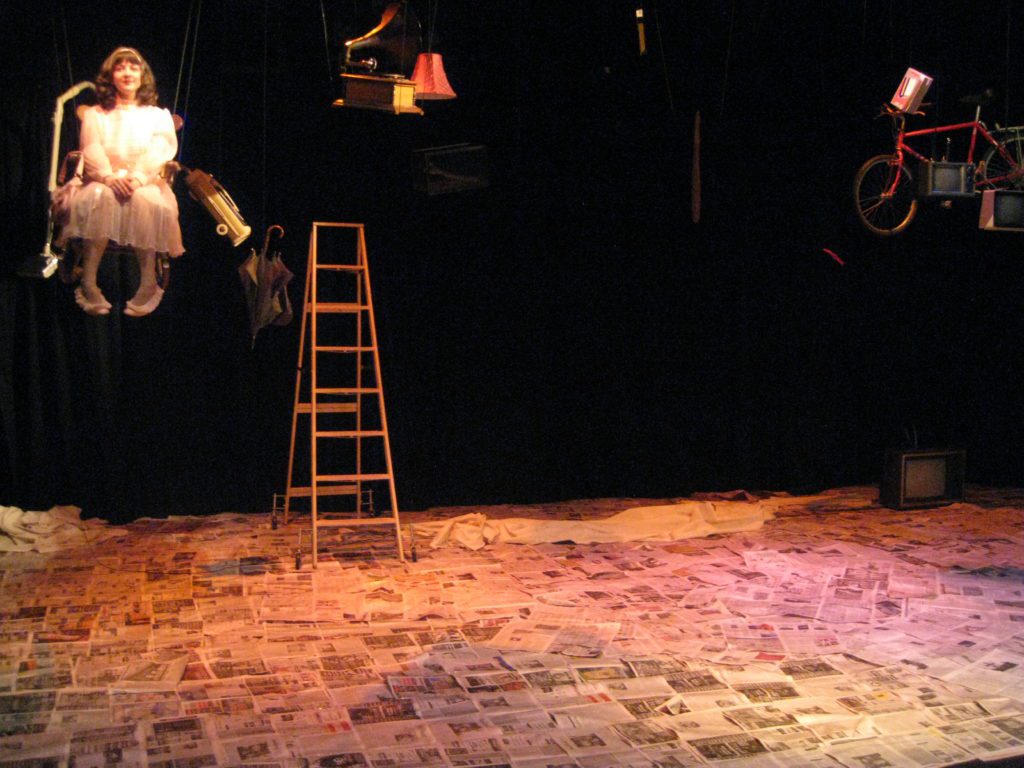
Suspended in midair are seemingly random objects covered in sheets – a vacuum cleaner, a toaster, a bike … and a woman, sitting patiently in a hanging rocking chair (Erin Rollman). Her unveiling is the first of many signature examples of Buntport’s uncanny presentational creativity. She’s straight out of a Tennessee Williams play – a fangirl who’s deliriously pleased to be held here in ongoing captivity.

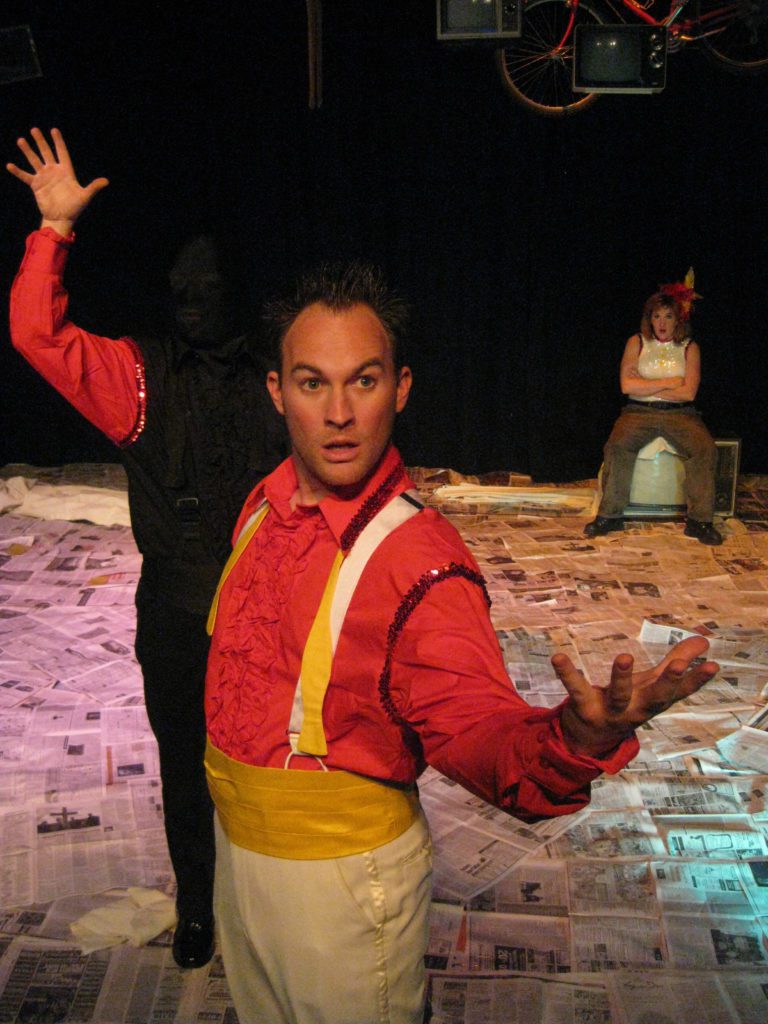
A few parameters: Snowball is the actual magician here. His doting human assistants are Alec the Amazing and All-Powerful, and Mystical Marla. And because of Snowball, neither is whole. Snowball failed to make Alec (Evan Weissman) completely disappear, leaving him with a disembodied arm that now has a mind of its own (played by Brian Colonna). Marla (Hannah Duggan) is saddled with “nasty man legs” because, in a fit of spite, Snowball sawed hers off, and replaced them with a mechanic’s.

He’s cruel and dismissive to them, and yet both have a pathological need to be loved by him. But the ones we love are not always kind to us, Alec aptly says. And when these two sing out of their willingness to change themselves, to disappear into a top hat and emerge as something else in order to be loved by Snowball in return, well, this musical transforms from a charmingly elusive menagerie into one that is painfully, identifiably human. We all, after all, want to be wantable. In the the brilliantly titled song, “Take Me, Break Me, Make Me Something More,” Marla sings of needing to be nicer. Alec sings of needing to be meaner. To win the same man’s affection. Who can’t relate?

But Snowball, as the doted-upon often are, is otherwise consumed. He’s convinced himself that his fate is to twirl on a roasting spit, as did his parents before him, a mere ingredient in someone else’s stew.

This heady talk of fate versus self-determination takes us out of the land of Lewis Carroll and into that most classic and human of storytelling genres: We’re in the land of the Greeks. Of Shakespeare. And you know what happens to the tragic hero there. Only in Snowball, we have a tragic hero who isn’t at all heroic.

How this musical handles Snowball’s epiphany will have audiences asking: Is the finale inevitable … or irresponsible? Those paying the most attention might be left shaken, even indignant, by what it seems to be advocating.

It’s certainly impressively staged, if bloated at more than 2 ½ hours. It’s unnervingly well performed – and yes, that takes into account that none of these actors are trained singers. That’s part of their charm.

Stone’s considerable 17-song score (performed to his taped synthesizer accompaniment) is laden with meaningful, soul-searching lyrics that evoke everything from “Sweeney Todd” to “Les Miserables.” They are often performed in the rapid-fire (and sometimes indecipherable) tempo of, say, REM’s “It’s the End of the World as We Know It.” Fine for a rock concert, but not ideal for a musical where we’re hanging on every word.

This is a stew, all right – ideologically, philosophically and musically. And it’s just like Buntport to leave audiences both dazed and amazed.

-John Moore, May 28, 2010, Denver Post

A magician and his disembodied arm strike a pose. A woman dressed as the magician’s assistant but wearing mechanic’s pants sits on a television looking angry. A red bicycle and two televisions hover above her.

Westword- Buntport Theater creates a hare-raising musical with Jugged Rabbit Stew

You have to wonder at the sheer gutsiness of the Buntport Theater Company, whose members took an absurd idea and then – instead of playing around a bit, giggling and letting it go – decided to carry the concept forward, step by step, moment by moment, to its logical and intensely illogical ending, trusting that others would willingly give themselves up to this phantasmagorical universe. Jugged Rabbit Stew is an original musical whose sunnily innocent surface carries a darker underlay, an underlay involving blood, dismemberment, the way humanity destroys its gods, predation and carnivorousness – which takes on a whole new dimension when the meat in question not only walks and talks like a man, but can perform astounding feats of magic. All of this is pounded home by Adam Stone’s inspired rock songs, some hilarious, some carrying a thumping portentousness reminiscent of Andrew Lloyd Webber.

The plot concerns Snowball (Erik Edborg), a giant rabbit who works with a magician called Alec the Amazing and All-Powerful (Evan Weissman). At his best, Alec can pull off only the simplest and most obvious sleights of hand; Snowball is the genuine magical power behind the act. This bunny is anything but sweet and fluffy, however. He’s a miserable, scruffy creature who looks a little like the ugly, ragged-toothed White Rabbit in Jan Svankmajer’s film Alice and who likes stealing things that others value and are useless to him, simply to make as many people as possible miserable: the VHS tape of a graduation ceremony, a gravy boat, an old-fashioned gramophone. All of these objects hover below the ceiling throughout the action. Snowball has confiscated the legs of magician’s assistant Mystical Marla (Hannah Duggan), replacing them with those of a middle-aged workman so that she can no longer dance; he took away Alec’s right arm. Despite the depredations he’s wrought on their bodies, both Marla and Alec are in love with him. Also dangling from the ceiling, seated, is Woman (Erin Rollman), a regular audience member whom Snowball loved until he spotted her one evening in the company of another rabbit. A chatty, cheerful person in pink ruffled shoes, remarkably unfazed by her predicament, Woman eventually falls in love with Alec’s disembodied arm, played by Brian Colonna, and the two enact a Hollywood fantasy in which she is the gutsy ranch owner and he the traveling farm hand (pun most definitely intended) who’ll save her land.

This is not the only place where the production underlines its own artificiality, satirizing magic shows and theatrical conventions in general (a character standing in the distinct spotlight that universally signifies a soliloquy overhears another in a similar spotlight, to the latter’s great irritation), and looking at the ways we use language to create story and propel action. They niggle over usage: the fact that a rabbit is not a hare (unfortunately, “hare” works much better for song lyrics) and whether the potatoes in TV dinners are whipped or mashed. Woman is a chattering ninny most of the time, but Snowball had originally imagined her as an intellectual and, toward the play’s end, she becomes the figure he’d imagined, lapsing into erudition and discussing his role as tragic hero: Is he the classical noble-but-with-a-fatal-flaw model, the romantic Byronic type in rebellion against convention, or a twentieth-century anti-hero?

Edborg’s crazed energy somehow shines through the face-obscuring bunny mask, and Colonna also manages to surmount a smothering black costume that covers everything but his right arm and delivers a sizzling performance. Duggan is by turns cynical, angry and pathetic as lovelorn Marla; Rollman makes Woman as appealing as she is fluff-headed. Weissman has tended to play the quieter and more sensitive Buntport roles in the past, but here he lets loose with a brilliant cascade of tics and tricks, and a balls-out singing style that parodies every dopey, mannered vocalist you could ever imagine.

With its truly startling originality, Jugged Rabbit Stew is one of the deepest, weirdest, funniest and most assured things Buntport has done in its decade of amazing theater. It also testifies to the fruitfulness of the collaboration with Stone, as the Buntporters take on the musical form, bow to its conventions, then twist it every which way and back until it becomes their own. Don’t miss this production.

-Juliet Wittman, May 27, 2010, Westword

A wooden ladder is set up in the middle of an empty stage covered with newspaper. Suspended from the ceiling are various objects including a woman in a rocking chair.

Littleton Independent- ‘Stew’ introduces magical characters

Once upon a time there was a magician named Alec the Amazing and All-Powerful. And, he had an assistant called Mystical Marla. As magicians are inclined to do, Alec had a white rabbit he pulled from a hat in each show.

Until one day the rabbit, smitten by a sweet lady in the audience, became surly and took over, decreeing “no more magic shows!”

Soon, a pair of accidental characters became part of the action. Readers probably need to see this production to comprehend it, but we’ll try.

“Jugged Rabbit Stew” is a new musical written by the always-inventive crew at Buntport Theater with music and lyrics by Adam Stone, who was also composer for last season’s “Seal. Stamp. Send. Bang.”

Lights go up on a living room of sorts, with newspapers covering the floor and draped objects hanging from the ceiling. On one side is an overstuffed chair and several TV sets. A tall creature with rabbit ears and mask and white furry paws, wearing rumpled pajamas and robe staggers in and plops down in the chair, turning on a show about wild rabbits (home movies).

It’s Snowball (Erik Edborg), the magician’s rabbit with a fondness for the bottle, who, we learn, has stolen all the objects hanging from the ceiling and has a reason to justify each one. “I collect, not steal” he explains to Mystical Marla (the comical Hannah Duggan), who walks with a peculiar gait because Snowball once sawed her in half and gave her the “hairy man-legs” of a local mechanic instead, complete with smelly feet.

Enter next the red-clad magician (Evan Weissman) looking for his coin he uses for a sleight of hand trick. His right arm is missing, we learn, because the rabbit made him disappear and sent the right arm out to get Ding Dongs, while he made the rest of Alec return to the scene. That would, logically of course, lead to a mysterious black figure with one red arm and a western drawl entering the room – Arm (Brian Colonna).

Among the objects hanging from the ceiling is a rocking chair, which turns out to hold a sweet Woman (Erin Rollman) whom Snowball stole after making eye contact with her during a show – it was at this point that Snowball refused to perform any more.

Woman and Arm make a connection.

Throughout, songs burst forth, telling more stories.

Snowball maintains he’s a tragic hero and hoped to have intellectual conversations about Kepler and Galileo with the Woman, although she was at the show with another rabbit. Hanging over it all is Snowball’s fear that people will want to eat him – in jugged rabbit stew, a fate that befell his parents… Assorted story lines unroll as things get sorted out.

Buntport’s ingenious staging has microphones appearing from on high and a suspended Victrola that functions. Delightful, clever – what more can you ask? Perhaps a bit more polish on the musical delivery.

-Sonya Ellingboe, May 27, 2010, Littleton Independent

blogspot.com- Buntport’s ‘The World is Mine’: Memory, confession and O’Neill’s warty brilliance

We are all doomed. Isn’t that hilarious?

The six-pack of geniuses that collaborate to create Denver’s Buntport Theater have done it again with “The World is Mine,” a riveting examination of Eugene O’Neill from the inside out.

O’Neill was the most honored American playwright of the 20th century. He was also the most significant. And he’s yet another icon of the tortured-artist tradition, and by now the accumulated armchair psychoanalysis surrounding his late, “confessional” plays has permanently skewed our understanding of him and his body of work.

Buntport plays with these conceptions with adroit abandon. They set the play inside O’Neill’s mind during the germination period before his late great spate of creativity – including “Long Day’s Journey into Night,” a work so obviously patterned on O’Neill’s own family that he forbade its publication until 25 years after his death (his widow subverted his wishes, releasing it only three years after his death in 1953.)

Ostensibly, the time and place are Merritt Hospital in Oakland, California on February 17, 1937, where O’Neill received the Nobel Prize in Literature while recovering from an appendectomy (his wife took a room, too, just to keep an eye on him).

The premise is simple and freeing. We are afloat in the playwright’s consciousness, tossing chronology and logic out the same window O’Neill’s sacrificial plant falls from (you have to see it). Oh, and everyone sports O’Neill’s authoritative moustache.

Erik Edborg plays O’Neill as a paradigm of self-absorption – equal parts self-pity and self-contempt. waiting to become unstuck, paging through mystery novels, drinking steadily, and bantering with his wife Carlotta (Erin Rollman). (O’Neill’s strongest feeling of compassion is extended to the aforementioned plant.)

For once, Buntport presents us with a “traditional” set – almost. The room the characters inhabit looks suspiciously like the kind your average theater company would nail together to present a work of realism. The dark woody tones of the set are congruent with those found inside a writer’s mind, and the roomscape is littered with stacks of books, empty glasses, lamps and mirrors.

But there are traps, trompe l’oiel, and sight gags. Two O’Neill’s in self-portrait face each other on the back wall. As in technical rehearsals, there are tape-down marks for the furniture. The stage-right doorway is out of scale – O’Neill must duck through it. And in every object onstage lurks a hidden reservoir of “medicine” – the booze that all and sundry lap at throughout the evening, casually scooping it out of a side table, or milking a chandelier.

The “real” world is outside, and when O’Neill chooses to address that world he hits his taped X downstage center and yells into the void – at us, actually, gazing over our heads. Meanwhile, a pretty fair and funny rendition of the constant reinvention of the creative process plays out in front of us.

Trapped inside his head with him and his wife are Cathleen, a nurse (Hannah Duggan), who reminds O’Neill of his daughter Oona, whom he cut out of his life after her marriage to Charlie Chaplin in 1943 (a loop of screen test featuring Oona plays over and over on a number of screens hidden in a cupboard). Brian Colonna as Erland the Swedish emissary stomps in over and over, always at the wrong time, to present O’Neill with his Nobel.

Cathleen is also a shadow of her namesake, the maid from “Long Day’s Journey into Night,” and a female temptation, a potential nemesis for Carlotta. Colonna snaps with stupefying ease into and out of the character of O’Neill’s brother James – or is he spouting lines as Jamie from “Long Day’s”? As one point, during a tirade, O’Neill scrambles for paper and pen to transcribe the invective.

The overlying mood is that of suffocation and torment. (No wonder O’Neill loved Strindberg.) Buntport’s O’Neill can’t stop memories from intruding, replaying with variations in his head. In a closet sits his famous father’s costume from “The Count of Monte Cristo,” the hit play in which he found himself trapped, playing it over 6,000 times. When Carlotta throws it out, a replica appears in its place. “It never goes away,” Edborg intones mournfully.

Rollman’s daffy gloom seems a quite plausible way to characterize the last Mrs. O’Neill. Born Hazel Tharsig, she fled into the persona of Carlotta Monterey. She parlayed an affair with a wealthy Wall Street banker into an annuity that later helped support Eugene while he wrote his way to fame. She, chock-full of suspicion and paranoia, was determined to be the wife of a genius, and she effectively alienated him from everyone else, effectively imprisoning him so that he could work.

Her dithering with the cheesy details of the faux-Chinese mansion she intends to build with his Nobel Prize money did indeed get built as Tao House, where he scribbled out his last “confessional” masterpieces before the tremors of late-onset celebellar cortical atrophy destroyed his ability to write, and finally, move and speak. She sheltered him and herself – a haunting touch not mentioned in “The World is Mine” is that she, like O’Neill’s mother, was an addict. (She took, of all things, potassium bromide, an anticonvulsant and sedative.)

As usual, Buntport doesn’t really explicate anything. They produce a spray of ideas, associations, and fantasies and let them roam free, bouncing and colliding on stage. This removes the impulse to spoon-feed meaning to the audience, forcing it to collaborate and complete the puzzle presented.

When “Jamie” from “Long Day’s Journey into Night” is speaking, he’s not spewing a transcription of conversation brother James O’Neill, Jr. spoke decades before. In “The World is Mine,” O’Neill is doing what every creative person, haunted or not, does: rewriting, editing the past on the spot and ever after, and forcing it into position.

For better or worse, O’Neill’s family will now always be confused with the characters he created out of them. We are obsessed with the “truth,” how “real” the characters are, as if their value and validity can only stem from how closely they reveal the personal. If you’re not spilling your guts, nobody cares.

But it’s important to remember that when O’Neill won the Nobel Prize, he hadn’t yet delved into his personal past. Instead, he had created a large body of poetic, experimental work – including such great plays such as “Mourning Becomes Electra,” “The Hairy Ape,” “The Great God Brown,” “All God’s Chillun Got Wings,” his Glencairn cycle, “Ah, Wilderness!” and “Strange Interlude” – the last of which permeated public consciousness to the degree that Groucho Marx makes extended fun of it in a scene in “Animal Crackers.”

In a 1924 New York Times piece about Walter Huston, who was busy originating the role of Ephraim Cabot in “Desire Under the Elms,” John Corbin wrote of the performer’s task in O’Neill: “The actor has so much actualistic matter on his hands that he must be convincing as realism, but at the same time he must evolve a creation that transcends realism or resemblance.”

This Buntport gets, and like any great theater group it doesn’t tell us, it shows us. Its slim anchor line to “truth” leads into a more fantastic and truer realm.

O’Neill’s brand of drunken, grueling dramatic self-examination has cast him in legendary terms. But expiation is not art – in that case, every tortured and overwrought diary would be a masterpiece. O’Neill could write his last works because of his skill, not because of his past. And if he did redeem himself by writing these final plays, ease his fevered conscience? Or did he revenge himself on the past?

Does it matter a damn?

At the last beat of “The World is Mine,” the back walls fly apart and a platform holding a pair of hospital beds is revealed. There are Eugene and Carlotta, lying side by side. He has broken through. He will write. They seem pleased. They seem happy.

-Brad Weismann, February 19, 2010, bradweismann.blogspot.com

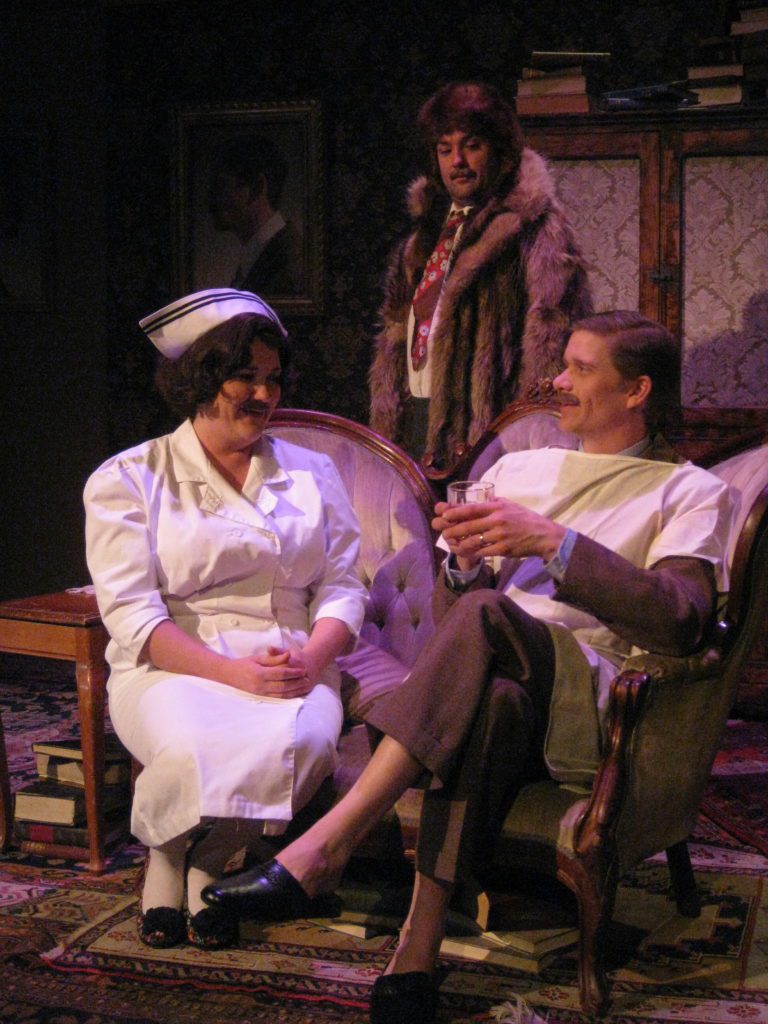
A man dressed entirely in furs observes a man seated on a love seat next to a female nurse. Everyone has the same mustache

North Denver Tribune- A Tale of Two Productions at Buntport and Paragon

Buntport Theater and Paragon Theatre have coordinated efforts this season to present two facets of a landmark American play, Eugene O’Neill’s Long Day’s Journey Into Night. Paragon is presenting a full production of this epic play in their new facility on South Santa Fe, and Buntport has created The World is Mine, an original world premiere that takes place in the mind of Eugene O’Neill as he struggles to come to terms with his life and family, and begins to write what would become his most famous work and receive a Pulitzer Prize. Both shows are good individually, but seeing them both adds a level of understanding that enhances both, giving “the full experience.” I saw the two productions on consecutive evenings, starting with The World is Mine at Buntport, which is the order I will describe them here.

The World is Mine follows Eugene O’Neill inside his own mind as the playwright recovers from an appendectomy and struggles with writer’s block. The other characters are people from O’Neill’s life (his wife; a nurse), but they are all (and they admit this) projections of O’Neill himself – a fact we can’t forget because they all have the same mustache. The script wanders from dialogue to explicit stage directions to surrealism to theatricality, with brief interactions with the real world delivered straight out at the back of the audience. As O’Neill remembers the events of the past, he begins to pull together the play, enlisting whoever he needs at the moment for characters, with snippets of dialogue from Long Day’s Journey interspersed with his internal mental conversations.

Erik Edborg anchors the show as O’Neill, and is excellent at “turning on a dime.” He jumps from thoughtful introversion to dialogue, and from clever comedy to serious pain to silliness adroitly. As his wife, Carlotta, Erin Rollman is melodramatic and clever, and her sing-song voice adds an extra level to the characterization. Hannah Duggan is naïve and genuine as Cathleen, the nurse, contrasting the cynical superficiality of the other characters. As the Swedish Emissary, Brian Colonna is funny, but gets serious and even brutal when he steps into Jamie, O’Neill’s older brother, in the memory sequences.

The set, lighting, and costumes, created as always by the Buntport ensemble, fit the show well. The set has surreal and idiosyncratic elements that support the story, including some very funny ways that drinks appear or are filled, carrying through the alcohol that pervades Long Day’s Journey.

Long Day’s Journey Into Night is the story of one day, a very difficult day, for the Tyrone family. There is hope initially – the mother has shaken a long-term addiction to morphine and in spite of the usual sibling and parent-child bickering, things seem to be on the right track. But as the day progresses, things get worse, the arguments get more vicious, blame is bandied about, and everything falls apart.

The cast is superb. Kathryn Gray is Mary, showing beautiful tenderness, but lashing out in anger unexpectedly. Her bald-face denial of “I don’t know what you are talking about” is chilling. Her treatment of husband James, played by Jim Hunt, drives our sympathy – Hunt is loving and initially hopeful, but when things crumble, we feel his pain deeply. Michael Stricker is brother Jamie, hardened and cynical, but caring deep down. Brandon Kruhm is Edmund, the character O’Neill based on himself. Kruhm’s Edmund is sympathetic, truly caring about his family, and earnestly hoping that things will work out. Holly Ann Peterson rounds things out as Cathleen, the mostly comic maid, with an authentic thick Irish brogue.

David Lafont’s set design is clean and works well in-the-round, extending upward to define the space on stage. Brynn Starr Coplan’s costumes fit the period well, and carry through the palette of the scenery nicely. Unfortunately, Jen Orf’s lighting design caused some real problems – the lights glaring directly in my face for most of the show made even looking at the actors difficult at times. Perhaps it was because of unfamiliarity with the new space, or due to the challenges of a low ceiling and theatre in-the-round, but something went very wrong. Orf is an excellent and experienced designer – I just don’t understand what happened here.

Taken individually, these shows are both engaging and well-performed. After seeing The World is Mine, Long Day’s Journey Into Night seemed somehow more clear to me than it would otherwise have been. While some of what the Buntport ensemble included was based on fact, some was included to make a better story (just as O’Neill undoubtedly did in his play), but all increased the depth of my understanding. Long Day’s Journey is a very sad story, but a very real story about complex family relationships and the toll that secrets can take. As Mary puts it, “None of us can help what life has made of us.” It is not hopeful, but knowing that in the character of Edmund, O’Neill is representing himself added insights and gave the play some hope. These two plays are very different, but are tied together – both are worth seeing, even if you can only see one. But if you take advantage of the opportunity to see both, you will be rewarded with a unique perspective on one of this country’s most important playwrights

-Craig Williamson, February 16, 2010, North Denver Tribune

In the foreground a man dressed entirely in furs and wearing a tie holds a glass of whiskey. Behind him, a man dressed in a suit covered by a hospital gown smiles. The two men have the same mustache.

Littleton Independent- Imaginative performances highlight ‘World’

The set is “inside the head of playwright Eugene O’Neill,” according the Buntport Theater Company’s program.

What the audience sees is the coastal Connecticut cottage parlor of his childhood summer home, where he is aware of the fog and the sea – and where his masterpiece, “Long Day’s Journey into Night,” an autobiographical account of a day in the life of his alcoholic , drug-addled family takes place.

Erik Edborg, as O’Neill, enters, ducking through a too-short doorway and fiddles with a whole bunch of light switches, and other peculiar features of the room.

The playwright is wearing a hospital gown over a business suit and we learn that he is recovering from an appendectomy.

He is planning his set, moving things around in his mind. The audience notices more and more skewed details. Does he want this lamp or that one on? There are lots of lamps he turns on and off. There are two chandeliers, two desks and two phones plus a good many chairs and a Victorian sofa. Glasses are piled on top of every surface. And in a whimsical bit of staging (a Buntport strong point), the boozy O’Neills can fill those glasses from surprising sources!

The room has flowered wallpaper, a clutter of books everywhere. (O’Neill’s detailed stage directions in the actual script even specify what title are on the shelves).

Buntport’s ensemble is known for its clever spins on great literature and “The World is Mine” is probably the most successful and fine-tuned yet.

Enter Carlotta Monterey O’Neill (the inventive Erin Rollman) in an elegant dressing gown and stylish hat. Her costumes and hats change through the evening, but she maintains a moustache that looks just like her husband’s, as do nurse Cathleen (Hannah Duggan) and a fur coat-attSwedish emissary, Erland (Brian Colonna), who arrives to deliver O’Neill’s Nobel Prize since he is too ill to go to Sweden to accept it. O’Neill actually did have tuberculosis.

The Swede does a lightening fast switch to O’Neill’s brother Jamie and delivers a nasty rant that foretells the mood of the play to come.

Back to images in the playwright’s head – he imagine them all with a moustache, looking like himself. The brilliant, but self-centered genius also has two portraits of himself – profiles facing each other and can’t decide which is best.

Carlotta opens a closet door and pulls out an old theater costume-one worn by O’Neill’s actor father in the “Three Musketeers.” The costume reproduces itself each time it’s thrown away – the old man’s spirit is ever with his son.

Hence the play’s title: in the Dumas play, Edmond Dantes throws out his arms and yells “The world is mine.” O’Neill observes sadly that his father said that line 6,000 times and never believed it.

A picture of O’Neill’s daughter Oona appears on TV panels inside a cabinet door and he is remorseful about how she ran away and married a clown (Charlie Chaplin) and was estranged from her father. Nurse Cathleen reminds him of Oona, he says. He tells her about his difficulty in starting to write the play in his head. “I’m trying to figure out why I’m going to write this play.” Occasionally someone says something and he grabs his pen and notebook. Lines in the play are his words.

Meanwhile, Carlotta, who is hospitalized for her nerves, is focused on decorating the house they are going to build: “maybe Spanish, with a Chinese flair!” It clearly won’t have and wicker, which is in the cottage and she detests it! “Why can’t you think about me for a change,” she whines, while sipping steadily on her drink of the moment, which may have been drawn from the chandelier. O’Neill lovingly promises he will give her the script when it’s completed.

These skilled playwright/actors deliver a performance that is both entertaining and imaginative. Don’t miss it!

-Sonya Ellingboe, February 13, 2010, Littleton Independent

Denver Post- Fanciful trip inside O’Neill’s head

Just imagine if Buntport Theater had Eugene O’Neill’s ego.

Why, the world would be theirs.

If “The 39 Steps” can play for two years on Broadway, think how warmly a national audience might embrace the smart, quirky little inventions Buntport turns out four times a year in their little warehouse on Lipan Street.

Lucky for us their ambitions remain so humble.

Their latest, “The World Is Mine,” plays out inside the mind of America’s greatest, most damaged dramatist as he recovers in a hospital from an appendectomy. O’Neill is just getting started on “Long Day’s Journey Into Night,” the play he wrote to be his epitaph: a bleak, boozy look back at his messed-up childhood.

Sickness underlines “The World Is Mine,” mostly of the self-inflicted or indulged variety. But it was in actuality sickness – specifically recovery from a nasty bout with tuberculosis – that turned a young, derelict O’Neill to writing in the first place. That, in essence, makes “The World Is Mine” as much about creation as disease. Even if writing can be equally consumptive.

We open in O’Neill’s living room in Connecticut – as the patient remembers it. A furrowed Erik Edborg, as O’Neill, enters with a hospital gown covering a business suit. He’s setting the scene for “Long Day’s Journey,” and he hasn’t quite settled on the floor plan. So there are duplicate set pieces. A lamp might yet go here – or there – so, for now, they exist in both places. Lights turn on and off with a flick of his finger.

He’s narrowing things down.

O’Neill was consumed with the complex psychology of his characters, and “The World Is Mine” turns out to be a fanciful and elucidating examination of his own inner workings. He doesn’t just simply conjure the ghosts from his masterpiece – his nomadic actor father or morphine-addicted mother. He does what all whiskey-soaked brains do: He intermingles past and present.

So a nurse reminds him of the daughter he never saw again after she ran off with Charlie Chaplin at age 18, but still lives perpetually in his subconscious. A Swedish emissary who has come to deliver O’Neill’s Nobel Prize reminds him of the disintegrating brother who came to viciously resent his sibling’s success.

These visitors at times become their doppelgangers, most devastatingly when the affable Swede (Brian Colonna) suddenly delivers a scathing attack on O’Neill that doesn’t so much pierce the writer but send him scrambling for a pen.

In one of many delightful twists, O’Neill is both inspired and tormented by his coquettish third wife, Carlotta (a wonderful Erin Rollman), the provocateur and collaborator who shares both his mind and hospital room (she’s been admitted for nerves).

Buntport, well-known for its whimsical staging conceits (Let’s just say they give new meaning here to an “Irish coffee table”), most cleverly illustrates O’Neill’s pathological self-absorption. The women wear mustaches that mirror his own. Not only does O’Neill’s adult portrait now hang on the wall of his childhood home, there are two facing versions of it (Who can decide on one’s best side?). All these characters are merely variations of O’Neill himself.

Of Buntport’s more than two dozen original productions, “The World Is Mine” is easily among its best-acted and written. O’Neill’s life was so absurdly laced with tragedy, including suicides by two erudite sons, it would be easy to almost lampoon it.

Instead, the play is melancholy and earnest down to its wonderful title. It’s a line Edmond Dantes yells in “The Count of Monte Cristo” – a role that defined and haunted O’Neill’s actor father. He said the line 6,000 times and didn’t once mean it, O’Neill says. He considered his father a condemned man, “doomed to live life as the same person.” Just like the rest of us.

O’Neill single-handedly changed how we think about theater. And Buntport, collectively, is doing the same thing.

“The World Is Mine” is a prescient introduction to “Long Day’s Journey,” which the Paragon Theatre will also be presenting, opening Feb. 13. Together, they will make for terrific companion pieces

-John Moore, February 4, 2010, Denver Post

A mustached woman, wearing a red velvet gown, reclines on a turn of the century love seat. Her bare feet dangle above a piano bench set to the right of the love seat. The woman holds a glass of whiskey and puckers her lips. Books are stacked in separate piles on the floor.

Westword- Buntport channels its inner O’Neill in The World Is Mine

The members of the Buntport Theater troupe have always been interested in the creative process. They’ve imagined Alexandre Dumas creating his three musketeers after reading a novel borrowed from the library; suggested what would happen if Ovid, having burned the manuscript of Metamorphoses in a fit of pique, came face to face with one of his creations on the road, the woman-turned-cow Io; and woven the strands of Franz Kafka’s own history into the plot of his best-known work, Metamorphosis.

In The World Is Mine, Buntport gives us Eugene O’Neill in the hospital recovering from an appendectomy and thinking about beginning work on Long Day’s Journey Into Night, the play that dramatized the life of the author’s booze-drug-and-self-pity-soaked family and that he famously said was written in tears and blood. (In an interesting piece of artistic cross-fertilization, Paragon Theatre will open Long Day’s Journey Into Night next week.) The Buntporters treat this somber material with their usual fizz and humor without in any way trivializing it. They tackle O’Neill’s self-absorption head on: The set represents the inside of his mind, and the three other characters – all mustachioed like O’Neill himself – exist only as he sees them, or pretty much as he sees them; every now and then, one or another hints at an alternative self the playwright hasn’t noticed. The action takes place in the living room O’Neill envisions for his play; it has a sofa, piles of books, patterned wallpaper, a desk – or are there two desks? It takes a second to realize that much about this realistic-seeming set is out of kilter: in addition to the two desks, there are two chandeliers and two telephones; there are also a plethora of light switches and an oddly too-low entrance space. The kind of tape theaters use to mark the placement of props and furniture outlines almost everything. A profile of Erik Edborg, who plays O’Neill, is mounted on the back wall, facing left; opposite it, the same portrait has been flopped so it’s facing right. Or rather, facing itself. We half notice that there are glasses everywhere. And once the action begins, we find that the entire place bleeds alcohol as characters pour drinks from almost every available object, from a chandelier to a telephone.

One of the playwright’s sons has committed suicide; he is estranged from his surviving children, a drifter son and his daughter, Oona, who, to his fury and chagrin, has married a clown: Charlie Chaplin. O’Neill is being taken care of by a nurse, Cathleen, who reminds him of Oona and whom he will transform into the Tyrones’ dim, flirtatious Irish maid in Long Day’s Journey Into Night – hence the absurdly high heels she wears along with her mustache. His wife, Carlotta, is on the scene, too. She talks about creating a space where he can write (as the real Carlotta did), but mostly she babbles about the Chinese furnishings she plans for the house they intend to build and parades around in a succession of elegant dresses and surprising hats. The final character is Erland, come from Sweden to give O’Neill the 1936 Nobel Prize for Literature, which he must present to the playwright in the hospital because he is too weak to travel. Erland sometimes morphs into Jamie, who represented O’Neill’s loved and hated older brother in Long Day’s Journey.

As always, Buntport manages to lighten ponderous material while finding in it unexpected depths. One trick the company uses brilliantly is to concretize the metaphorical; the booze-soaked room, for instance, tells us everything we need to know without the characters having to stagger and slur. Oona’s image appears unexpectedly on a screen; O’Neill finds there’s no way to get rid of the costume his actor father wore in The Count of Monte Cristo, which reappears every time it’s bundled out of sight. What better way to communicate the iron hold of the past? Then there are the twin portraits. They’re clearly a sign of O’Neill’s narcissism – he’s trying to figure out which profile is the better – but they also represent the artist confronting himself, the man who must write versus the man who’d do anything, including kill himself, to avoid the pain of writing.

The World Is Mine raises the central question about Eugene O’Neill’s artistry: the fact that his focus is so relentlessly, claustrophobically inward. In their humorous and unpretentious way, the Buntporters – actors Edborg, Erin Rollman (Carlotta), Hannah Duggan (Cathleen) and Brian Colonna (Erland), along with co-creators SamAntha Schmitz and Evan Weissman – suggest that when feelings run deep enough and genius is sufficiently capacious, personal obsession becomes universal and transforms into art.

-Juliet Wittman, February 03, 2010, Westword

A man wearing a half mask sits on top of a washing machine. A man wearing suspenders stands next to him. A dirt road is projected on the floor around them. A wall made of many glass jars can barely be seen in the dark behind them.

Westword- Buntport’s production of Indiana, Indiana is pure poetry.

Every now and then, the Buntport troupe decides to remind audiences that they’re not just clever, funny, creative and entertaining; they’re also artists. And that’s just what they do with Indiana, Indiana, a production based on a novel by Laird Hunt of the University of Denver. The story isn’t complicated. An old man, Noah, who’s always been a little touched, remembers his life and obsesses over his brief, lost marriage to Opal. Scenes from his life – his childhood, his short stint as a mailman, his interactions with his parents – are acted out in a surreal way; periodically, someone called Max reads him letters from Opal, most of them communicating a kind of febrile ecstasy. It turns out that Opal, too, had mental problems, and was committed to a mental institution by (I think) Noah’s father, Virgil. Virgil may also have ended Noah’s visitation rights, so there’s longstanding and unresolved pain between father and son.

The piece is imagistic and poetic rather than literal. With their usual deft and imaginative stagecraft, the Buntporters have filled the evening with fluidly surprising moments. One thing transforms into another, windows and doors appear where once there were none, furniture slides on and off the stage, and mood and meaning are created by the interplay of different media: music, human voices and bodies, still and moving images, concrete objects that shimmer with an undefinable significance. At one point, an actor begins playing the saw. No sooner has the creaky note sounded than it starts to rise and purify, and we realize we’re hearing the haunting sound of a woman’s voice. For weeks, Buntport’s Facebook page sported a request for Mason jars; filled with a variety of things that denote the thoughts and events of Noah’s life – corks, dried leaves, yarn, used tea bags, buttons, seed pods, sticks, bones – these homely objects become a shimmering wall that dominates the set.

The visual metaphors are so luminous and beautiful that I hate to admit that sometimes I don’t quite see why they’re there, or what they have to do with the theme or storyline – a storyline that isn’t, in itself, particularly riveting. Take the man playing the saw. This is a moment of pure visceral pleasure, and interesting thoughts follow about the melding of the mechanical and the human, the artist’s ability to make something ethereal out of something mundane – just as the company does with its canning jars. It’s all very lovely and touching in an abstract sort of way, but what does the saw man have to do with Noah? There’s another, equally inventive moment that works gloriously, however: the joining together of Noah and Opal, done with swaying lights in a way I won’t describe because you just have to see it for yourself.

As actors, the Buntporters have taken a risk with Indiana, Indiana. They’ve set aside their usual hilarious antics and are playing it straight and vulnerable – an approach that reveals just how accomplished they’ve become. Taking on characters that range from the town sheriff to the genial Max (Noah’s son, perhaps?) to a coughing minister (Is he sick? Why doesn’t the script tell us?), Brian Colonna works with quiet assurance and is as good as I’ve ever seen him. Hannah Duggan is nurturing as Noah’s mother and purely touching as Opal. Playing Noah, Evan Weissman dons a mask early on, a weird, puff-cheeked thing, above which the dark line of his hair looks like a cap. He takes it off only once, when Noah and Opal come together, but manages to communicate all of Noah’s passions and regrets from behind this ambiguous mask. And while I never quite figured out what had caused the rift between Noah and his father, Erik Edborg’s profound sorrow as he walked slowly across the stage stilled all my questioning.

Buntport’s low-tech, high-creativity approach has had us seething with laughter often enough. This time, it’s the force behind an evening of quietly hypnotic beauty.

-Juliet Wittman, September 16, 2009, Westword