Buntport Theater

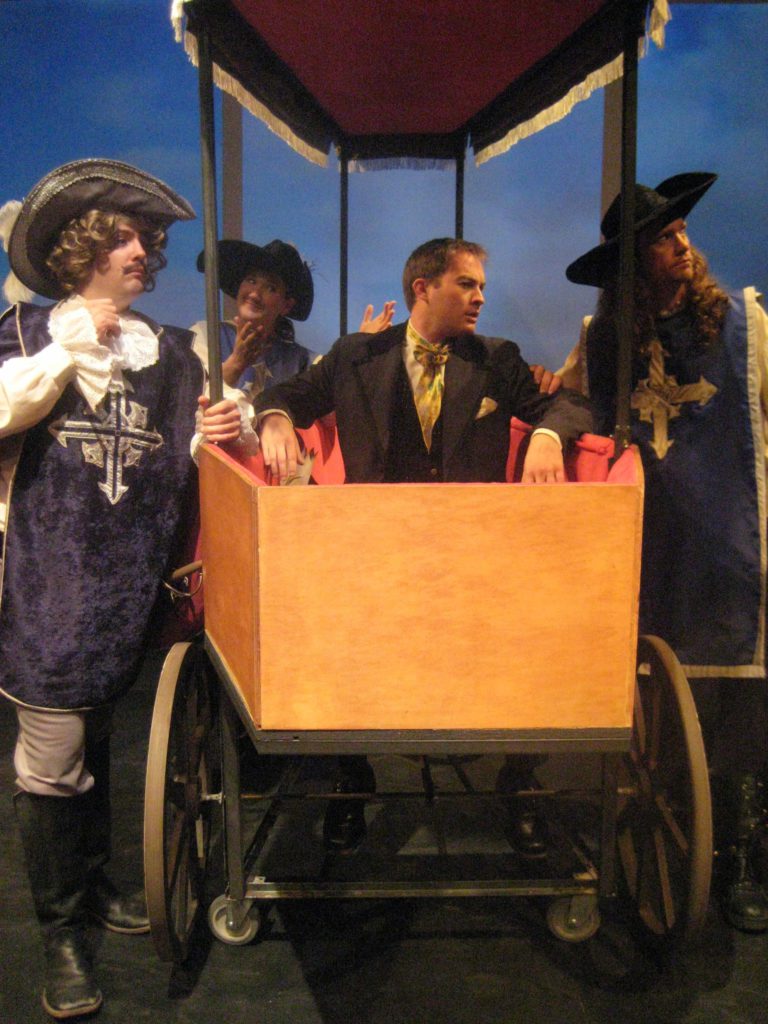
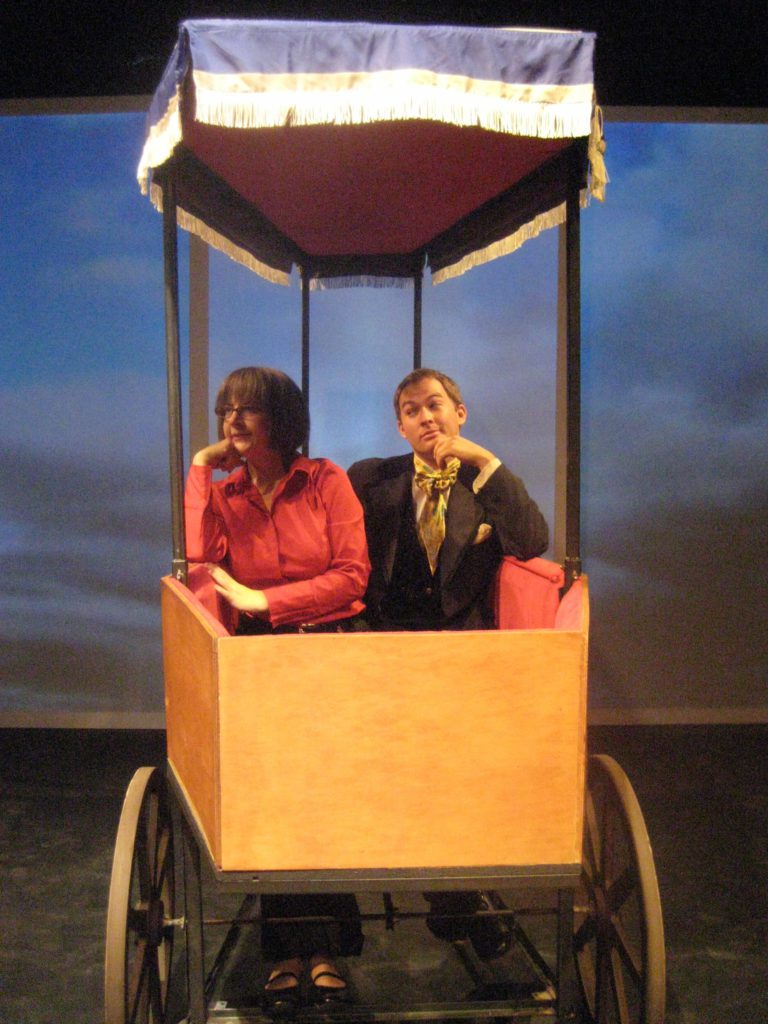
A modern woman and a man from the 1800s sit in a carriage shaped like a coffin. Behind them, an image of the sky is projected on a giant screen.

Parker Chronicle- One for all and all for one

Buntport Theater Company is a smart, funny sextet of young theater folks, Colorado College graduates, who write all their own material, dream up ingenious staging and sets and handle all the technical aspects of a production: sound, lights, special effects, costumes. With tongue firmly in cheek, the group takes on the classics, short stories, film genre and creating productions unlike any others in Denver’s rich selection of theater listings.

“Musketeer” promises, in Buntport Theater Company’s words, “to mix true life events and Alexander Dumas’ classic novel ‘The Three Musketeers’ with a lot of imagination and improbable nonsense.” Indeed, it does.

The premise, according to Buntport’s program: Dumas, despite claiming otherwise, based “Three Musketeers” on a book called “The Memoirs of Mister d’Artagnan.” He checked the book out from the Marseilles Public Library. He kept the book. In 2002, Dumas’ body was exhumed from a grave site in his home town to be moved to the Pantheon in Paris, a more suitable burial site for an illustrious French writer. The Castellane Branch of the Marseilles Public Library is in an underground metro station.

These items provide a jumping off point for a flight of fancy, the writers say. “And if we were you, we wouldn’t let little things like ‘how things really are’ get in the way.”

Lights go up on a silhouette of a librarian searching her shelves for a book. It’s Charlotte (Erin Rollman) who realizes that Dumas never returned the above book and, since she knows his body is being moved to Paris, decides to go ask him for it.

Abandon any preconceived ideas about the tale and join her in her journey as, throwing in a spoof of the detective genre, she meets a trio of characters attired in 19th century clothing appropriate for swashbucklers, and eventually the late, lamented writer himself. “I’ll just knock on the coffin.”

These three inept Musketeers plan to push the casket on wheels to Paris. We meet sword-swishing Porthois (Brian Colonna), who owns his fancy costume and is a 19th century re-enactor when he can get a gig. In less grand, on-backwards, government-provided costume is, lanky, bewigged Edgard/Athos (Erik Edborg). Hannah Duggan, as Aramis, is the third member of this goofy crew, who all have big hats, swords and boots.

Evan Weissman plays the writer who created “Three Musketeers,” and is a bit annoyed at being disturbed from his rest. As the casket becomes a carriage, he cheers up and invites her to ride with him. He does produce the somewhat musty-looking volume in question for the persistent Charlotte.

A real strength of Buntport, in addition to dreaming up the story in the first place, is the ingenious way they present a play with multiuse props – a casket morphs into a carriage, sound effects, and in this case, projections and shadowy figures behind a floor-to-ceiling screen on a low budget.

-Sonya Ellingboe, September 2, 2008, Parker Chronicle

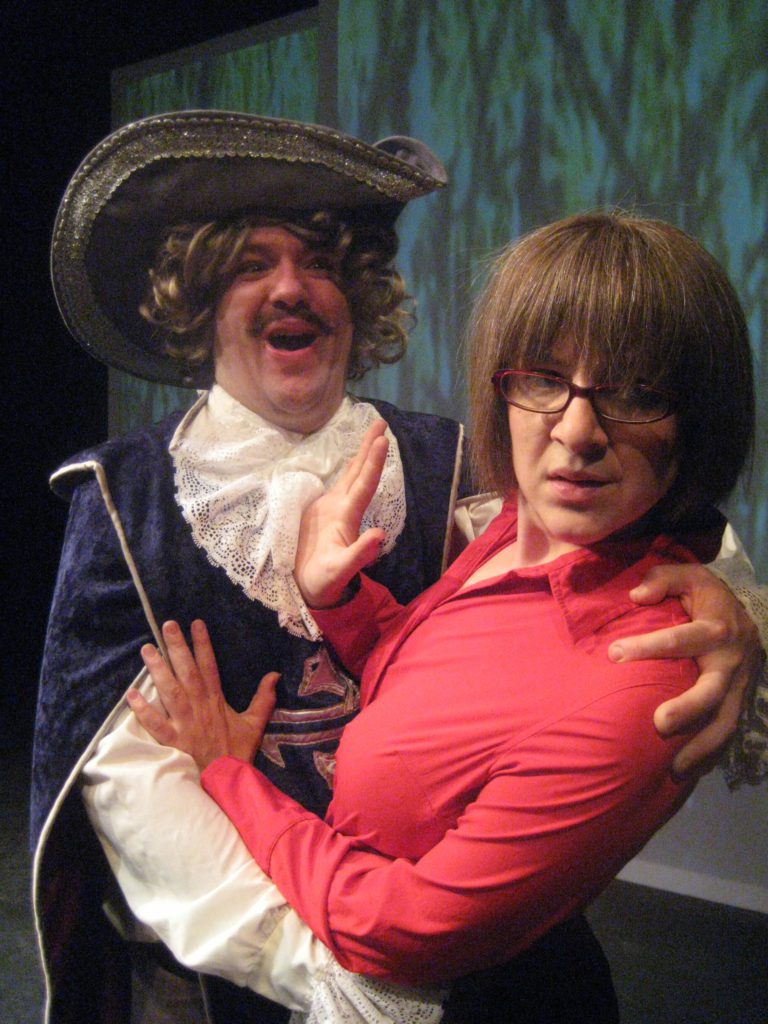
A man dressed as a musketeer happily embraces a woman in a red shirt. She pushes him away.

North Denver Tribune- Buntport’s Musketeer creative, funny, and almost deep

Many theatre companies occasionally develop spoofs of classic theatre and come up with very funny productions. Buntport Theater never makes it that easy on themselves. All their productions are original creations, and to call them take-offs or spoofs sells them short. Musketeer, the latest Buntport creation, is (of course) very funny, includes some clever plot twists and time warping devices, and has, dare I say it, an almost deep message about art and creativity.

A word about Buntport: six people collaboratively develop all aspects of each show, including writing, directing, designing, and acting. While my reviews normally mention each role and discuss that person’s contribution, that makes no sense with Buntport. Suffice to say, when I talk about each component of the production, credit goes to all six œ Erin Rollman, Hannah Duggan, Erik Edborg, Brian Colonna, Evan Weissman, and SamAnTha Schmitz.

Musketeer starts with the (presumably) factual exhumation in 2002 of the body of Alexander Dumas, author of The Three Musketeers, in order to be reburied in the Pantheon in Paris. The twist comes from the accusation that Dumas based his most famous story on an obscure book entitled The Memoirs of Mister D’Artagnan, which he allegedly borrowed from the Marseilles Public Library and never returned. In Buntport’s story, a present-day librarian hears that Dumas’ body is being moved, and decides to get the long overdue book back (and collect a huge fine). The challenge of getting a book from a man dead for 132 years doesn’t seem to daunt her in any way, and the fun begins. The story bounces back and forth between the past and the present, and between reality and imagination, drawing the audience along at every step.

The staging of Musketeer is clever and effective. The actors use the small space and interact with the few scenic elements well. I particularly like the staging of Charlotte and Dumas jammed into the casket together, part live and part projected onto a screen. The pacing is quick and the comic timing strong.

The acting ensemble is well balanced, with all actors contributing. Erin Rollman is Charlotte, the librarian, with many wonderful small character bits that really establish her personality clearly. Opposite her and in contrast is Evan Weissman as the writer Dumas. Charlotte and Dumas represent the two extremes of rationality and expression, and they battle delightfully throughout the show. As the three musketeers, both present and past, real and imagined, Hannah Duggan, Erik Edborg, and Brian Colonna all capture the essence of their characters’ personalities. In the present, they show flashes of their parallel selves from the past, giving the intertwined stories a strong connection.

The set is creative and effective. The two main elements are a set of three rear projection screens, and a casket on wheels that transforms into a carriage. I’ve seen projections used in live theatre every once in a while, but rarely are they integrated into the action of the play as completely as they are in Musketeer. The projections are sometimes just background, sometimes informational, but occasionally move into the foreground and become an integral part of the action. The transformation of the casket into a carriage and back again helps change the setting from real to imaginary each time it happens. The costumes also help reinforce the parallels between the two worlds, functioning both as anachronistic costumes in the present, and as appropriate attire in the past. The lighting is unremarkable but mostly all right. Occasionally it is a bit difficult to see into the carriage, but that does not detract much from the scene.

The message of Musketeer is that there is more to life than simple facts. Charlotte starts as a completely rational and sensible person, focused on facts. But Dumas convinces her of “the importance of disregarding the facts,” and that there is so much more œ art is what adds meaning and substance to life. At the risk of getting too deep, Buntport is really presenting the case for their very existence. Creativity and artistic expression can enhance reality and move it beyond the mundane. Perhaps at its best, art can confound and transcend reality. Okay, so that is probably way too deep. Let’s go with this: Musketeer is hilarious, clever, intriguing, and well worth seeing.

-Craig Williamson, September 1, 2008 , North Denver Tribune

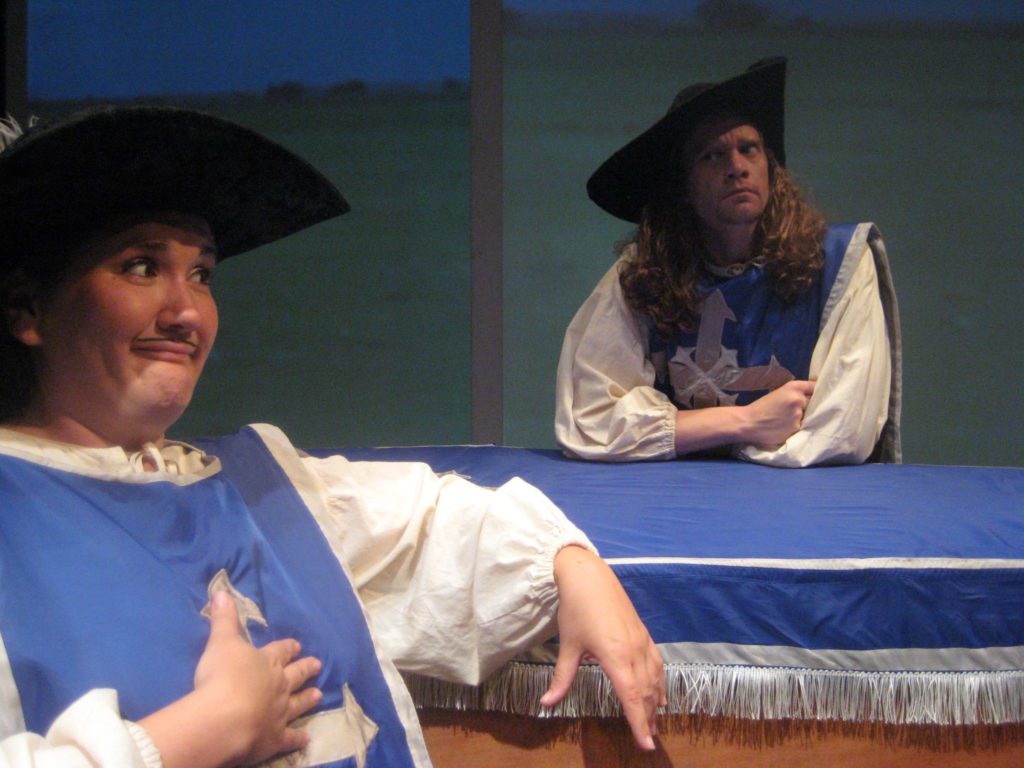
Two people dressed as musketeers lean on a coffin draped in a blue and white cloth. The musketeer in the foreground has a mustache drawn on her face.

Colorado BackStage- Musketeer

A library book? A library book never returned? Who would have thought such a small premise could turn upside down and sideways keeping the majority of a full house Opening Night at Buntport doubled over in laughter?

A brilliant premise, based on historical fact, knocking down walls of time and space, flying on fantasized wings definitely excites the gears in the Buntport people.

Erin Rollman transforms herself into an uptight, over achieving, conscientious librarian, Charlotte, with a staccato twitch. Taking her librarian duty seriously at the Marseilles Public Library, Charlotte answers the phone with sharp, clipped words while making absolutely certain records remain up to date.

Oh, oh! Major problem. Charlotte discovers a library book over due. To her horror, the book is 187 years and 22 days late. Alexandre Dumas checked out The Memoirs of Mister d’Artagnan June 7, 1844, and never returned it. Something must be done. Dumas based his famous Three Musketeer personalities on characterizations detailed in the missing book. He never got around to returning it. Why should 187 years and 22 days hinder Charlotte from living up to her efficient library training? Fantasies know no boundaries.

Charlotte just happened to read in a local paper, Dumas’ body was being exhumed for the second time to be moved to the Pantheon in Paris.

Of course, she was going to get this book back. Time and space mean nothing when it comes to the imagination.

Buntport set the comedic world a blaze with its collaborative spirit in writing, directing, set design, and costuming. The ingenious set for Musketeer allows the fantasy defying time and space to move easily however, wherever it wants to go with ease. Interestingly enough, there is never any question where the characters are in the clever process.

Hannah Duggan plays Simone who works for her local Chamber of Commerce who also has been chosen to play Aramis. A girl as Aramis? That’s what the other two Musketeers want to know. Duggan plays Simone and Aramis with strong understanding and knowledge, and proves her worth as Simone and Aramis.

Erik Edborg takes on Edgard, an actor chosen to play Athos. Edborg happily and funnily plays Edgard who funnily plays Athos. Brian Colonna takes on Gilbert, also an actor, chosen to play Porthois. While taking his double role seriously, he does so on a merry gallop in carefree abandon.

The three Musketeers have been chosen to walk the wagon carrying Dumas’s coffin to Paris. What a sight for sore eyes this must have been to people living in 2002. In a fantasy nothing appears to be unrealistic. Of course, Charlotte finds the wagon. On her own, she creates an ingenious opportunity be alone with the coffin. By hook or by crook she will get her hands on that library book. There’s only one person to ask, and that’s Dumas himself. With no one is sight she crawls into the coffin. Evan Weissman covers himself in the persona of Dumas creating some very funny scenes.

Buntport adopted the use of video to expand the set to move far beyond the small stage. It works wondrously, especially reflecting scenes inside the small coffin with Charlotte and Dumas in an exclusively tight conversation. Sword fights dance with hilarious Musketeer bouncing moves keeping eyes alert and wide open.

Musketeer should not be missed under any circumstances for its comedic bent, its creativity, and its delicious quality of acting, its video, and its humored laughability. If I had the power, I would insist every creative writing teacher and professor in the Denver Metropolitan arena schedule time for his or her classes to attend a performance keyed to ignite imagination into a flight of fantasy.

An over due library book? Who else but Buntport would have zeroed in on such a tiny thought expanding it to a delectable, delicious, fun-filled production? Your sense of humor calls. Can you hear it? Respond now before the sold out sign flashes into eyesight.

-Holly Bartges, August 21, 2008 , Colorado BackStage

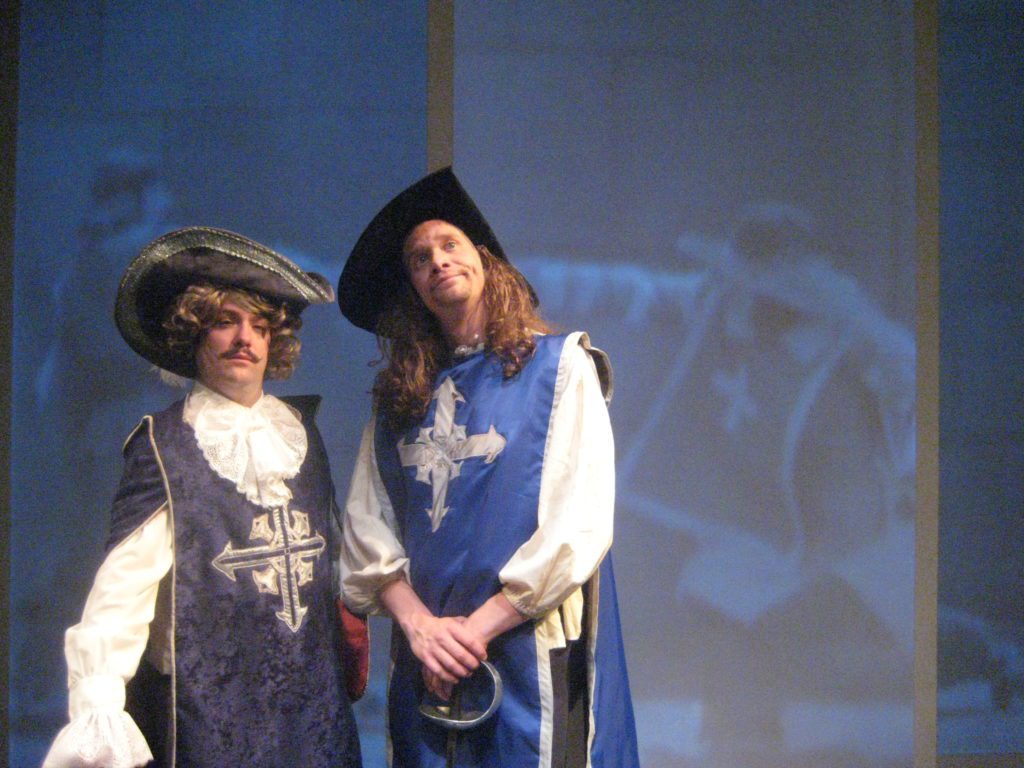
Two men dressed as musketeers pose in front of a giant screen that has video of musketeers fighting projected onto it.

Daily Camera- Musketeer

DENVER — Put six talented, educated people in a room to brainstorm a play, and eventually they may get to thinking about the book 19th-century writer Alexandre Dumas checked out of the library but failed to return.

Then, within the space of six weeks, they come up with a full-length production: “Musketeer,” which opens Buntport Theater’s eighth season.

The six-person Denver theater ensemble is known for its original, quirky and intelligent plays. Truly, the company gets an “A” for inventiveness and attempts at highbrow humor. For six people to write, direct, perform in and stage a show like this in six weeks is impressive enough that even if every bit doesn’t quite work, you’re willing to forgive. In the case of “Musketeer,” some exchanges between characters are mundane and too long, and a running gag or catchphrase may become repetitive. One wonders what the result would have been if the writers/actors had had more time to tighten and hone the material.

The show’s premise is simple enough. Dumas based some of his popular book “The Three Musketeers” on “Les Memoires de M. d’Artagnan,” by Sandraz de Courtils. According to records kept by the Marseille library, Dumas checked out that book in the 1800s and never returned it. In 2002, an avenging librarian named Charlotte (Erin Rollman) discovers this discrepancy and decides she wants the book back — and she’ll stop at nothing to get it.

The year 2002 is significant because that’s when then-French president Jacques Chirac had Dumas’ body exhumed from his hometown of Villers-Cotterets and moved to the Pantheon in Paris, the resting place of the nation’s heroes. This sets the stage for our three contemporaries, Simone (Hannah Duggan), Edgard (Erik Edborg) and Gilbert (Brian Colonna), who, dressed in musketeer garb, are charged with the task of walking Dumas’ casket along the countryside to Paris.

The librarian tracks them down and presents the laid-to-rest Dumas with a way-overdue fine. It all borders on the absurd, farcical and oftentimes nonsensical, as the action shifts between 2002 and 1844 (the year “The Three Musketeers” was published), at which time our 21st-century librarian meets the same actors, this time as the fictional musketeers Aramis (Duggan), Athos (Edborg) and Porthos (Colonna). Dumas is played by Evan Weissman. Buntport regular SamAnTha Schmitz is offstage for this production.

To say the set is spare is an overstatement: Its centerpiece is a casket on wheels. But we follow the story by the ingenious use of scrim — a flat, translucent panel onto which both scenery and narration are projected. Suddenly our heroes are in rural France, or at a cafe, and audience members never get mixed up about time sequences because they are reminded about which year it is on the screen.

The show is crafted around components of 19th-century “swashbuckling novels” — intrigue, adventure, romance, plots and subplots — combined with a generous dose of histrionics, duels and desperate situations. Even the act of moving the casket through the countryside is a nod to swashbucklers, whose adventures and enemy encounters most commonly occurred along the high roads.

You’d think a librarian would be more enamored of a legendary author from another century, but this one is dogged in her determination to retrieve the book, like a pit bull that won’t let go. One scene is even reminiscent of Glenn Close’s character in “Fatal Attraction.” Still, we don’t really know if the librarian has a deep, enduring love for the book or if she is just the most anal-retentive, rule-abiding librarian the world has ever known, literally willing to risk her neck for her principles. It’s a one-note concept mixed with swashbuckling swagger, banter and bravado, a peppering of literary high-jinks and a dash of slapstick.

Buntport Theater has a corner on intelligent, irreverent and experimental original pieces. Clearly, the actors have a lot of fun doing it, and the audience has a great deal of fun watching.

-Karen Goodwin , August 14, 2008 , Daily Camera

Two people dressed as musketeers lean on a coffin draped in a blue and white cloth. The musketeer in the foreground has a mustache drawn on her face.

Rocky Mountain News- Buntport’s ‘Musketeer’ a multifaceted work

The word multimedia is overused, basically meaningless and usually a letdown.

So let’s just call Buntport Theater’s new play, Musketeer, multifaceted. Or to streamline things: creative.

The ensemble company, which creates original work, adds to its usual Transformer sets and spot-on costumes a complement of expertly presented, thematically useful video.

As the company has frequently done, it started with a classic work, Alexandre Dumas’ The Three Musketeers. And if you know the title, you know enough to get by in this time-traveling oddity that takes a few facts and spins them with credulity-defying fiction.

The show opens to the tension-filled instrumentals of Marian the Librarian, and a video of rapid leafings through a book. We’re under a Metro station in Marseilles, where librarian Charlotte (a dogged Erin Rollman) has just discovered that a book has been overdue for 162 years. The book is The Memoirs of Mister d’Artagnan, from which Dumas is said to have cribbed the idea for The Three Musketeers. Charlotte doesn’t care about plagiarism or inspiration. She just doesn’t like scofflaws.

At the same time (and this indeed happened in 2002), the French government has exhumed Dumas’ body to reinter him in the Pantheon in Paris. Three pallbearers dressed as Musketeers accompany the casket through the rolling countryside (portrayed in perfectly timed rolling video): a cheerful tourism official (Hannah Duggan as Aramis, a slightly dour volunteer) and Charlotte’s ex-boyfriend as Athos (Erik Edborg) and an overly confident professional Porthos interpreter (amusingly self-aggrandizing Brian Colonna).

Getting the book back requires a bit of time travel on Charlotte’s part, and she ends up both in the present crawling into Dumas’ coffin (they have a tete-a-tete on screen and stage) and riding with him in the coffin-turned-carriage back in 1844. (Evan Weissman is dapper and flirtatious as the author.)

There are playful bits of comedy tucked in throughout the story, from Colonna routinely unable to replace sword in scabbard to the silent-movie style title cards that remind us “Time and space being of little consequence on an adventure such as this.” Three Stooges swordfighting entertains, and Weissman is given a bit that artfully explains an author’s motivation.

The end, though, fits loosely. It feels as though the company wasn’t quite sure how it wanted to wrap up the tale and was looking for an escape hatch. The gruesome last effect is well done, but doesn’t make much sense, even within the absurd world of the play.

-Lisa Bornstein, August 14, 2008, Rocky Mountain News

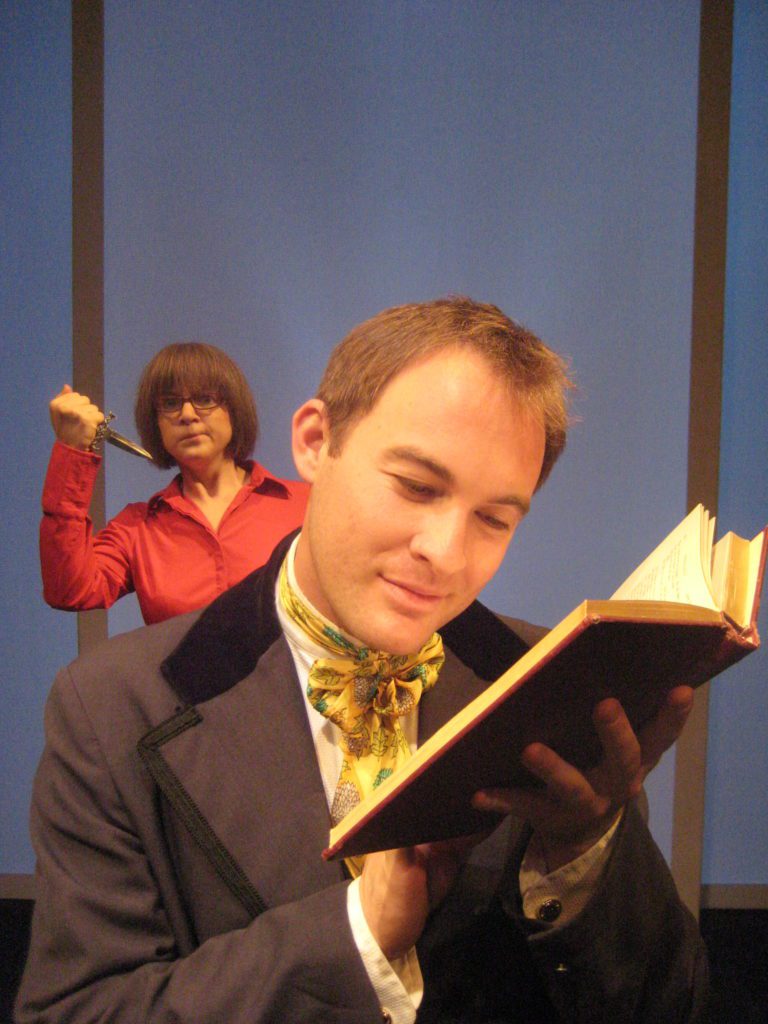
A man from the 1800s smiles while reading a book. Over his shoulder there is an annoyed woman in a red shirt and glasses holding a knife.

Westword- Buntport Theater Company skewers other swashbucklers with Musketeer

One of the things I love about Buntport is how the company comes at a subject from a genuinely original, sideways angle. Dramas based on Alexandre Dumas’s The Three Musketeers are usually romantic swashbucklers. But the Buntporters, who create their scripts through a collaborative process, were more intrigued by news stories from a few years back that told the kitschy yet oddly touching tale of Dumas’s body being exhumed and transported from the cemetery of his native village, Villers-Cotterêts, to Paris for burial at the Pantheon. The coffin was accompanied by actors dressed as Dumas’s characters and greeted in Paris by a white-robed woman on horseback representing Marianne, the spirit of France. President Jacques Chirac then read a solemn tribute to the author, who some critics considered too popular to be truly literary. And for this production, the troupe also fixed on a second fact, which they admit they found in Wikipedia: Dumas based his famous novel on a book he’d checked out of the Marseilles Public Library and never returned.

From this juxtaposition, we get a contemporary librarian named Charlotte (like all librarians who aren’t named Marian), who has noted the overdue book and is determined to get it back from Mr. Dumas — a feat that involves waylaying the coffin, confronting the three faux musketeers escorting it, and eventually engaging in a very lively duel of wits with the deceased author himself. In the course of all this, Charlotte is transported back in time to the carriage ride during which Dumas first read his library book, pondered its shortcomings and began to conceive of his own deathless characters. These scenes, in which the author transmutes tendentious dross into fictive gold while arguing with Charlotte about the virtues of logic and order versus those of romance and invention, are among the most delightful of an altogether delightful evening.

As regulars know (the company is starting its eighth season), Buntport achieves its effects in large part with low-budget but highly ingenious staging. A large wooden box serves as both Dumas’s coffin and his carriage. Borrowing the technique from former college classmate Thaddeus Phillips, Buntport also makes brilliant use of video — and the borrowing is particularly appropriate, since Musketeer explores issues of originality and the debt all artists owe their peers and predecessors. Three large screens in the center of the playing area show us the shelves of Charlotte’s library; placid green scenery moving past Dumas’s carriage; Charlotte and Dumas squished together inside the coffin, arguing. Many of the onscreen images are very beautiful: tall, waving grasses, radiant skies. Through a trick of light and perspective, characters leave the playing area, cross behind the screens and seem to enter a magic zone, becoming elegant silhouettes.

There are terrific bits of dialogue as well, as when the three people walking the coffin to Paris discuss their lives and why they’ve taken on this job. Gilbert tells the others he plays Porthos for children’s birthday parties, where he duels with balloon animals. Simone wants to go to cooking school, and comes up with a wistful description of the process of making fish quenelles. (Dumas himself was a well-known gourmet.) And Edgard was once in love with Charlotte and isn’t yet over it.

All of the actors — Hannah Duggan, Erik Edborg, Brian Colonna, Erin Rollman and Evan Weissman — are versatile, funny and expressive. Weissman makes Dumas preternaturally good-natured and unflappable, while Rollman brings schoolmarmish precision to the role of Charlotte. And Andrew Horwitz’s music adds zing to the event.

Despite the production’s many strengths, the plot isn’t entirely satisfying. There’s a jolting contrivance toward the end. And although Charlotte’s onetime affair is intriguing, it never becomes a significant part of the story, and neither she nor Edgard changes or develops as a character. Still, Musketeer is enjoyably nutty and farcical, with duels erupting at the drop of a hat, slapstick humor and absurd running jokes. And there are serious ideas here as well: questions about the artistic process (one of Dumas’s own characters asks him to slow down and put more thought into the writing), as well as a growing understanding that poor Charlotte may be the guardian of these texts, but she can never understand the life throbbing inside them, a life that continues to enthrall readers more than a century after their creation. Watching this daring, imaginative work, we’re reminded that the process of transmutation from fact to fiction and fiction to art is one that the Buntporters explore every working day of their lives.

-Juliet Wittman, August 14, 2008, Westword

Closeup of two people dressed in 1940s garb scrunch their faces at the camera.

Rocky Mountain News- Buntport knows its gumshoe comedy

Buntport Theater has returned to its giddy but thoroughly committed roots with a remount of its 2004 comedy noir McGuinn & Murry.


Fun and games turn serious – that is to say, funny – when Joan Murry (Rollman) starts a mystery in motion by sending a suggestive letter to McGuinn’s house, where his wife reads it. Certain that he’s having an affair and will kill her, the wife, Budge, begins to plot with her own lover, Pauly.
Formerly played by Brian Colonna and Hannah Duggan, the show’s tough but underemployed gumshoes are played on this outing by Erik Edborg and Erin Rollman. Whiling their days away in an office where no dame ever knocks on the door, they entertain themselves by making up cases to solve.

The plot thickens as sundry characters get in on the action, all of them played by Edborg and Rollman. Edborg’s McGuinn lacks some of that Bogart panache but gets laughs with his lightweight alcoholism (he drinks whiskey through a straw), and Pauly is even funnier, an eyepatch-wearing Englishman with that country’s particular strain of nebulous sexuality.

Rollman calls up her particular affinity for this period, expressed in the James Thurber collection of Buntport’s show 2 in 1. Her hair has fine ’40s rolls, but it’s her speech and stance that so perfectly connote the era. Her Murry is a tough- talking dame, interested in nothing but getting the job done, while Budge is a high-pitched flit of a wife. Esther’s the lonely, guarded bartender, while the Fat Man is a gender-eliminating parody of a Mafia kingpin.

Joining them onstage is the sign of Buntport’s special magic, its dexterity with set design. A massive partner’s desk that serves the two detectives converts over the course of the play into a bar (front and back), a diorama for a car- chase scene and, most magically, a fully appointed apartment with bedroom, kitchen and clothesline. It’s like a magic show built into a comedy.

Giggles are sprinkled throughout the play, and they never abandon the central conceit. When you hear flimflam, doll and chickie coming from their mouths, you know the artists at Buntport have gotten it right again.

Grade: A-

-Lisa Bornstein, May 22, 2008, Rocky Mountain News

Closeup of two people dressed in 1940s garb scrunch their faces at the camera.

Colorado Daily- Duet for gumshoes • Buntport’s ‘Mcguinn & Murry’ A Tour De Farce

It’s not often that Denver’s Buntport Theater Company revives a production, so it had better be a good one, don’t you think?

Fortunately, “McGuinn and Murry” is. A noirish intellectual confection that features the performances of two of the company’s six creator-partners, the play is a zoom through the Buntportian analytical-parodical cosmos, serving as an excellent (and hilarious) introduction to the group’s work.

First produced four years ago, the subject of the piece is the detective story – its literary and cinematic cliches. Two slap-happy, underemployed sleuths, clad in 40’s fashion, contemplate an unringing phone. McGuinn (Erik Edborg) is a washed-up, boozy former boxer harboring a shameful secret; Murry (Erin Rollman) is the wisecracking dame who’s the brains of the outfit.

They’re driven to pose each other theoretical mysteries, to keep from getting rusty, as Murry puts it. Vigorous flights of fancy later, Murry decides to top McGuinn once and for all – by getting him to investigate himself for murder.

What follows is a fast-paced series of blackout scenes, propelled by a wry and intimate sense of how those creaky plots work. The shady encounter, the hard-bitten dialogue, the random gunplay’s all there. Like some demented commedia del arte performance, Edborg and Rollman inhabit tough-talking, two-fisted archetypes and race them clownishly through their paces.


The performers walk a tightrope of quick change and rapid switches of identity. Each plays 5 or 6 roles. Edborg dons an eye patch and vanishes into the character of a fussy English playboy named Kermit; Rollman becomes an old, fat gangster – instantly, almost by sheer force of will. It’s astonishing.
What propels the entertainment to a greater level is its insistence on constant transformation. Buntport is known for its incredibly inventive staging, and the set here consists entirely (seemingly) of two large office desks, bound together back-to-back on casters. As the actors end a scene, they remain – to revolve, rearrange and transform their office into McGuinn’s home, a bar, and other landscapes. (SamAnTha Schmitz, Hannah Duggan, Brain Colonna and Evan Weissman complete the ensemble, and everyone works together on all the aspects of each Buntport production.)

You never get an easy out with Buntport. There is a climax of sorts – miniature cars chase each other across a pasteboard city, details are cleared up – but there isn’t any emotional revelation at the finish, no heavily stressed moral. In “McGuinn & Murry,” the clockwork winds up, and then it winds itself down, stuttering to a halt.

Buntport has enlisted the local jazz combo The Hoagies to accompany the play on May 15 and 22, and perhaps other dates as the run continues through the end of May. In addition, they’ve scheduled Buntport Movie Nights with noir features on the next two Sundays – “The Big Sleep” on May 18, and “The Thin Man” on May 25. (Free ice cream, too!)

“McGuinn & Murry” is strong spring fare – fast, light and funny.

-Brad Weismann, May 12, 2008, Colorado Daily

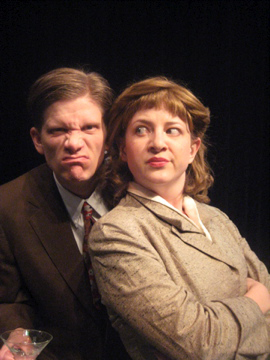
Close up on the faces of 1940’s detectives. The man looks silly with cigarette hanging out of his mouth, while the woman looks on disgusted.

North Denver Tribune- Buntport’s McGuinn and Murry Captures Film Noir Brilliantly

Buntport Theatre is truly unique. They do theatre differently than any other company I’ve ever known. Instead of starting with a script, they start with something-it could be a book, an idea, a loose concept, or, as with their latest offering, a genre. Then they transform that into a play. But they do not do things simply or superficially, tempting thought that might be. They truly reinterpret the original material, and in doing so, create something fresh and new. Their current production, McGuinn & Murry, has fun with the detective story genre, but it has its own interesting storyline, fully defined characters, and clever twists and turns. And all elements of the play are created collaboratively and in parallel, allowing for more integration of elements such as costume, scenery, acting, and direction.

McGuinn & Murry is both a spoof and a tribute to the 1940’s detective story and Film Noir genre. The story starts with our two detectives waiting for work, killing time by making up mysteries to solve. One of these mysteries takes on a life of its own, creating much more than a simple mind exercise. McGuinn is on the case-and the fact that he is his own prime suspect doesn’t slow him down one bit. Murry joins in, at first thinking it is just a mind exercise, until both get swept up into a real mystery. Maybe.

The language of this play is brilliant. I’ve always loved the 1940’s detective movies, and the dialogue perfectly captures the genre. Both actors deliver their lines with just the right amount of affectation-it sets everything up so well. Most impressive is that this dialogue was created entirely by the Buntport crew, though they undoubtedly watched a few classic films along the way.

With only two actors playing all the roles, much of the show depends on Erin Rollman and Erik Edborg. Both are more than up to the task. Edborg captures the hard-boiled detective McGuinn well, and contrasts that with the fastidious Pauly. Rollman is very good as Murry, and brilliant as she transforms herself first in to the ditzy Budge, then into a barkeep, and finally completely changing her voice, stature, and gender to become the Fat Man. The culmination of the story is hilarious and delightful to watch, as both actors bounce back and forth between multiple clearly-defined characters, never missing a beat.

The scenery becomes almost a character on its own. It is one of the most transformable sets I have ever seen anywhere. There are many clever devices used throughout the show. The lighting is competent, providing some variety and good illumination. The costumes were, like the set, an integral part of the transformation of the actors. Simple but clear changes helped differentiate the characters well.

McGuinn & Murry is a pleasure to watch. The pacing is excellent, the plot twists and the multiple characterizations are incredibly creative, the dialogue is very funny, and the acting is top-notch. If you would like a fun evening of creative and clever theatre, then go see McGuinn & Murry at Buntport. And if you choose one of the right performances, you get the bonus of live local music beforehand.

-Craig Williamson, May 2008, North Denver Tribune

Two people wearing clothes that look Shakespearean, but are made from jeans, are holding hands and skipping in front of a van painted like a forest. There is a plastic owl on the van's side mirror.

Westword- Buntport brushes up on the Bard

I’ve already seen Buntport Theater’s Titus Andronicus: the Musical twice. But with a few honorable exceptions, theater-going has been pretty dismal this fall, so I figure I’m entitled to a little fun.

As we prepare to file in, we see an eccentrically clad woman in the lobby. She’s commenting loudly on the decor, as well as all the newspaper reviews and award plaques pasted on the walls. She does this with such conviction that it’s a few moments before I realize that she’s Buntporter Hannah Duggan, and the play has essentially begun. The conceit is that a wandering troupe of five actors, led by P.S. McGoldstien, is presenting Shakespeare’s bloody and incoherent Titus Andronicus as a musical. There’s lots of plotting here. Saturninus wants to be king, but the people are leaning toward Titus, conqueror of the Goths, who’s just returned to town with four prisoners: Goth queen Tamora and her three sons, one of whom he rapidly executes. Tamora marries Saturninus, and proceeds to plot revenge on Titus — a revenge that includes having her two surviving sons kill Saturninus’s brother, Bassianus, and rape and mutilate Titus’s daughter Lavinia, Bassianus’s love. More plot twists include the framing of Titus’s two innocent boys for murder; Tamora’s affair with the villainous Aaron, which results in an illegitimate baby; Titus’s attempt to save his sons from execution by cutting off his own hand; and a feast during which Tamora is served pies containing the flesh of her own children — that is, the sons who destroyed poor Lavinia.

Buntport actually gets us through the entire plot, and it’s all quite coherent — or at least as coherent as the original. The troupe uses a board with caricatures and lightbulbs to tell us which of the five actors is playing which of the several dozen characters at any given moment. Evan Weissman gets to act essentially the same role every time: “Someone Who Will Probably Die.” There’s also a chalkboard on which the actors keep track of the death toll. The cast makes inventive use of objects and weird scraps of costume, and not all the characters are flesh and blood. One is simply a hat on a stick, and Tamora’s sons are played by a gasoline can and a car radio, complete with ashtray. The scenery consists of a van that is pushed from place to place in the echoing warehouse space by perspiring members of the cast, while McGoldstien exhorts the audience to encourage them. This van has been painted and outfitted to represent different locations: trees on one side for a forest; a table set with plates and other dining accoutrements that pops down when needed. A stuffed owl sometimes perches on the antenna; naked umbrella spokes poke through the roof and open to reveal little green leaves; during one scene, the windows are awash in fake blood. Though I’ve seen all this before, I’m still struck by the ingenuity of the approach, and the jokes are just as funny as ever. I find myself fixing on amusing little things like the blobs of fake blood on Titus’s bare knees, or the watch on the wrist of a severed hand.

In their approach to their roles, the actors have it both ways: They speak and act with complete conviction while also communicating their awareness of the absurdity of the entire situation. They take a few pokes at Shakespeare. “It’s in the text,” one of them says after a particularly ludicrous exchange. “I didn’t make it up.” Brian Colonna is a marvel of energy and good humor as he darts from place to place keeping the entire show together; Erik Edborg manages to be simultaneously puzzled and full of insane energy; Duggan’s silent response to her mutilation at the hands of her rapists — and her tongueless exasperation when her father exhorts her to speak and tell him who they are — is priceless. Erin Rollman brings all her usual assurance to her several roles, and Evan Weissman punctures the action with a series of howlingly funny mini-characterizations.

It’s the Buntporters’ playfulness that makes coming here so pleasurable. Their work contains in abundance what so few productions have these days: exuberance and life. In this, they remind me of Al Brooks’s days at the Changing Scene: Some of the things I saw in that small, colorful space still resonate in my mind, while I couldn’t forget others fast enough. But the unevenness didn’t matter, because the entire place vibrated with energy and surprise.

There are huge differences between Buntport and the old Scene, of course. Al’s take on theater was profoundly idealistic; he believed in the art form’s ability to subvert and in its powers of redemption. He took big risks but could also be downright silly, putting on the work of almost any playwright who requested it, encouraging his dancers to cavort in the mountains naked while he filmed them. I don’t think the Buntporters are motivated by any idea of bettering society or communicating the lofty significance of art. Instead, they keep saying that their goal is to provide cheap, unpretentious entertainment — and this they certainly do.

Sometimes I wish they were more ambitious, interested in deepening and developing their work, since they are quite capable of transcendence. Instead, they seem content to alternate times of wonder and discovery with evenings that are simply amusing, but always — no matter what they’re doing — making us marvel at the good-humored fluidity of their approach and the imagination that lies at the very heart of theater.

They’re saying that this is definitely, positively, absolutely the last Titus Andronicus. I suggest you get over there.

-Juliet Wittman, December 12, 2007, Westword