Buntport Theater

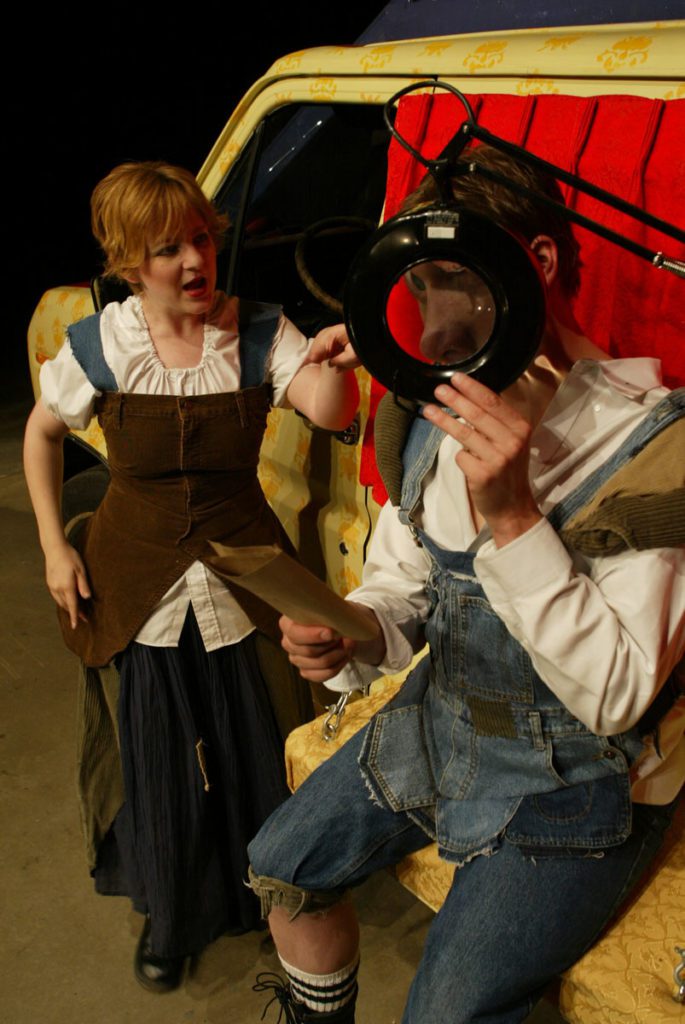
A man in makeshift Shakespearean clothes looks at a piece of paper through a large magnifying glass. In the glass, his nose and eye are large. A woman is pointing and talking to him.

Denver Post- Yuks and yucks with Bard’s gory “Titus”

Interpreting Shakespeare’s goriest play as a musical comedy is a stretch, even in an era renowned for idiosyncratic Shakespeare stagings in samurai mufti or deep space. Not only do these Colorado College alumni accomplish this admirably, but they manage so successfully that this marks the fourth time that their Buntport Theater company has mounted it.

“People seem to like it,” said Erin Rollman, who plays both Titus’ brother, Marcus, and his nemesis, the vengeful Goth queen Tamora.

Tickets to the current production began selling months ago, when rumors spread that “Titus Andronicus!” would be remounted for the final time. Earlier productions routinely sold out, disappointing latecomers who thought they could show up without reservations. Several book clubs already bought blocks of tickets as an alternative to hosting a holiday party.

“Nothing like baking children into pies for holiday cheer,” observed Brian Colonna, referring to a particularly grisly scene that rigorously interprets the adage about revenge being a dish best served cold.

Turning a Shakespeare tragedy – particularly such a confusing and multiply flawed script that scholars debate whether Shakespeare actually wrote “Titus Andronicus” – into a musical comedy was an enormous leap, particularly for a young company.

The actors who formed Buntport all graduated from Colorado College, an elite liberal arts college that breeds unorthodox intellectuals, between 1998 and 2001. The Buntport crew is so devoutly collaborative that Denver Post critic John Moore once posited that the company “writes, directs, designs, acts, builds and probably showers as one.”

Their hallmark lies in distilling an often familiar story to its utter essence whilst plundering and frolicking with its beloved details, rather like Monty Python’s anarchist grandchildren.

The decision to present “Titus Andronicus” as a musical comedy emerged during a brainstorming session. Someone suggested that it would be funny to have Lavinia – a character whose tongue is cut out early in the play – sing an aria upon being dismembered.

“We were amused and mortified, which pretty much describes the usual audience reaction,” Rollman said.

“But it IS funny. It’s hard not to laugh.”

So they allowed the aria – a Britney Spears parody as vicious as it is visual – to set the show’s tone.

Since 2002, when they debuted their version of what they delightedly call “Shakespeare’s bloodiest play,” Buntport similarly dissected “Hamlet,” “Moby-Dick” “Macbeth” (as “Macblank,” referring to the theatrical superstition that forbids naming the play offstage), and “The Odyssey: A Walking Tour.”

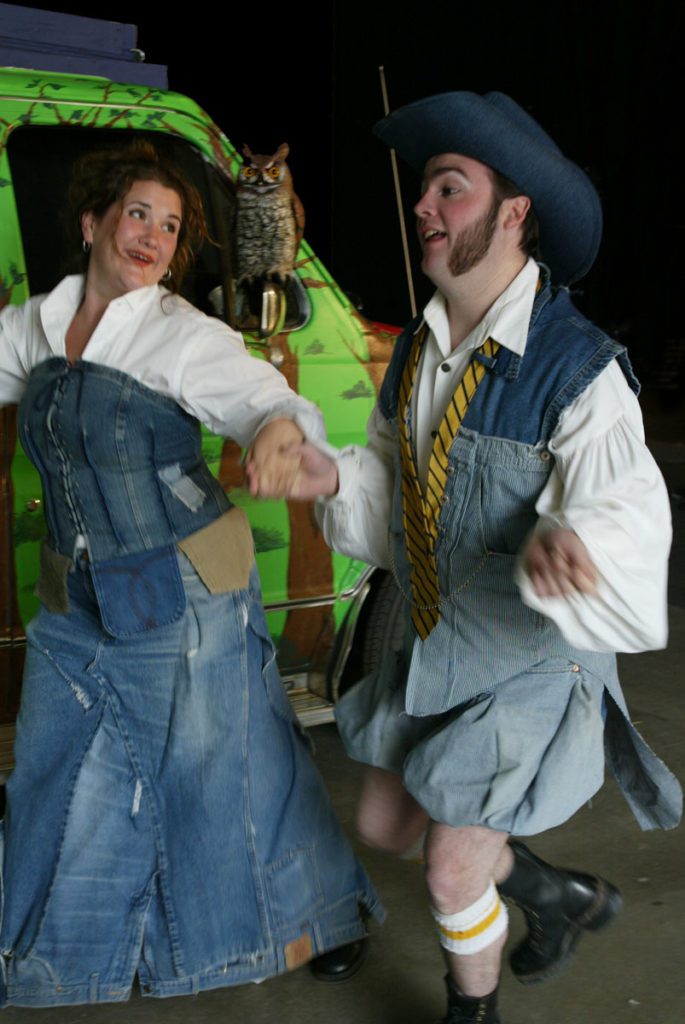
The results are as reachable as they are illuminating, both conceptually and concretely. Those Elizabethan frocks are made from corduroy and denim pants acquired at the ARC thrift store on South Broadway. A car radio/ashtray and a gas can serve as two puppets. A hat on a stick becomes an appreciative listener.

“You end up with integrity when you stage a show you can afford,” Rollman said.

“It doesn’t take a big budget to put on a good show. We wink at the audience. We all know this forest is just a van. So let’s be in cahoots!”

-Claire Martin, December 2, 2007, Denver Post

Denver Post- Buntport votes against passivity

What if you came home one day and, say, your wall paintings were turned upside down, but you didn’t even notice? Eventually the upside-down version might begin to look more “right” to you than wrong. And what if you came home one day and your TV were turned to a 90-degree angle … but rather than turn it right, you simply starting watching TV with a crooked neck?

Buntport Theatre’s 22nd original production, “Vote for Uncle Marty,” seems to be warning audiences that when you passively allow one incremental change after another to happen to you without question or protest,

Now apply this thinking to everything from the electoral system to civil liberties to the Iraq war to your own marriage.well then, one day you might find that your whole world has been turned upside down. And you let it happen to you, right before your eyes.

Welcome to Buntport Theater’s head-first dive into Ionesco’s absurdist pond – only more fun. Only Buntport could conjure a challenging, comically disturbing play that combines the paranoia of a Talking Heads video with the family dynamics of a Thornton Wilder play with the skewed perspective of “Being John Malkovich” or an M.C. Escher painting.

This innovative collaborative company, which writes, directs, designs, acts, builds and probably showers as one, tells all its stories from mind- bending points of view. One took place suspended 3 feet above the ground; another entirely in an elevator; and who could ever forget Kafka – on ice?

“Uncle Marty” takes place in a brilliantly built upside- down house, where a bizarro family of unhappy eccentrics must avoid the ceiling fan on the “floor” as they walk. Who vacuum the carpet on the “ceiling.” Who must step over arched doorways to move into the next room.

Most are intractably oblivious. Colby (Erin Rollman) is a pregnant delusional lost in her world of Spanish soap operas she can’t even understand; husband J.J. (Brian Colonna) is a theorist who contemplates jigsaw-puzzle solutions without ever actually touching a piece. Heather (Hannah Duggan) has for seven years been running a pointless exploratory campaign to determine whether her inept Uncle Marty (who’s neither her uncle nor named Marty) should run for town council. An unseen matriarch never leaves her room. These are the habits of five highly ineffective people.

It’s only the crazy-haired, conspiracy-theory rebel anarchist Uncle Gene (Evan Weissman, at his best) who acknowledges that something is very wrong in this world. Crazy- haired, we learn, because he finds his oasis by hanging upside down from moon boots. It’s in these few fleeting moments of “suspended belief,” with blood rushing to his brain, that things look to Gene as they should.

This conceit ranks among Buntport’s most clever of inspirations. But while these youngsters never explain their worlds or telegraph where they might be taking you next, neither are they typically as obtuse in their storytelling.

“Marty” is navigable, but also abstract and circuitous, never building to that expected “aha!” epiphany that lets you fully in on its purpose. That’s fine if you’re doing Beckett or Pinter, but Buntport is usually much more accessible and absorbing. So while “Marty” is a treat for veterans, it’s not the ideal introduction if you’ve not seen Buntport’s work before.

The most cogent scenes allow the staunchly platform- free candidate Marty (Erik Edborg) to blithely spoof the inanities of American political campaigns, which is humorous if a bit obvious.

Weissman’s volatile explosion clarifies that the target here is not so much the powerful but you and me. The play is a condemnation of complacency, of everyday ineffectiveness, of our steadfast need for all the pieces to fit together in a world where the puzzle keeps changing.

“Marty” is payback for our letting Bush steal the election(s). For allowing the Patriot Act. For turning into a nation of oblivious “passivists” with a dogged need to believe that everything is perfectly … normal. For the collective abdication of our civic responsibility to ask questions, to watchdog, to protest … to turn the painting right side up.

Problem is, if you stare into an Escher painting long enough, after a while, who’s to say what’s right side up?

-John Moore, September 28th, 2007, Denver Post

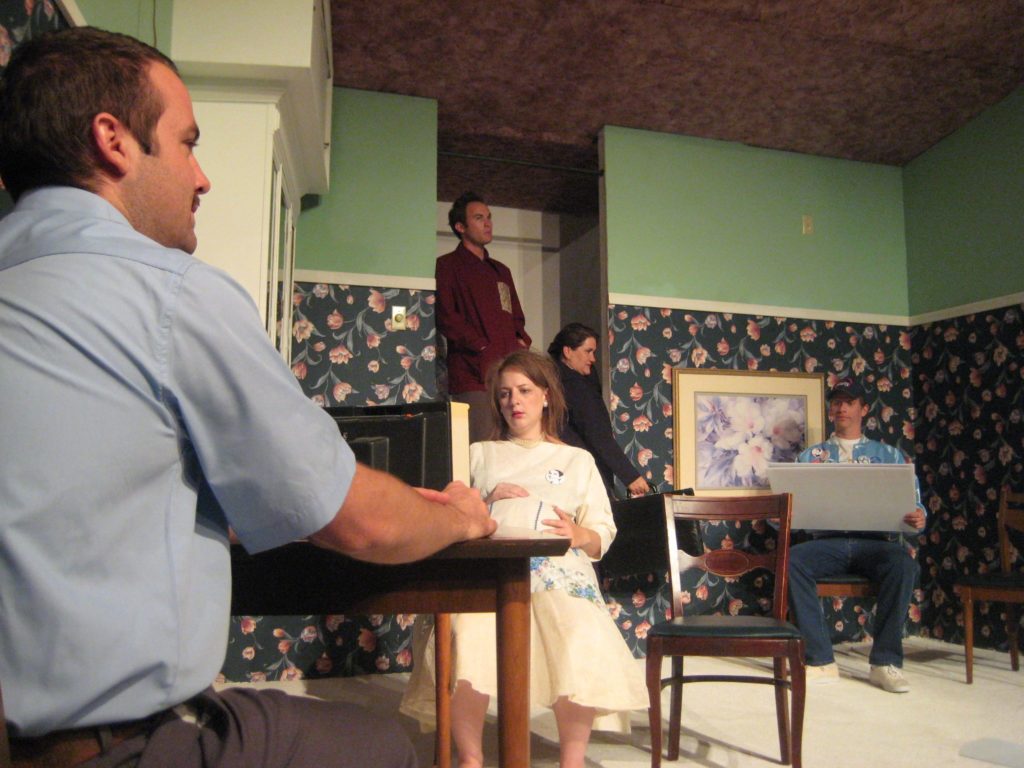
The setting is an upside down room, with pink carpet on the ceiling and flowered wallpaper. Five people crowd into the room, each doing their own activity.

Rocky Mountain News- Weak script sinks campaign of comic satire

It had to happen, eventually, but it still hurts. Buntport Theatre Company, those collaborative creators of eight years’ worth of funny, inventive and zippy new works, has come up with one that sinks rather than sparkles.

Mom never surfaces, but visible in the house are her warring daughters, the extremely pregnant and telenovela-obsessed Colby and the careerist Heather, played by Erin Rollman and Hannah Duggan. Colby’s husband, J.J. (Brian Colonna), is devoting his life to the study of jigsaw puzzles, while their uncle, Eugene (Evan Weissman), struggles for respect from nieces who are older than he is.Things never quite gel in Vote for Uncle Marty, the company’s comedy about a family of five living in an upside-down house, where the ceiling is the floor, the arched doorways provide an impediment to walking and light fixtures protrude from the floor.

Meanwhile, everyone calls their visitor Uncle Marty (Erik Edborg). He’s a stranger who wandered into the house six years ago and has since been Heather’s project as she prepares his campaign for city council. Marty has no reason to run. He has no platform, no desires, no philosophy. But he’s friendly. People like him. And Heather has been coaching Marty on his gestures (Clintonian thumbs) and searching for a meaningless slogan.

The satire is a little too spot-on. Candidates more enamored of process than belief have been mocked before and better.

The writing suffers here, but other Buntport assets continue to shine. Rollman and Weissman in particular display ever more nuanced acting. Her character is infuriatingly passive-aggressive; watch her eat peas for a bit of performance immersion. Weissman is dark and strange here, obsessed that he is the only one troubled by the house’s geographic disorientation.

The house is its own triumph, a full-size first floor that looks as though it could withstand a hurricane.

Vote for Uncle Marty strives to be a comic analogy to our contemporary world. But saying the world is upside-down doesn’t tell us much we don’t already know. It’s not terribly profound, which is OK; but it’s not very funny, either.

-Lisa Bornstein, September 21st, 2007, Rocky Mountain News

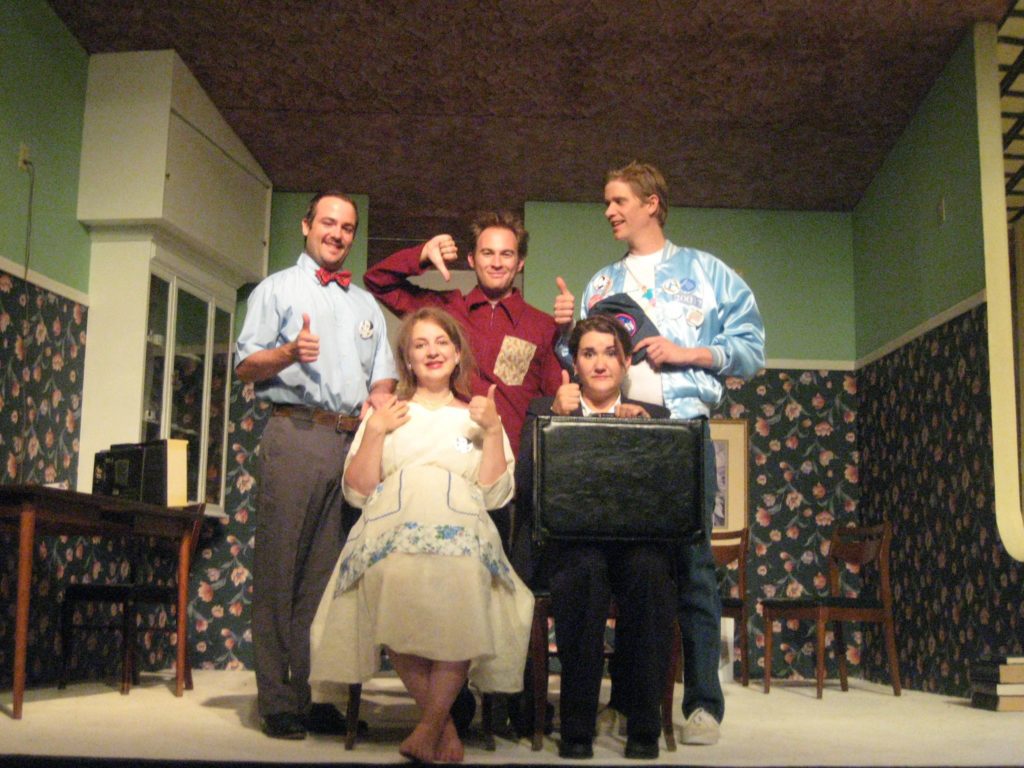
Four smiling people give the camera a thumbs up while one smiling man gives a thumbs down. They are grouped together in the middle of an upside down room.

Westword- Buntport does right by an upside-down world.

From the moment you walk into the theater and see the topsy-turvy set, the central metaphor of Vote for Uncle Marty is obvious. And although the suggestion that we live in an upside-down world isn’t particularly original, the play certainly is, since it arises from the collaborative work of Buntport’s five actor-director-playwrights – Brian Colonna, Erik Edborg, Hannah Duggan, Evan Weissman and Erin Rollman – as well as the sixth, non-performing member, SamAnTha Schmitz.

What else are these characters doing? Well, Colby, very pregnant, is watching Spanish soaps on television, trying to figure out the action though she doesn’t understand the language. Her husband, J.J., has a jigsaw puzzle on the table and is attempting to solve it on a theoretical level without actually manipulating the pieces. Several years ago, Colby’s sister Heather befriended the affable, empty-headed Marty because she believed he would make a good city councilman; she’s been planning his campaign ever since, worrying more about the color of his posters and the need for a slogan than about his complete lack of anything resembling a platform. There’s also Colby’s Uncle Gene – her mother’s brother, and not much older than she is. Gene is the only character who seems troubled by the house’s topsy-turviness. He places himself in various upside-down positions, hangs a mirror above his own nose so that he sees a right-side-up reflection, and rails at the others for their lack of interest in the problem. The final member of this household is Colby’s mother, who remains upstairs and invisible throughout.The company usually makes an art of scene-changing and object manipulation, but this set is remarkably stable and solid. It shows a tightly constructed house interior, with carpet on the ceiling and weirdly vertiginous stairs (to go downstairs, you ascend). The arch of a doorway curves from the floor like a C set on its back. The wallpaper’s floral pattern is upside down as well. The furniture is all right side up, and the inhabitants of the house have set up various objects to serve as steps where needed – a pile of books here, a toaster there. Eventually, two of the characters will get into a heated dispute over a painting of flowers that looks fine no matter how it’s hung.

These activities – Colby’s withdrawal into fantasy, Marty’s ineptitude, Heather’s meaningless political busywork, J.J.’s devotion to abstraction, the patently absurd manipulations of Uncle Gene – are all intended to represent the American public’s response to the current political situation; that much is clear. Even the complete inactivity of the absent mother figure is meant as a protest. (During the Vietnam era, John Lennon said that he and Yoko Ono intended to stay in bed until the war was over. As explained by Uncle Gene, the mother’s gesture is just as dopey, but a good bit more entertaining.)

As I watched, I couldn’t help but think about Ionesco’s 1959 play Rhinoceros, in which one person after another metamorphoses into a thick-skinned, lumbering, snorting beast. Everyone in Ionesco’s original audience would have understood that this was a warning both of the dangers of fascism and of the kind of mindset that allowed fascism to prevail. But in this interesting, evocative piece, the Buntporters never tell us why they feel our world is upside down. Perhaps they assume that in a time of endless war, secret imprisonment and torture, not to mention government propaganda unquestioningly parroted by the mass media, the answer is apparent. Still, while no one wants to sit through a political polemic, I’d have liked more of a clue.

Uncle Marty is far more than political satire, however. There are other currents at work here, and lots of wit in the writing. And the characters are truly fascinating: Edborg’s hapless, good-natured, oddly soulful Uncle Marty; Colonna’s squeaky, jerky J.J.; Duggan’s campaign manager, who keeps storming off the job only to return again, and who hides a pathetic insecurity beneath her businesslike saleswoman’s exterior. There may still be a few folks around who haven’t figured out that Rollman is one of Denver’s most accomplished and original actresses; if so, her performance here should clear the wool from their eyes. Colby is more hugely and monstrously pregnant than any woman has ever been before; her great swollen mound of a belly seems to control her every action, while she peers around it like a toddler carrying a beach ball. Despite her increasingly dark-ringed eyes and ever-lanker hair, Colby is trying to be sweetly maternal, but flashes of demented rage keep piercing her mellifluous exterior. Weissman hurls himself both physically and mentally into the role of Uncle Gene, and even though he’s ridiculously funny, you can feel the real desperation at his core.

The Buntporters have worked together for several years now in a way that few other theater artists can match. They know each other’s tics and rhythms, passions and ideas, and the resulting inventions are wonderfully wry and entertaining. Although I still think the time has come for someone, somewhere, to revive Rhinoceros.

-Juliet Wittman, September 13th, 2007, Westword

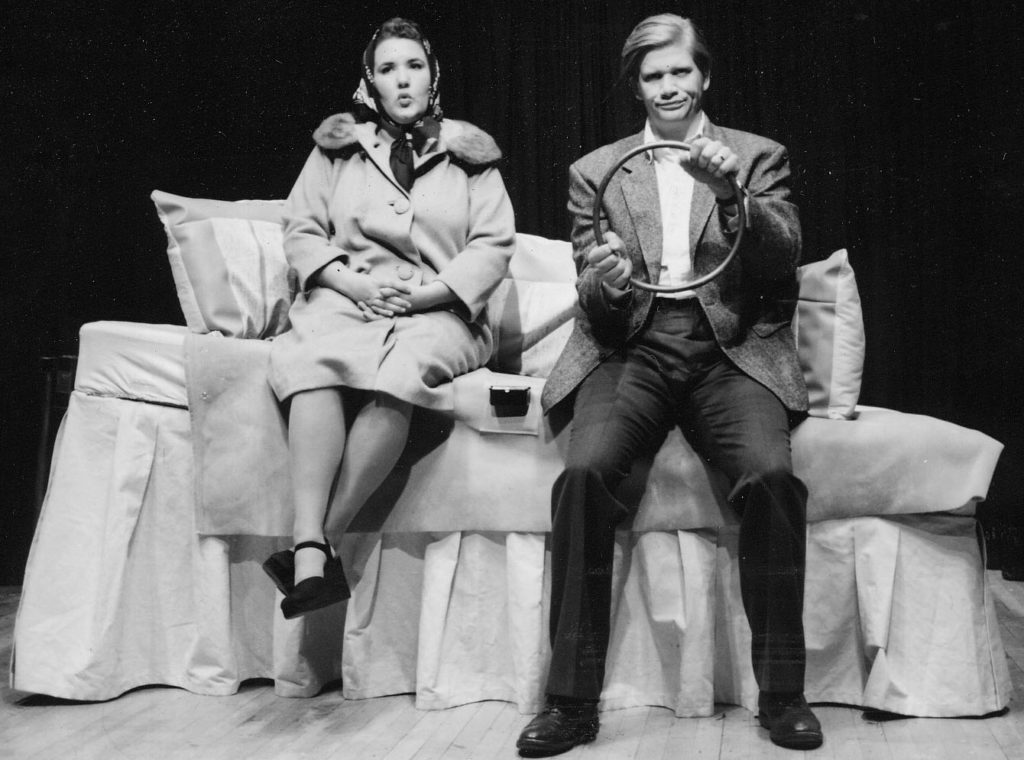
A man and a woman are seated on the side of a large bed that’s been made to look like the interior of an old car. The man holds a circular part of the headboard like a steering wheel.

Westword- At Buntport, two one-acts reflect the company’s style: clever, playful and inventive

Now that the Buntport Theater Company is winding up its tenth season – filled with remounts of several past shows – it’s time to stop thinking of this troupe as talented kids who got together at Colorado College to create a theater style all their own, and instead consider them the creators of a distinct body of work. Still, it’s hard to generalize from the year’s mix of staged readings, extemporaneous evenings and full productions culminating in the current offering of two early one-acts which – as the program helpfully points out – have nothing to do with each other: And This Is My Significant Bother (2000), a series of scenes based on James Thurber’s short stories, and an insane, babbling interpretation of Cinderella (2003). You can pinpoint specific Buntport tendencies: clever work with objects; playfulness and humor; an inventive approach that continually constructs and deconstructs the very idea of theater itself; a love of language that means the Buntporters’ favorite writers, from Melville to Kafka, are treated with a wonderful mix of cheeky overfamiliarity and profound respect. This company likes dramatizing odd fragments of fact they come across: for instance, the trauma suffered by the poor brontosaurus after it was demoted and renamed by scientists (The Mythical Brontosaurus); the obsession of one Wilson Bentley, who spent his life photographing snowflakes (Winter in Graupel Bay); the actions of Niyazov, dictator of Turkmenistan, who upended all notions of truth and time in his country, in part by renaming the months of the year for himself (The 30th of Baydak).

At the beginning of This Is My Significant Bother – which was Brian Colonna’s senior thesis – four actors are lying on a large bed, their left arms over the coverlet and perfectly aligned, each wearing a wedding ring. James Thurber didn’t have a very positive view of marriage. His men tend to be put-upon dolts and the women bossy harridans. The tone is slightly waspish, also sad and, in an understated way, very funny. The actors – helped by the music of the Hoagies, who play things like “Making Whoopee” and “Two Sleepy People” – have caught it perfectly, giving their portrayals a sort of stubby elegance.

A man kills a spider at his wife’s behest and then huddles under the covers, terrified by a flittering bat; a couple argues in their car about where to eat and whether Donald Duck is a more significant cultural icon than Greta Garbo; a husband decides to kill his wife so he can marry his stenographer, and the wife, having gotten wind of this, tells him exactly how he’s to do it; a divorced woman fills in her successor on all her ex-husband’s idiosyncrasies while he silently and meticulously makes up the bed. And there’s a touching story about a failed love affair, the sentences punctuated by silences and blackouts. If this is an early effort, you can’t help reflecting, it’s certainly a sophisticated one.

Cinderella is an extended piece of intense silliness, narrated by a be-rouged Evan Weissman in what can only be called Manglish; the rest of the cast speaks pure gibberish. The play begins when Cinderella’s sweet-faced mother (Erin Rollman) gives birth and almost instantly transforms into the Wicked Stepmother. She does this through a very clever costume change that forces her to walk backwards through the rest of the action. (Evil usually does occur when good is distorted or turned on its head, right? That’s why the word “sinister” is connected with left-handedness and the left side of things in general.) Doubling is a central theme in Cinderella. Both stepsisters are played by Hannah Duggan, wearing an asymmetrical wig and two different shoes. Erik Edborg, the tallest member of the troupe, is our heroine. He’s comforted in his sad predicament by his own left hand, which sings opera to him. When he’s dressed up for the ball, he’s represented by a simpering doll through another piece of costume magic. Weissman’s narrator becomes the Prince. The coach is signified by a pair of horses clipped to a hat, the importance of Cinderella’s leaving the ball by midnight emphasized by the clocks on the breast of her ball gown. “Your Feet’s Too Big,” the Hoagies sing helpfully, as an ugly sister tries to cram on that mythical slipper.

There’s no predicting what the next ten years at Buntport will bring, but we know they won’t be boring.

-Juliet Wittman, June 7, 2011, Westword

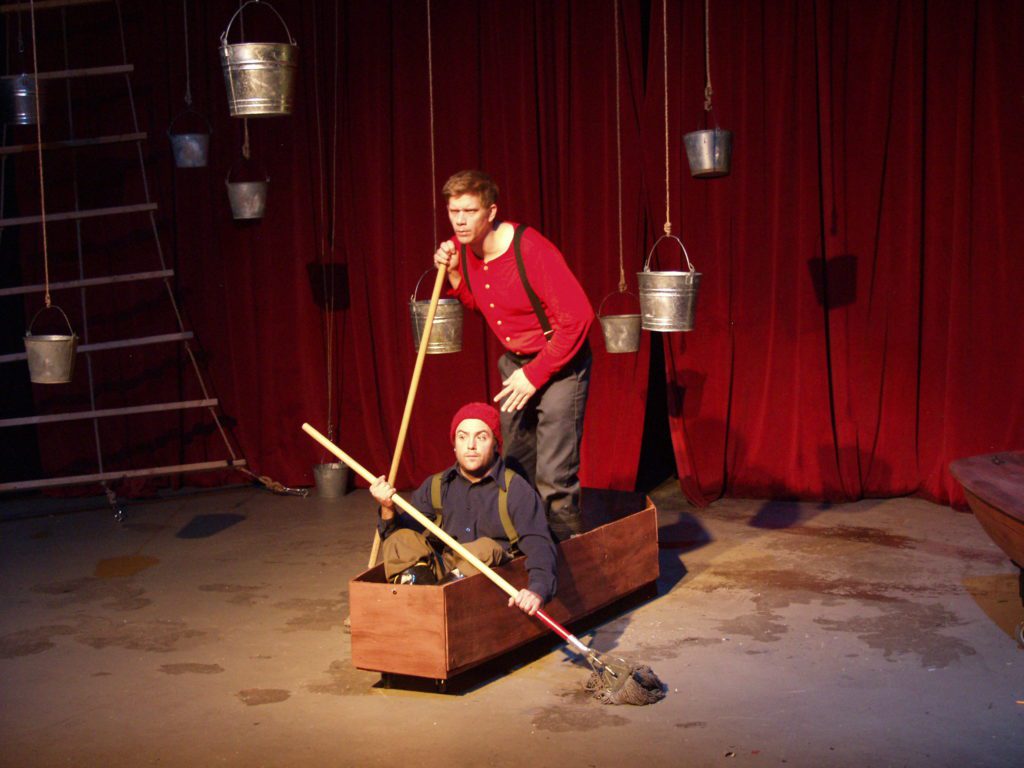
Two men, one seated and one standing, are “rowing” in a wooden coffin, using mops as oars. In the background is a red curtain, a rope ladder, and several hanging buckets.

Westword- Moby Dick Unread • Buntport presents a whale of a tale

One of the perils of an English education is that it leaves gaps. While I and any of my old school friends could discuss Shaw, Shakespeare, Jane Austen, George Orwell and Virginia Woolf at some length — and on a more contemporary note, I’d be happy to talk your ear off about Zadie Smith and Salman Rushdie — I’ve read very little of Steinbeck, Hemingway and quite a few other American heavyweights. Of Herman Melville, I know only “Bartleby, the Scrivener.”

When members of Buntport Theater promise that you don’t have to have read Moby-Dick in order to enjoy their Moby Dick Unread (in fact, they suggest that you see the production, then impress your friends by pretending you’ve read the novel), they’re telling the truth. I did enjoy the play.

Most stage and film adaptations of novels emphasize the story line, streamlining the action and trimming away minor scenes, the author’s digressions, sometimes a subplot or two. But the Buntport team announces proudly, “This is Moby-Dick with all the fat.” They linger lovingly on Pip’s ordeal alone in the vast sea and the arcana of an actual historic London court case on whale fishery that made a careful distinction between a “fast fish” and a “loose fish.” The result is a kind of serio-comic glossary, a meditation on Melville’s masterwork. It’s also as inventive as everything Buntport does, making clever use of space arrangements and objects (a rope ladder, buckets of water suspended from the ceiling) and combining parody and homage.

As always, the actors create their low-tech special effects with what seems like touching earnestness while their faces and bodies offer ironic comments: Look, we’ve drawn a large chalk whale on the back wall. Laugh all you want, but notice that it’s also resonant with meaning. Perhaps even mythic. Think of the vastness of the sea, the mystery of these huge creatures. Think of Job. Oh, come on, folks — don’t get that serious. It’s just a chalk drawing. “We’re making do,” various members of the cast keep telling us after particularly iffy or unexpected pieces of business. Because the style is so unpretentious, the heavy subject matter seems light and palatable, yet it’s never trivialized. Rather than coming between you and Melville’s world, the Buntporters — Brian Colonna, Hannah Duggan, Erik Edborg and Erin Rollman, with Evan Weissman and SamAntha Schmitz working off-stage — illuminate it. And Edborg’s prologue, which uses an aquarium and a wind-up toy whale to give you the entire action of the play, is worth the price of admission on its own.

But though I had the promised good time, I couldn’t help noticing that my friend, Jim, who had studied the book in college, was more deeply mesmerized by the production, and hugely exhilarated afterward. When he talked about what we’d seen on the way home, I realized that he’d found all kinds of echoes and subtleties that I’d only partly glimpsed, and Moby Dick Unread became thicker and richer in my mind. My response to the idea of actually reading Melville’s swollen, portentous, 650-page epic has always been quite unequivocal: I would prefer not to. Buntport not only provided a fine evening of theater, but it inspired me to pick up the damn thing and begin. That has to count for quite a lot.

-Juliet Wittman, April 12, 2007, Westword

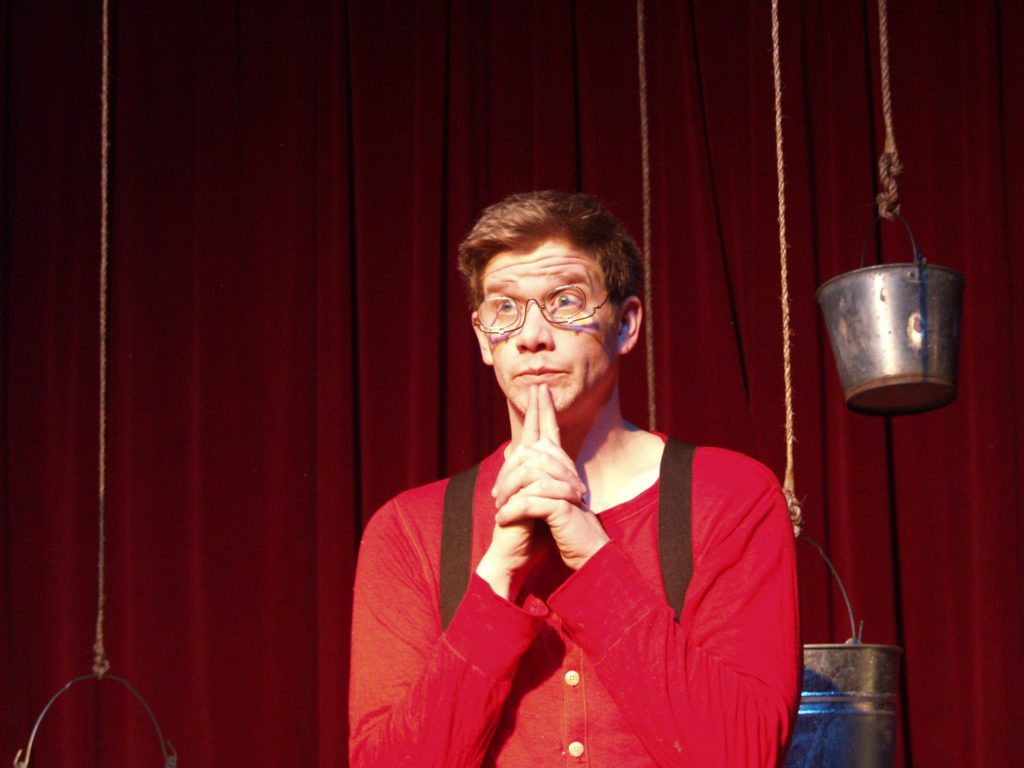
A man in a red top, black suspenders, and glasses looks out inquisitively. Behind him are several hanging buckets in front of a red curtain.

Out Front- “Moby Dick Unread”

Landlubbers beware! Buntport hath lampooned the whale!

Do not arrive late for “Moby Dick Unread.” The curtain-raising scene done by Erik Edborg is sublime in its supremely funny conception and execution. It involves a toy whale, an aquarium and one of the funniest faces and physiologies to hit the Denver stage in eons. More I will not tell you. You have got to experience this funny bone satisfying condensation of the essentials of Melville’s novel for yourself. Brian Colonna’s a Pip which slips beneath the waves to Davey Jones’ Locker as skillfully as he ascends to the light at the top of the waves, er, buckets. This is Moby Dick with the blubber left on. All the parts you skipped over to get to the juicy parts are suddenly alive with the imaginative writing, acting and staging at Buntport. Izaiah d. buzeth’s sound design for “Moby Dick Unread” is so right on target that whenever he aims his sonic wand at the young geniuses on stage, their art is experienced to an exponentially funny degree. Magnificent! Hannah Duggan is especially funny as the peg-legged Ahab. One scene in which the Pequod skims over the stage and past the first row with Ms. Duggan staring stony-visaged above the crowd, did not receive the applause and laughter that it should have on the night I attended. It was a moment of sublime cinematic theatricality of the comic variety. The marvelous inventiveness of the scenic design comes from that childlike creativity one associates with the sandbox. And as Hamlet says, “The play’s the thing.” The energy of this group is formidable as they take on the major and minor characters of Melville’s famous tome. Erin Rollman is outstanding in numerous roles which are delineated in costume and prop only by the switching to beard or hat or pipe. There is a storm in which it rains “buckets,” which is magnificently staged with Buntport’s signature panache. The show is dazzling, and I must thank Buntport. Now I don’t ever have to read the book.

Get on board the Pequod now or be keel-hauled by those who color within the lines!

Not to be missed.

-David Marlowe, April 2007, Out Front

Rocky Mountain News- Buntport navigates wacky waters

From its beginning, Buntport Theater has shown some marked strengths: taking an irreverent approach to literary classics; creating sets that dazzle the eye because of their ingenuity, not their expense; and making the audience laugh rather hard.

All three talents take the stage again in Moby Dick Unread, a 90-minute take on the Melville novel that most people know but few have read. Buntport takes advantage of that point to spin off in wild tangents, focusing more on the arcana of the epic than silly things like plot and character development.

Things begin portentously, as Erik Edborg silently takes the stage, where, to very serious music, he winds up a plastic whale and drops it in a fish tank, enacting a pantomime battle with nature as he plunges hands, arms and head into the water in a fruitless attempt to capture the toy.

But these creative forces – four onstage actors, aided by Samantha Schmitz and Evan Weissman – would never settle for such a simple setup. Rather, they roll out a small wooden sailboat that serves as the Pequod, and buckets of water descend from the ceiling, soon serving a multitude of purposes and suggesting a sailing vessel’s riggings. A large rope ladder in the corner allows for more diverse staging, as well as an allusion to a ship’s crow’s nest.

The actors go through an elaborate explanation of how we know, for example, when Erin Rollman is Starbuck and when she is the ship’s carpenter, but distinctions like a beard or a hat don’t help as much as characterization. In truth, any fidelity to portrayals carries less weight in this production than the comic surprises in store.

Brian Colonna utters the book’s opening words, “Call me Ishmael,” and serves as a kind of everyschlub observing the battle royale before him. Hannah Duggan wears a brown sock for Captain Ahab’s peg leg but is most enjoyable when her Ahab sobs over the whale or whines over leaking oil.

Like most of the company, Edborg plays multiple characters, and contorts his face with lickety-split reactions.

Rollman distinguishes herself again, creating characters so distinctive they don’t need costuming. Her barking, growling Starbuck contrasts nicely with the muttering, stammering ship’s carpenter.

Bits and pieces float through this production, from the taxonomy of whales to the story of Jonah. The play does begin to outlast its inventions, but when a group consistently turns out dazzling, original work of high quality, such complaints seem like asking for a second dessert.

-Lisa Bornstein, April 6, 2007, Rocky Mountain News

A woman in a peacoat and fingerless gloves holds rope tied to a spoon in a threatening manner. Several metal buckets hang from above.

Denver Post- “Moby” fathoms the funny while trolling the deep

“Moby Dick Unread” begins with a mad actor dropping a tiny wind-up whale into an aquarium.

Hit the dramatic music, and soon Erik Edborg is splashing madly trying to retrieve the toy, finally taking a desperate cue from Buster Keaton and attempting a candy- apple-style head-bob. He fails. He silently curses the gods. Blackout.

This prologue could be subtitled, “Moby Dick in Miniature.”

They’re lying, of course, with that “Unread” title. The smarty-pants from the Buntport Theater have not only pored over Herman Melville’s 135-chapter classic, they’ve likely burned a few bags of popcorn mocking Gregory Peck and Patrick Stewart taking turns as the apoplectic Ahab on celluloid.

“Moby Dick Unread” is Buntport’s 21st original undertaking, though if this great young company has an m.o., it’s just this kind of quirky literary re-interpretation (having already toyed with “Cinderella,” “The Odyssey,” “Hamlet,” “Titus Andronicus” and “Don Quixote,” not to mention five years of “Magnets on the Fridge” book-club episodes).

These are theatrical Cliff’sNotes for short-attention spans – respectful of the original but infinitely more fun.

Walking into Buntport is like walking into a new world every time. This group of six thirtyish pals always comes up with something so wonderful to behold, you feel like a kid again.

For “Moby Dick Unread,” it’s the 15 pails of water dangling from the rafters, which will become overturned during a brilliantly staged storm. It’s the glorified canoe on wheels that doubles as the Pequod. It’s the use of Edborg’s stomach as a storyboard. It’s the chalkboard etching of a whale against a wall that’s just big enough to make the man standing in front of it appear to be Jonah inside that other famous fish’s belly.

It’s easy to see how staging Ahab’s epic, ongoing aquatic chase on dry land must have seemed irresistible to Buntport. The universality of our obsessive need to stare down our demons is evident to anyone who’s seen “Zodiac.” White whales: We all have one.

But at its core, Melville’s tale is a lonely and solitary pursuit. Buntport also captures its melancholy, as well as its musical, mystical and religious undertones. There’s a constant underscore of ocean sounds punctuated by sad strings and hearty whaler songs. Like the book, this staging is funny and weird, and ultimately quite sad.

Our four on-stage actors are Edborg, Erin Rollman, Hannah Duggan and Brian Colonna (with Evan Weissman pulling backstage ropes and Samantha Schmitz handling technical duties). In quick-change fashion they bring us Ishmael, Starbuck, Elijah, Queequeg, Pip and more.

But this ensemble, which writes and stages all its shows in collaboration, is also charmingly enamored with Melville’s odd meanderings and side stories, which is why they bill the show as “Moby Dick with the fat left on” – while still coming in at a lickety-split 80 minutes.

The actors have self-deprecating fun with their own lack of ethnicity (the crew of the Pequod was multinational, and our four actors are as white as Ahab’s whalebone leg). They each have great moments but this time it’s the versatile Edborg, and particularly Duggan as the revenge-driven Ahab, who most resonate.

The actors’ recurring mantra is, “We’re making do.” And do they, until things end with a thud. After that stunningly staged storm comes the climactic chase, in which Ahab gets caught in harpoon ropes and becomes forever lashed to the whale. But we don’t see it. We’re told straight out, “We couldn’t think how to show that to you.” So, finis.

I appreciated the honesty, but having been spoiled by that storm, I felt let down. It didn’t seem so much like they were “making do,” it seemed like perhaps they had just run out of time.

-John Moore, April 5, 2007 Denver Post

A woman in a pink top and flowered apron holds a watering can in one hand and a white cockatiel bird in the other. She is speaking to the bird, dotingly.

Rocky Mountain News- Buntport players bring eccentricities of ‘Graupel Bay’ to life

Even when they’re telling the sweet, Capra-esque story of a small town, the creators of Buntport Theater sprinkle plenty of oddity on top. The result is Winter in Graupel Bay, a wonderfully strange cluster of characters exhibiting their eccentricities and their humanity.

An original work, Winter in Graupel Bay plays like Our Town with crossed eyes.

Instead of a grounded man, our narrator is a little girl who sees all the transactions of her hometown and brings them to us. Like most Buntport work, the five actors of the troupe play multiple characters. They live their lives on a warehouse-sized set that displays the town interiors like a skeletal dollhouse.

It’s the shortest day of the year in Graupel Bay, but that’s all right – no one has all that much to do. Two middle-aged women, played squeaky-voiced by Erin Rollman and smoky by Hannah Duggan, gossip about the town residents while trying to poison one another. Town drunk Toothy Bill (a just tipsy-enough Erik Edborg) stumbles around delivering editorials on such subjects as raisins (he’s against them, a stance I wholeheartedly support).

Brian Colonna plays the town sad-sack, Andrew Fromer, who can’t find a job, while Evan Weissman is most memorable as the solid yet dreamy Bruce Bentley, trying to conjure a snowfall so he can continue documenting individual flakes.

Humor falls across the town, particularly delivered by Rollman and Duggan. As the little girl, Polly, Duggan corrects the ladies’ gossip: “Mr. Morgan, it’s true, isn’t talking to his wife, but mostly because he lost his voice on Tuesday.” As the bed-bound Lady Fergus, Rollman petulantly and memorably bosses around her patient manservant.

Duggan gives the most wistful performance as the lovelorn Peg, who dreams of Bruce Bentley and being called Margaret. She dreams up a lovely romantic dance number with Bruce, a flight of fancy interspersed with sad and funny bits of realism.

Technically, the show is not showy but well-dreamt. Lighting and direction guide our attentions across the little boxes that make up this tiny, endearing town.

-Lisa Bornstein, December 15, 2006, Rocky Mountain News