Buntport Theater

Westword- Detecting Noir • Buntport stalks laughter

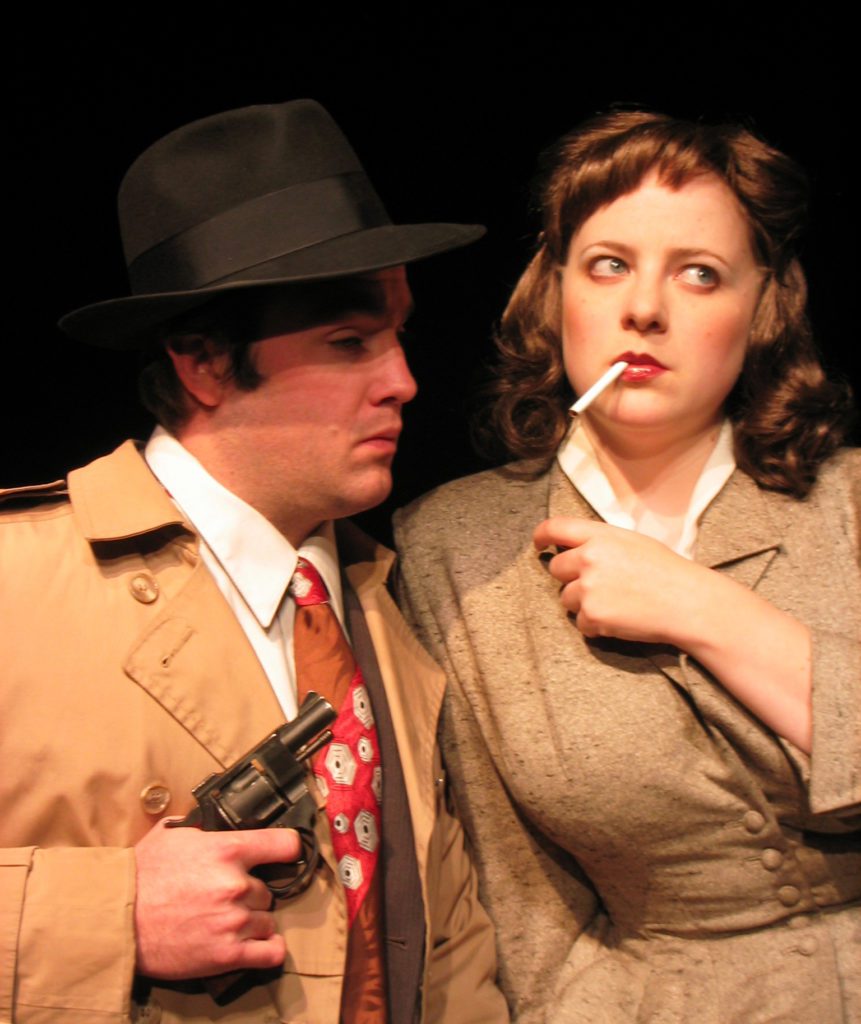
McGuinn and Murry is a spoof of those ’40s detective movies in which the men wore fedoras and the women had gams. It’s a lighthearted, skimming take on the genre that’s neither cliche-ridden nor weighted by scholarship. The helium that keeps this smart, entertaining trifle aloft is Buntport Theater Company’s irrepressible inventiveness.

A pair of washed-up detectives slump around their dusty office. The phone never rings. No shadowed, mysterious, cigarette-holder-wielding blonde ever appears at the door. McGuinn is a onetime prizefighter who disgraced himself by throwing a match. Murry is a tough broad, given to barking out orders. To pass the time and keep their wits sharp, the two P.I.s try to stump each other with hypothetical cases. Murry sets McGuinn a puzzler that involves a letter sent to his home, but the letter gets into the wrong hands; soon McGuinn is frantically pursuing what he believes to be a real case — in which he is somehow the suspect — while Murry applauds the veracity of what she perceives as his performance.

Obviously, there’s a lot of playing with frames of reality here, and transformation rules. Brian Colonna and Erin Rollman, who play McGuinn and Murry, respectively, take on many additional personae, signaling the changes through adjustments in voice and posture, or with props that serve as a kind of shorthand. Colonna assumes a black eye patch and becomes the lover of McGuinn’s wife, Budgie. It takes only a change of footwear, a fluffing of her blouse and a shuffling off of Murry’s severe jacket for Rollman to metamorphose into the breathy adulteress. The set is transformed with the same economy and dexterity. Everything evolves from the office’s hefty desk and its two chairs. Panels slide aside; boxes are opened and props tossed in or whisked out of them. The desk becomes the kitchen of McGuinn’s home, complete with stove, cabinets and a clothesline sporting a tabbed rubber girdle. With a little more manipulation, the desk is a bar, a cityscape, a park bench, the lair of a fat, wheezing Mafia reprobate apparently based on Marlon Brando. Much of the evening’s entertainment stems from the surprising and creative shifts in character and set.

Conventions are created, then casually broken. For example, the one door on the set is raised and appears to open onto the top of the investigators’ desk or, in the household scene, the kitchen counter. I’d guess this was the only way Buntport could make the desk-becomes-everything-else concept work structurally. When the door first opens, we’re surprised momentarily, but the two actors play it straight, and we come to accept the anomaly. No sooner have we done so than Budgie snaps at her husband to stop walking on the countertop.

There’s a knowingness to all of this, a self-referential quality. At one point, parodying Lana Turner’s famous line about whistling from To Have and Have Not, Rollman explains to Colonna how to exit: “You just put your hand on the knob, and you walk out…the door.” The peculiarities of the door in question only underline the humor. If there’s a misstep, Rollman and Colonna treat it as if it were intentional, and somehow their skill and assurance, along with the mocking quality of the entire show, make the moment doubly funny.

Props take on a life of their own, and scale becomes meaningless. When all of the characters need to meet at the park, they arrive in a succession of toy cars, which are guided over the surface of a kind of relief map by the actors.

The only problem is that the set changes, while fun to watch, take too long. The dialogue is witty and bright, but it’s not so deep that we want to contemplate a scene’s final lines for several minutes. A piece like this demands speed.

Both actors are talented, but it’s really Rollman, with her elastic face and ability to morph from character to character, who carries the show. She gives life and spirit to each of her characters: mannish Murry, flirty Budgie, the creepily disembodied-seeming fat man. There’s something unformed about her stage persona, as if she were just waiting to flow into one role or another. The characters she creates can be hard-edged and defined or oddly amorphous. She can make you laugh by raising an eyebrow, and she seems to know instinctively just how long to hold the expression for maximum effect without milking it. Sometimes she appears to have the unfinished, partially defined quality of a James Thurber cartoon. Colonna, too, has wonderful moments — particularly the flashback during which he re-creates the thrown fight, striving mightily to help McGuinn’s wimpy opponent score a hit.

Like all of Buntport’s scripts, this one was created (through both writing and improvisation) by the entire group — Hannah Duggan, Erik Edborg, Matt Petraglia, SamAnTha Schmitz and Evan Weissman — in addition to Rollman and Colonna. And, like all their work, it has inspired moments along with a few that are less inspired.

The first time I visited the Buntport Theater, there were six people in the audience. Every time I return, I see that the numbers have grown. And this is a crowd you can’t pigeonhole: children, teenagers, young adults and their parents, entire families that have arrived together, people who look like students, businessfolk, bus drivers, intellectuals, bums or bohemians. Buntport is attracting a following not because everything they do is completely successful, but because their work is sophisticated, welcoming, unpretentious and, above all, original.

-Juliet Wittman, January 7, 2004, Westword

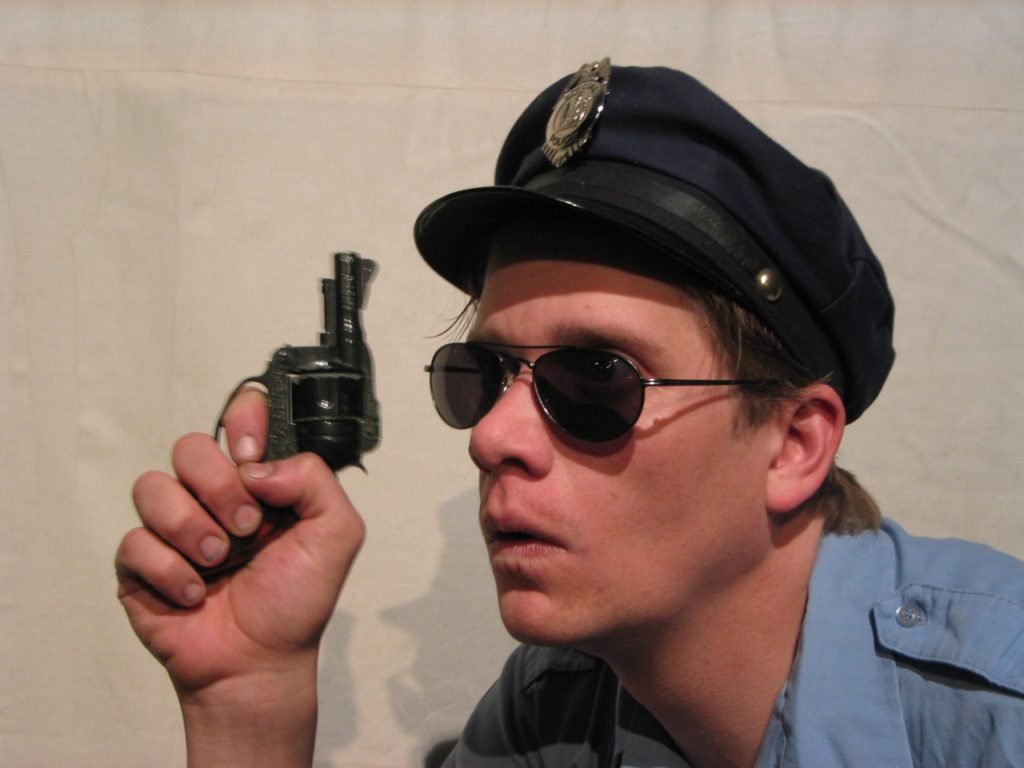
Close up on a dopey looking cop wearing sunglasses and holding his six shooter up to his face.

Rocky Mountain News- Brilliance plays on “Idiot Box”

In some ways, sketch comedy seems a step down for Buntport Theater, a group that has been developing original, comic, full-length works since its inception.

It’s also a skill they’ve never explored in Denver, and one which in most ways comes naturally to this group of seven inventors.

With its first sketch comedy show, Idiot Box, Buntport takes a tired premise and even a few hackneyed sketch formats and still creates something hilarious and clever, as if talent will overcome even the group’s worst impulses.

For structure, Idiot Box posits that tiny fairies inside every television are acting out the shows we choose to watch. One hour they’re in a soap opera, the next a cooking show. A channel surfer can exhaust them.

Those fairies, played by Buntport’s five actors, mostly serve for transitions. Otherwise, Buntport has borrowed the format of SCTV, creating a variety of sketches all derived from various TV shows.

And so we inherit the game show parody and the cooking show parody, frayed staples of sketch comedy. And in Buntport’s hands, even these can be amusing (well, not the cooking show, which is basically a single Stalin joke).

These creative powers instinctively know that there’s no such thing as a too-short sketch. They know that fully developed characters make every joke hit harder. And they know that delays kill comedy.


There’s also an adventure show,
Tyler and Shane’s Outback Exploration, in which Edborg and Evan Weissman demonstrate that not all Aussies are brave and blustery.Among their pierced targets are the TV show 5-O and the Fuzz, in which two cops (Hannah Duggan and Erik Edborg) are shocked when suspects lie to them; their world is one bound by an honor code.

On public access, a school bully (Brian Colonna, cast against type and rising to the occasion) hosts his own talk show, falls for a victim and delivers a wallop of a surprise ending.

Erin Rollman proves once again her gift for standing on the border of creepy and taking the plunge. Her dating show contestant is a disturbingly deluded geek. But her Stacy Petrovsky, the capitalist Girl Scout, is a transcendent character given a return performance. This time, instead of selling cookies, she’s commandeering the TV news with an invented board game (Monopoly mixed with Risk: capitalism plus world domination) and tormenting her Brownie brother (Colonna).

Offstage, the performers owe all to troupe members Matt Petraglia and Samantha Schmitz, who somehow keep the manic show moving at a fluid pace. Full costume changes and proficient sound effects happen with the ease if not the budget of shows with far larger staffs.

By the time the cast resurfaces in fairy gear (technicolor Lycra bodysuits) to sing a Doris Day song, they’ve long ago won us over. And they know enough to take their bows while we’re still madly in love.

-Lisa Bornstein, December 19, 2003, Rocky Mountain News

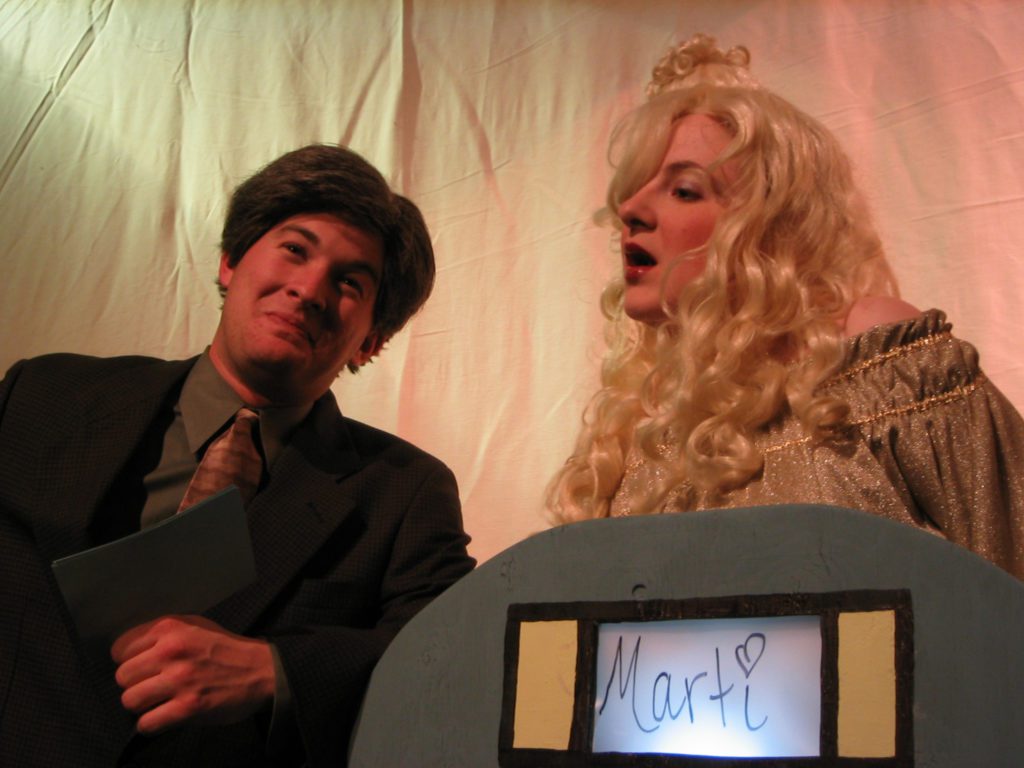
A male gameshow host is leaning against the podium of contestant Marti who has long blond hair and spells her name with a heart over the I.

Denver Post- Theater group tunes in to TV’s vast wasteland

The busy Buntport Theater Company, which is to rest what adult companionship is to Michael Jackson, is parking it on the couch this December for a brief series of comic parodies targeting all things television.

The Buntporters are calling “Idiot Box” their first foray into sketch comedy, but aficionados of their biweekly original book-club sitcom, “Magnets on the Fridge,” will quickly recognize its irreverent style and sensibility.

Though there may not be a subject more rife for Buntport’s sophisticated and intellectual brand of comedy than the vapidity of television, “Idiot Box” does not aspire to be much more than ticklish. This is neither high concept nor particularly biting social commentary. It’s just, for the most part, very funny.

And not surprisingly, it is executed at a level of exactness, characterization and timing that betters most companies around town who do sketch comedy for a living.

During a stretch when Buntport will open its 12th and 13th original mainstage productions within three weeks, and while still cranking out its midweek “Magnets” episodes to a stunning standard of originality, it’s frankly a bit of a relief to see Denver’s hardest-working theater company unburden themselves of the need to be so darned relevant all the time.

“Idiot Box” plays on the fact that most of us only have vague notions of the way televisions actually work. It opens with an unseen conversation between some kid (Andy Vickory) rattling off his blah blah scientific theories about electron beams and cathode rays, and an adult(-like) Evan Weissman, who sets his precocious counterpart straight: Actually, young Andy, tiny fairies are trapped inside our television sets and are forced to act out whatever show is playing on the selected channel.

That’s how televisions really work, Andy. Cathodes. Hah.

Our five bickering and sardonic fairies operate on a stage framed by the simple outline of an old fashioned television set. When these proletariat pixies interact behind a silhouette that represents the television screen itself, we get to know their off-camera personalities. When they are in front of the silhouette, they are considered on-duty, and subject to the channel-changing whims of their unseen despotic couch potato.

Among the easy targets are buddy-cop shows, soap operas, the Food Network, inane game shows, vapid local newscasts, the strange preponderance of Australian outdoorsmen on American television and, most especially, the emerging genre of “Mean TV,” with all its subhuman reality genres including cruel coupling contests and demeaning prank shows.

Among the less-obvious gems are Erik Edborg performing “Cooking With Stalin,” a cooking show for dictators. “Remember what Lenin says,” we are told, “You can’t make an omelet without breaking a few hundred people.”

The incomparable highlight is the triumphant return of young Mitchell and Stacey Petrovsky, Buntport’s longest-running and most revered characters (played by Brian Colonna and the queen of comedy, Erin Rollman. Bow before her.).

For three years, the Buntport’s signature traveling sketch has been Mitchell and Stacey’s riotous foray into Girl Scout-cookie capitalism, which featured a diabolical pre-teen Stacey domineering her braided and brown-skirted younger brother in her pursuit of the local cookie-selling crown. Here, maniacal Stacey is being interviewed on the local news about her science fair invention, “Monopolize Your Risk,” a board game of “capitalistic skill and global domination.”

Television presents such a target-rich environment that by the evening’s short (70 minutes) end, one wonders how topics such as infomercials, sports, humiliating talk-show revelations and Paris Hilton escaped unscathed.

Given more time and energy, you might expect to see more multimedia touches from Buntport and some sort of social commentary beyond Hannah Duggan’s prescient observation that most of us like to watch others humiliate themselves on TV “just so we can feel patently superior to them.”

After all, the evolution from “The Dating Game” to “Average Joe” is as apparent as the bloodlines linking “Candid Camera” to “Punk’d.”

But while some parodies such as the situational game show “Blame It On” are standard stuff, Buntport on a day off is still vastly superior to any banal collection of “Saturday Night Live” sketches.

In small ways, “Idiot Box” manages to accomplish what Buntport always has been known for. It manages to stretch the sketch-comedy form like those poor fairies’ multicolored, skin-tight Lycra costumes.

-John Moore, December 19, 2003, Denver Post

Close up on a dorky looking lady.

Westword- Fairy Amusing • Buntport’s clever Idiot Box shows the tiny rubes behind the tube

Speaking as someone who was terrified of the telephone when I was a child because I couldn’t understand how the voices of people I knew could get trapped in this black plastic thing, I am very grateful to Buntport Theater Company for explaining how a television works: Little fairy people are trapped inside the box and act out all the shows and commercials.

In Idiot Box: An Evening of Sketch Comedy, five Buntporters illustrate this theory with a series of sketches. There’s a lot of danger in the premise. To begin with, it could lead to a show that’s unbearably cute. And skits featuring game shows and other standard television fare have been done. And done and done. Apparently every time a Saturday Night Live writer runs out of ideas — clearly a frequent occurrence — he comes up with such a scnenario. It’s inevitably lame, because there’s no way of mocking a genre that comes across like a parody of itself in the first place. But Erik Edborg, Hannah Duggan, Erin Rollman, Evan Weissman and Brian Colonna, who (with SamAnTha Schmitz and Matt Petraglia) created Idiot Box and also perform it, avoid these traps. They’re very good actors and deft, witty writers. No skit goes exactly where you think it’s going; no flight of lunatic fantasy is too ridiculous to be undertaken; no joke gets belabored past the point of funniness. The whole evening is light and stylish, and the group is smart enough to stop the entire proceeding while you’re still rocking with laughter and wanting more.

There are, of course, takeoffs on standard TV fare: a cop drama, a game show, a reality series, the Food Network. These are punctuated by scenes in which we see the fairies — only their silhouettes are visible behind a transparent white screen — warming up, arguing, making shadow puppets and discussing whether work in the microwave business wouldn’t be less stressful and more satisfying. Then there’s the sound of someone channel surfing — the idiotic bursts of dialogue, laughter, music and impassioned selling we’re all so familiar with — and another skit begins.

In a dating-game show,

a horrified Evan Weissman is paired with a sluttily oozing and squeakily singing Erin Rollman as “another couple you can look down on.” Edborg gets in shots at arrogant chefs, along with some cogent allusions to current events, in “Cooking With Stalin.” There’s a takeoff on nature shows featuring daring Australians handling snakes and alligators, only here the two Australians are terrified of anything resembling untrammeled wildlife. “Birds,” says one of them. “You can’t trust them.” In a Sesame Street-style show, song, metaphor and action are used to teach kids how you find a clitoris.

Where the lines aren’t that strong, the characterizations are. When the characterizations flag, a clever or audacious comment comes to the rescue. Duggan shines as the female half of a cop team and as the gum-chewing girlfriend of the pathetic, mindlessly violent host of The Bully Show. Evan Weissman is a convincing straight man with a hilarious repertoire of hapless expressions. Brian Colonna is so filled with delight at his (or perhaps it’s her) own cleverness in the game show that he can’t stop patting himself on the back — and we can’t stop chortling every time he does it. As comedians, Edborg and Rollman take things right to the edge and then over it. Why is Edborg imitating a chicken behind that scrim, and is he really going to lay an egg? How does Rollman come up with these insane characters? All her bits are funny, but one of them takes the cake: a monstrous adolescent who’s just won a science fair with her world-conquering board game, Monopolize Your Risk. This girl is such a bullying, self-satisfied, evil, lisping little megalomaniac that you don’t know whether to laugh or cry, but you do know you can’t take your eyes off of her.

-Juliet Wittman, December 18, 2003, Westword

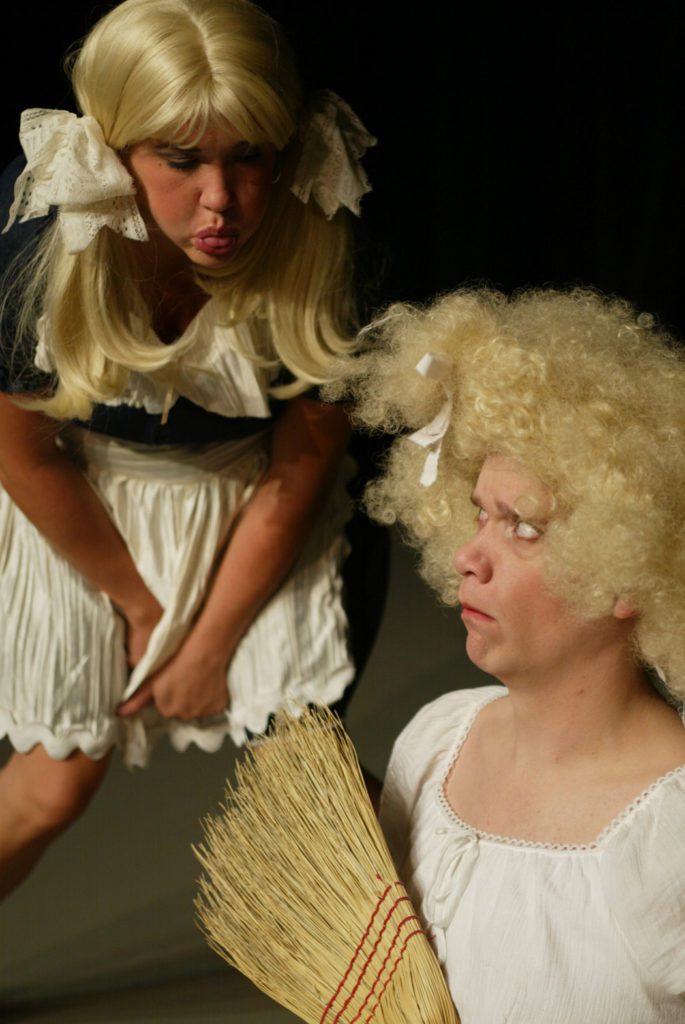
A woman in blond pigtails leans over blowing a raspberry in the face of Cinderella, who looks upset and holds a broom.

Westword- Major Props • Buntport dazzles with silly yet serious inventiveness

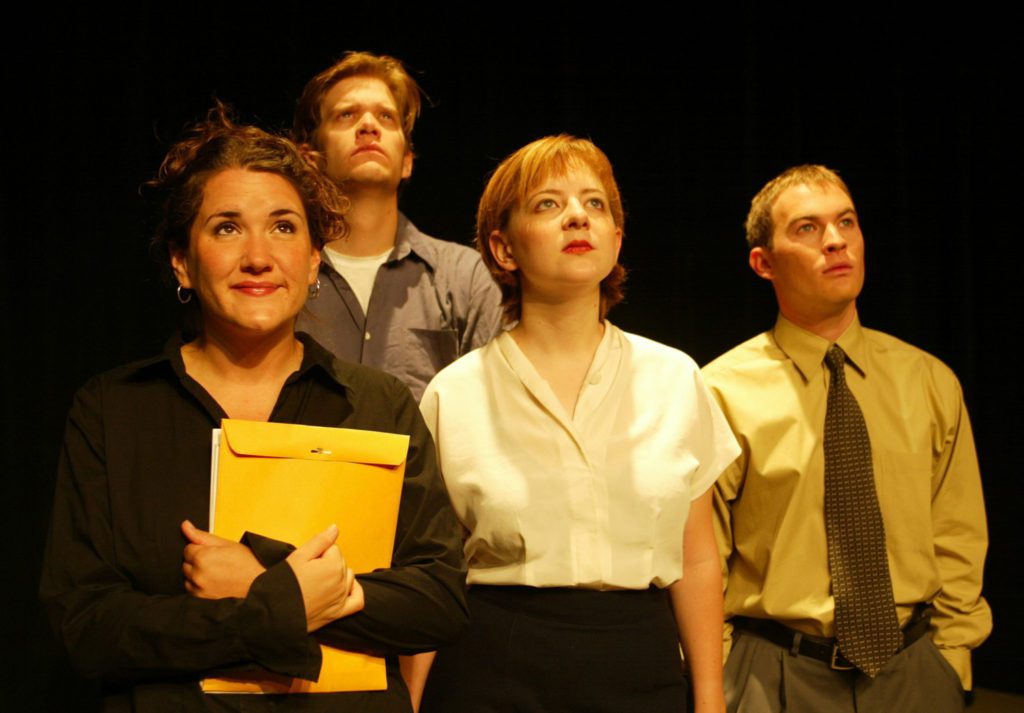
In Elevator, the first of Buntport Theater’s two original one-acts presented under the title Misc. , three people stand in an elevator, pretty much unmoving. We’re treated to several silent minutes, during which we study the actors’ expressions. A fourth person gets into the elevator, then gets off. There’s a blackout. Then the exact same scene is replayed, except this time you can hear the characters’ thoughts. The tall, skinny guy (Erik Edborg), who seems so convinced he’s fat that he has somehow persuaded the other characters of that fact, is a hugely talented and successful author who’s completely at a loss about how to begin his next book. He’s on the way to pitch this shaky project to his new editor. Unbeknownst to him, the new editor (Erin Rollman) is standing right beside him. She’s a smartly dressed woman clasping her briefcase in front of her, and she’s alternating between exultation at being handed so eminent an author and the conviction that she herself is an imposter. The third rider (Evan Weissman) is on his way to the top floor to commit suicide. As for the fourth insouciant player (Hannah Duggan), you’ll have to find out her motivations for yourself.

The dialogue begins with musings — some of them very funny — about butter, umbrellas and untucked shirts, but it becomes deeper and more complex as the piece progresses. People’s thoughts and words overlap. Sometimes the characters seem to hear each other. At least once, they clearly do. But each rider’s individual solitude is never entirely broken.

Something serious is being explored here, although with a light touch. We’re reminded that an elevator is an essentially liminal, almost timeless space. Ideas about time, language and memory surface again and again. The characters ponder the power of narrative and the way all of us create a coherent life story for ourselves. The editor remembers having once kissed the Blarney Stone in Ireland and wonders if she’s too facile with words. Foreshadowing the ubiquitous dualism of the second play of the evening, <Cinderella, she wonders if it wouldn’t have been better to kiss the back of the stone instead and lose her verbosity.

Elevator is pleasant and amusing, but it needs some trimming and tightening.

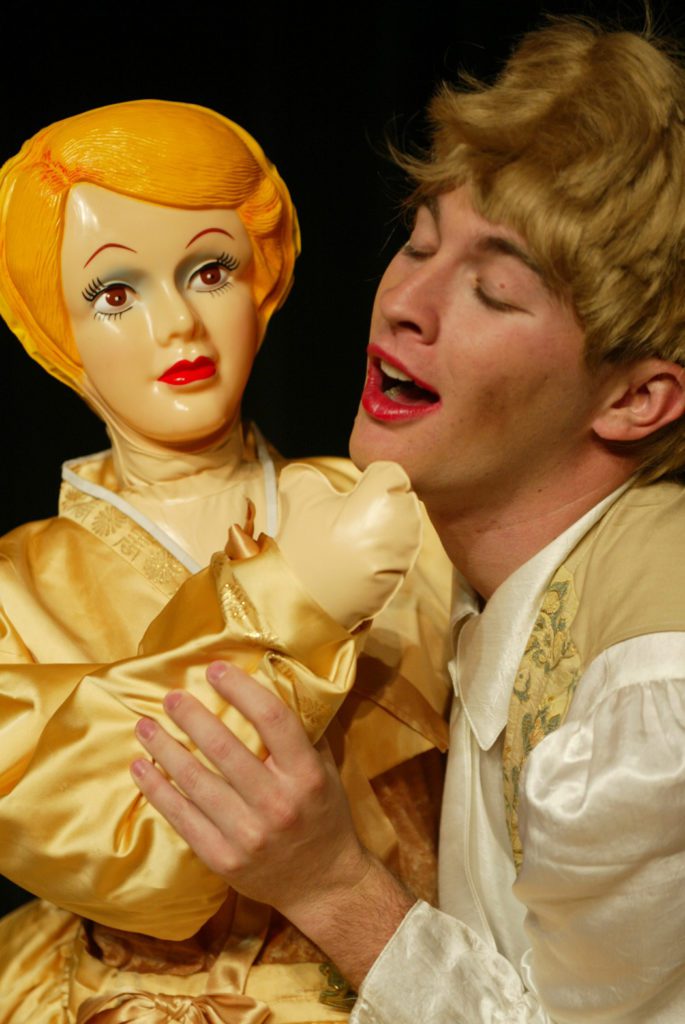
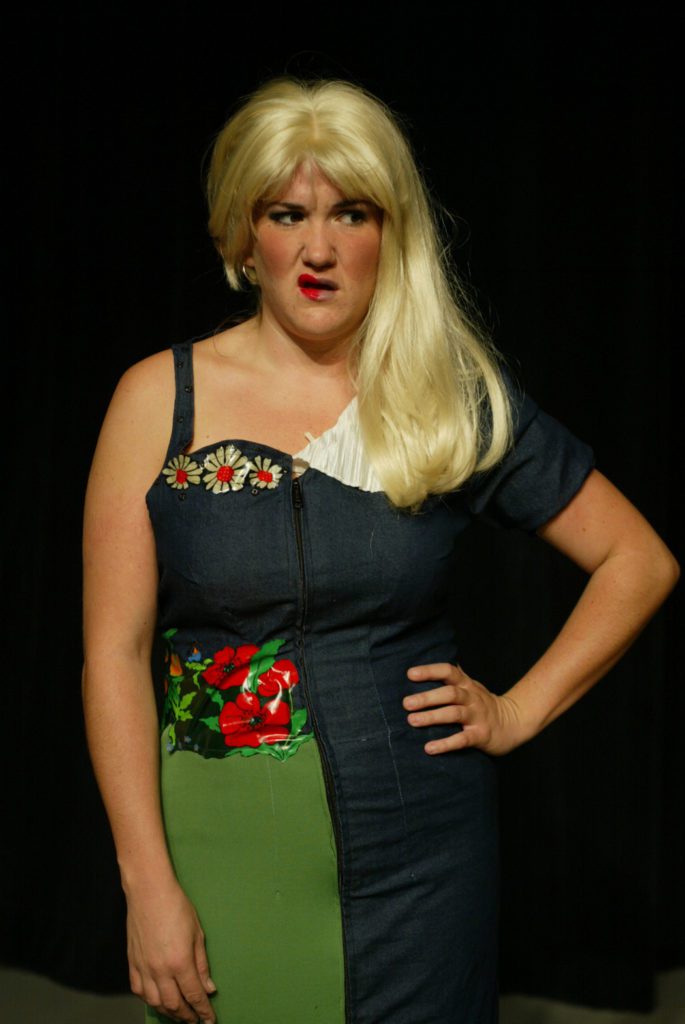
The second piece bubbles with cheerful invention as the same four actors play out the story of Cinderella, using movement, nonsense syllables, props, masks, many kinds of music and semi coherent sentences that seem to have been distorted by helium. Erik Edborg is a wistful Cinderella who consoles himself in his solitude by making a puppet of his left hand and having it serenade him. Erin Rollman plays both the good mother and the wicked stepmother; for the latter, she simply turns, revealing a mask on the back of her head. Of course this requires moving, even dancing, backward for the rest of the evening, and the result is scuttling and grotesque and hilariously funny. Duggan, also appropriately bifurcated, plays both ugly sisters. And, red-lipped and wearing a platinum wig, Weissman serves as the impresario, uttering frantic nonsense syllables as he tries to make himself understood.

Masks, puppets and doubles abound as Edborg morphs into a plastic doll and back into Cinderella again and Weissman dutifully puffs out his pants to impersonate the prince. The only character who remains resolutely herself throughout is the Fairy Godmother, played as a helmet-haired teenager by a silently exasperated Rollman.

Buntport is made up of several onetime students from Colorado College who studied Eastern European theater together. (Surely no one who hadn’t would come up with the pronunciation “pranshay” for “prince.”) These folks can do astonishing things with objects, and their inventiveness is amazing. They push boundaries and sometimes touch on the profound, but it’s all done with lightness and a fizzing good humor.

-Juliet Wittman, October 2, 2003, Westword

A man with an odd haircut is cuddling up to a blow up doll.

Rocky Mountain News- ‘Misc.’ a refreshing comic turn

Buntport embraces strengths in one-acts

The laughs are fast, furious and dizzyingly inventive in Buntport theater’s latest original production, Misc.

The umbrella title encompasses two one-acts that are entirely unrelated but for their lack of sets and their boundless creativity. After a period of more serious work, it’s refreshing to see Buntport return to its metier: comedy that fulfills its premise in every gesture.

In Elevator, the audience’s patience is tested as four people ride in near silence during a two-minute elevator ride. Soon, though, that ride is replayed in longer form, with the actors voicing the inner thoughts that accompanied every facial gesture or posture shift.

As a past-his-prime wunderkind writer, Erik Edborg grasps desperately for a book pitch as his mind caroms through his skull, lighting on topics from Fabio to butter to sex to claustrophobia. He shares his space with Evan Weissman as a young man contemplating suicide and Erin Rollman as a rising editor who fears she’s a fraud. Their stories cleverly overlap, and Hannah Duggan enters on a sublimely subversive short ride.

Elevator stretches its premise and would benefit from a 15-minute cut. <Cinderella (Less Than Cinderella), on the other hand, is crammed so full of brainstorms that it’s likely a dozen more jokes were left in the rehearsal room.

This four-actor version of the fairy tale is told nearly without words but overflows with clever musical choices and transformative costumes that fill the usual role of the company’s scenery. It may also be the only version where the audience not only hopes Cinderella doesn’t get the prince but wants to bash her over the head with her own dustpan.

Edborg plays the title character, an ugly loser with a ratty blond wig. Duggan takes on both evil stepsisters, with her costume and makeup split neatly down the middle along with her personality. Rollman does extraordinary work as a stepmother performed with a mask and a dizzying physical impediment.

Weissman, the company’s newest member, gets his moment here as a narrator/harlequin who speaks in fairy tale pidgin English and is unwillingly conscripted to play the prince. The entire cast comes off as a group of perverse living Muppets, and while kids may enjoy the show, it’s unabated delirium for adults.

As always, there are company member unseen onstage but intimately involved in the plays’ creation. This time, those shunning the spotlight are Brian Colonna, Matt Petraglia and Samantha Schmitz. They must be cited, because all seven Buntport brains were working at full power on Misc.

-Lisa Bornstein, September 26, 2003, Rocky Mountain News


Four people wearing business casual attire stand together. All of them are looking up. One is holding a large yellow envelope.

Denver post- >(more than) funny • Buntport’s new work inspiring, as usual

All aboard the Buntport bandwagon.

I have grown completely enamored of Denver’s Buntport Theater Company. After taking in the latest brilliant effort in a steady stream of groundbreaking original material from its seven wits, I can announce that I would watch anything these kids came up with anywhere and at any time.

Why, I’d watch them stand still in an elevator. I’d even watch them reinterpret the dustiest of old fairy tales.

And that’s just what they do in their 10th original work, “Misc.,” two one-acts titled “Elevator” and “< (Less Than) Cinderella.”

Buntport’s pieces aren’t always ingenious but they are always funny, surprising and wreathed in magic. Their writing and execution is both inspired and inspiring to anyone who appreciates the difficulty of the creative process.

The beauty of “Misc.” is that it does not rely on the company’s well-established individual talents. This is a risky conceit that constitutes a confident leap forward in the complexity of their repertoire. And they do all this without a set.

“Elevator” is a 45-minute look inside the minds of four strangers during one short and awkward elevator ride; while “< (Less Than) Cinderella” is the classic story performed without discernible words. That might seem like a disparate match, but these are companion pieces. The first story must be communicated with minimal movement; the second only with movement and sound.

The evening opens with a square pool of light on the floor that represents an elevator’s interior. First we witness the actual, seemingly uneventful two-minute elevator ride in a generic office building, the kind where strangers feign tolerance for only as many floors as they must travel. The sole dialogue comes from one man informing another that he has a spot on his shirt. The elevator stops and a woman gets on; she also becomes the first to get off.

After a short blackout we see the same event unfold again, only this time without the constriction of time. Now we hear detailed thoughts, and it’s soon evident that every glance and weight shift we saw in the first scene was a clue to understanding the longer version of the same story.

Because the writing is smart and concise, we soon know the characters intimately: Erik Edborg is a washed-up and terrified novelist heading to a pitch meeting without a pitch; Erin Rollman is the unknowing underling from the same office assigned to meet with this writer; and Evan Weissman is a claustrophobic man contemplating suicide. When the elevator stops, Hannah Duggan injects a lightning rod of wicked energy as a woman who revels in knowing her quick one-floor ride is a rude aggravation.

The dialogue is based on a creative-dramatics game called “Radio,” where actors stand side by side, each representing a radio station. Each time the leader turns “the dial,” a new person picks up speaking where the other left off.

But here what we hear are not just randomly improvised thoughts. These are delicately interwoven transitions that flow with the rhythm of the elevator car. The tone grows from inanely comic observations (did you know that Keanu spells “unique” backward … “only wrong”?) to more metaphorical ruminations on the nature of experience to finally, some rather sad realizations about the inadequacies of their lives.

While “Elevator” is a successful experiment, “< (Less Than) Cinderella” is an epic opera of movement. It most obviously draws on the masks, puppetry and spectacle of commedia dell’arte, and the costumes and ritual of Kabuki, but it is above all a nod to silent film clowns such as Charlie Chaplin and Harold Lloyd. In 1936, long after the advent of talkies, Chaplin’s classic “Modern Times” included his first spoken words on film ­ a gibberish song meant as a rebuke to talking pictures.

Buntport honors that classic moment by having the narrator (Weissman), Cinderella (a remarkable, impeccable Edborg), her stepsister (Duggan) and stepmother (Rollman) communicate in garble. At Colorado College the Buntporters were schooled in transformational theater by Bulgarians; those Eastern European influences flavor this entire work.

The transformations are lessons in originality: Edborg morphs from ugly Cinderella into a princess, and Weissman from the narrator into the prince.

But how Rollman turns from Cinderella’s mother dying in childbirth into the wicked stepmother right before our eyes is a creative tour-de-force. When she turns her back on the audience, her flip side is the evil one. Rollman wears a mask on the back of her head, and her backward clothes and shoes create the illusion of the front of another person. From then on Rollman walks only backward, which is forward for her new character, complete with behind-the-back hand gestures. Her backward line dance is a memory to treasure.

The Buntport team could not pull this off without the visual and audio support of SamAnTha Schmitz and Matt Petraglia. The latter’s masterful soundtrack includes songs such as Fats Waller’s “Your Feet’s Too Big.” (Guess where that one comes in?)

The miracle of Buntport’s opus is that this is textbook minimalism. With only their imaginations and intellect, they have conjured the illusion of a world far bigger than our comprehension.

-John Moore, September 24, 2003, Denver Post

A woman looks annoyed. She is divided in half. One side of her hair is short, the other is long. One half of her dress has flowers, the other has a large white collar. only half of her mouth has lipstick. She plays both of the stepsisters.

Colorado Daily- Double Delight

Hidden in a warehouse, not too far from the tracks of Denver’s light rail, lies a rare theatrical gem. Wrapped in hundreds of yards of sturdy black velvet, Buntport Theater beckons to patrons seeking something more than pent-up classics and worn-out Broadway rehashes.

Buntport Theater Company has been producing outstanding alternative theater since 1998. Since obtaining their own space in 2001 they have realized great success, due in large part to the originality, intelligence, energy and precision displayed in every one of their productions. Members of the company collaborate to produce elegantly written original works that pertain to modern issues. But what defines Buntport as a rapidly growing cultural force in Denver theater is its penchant for transforming theater into an exotic experiential cocktail composed of one part dizzying roller-coaster ride, one part classical literary relevance and one part wrecking-ball deconstructionism.

For most companies the approach, much less the individual production, would be hard to pull off on a consistent basis, but this team regularly produces work that consumes audiences with its raptorial eye for sleek, swift, resonant theatrics – be they dramatic, comedic, or a little of both.

“Misc.” is Buntport’s season opener, comprised of two one-acts that contrast sharply with one another. “Elevator” is a frieze of motion on stage, employing internal dialogue among four characters as the point of action that drives the play. “Cinderella” is a nearly wordless jaunt into the cellars of surrealism embedded below the ground level of many classic fairy tales.

“Elevator” contrasts the outwardly indifferent behavior prominently displayed in elevators with the internal conflicts and wars we all wage in our heads on a daily basis.  The dialogue speeds forth like an express train of stream of consciousness debate, with one character’s thoughts cleverly woven into another’s. The elevator itself is supremely slow, surreptitiously engaging the audience in the foot tapping, eye-rolling, blank-wall-staring behavior of the characters on stage, who painstakingly wait to rise from one floor to the next while all the events of their lives flood through their minds like a cranial tidal wave. The use of the elevator as the vehicle behind the conflict can’t be overlooked, as each of the characters’ dialogue exposes their climb towards one climactic experience or another – except for the character (reminiscent of a segment of society that never really works that hard and never really cares what people think about it) who gets on the elevator to make the short trip up to the next floor “just because she can.”

“Cinderella” is an intricate magical realism piece in which utterances are rarely intelligible, but inflections are well understood. The play revolves around paradoxes and the collaborators successfully carry that theme into the dialogue, which not only leads the audience into the outer world of fairy tale, but also makes them forsake conventional logic in order to listen differently. This piece achieves Buntport’s goal of transformational theater not just on the stage, but in the minds of the audience as well, where the suspension of disbelief effortlessly rises to an all-time high.

“Cinderella” is comical, but it also can claim a monumental achievement in the realm of “fresh” theater. The choreography is outstanding, as are the costumes, and would-be playwrights and directors should take note of the tremendous plot enhancement achieved by use of the background music. In other words, it is everything NOT spoken that drives this play, in utter contrast with the earlier, dialogue-driven “Elevator.”

Although both works are tremendously innovative, “Cinderella” stands out as a true piece of artistry that pushes the boundaries of contemporary theater into a rarely explored dimension. Actress Erin Rollman gives an amazing performance as the wicked stepmother, transforming her character into an obviously wrong-minded maternal icon who takes anything but a forthright approach to parenting. Rollman does double duty as a hypnotic fairy godmother who enchants and invents with every movement she makes, playing the one character who never utters so much as a sound. Hannah Duggan plays the wonderfully duplicitous stepsister – switching from coy debutante to party girl with an effortless change in inflection and movement. Erik Edborg performs the perfect Anti Cinderella with wit and his trademark over-the-top physical comedy. Evan Weissman pulls off enough linguistic gymnastics to keep the audience reeling while he beguiles the stage with an embodiment of magic.

The offstage team of Brian Colonna, Matt Petraglia and SamAnTha Schmitz have to be mentioned not only for their collaboration in the work’s composition, but for the obvious synchronicity they provide in lighting and, most notably, sound. Without the precise execution of all these elements, the facets of this gem of a play would not be buffed to perfect clarity.

Without a doubt, “Misc.” is edgy, surrealistic, experimental theater that endeavors to relay an experiential transformation to the audience. Without a doubt, it succeeds. Amazingly, it is also tremendously fun – so if you’re new to experimental work, this is a great one to start with.

-Cilicia Yakhlef, September 22, 2003, Colorado Daily

A down-shot of a room with several large stacks of paper piled up on the floor. A man in a brown suit, sitting at an awkwardly small desk that is suspended above the floor by wires, is holding a cutting blade. The man in the suit is looking concerned at another man in the foreground in a tan jacket and light green shirt who is speaking.

coloradodrama- The 30th of Baydak

Though it may not seem so to the average American, these are desperate times. 57,000 people are disenfranchised in Florida before the 2000 election, yet the follow-up stories appear only in the European press; fact-finding for the investigation of 9-11 is suppressed by the Bush-Cheney junta, yet the Congress passes the Patriot Act and creates a Homeland Security Department to remedy “terrorism”; finally, our “leaders” manufacture evidence to justify the invasion of two countries vital to our un-checked oil consumption, yet opposing nations cave in to our take-over, as long as we promise them some construction contracts and a share of the booty.

While Americans insist that they are free and continue to believe in the “facts” they are served by the ever-consolidating corporate media, any minimally trained political scientist can see that we are treated as nothing more than another glorified banana republic by the ruling families who control our major corporations and the government that runs interference for them. Such observations are also inescapable in Buntport Theatre Company’s current original collaboration, The 30th of Baydak.

Set in modern Turkmenistan, where the supreme ruler willy-nilly changes the names of the months and anything else that suits him, The 30th of Baydak lays bare a society in which the safe route to survival is to keep your head down and don’t ask any questions. Erik Edborg is Yousef, a bureaucrat who cuts out words from government documents. Not knowing what to do with the banished nomenclature, Yousef takes the slips of paper home and puts them in soon-to-be-forgotten boxes, relegating these once-living thoughts to the dustbin of history, much in the same manner as Winston Smith assigned pieces of the historical record to the terminal obscurity of the memory tubes in 1984. Edborg’s downcast gaze, slumping posture, small steps, and mushy compliance makes Yousef the ubiquitous Orwellian yes-man that is the glue of totalitarian societies.

Yousef’s is a shifting world where everything literally hangs by a thread: the entire set, including desks, chairs, cubicle dividers, beds, dresser, and walkways, is suspended from the ceiling by airline cable.

Yousef’s supervisor, Ogul, long-ago having been stripped of her own keywords, is, in Hannah Duggan’s characterization, an impossible, unending string of clichés and platitudes, who strews a surfeit of paperwork everywhere she walks.

In the cube behind Yousef sits Farzad, the only office worker who turns away from the omnipresent posters and pictures of the supreme ruler. Evan Weissman draws Farzad as pesky, insistent naysayer, who, when no one else is around, raises his fist, questions government policy, and attempts to goad Yousef into joining his revolutionary cell.

Into this bleak existence comes Meret, who takes over the long-abandoned cube next to Yousef and attempts to break through his insularity. Sunny and curious, Erin Rollman’s Meret engages Yousef in a gradually expanding dialogue that briefly seems to offer some hope of expression for his long suppressed feelings.

Yousef’s only friend is his imaginary roommate Ismail, a camel dressed as a man, who appears one evening and begins to question Yousef’s routine. Mixing patient, fatherly advice with subtle mask positionings, Brian Colonna becomes the deus ex machina that provides Yousef with a potential path to redemption. Ismail tells Yousef, “You have a choice how you act.”

In The 30th of Baydak, the noble ensemble of Buntport once again creates a strangely familiar yet magical world that asks difficult questions about our complacent acceptance of business as usual. It runs through June 15th.

-Bob Bows, June 2003, coloradodrama.com

A man in a brown suit stands looking thoughtfully up and to his left. He is standing in front of a large mural of a man’s face with dark hair.

AP- Reloaded Beats Out Baydak

DENVER (AP) – The numbers are in. The opening weekend of Baydak went head to head with The Matrix Reloaded and, as it turns out, The Matrix squeezed by into the lead. The Warner Brothers’ blockbuster boasts that 12.5 million people rushed to the theaters for some action-packed fun. Buntport, however, nearly tipped the scales with a surprising 64 audience members. Actor Brian Colonna explains the slight discrepancy by pointing out that Buntport did not do a Sunday show this week. “I think we may have really limited ourselves from the get-go with our scheduling. You should talk to Erin about that.” Miss Rollman, however, did not wish to discuss the scheduling quite as much as she wanted to point out that “we didn’t really have much hope against The Matrix when you consider that some members of Buntport are traitors and chose to go to the stupid movie themselves right smack in the middle of our weekend run.” At this point, Colonna began wildly gesturing at Rollman and any further comment became unprintable.