Buntport Theater

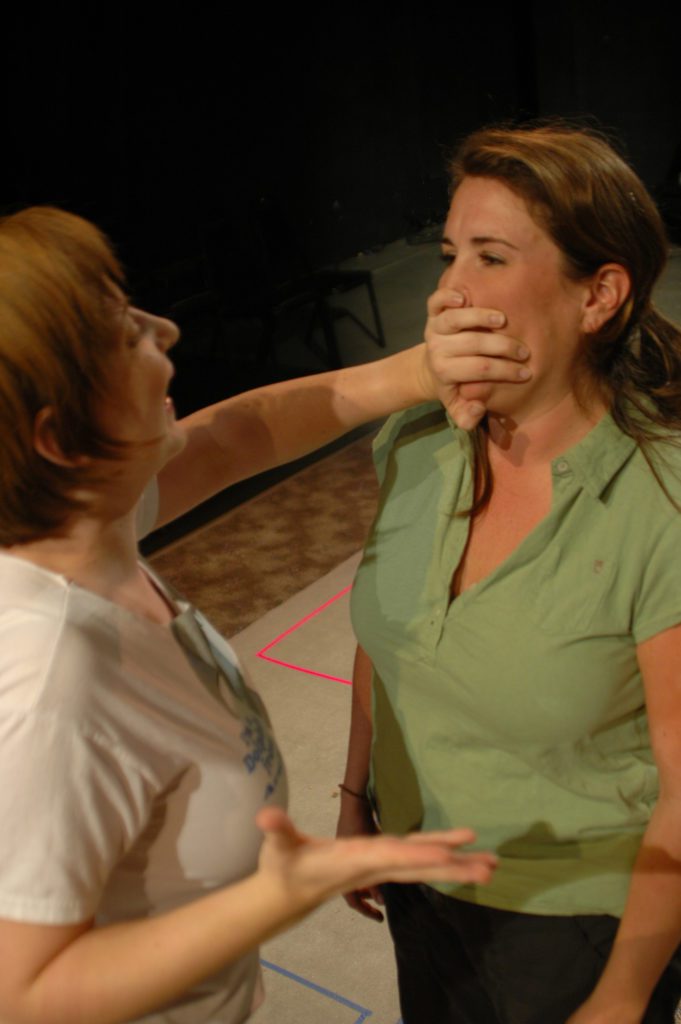
One woman holds her hand over the mouth of another woman.

Westword- Sketchy Stuff • Buntport’s Macblank, while funny, feels like an extended skit

In putting together their original comedy Macblank, the folks at Buntport relied on the theatrical superstition that there’s a curse on Shakespeare’s Macbeth and that those performing it are in danger of unknown catastrophe. There really are actors who refuse to speak the play’s title in a theater, and it’s well known in theatrical circles that if the name has been spoken, the speaker must turn three times and spit over his left shoulder. Or quote a line from A Midsummer Night’s Dream. Or something like that.

Macblank involves a company of five that is developing an experimental version of “The Scottish Play,” and their curse is Beth, played by Erin Rollman, who’s both the most superstitious and the most murderously ambitious member of the cast. Beth is blind, self-righteous, a whiner and a bully. She’s followed everywhere by devoted Greg (Evan Weissman), who’s given to quoting outworn proverbs and uttering strange non sequiturs. Hannah Duggan’s Miranda tries to serve as the voice of reason, but she only becomes genuinely animated and involved when describing her own life, whose turns and twists mirror several of Shakespeare’s plots. Brian Colonna is Rob, who lives a typical actor’s life. That is, he works six jobs, arriving at the theater exhausted to watch in horror as everything falls apart. And, of course, there’s the company star, the guy with the phony British accent: Ryan, as played by Erik Edborg.

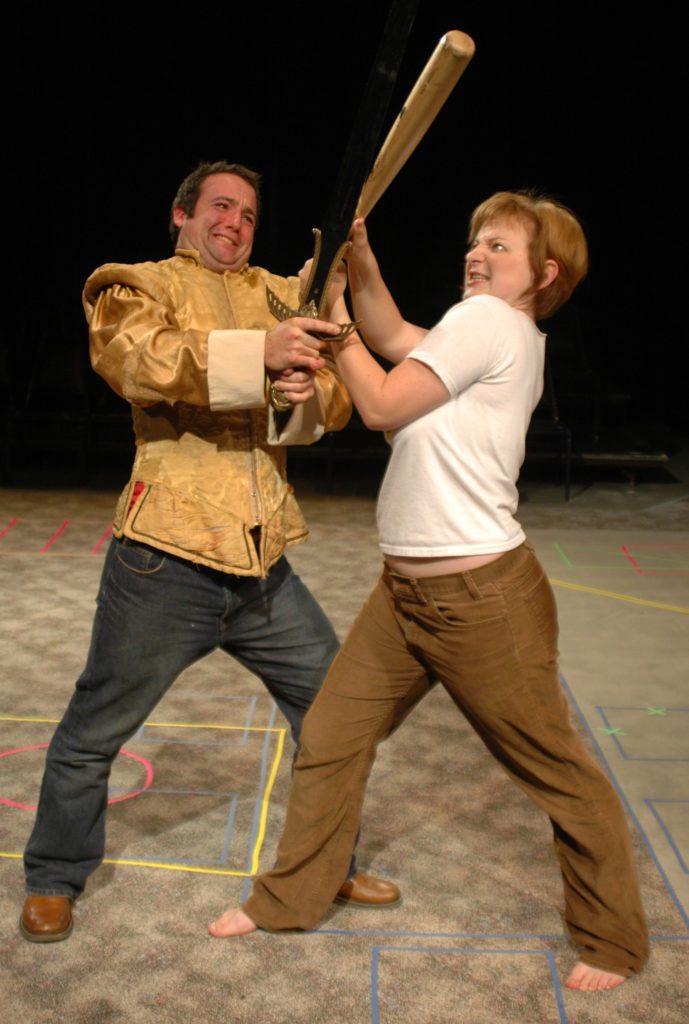
These are smart, inspired and highly original comics, and their audacity alone has the audience spluttering with laughter. Beth recites, with profound satisfaction, example after example of problems attending Macbeth productions (she knows, because she’s Googled the topic); consults her horoscope in Cosmopolitan for hints that she, not Ryan, should be playing the lead; ignores lovelorn Greg; and wields a baseball bat with fiendish determination. Miranda glows as she describes a boyfriend “hung like a donkey,” a cousin who was served gerbils baked in a pie, and the time she accidentally made out with “a girl dressed as a guy.” The best monologue is delivered by Greg, who describes his childhood performing experiences in a meaningless mishmash of sense and sentiment that includes memories of his grandmother’s gifts of packets of saccharin. This is the kind of odd, discursive humor pioneered by the late, lamented Andy Kaufman — except that where Kaufman, under his mask of innocent passivity, was clearly a hostile character, Weissman’s Greg is all shiny eyed ignorant sweetness.

Buntport opened two shows in tandem this season. The first, Kafka on Ice, is brilliant, while Macblank shows signs of being hastily put together. Edborg, in particular, seems to only half inhabit his role. Ryan is fascinating at the beginning, and Edborg certainly rises to all the big comic moments, including a brilliantly uninhibited rendition of Puck’s epilogue in Midsummer Night’s Dream, but the English accent comes and goes, and when Ryan sustains a leg injury, Edborg can’t even be bothered to limp, climbing onto a chair with the supposedly injured limb taking all the weight — an Acting 101 mistake.

Macblank is more an extended comedy sketch — albeit a sophisticated one — than a play. After a while, the humor begins to feel a little repetitive, and you want a trace of plot and some character development. Still, even though this show lacks the inventiveness of Kafka on Ice, it makes for an entertaining evening.

-Juliet Wittman, October 28, 2004, Westword

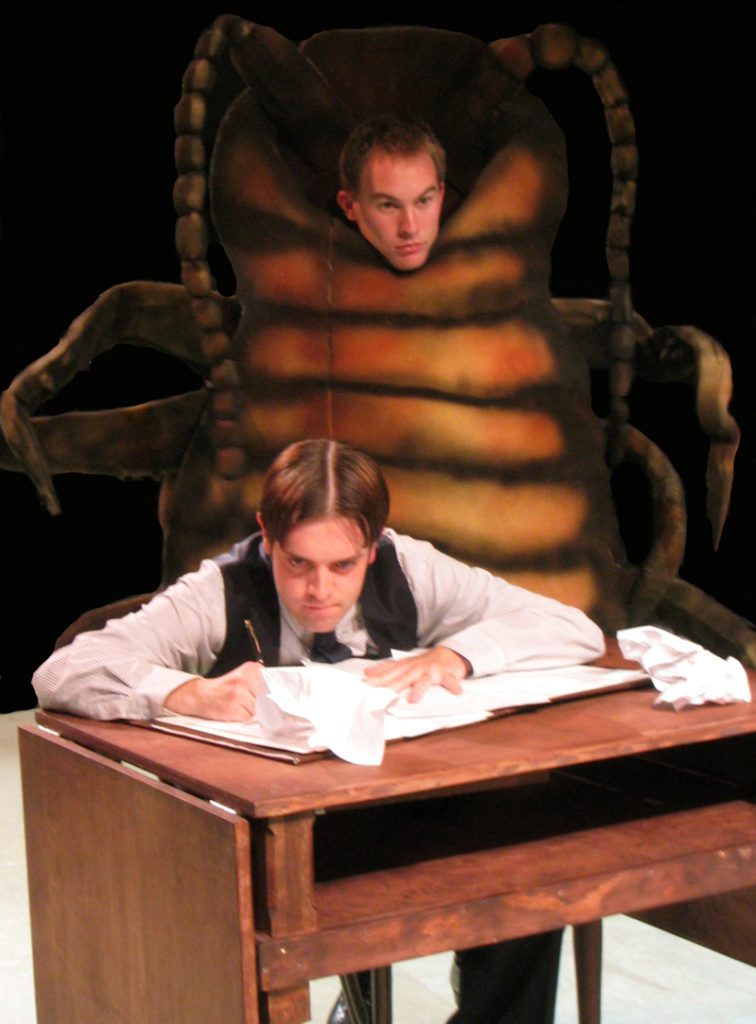
A man writing at a desk concentrates as a large beetle looms behind him.

Rocky Mountain News- Kafka’s life gets a frivolous spin • Buntport skates over a few of play’s themes for sake of humor

More frivolity onstage occurs during the 90 minutes of Kafka on Ice than Franz Kafka probably saw in his entire life.

The socially maladjusted Kafka comes in for Buntport treatment in an original show that weaves together Kafka’s life; his most famous story, The Metamorphosis; and an ice capades show.

If this isn’t the highest of Buntport’s achievements, it’s because the themes of the play never quite mesh with its presentation, delightful though it may be. Company members awkwardly, often hilariously, skate their way across a green synthetic rink without ever drawing parallel between the ice and the wintry discontent of much of the author’s life.

As Kafka, Gary Culig tamps down his often manic, childlike persona to capture the internalized, sickly and emotionally thwarted man who died at 30 of tuberculosis with relatively little fame. It took his longtime friend, Max Brod (Brian Colonna) – who overrode Kafka’s last wishes and published him posthumously – to turn a man into an adjective for a world filled with threatening, anonymous forces.

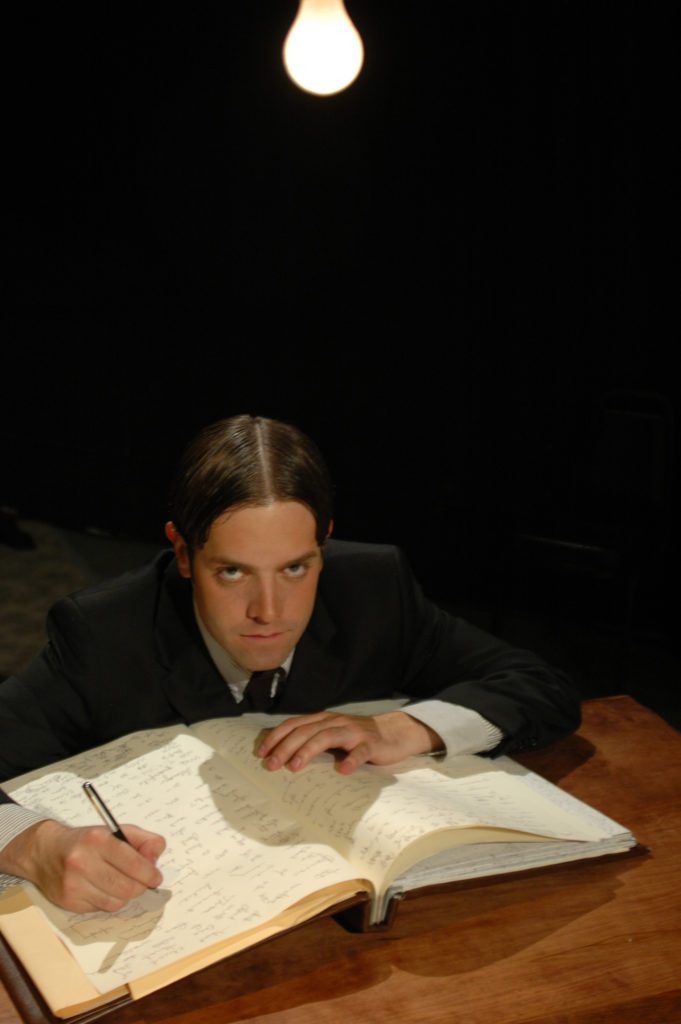
The play opens with the Czech author bent over his writing table under a bare bulb with the piped-in disconcerting sound of a pen scratching (a sound that, in one of the play’s most clever developments, later resembles that of a fidgeting insect).

There are scenes throughout that bring new levels of invention to Buntport’s repertoire. Kafka’s first sexual experience is dramatized as a silent film, complete with flickering lights, title cards and Erin Rollman clumsily skating in for romance.

Less original, but fun to watch, is the representation of the academic debate over just what kind of insect Gregor Samsa becomes in The Metamorphosis, a beetle or a roach. A microphone drops from the ceiling and a boxing match ensues as Colonna and Evan Weissman, insulated by huge foam insect costumes, battle it out until they fall on their backs.

Because he died so young, Kafka’s life was told by others. Buntport gives too much time to the opportunistic diarist who sold his memories of Kafka, and never quite draws the connection between the writer’s overbearing father and his writing. And while we see a series of failed love affairs – mostly with women played by Hannah Duggan – we don’t get much insight into why Kafka was so isolated.

In fact, here the highest peaks are themselves isolated moments, as when Kafka’s letters are projected into luminous swirling script around the theater, or the ridiculous ice pas de deux in which Culig skates in his oxfords. A death scene in which Kafka sings like Angel in Rent just seals the case: Buntport has a lot more fun with his life than he did.

-Lisa Bornstein, October 22, 2004, Rocky Mountain News

On a carpeted floor, two people are in a battle. One has a sword, the other has a baseball bat.

Denver Post- Curse of Macbeth: “Macblank” loses steam

Who would have thought if you pitted William Shakespeare against Franz Kafka mano a maggot, the bug would squash the Bard?

When it comes to the two original productions the Buntport Theater Company is running in repertory through Dec. 3, “Macblank” is an amusement compared to the more sophisticated and realized “Kafka on Ice”.

No one produces original ensemble comedies with the intelligence and depth of Buntport. What makes them so magnificent is that they have such a low threshold for boredom. They constantly concoct artistic challenges for themselves both noble and mad. Here, not content with merely presenting their 14th new collaboration, they are debuting Nos. 14 and 15 simultaneously.

“Macblank” would have made for a fabulous episode of Buntport’s winter side gig, “Magnets on the Fridge,” the biweekly original sit-com that returns for a fourth season Nov. 16. Each episode is loosely based on a random book title, and “Macblank” plays as if the Scottish play were the most recent slip of paper pulled from the lunch pail.

Each “Magnets” episode is developed in its miraculous entirety in two weeks. That is part of the appeal. But as a mainstage production, “Macblank” feels similarly rushed.

“Macblank” is constructed, too loosely, as a documentary of one company’s doomed production of “Macbeth,” the world’s most famously cursed play. So many bad things have happened during 400 years of productions, thespians won’t even utter the title inside a theater unless in performance.

“Macblank” is so pregnant with parody possibilities, it’s like plugging fish in a pond. The Buntporters lampoon all those “Macbeth” superstitions while sweetly toying with the peccadilloes and insecurities of actors and poking self-effacing fun at themselves.

The “Macblank” troupe consists of five lovingly hardcore theater geeks whose names have been changed to protect them from being too easily compared to the Buntporters playing them.

Stuffy Ryan (Erik Edborg) dons a faux British accent from having lived in London for 21 months as a boy. Rob (Brian Colonna) is the typical tense actor working six miserable jobs. But underdog Evan Weissman walks away with the show as misfit Greg, the prototypical theater outcast. He’s a sweetly insecure loner looking more for a home in this theater (or a girlfriend) than a calling. Greg constantly blurts awkward non-sequiters that ring painfully true to anyone who has ever tried a little too hard to fit in.

Then there is Beth (Erin Rollman), heartbreakingly passive-aggressive and growing drunk with desire to improve her position in the production. You know there must be underlying parallels to Shakespearean text, and in Beth we are clearly witnessing a descent into murderous madness to match the killer king. Ah, such a thin line between a curse and a capital crime.

Between scenes, cast members offer “Real World”-style confessionals. Most amusing are Miranda’s (Hannah Duggan) real-life travails, all of which parallel Bard works such as “Romeo and Juliet,” “Hamlet” and “A Midsummer Night’s Dream” (my boyfriend looks like a donkey!”).

But as the evening wears on, “Macblank” runs out of steam. The evening is dominated by Beth’s anecdotes about past cursed productions, and a device that works initially grows tiresome. More fun could have been had with the fact that Charlton Heston once suffered severe burns on his groin from wearing tights that had been “accidentally” soaked in kerosene in a 1953 production.

Because the company’s adherence to “Macbeth” parallels go by the boards, the evening ends with a thud. Our perpetrator suffers no consequences, and no outsiders sweep in to clean up the mess.

But there are worse things that could be said of a company than that really it only suffers in comparison to itself. Call it the curse of Kafka.

-John Moore, October 21, 2004, Denver Post

A serious man looks up from a desk where he is writing. A single bare lightbulb hangs above.

Denver Post- Existentialism On Edge

On its synthetic surface, the premise of “Kafka on Ice” sounds as slippery as a fiddler on the roof. “Kafka on Ice”? What’s next? “Asimov on AstroTurf”?

“Shakespeare on Steroids”? “Capote on Peyote”?

But the Buntport Theater Company consistently makes miracles seem mundane. In this case, they stage the life of Franz Kafka with accessible intellect, self-effacing humor … and all the musical flair of the Ice Capades.

The crowd is seated around a rectangular synthetic surface, upon which the actors can skate as naturally as if they were in a real rink. We are introduced to Kafka (guest artist Gary Culig) as five company regulars spin and salchow around him in white figure skates and Lycra tights. Kafka’s grandfather, we are told, was so strong he could carry a sack of flour in his teeth, and whoosh! Here comes teeth-clenched Hannah Duggan speed-skating across the stage like Apolo Ohno.

The premise is not entirely ridiculous. The skating is choreographed so precisely, it actually adds elegance to the storytelling by heightening the pace and rhythm. That Kafka is the only character not on skates is consistent with his place as one of history’s quintessential loners. And there is even a literary basis: “I hold onto facts,” Kafka wrote in his journal, “like a beginner learning to skate.”

OK, that’s all a bit strained. The Buntporters skate because it’s fun … and funny.

Kafka’s bio is woven into a dramatization of his classic 1912 story “The Metamorphosis,” in which traveling salesman Gregor Samsa turns into a monstrous vermin.

Kafka died at 40 of tuberculosis, and much is made of how his private writings were later exploited for profit. Pesky acquaintance Gustav Janouch (Evan Weissman) even took his largely fabricated conversations with Kafka and sold them as a doctrine advocating libertarian socialism.

On stage, Kafka is horrified to learn these ramblings have been analyzed, recycled and turned into, well, this play. “But you love the theater,” friend Max (Brian Colonna) goads. “I am not sure this qualifies,” Kafka replies dryly.

It does. “Kafka on Ice” not only presents real insight into the man who came to embody all beaten down drones, it offers terrific opportunities for Buntport’s signature form of experimentation.

Kafka’s first, awkward sexual encounter is played out as a silent film. His briefcase opens into a miniature, 3-D map of 1883 Prague. The words of his short story unfold into a life-size man, with whom his lover dances. Music, costumes and video projections inject further understanding and humor. It is no accident that the sound of Kafka’s pen scribbling on paper duplicates the sound of Gregor’s bug scurrying across the floor.

This is another superb ensemble effort, but the smartly understated Culig stands out in the featured role. The most sublime moment is a wholly tangential scene in which Kafka finds himself in a contemporary English class led by a teacher (Erin Rollman) hilariously bluffing her way through Kafka’s text with the help of an online lesson plan.

“Kafka on Ice” has its problems. It intentionally loses its grip by turning almost wholly into a bad 1970s musical offering a much happier alternate ending to “The Metamorphosis.” No real attempt is made to explain why Kafka remains a beacon for the alienated and downtrodden. Or that buried in Kafka’s work is real hope.

The irony of “Kafka on Ice” is that Buntport never skates. Not only have they brought this enormously original work to life, they are performing it in repertory with another entirely new work, “Macblank.”

-John Moore, October 15, 2004, Denver Post

A man in stark lighting holds a briefcase while looking out of a windowpane.

Westword- Cutting-Edge • Comedy Buntport’s Kafka on Ice slices up the melancholy author’s life

The parking lot is full, and cars line the curb on both sides of the street. Inside, people throng the lobby. A couple is being turned away at the front desk: “I’m sorry. We’re all sold out.” When I first visited this place a few years ago, there were seven or eight people in attendance, including myself and my friend. Now word must be out that this is the place to be on Saturday night: Buntport Theater, the opening of Kafka on Ice.

We find seats and settle in to clip-cloppy, ’30s-style music that sounds like the Charleston. We’re going to be close enough to the action to see the sweat shine on the actors’ faces. There are rows of chairs on all four sides of a green square of artificial ice – not gleaming ice-rink stuff, but something that looks like ancient linoleum, scratched and scuffed.

What on earth do these people at Buntport think they’re doing? Franz Kafka is a melancholy figure, a Prague-dwelling German Czech, steeped in the history of his time, the creator of a dwindling, despairing art. Not noisily or grandly despairing, but art that’s a kind of falling away, a hopeless whispering, the toneless song of Josephine the Mouse Singer, the silent melting of flesh from bone in The Hunger Artist, an art of terror, self-loathing and wordless longing for what can never be attained – and all of it limned in that precise bureaucrat’s prose. Kafka’s best-known works include a novel about a man tried for an act he doesn’t even know has been committed – let alone by him – and ultimately executed. Another describes a castle from which it’s impossible to escape. And then there’s the long short story called The Metamorphosis, which almost every high school student knows and which begins, “As Gregor Samsa awoke one morning from uneasy dreams he found himself transformed in his bed into a gigantic insect.”

But all of these cheerful Saturday-night people haven’t come here to explore the sorrows of old Europe. They’ve come for a good time. And the Buntporters aren’t exactly known for their worshipful treatment of the classics. But then, they’re not known for denigrating or nullifying or being plain dumb about literature, either. So what are we going to see?

The bouncy music stops. In the darkness that follows, we hear the scritching of a pen on paper, like the sounds of a skate blade on ice. Under the sudden illumination of a single, bare lightbulb, we see Kafka, played by Gary Culig, writing at a desk. Within minutes, the rest of the cast has skated on in impressive unison – yes, wearing real skates – and the show takes off.

Kafka on Ice is part biography. It tells Kafka’s story, about his fear of his overbearing father, his unhappy love life, his friendship with Max Brod, the way in which Gregor Samsa’s predicament represents his own. But it also deals with the way a work like The Metamorphosis changes over time, as it passes through the minds of friends, readers, critics, fellow writers, teachers and tricksters like the Buntport gang. So at one point you have the great novelist Vladimir Nabokov (played by Erik Edborg) arguing that, contrary to some critical opinion, the insect in The Metamorphosis is clearly a beetle, not a cockroach. Then there’s a teacher (a hilarious performance by Erin Rollman) trying to communicate the idea of symbolism to her bored class while peeping periodically at her own cheat notes. The lights go out, and a voice reads a passage aloud in the darkness, bringing clarity and focus to the words. When the lights return, we watch a schoolboy cross the stage with his satchel on his back, reading as he walks.

The Metamorphosis goes through several transmutations: It’s played as farce, as an experiment with objects, as grinning, dancing musical comedy.

Buntport has its own way of dealing with Kafka’s life story. The writer’s meeting with his first love, Felice, is shown as a scene in a silent movie. She falls cutely about on the ice, while he, Chaplin-like, attempts to rescue her – all to the accompaniment of a plinking piano.

This show is anything but Kafkaesque. It’s lighthearted, giddy and goofy. As written, the climax of The Metamorphosis begins with a heartbreaking scene in which Gregor is drawn from his seclusion by the haunting sound of his sister playing the violin. In Kafka on Ice – which has earlier referred to Kafka’s thoughts on his own Jewishness – he hears the violin solo from Fiddler on the Roof.

Buntport creates an Alice in Wonderland world where objects take on their own life and shrink and grow at will. The city of Prague is represented by a pop-up in a book. Gregor Samsa is at one point a glove puppet, seconds later a remote-controlled mechanical toy, and finally, a costumed actor.

There are some really beautiful moments. Kafka sends Felice one of his stories to read; in her hands, it unfurls into the paper figure of a man, and she dances with it. “The writing does quite well with her,” observes Kafka. When Kafka proposes to another love, Milena, his words are made of light, flowing over the rows of audience members, across the ersatz ice and away up the walls. Her response is a calligraphic “Yes.”

I have a couple of quibbles. Every now and then, the script is repetitive. Culig is a good actor, but he has an endearing, vulnerable quality that doesn’t feel quite right for Kafka. Brian Colonna’s Max Brod is pinch-faced, squeaky-voiced and very amusing, but too much of a caricature – both as performed and as conceived. The real Max Brod was far more than a leech who took advantage of Kafka’s fame; he was also the author’s longtime friend and loyal advocate. But all six actors do well. Erik Edborg has to stifle his insanely anarchic instincts to play Kafka’s heavy-handed father, and it works. Evan Weissman’s turn as the charlady (in a uniform that’s pure French maid) is a hoot, as is Hannah Duggan’s determined yet perplexed expression every time she skates across the stage with a flour sack in her mouth (don’t ask). As for Erin Rollman, I don’t have words to describe her performance. She’s a brilliant comic universe unto herself.

All of which explains the crowd in the lobby. It’s safe to say that no one else – anywhere – is doing theater like this.

-Juliet Wittman, October 14, 2004, Westword

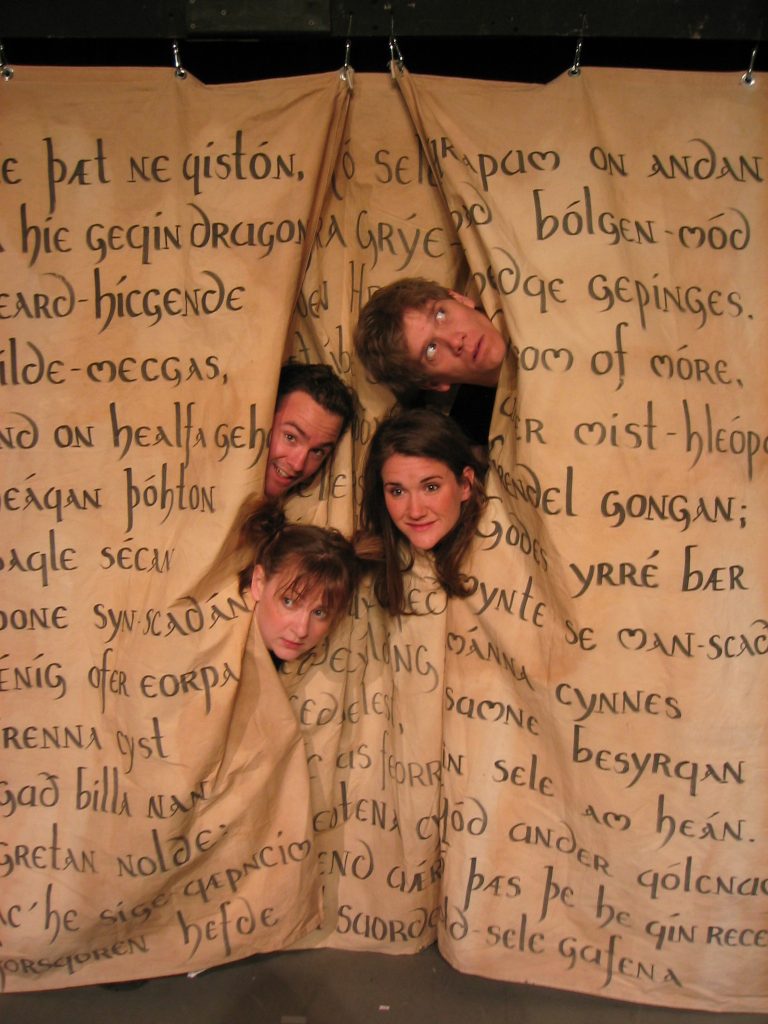
Four people poking their heads through the backdrop with the Old English Poem Beowulf written on it.

Westword- Cutting Edge

Buntport Theater has fun with one-acts and paper props

Now that Buntport Theater has come of age and is attracting reliably positive reviews and large, enthusiastic audiences, the six company members have revived one of their earlier works, an evening of one-acts titled 2 in 1. The first piece, “This is My Significant Bother,” is a dramatization of nine stories by James Thurber; the second is an explication of the Cliffs Notes explication of Beowulf (it makes sense when you see it — sort of). These are both slight pieces, but they’re clever and entertaining, and the sets and costumes are as inventive as ever. It’s pretty much impossible not to have a good time at Buntport.

As the evening begins, four actors — Brian Colonna, Erik Edborg, Hannah Duggan and Erin Rollman — are lying on a large bed, their left arms in perfect alignment on the coverlet, their hands conspicuously wedding-ringed. They manage to stay absolutely still as the audience arrives and settles in. Perhaps they’re asleep. One of the evening’s pleasures is the way the actors manage to move swiftly and soundlessly during blackouts, so that we’re always slightly surprised at where they’re each standing or sitting when the lights come on.

Although he apparently labored over their composition, Thurber’s stories are sketches rather than fully developed character studies or descriptions of events. They have the wistful, unfinished quality of his New Yorker cartoons, along with a misogyny so self-deprecating that it almost seems forgivable. If his women are all-powerful, soulless harridans, well, his men are pretty silly, too, and sometimes downright irritating. (Although, in a fable Buntport doesn’t attempt, it’s only the male of the species who’s capable of seeing a unicorn in the back garden.)

“Significant Bother” is not intended to be laugh-out-loud funny. It’s a sincere and gently humorous homage to Thurber.

A husband manfully protects his wife from a spider but cowers under the bedclothes when he hears a bat. A woman stands up in court and insists she deserves a divorce because of her husband’s habit of holding his breath. In one of the most absurd and amusing pieces, a police officer finds a woman seated in a car while a man crawls on the ground in front of the vehicle; they are trying to ascertain whether a human being’s eyes will glow in the headlights as a cat’s or dog’s would. In another car scene, this time inside the car, a couple fights over whether Greta Garbo is a more important cultural icon than Donald Duck and bickers about where to stop for a hamburger, the wife insisting that the eatery must be a cute one. Meanwhile, the car is emitting a threatening and unidentifiable noise. Yet another husband orders his wife into the basement so that he can kill her and make off with his stenographer. Wise to his plan, she gives him orders on how to accomplish the deed. All of this is interspersed with interesting renditions of such ’30s songs as “Makin’ Whoopee” and “Happy Days Are Here Again.” And the bed that anchors the play (in the very last scene, a man painstakingly smooths the sheets while his ex-wife discusses his failings with his wife-to-be) is manipulated by the Buntporters with their usual sangfroid, becoming by turns a car, a platform, even a cellar.

Perhaps the most interesting and unexpected piece is a mood story about a doomed love affair called “Evening’s at Seven,” which is told through a series of lighted tableaux separated by patches of darkness. It’s touching, original and sophisticated.

For the second play, the cast appears in front of a backdrop of text wearing dark-blue maintenance men’s outfits and tool belts that hold an arsenal of paper props. They proceed to act out the story of Beowulf, interspersing the action with textual commentary — and their own acerbic comments. In case you’ve forgotten, this Old English poem concerns the predations of a monster, the monster’s dam (or, as the Buntporters have it, “dam mother”) and a dragon. As always, the props are inventive; in this instance, they’re made entirely of paper. Beowulf’s army consists of a string of paper cutouts worn across Edborg’s chest like a bandolier; streams of paper representing blood from a wound are helpfully and multiply labeled “blood,” just as the paper crown bears the legend “crown.” The paper dragon is a thing of wonder. Periodically, we hear a voice reading from Beowulf itself and — though you’d need to know Old English to understand the words — the power and beauty of the text makes itself felt through all the loony shenanigans.

The acting is terrific, as always, though it concerns me a little that both Colonna and Edborg act so much from the neck upward. I’d like to see their voices and impulses coming from deeper in the body. In addition to the cast, Matt Petraglia, SamAnTha Schmitz and Evan Weissman helped create 2 in 1.

I’m getting tired of saying this, but if you haven’t attended a show at Buntport yet, you should. You won’t see anything like it anywhere else.

-Juliet Wittman, May 6, 2004, Westword


Four confused people wearing utility suits and utility belts with origami paper props hanging off of them are standing in a line. One of the people is wearing a huge Viking horned helmet made of paper. The helmet is covered in the word 'helmet.'

Rocky mountain news- Buntport brilliant in reprise of ‘2 in 1’

Buntport brilliant in reprise of ‘2 in 1’

You Buntport-come-latelies will want to hie yourselves over to Lipan Street and see how it all began, as the seven-person collective resurrects its second show. With the two one-acts that make up 2 in 1, Buntport reveals that its group’s amazingly cohesive aesthetic emerged full-force, like Venus from the half-shell, wearing a Groucho mask.

The two works together also demonstrate the breadth of Buntport’s abilities, from wry ’30s charm to a postmodern spoof that provokes such deep guffaws smokers may want to take precautions.

In . . . and this is my significant bother, the short stories of James Thurber are adapted into vignettes drawn with the light touch of one of the author’s own New Yorker cartoons. Each one tackles the foibles of marriage from its own angle, with the actors in superb period performance.

Brian Colonna personifies the meek, retiring and henpecked husband. He preens with macho pride after swatting a spider, then cowers from a bat. In another story, after falling in love with his secretary, he informs his wife of his plans to kill her, his voice squeaking like a bad hinge. Then he capitulates as the wife dictates exactly how and when the murder will occur.

Erin Rollman’s Betty Boop eyes and Clara Bow lips are a fast-track back to the ’30s, as is a falsetto voice that cries out screwball. In a scene where others voice their thoughts, both she and Colonna perfectly embody the facial tics of a busy brain.

Hannah Duggan, frequently severe or frumpy here, can browbeat without being hateful, and Erik Edborg turns the leading-man image on its ear.

It’s a journey back in time from Thurber to Beowulf, but Act II’s Word-Horde is hilarity of the postmodern variety. Using words in the most ingenious ways as costumes, props and set, they offer up a Cliff’s Notes version of the Anglo-Saxon epic poem that has been the downfall of many a high school freshman.

Not an opportunity for humor has been missed here, but none of it is superfluous or comes at the expense of the actual tale of Beowulf. Massive sections are dramatized in summary (don’t miss the human boat or bloody attack on Grendel), followed by pithy “commentary,” aided by a checklist of themes and symbols.

It’s not imperative that you have read Beowulf; it’s only necessary that you have attended school to appreciate the sublime humor of the piece.

Offstage, the four actors are supplemented by Matt Petraglia, Samantha Schmitz and Evan Weissman. In this seemingly anarchic environment, a solid company has emerged that devises the most brilliant of visual and sonic effects, always remembering that theater should enlist multiple senses.

-Lisa Bornstein, April 30, 2004, Rocky Mountain News


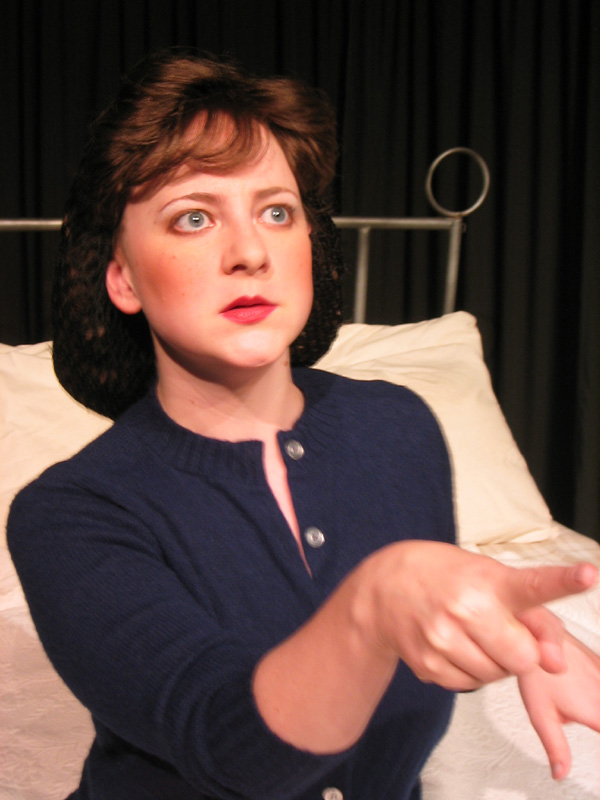
Close up of a woman sitting on a large bed wearing a blue button up sweater. Her long hair is gathered up in a hairnet 1940s style. She is pointing at something in the distance.

Denver post- Buntport finds new laughs in its archives

Adjectives that would seem like useless hyperbole anywhere else often find their legitimate homes when referencing Buntport Theater’s work. The young collective presenting original works on Denver’s Westside really is uniquely talented, madcap with energy and originality, and, as some have said, “genius.”

But nobody’s perfect.

Buntport’s latest excursion is the old-school “2 in 1.” It’s a throwback on multiple levels, but mainly because Buntport performed the two original one-acts in 2001.

Remounts are good business when you’re Buntport and always attracting new audiences to your mainstage productions and the excellent, biweekly “Magnets on the Fridge,” which closed for the season last week. It gives newbies a chance to see the work that made the company what it is today.

But Buntport has moved forward and, dare I say it, matured a lot in the three years since these were first produced. The interim has seen multiple self-written and -directed full-length plays, one-acts, “Magnets” episodes and at least one musical for this company, one of the busiest in town. So reaching back into their short history has to come at a sacrifice.

Act one is “… and this is my significant bother,” the Buntporters adaptation of some of James Thurber’s short stories. They attempt to explore the American humorist’s literary world, which is full of insight into both relational psychosis and the mind of the individual Everyman in mid-20th century America. Although the series of stories operates partly on Buntport constants (including an excellent multipurpose set and the use of different storytelling voices), it doesn’t always hit.

The theater company is obsessed with style and period and varying their stories’ approaches whenever they can, so this – subtle scenes involving couples in bed, kneeling in front of a running car, or amid awkward conversations about loving and longing – is Buntport’s tribute to the America of “New Yorker” cartoons in the ’30s and ’40s.

And it’s fair to say that this style doesn’t work as well for Buntport (and its core audience) as, say, the detective aesthetic of the ’40s – the setting of their tight, seriocomic “McGuinn and Murry” – or the Elizabethan era that was home to its spoof on Shakespeare, “Titus Andronicus: The Musical!”

They hit most clearly in one short where Brian Colonna’s aloof husband tells Hannah Duggan’s hard nosed wife of his plans to kill her and marry his stenographer. “No, I’m not going to bed,” he quips toward the end. “I’m going to bury you in the cellar.” It’s the least subtle of the pieces, but it’s also the one that clicks on levels that venture beyond the players psychoanalyzing simple-minded, nostalgic, Rockwellian images.

They get closer to comfort with act two, “Word-Horde: A Dramatization of the Study Guide to Beowulf,” which could be called “Compleat Text of Beowulf (Abridged).”

With the help of an ominous, omniscient voiceover acting as the voice of reason, the four Buntporters (Colonna, Duggan, Erik Edborg and Erin Rollman dressed in black and yellow mechanics scrubs, an homage to Cliffs Notes) act as the Everyman student circa 2004, mumbling obscenities and frustrations underneath faux-sneezes as they work their way through the text line by line … almost.

Like “Titus,” “Beowulf” lends itself to the self-deprecating, fast-talking production style. It’s olde, wild and weird, and the Buntport players – whose outlandish writing is more concise and pointed here than in the first act – seize every opportunity to poke fun at the book and themselves.

They perform against the backdrop of an enlarged version of the aged text. Props and costumes made of paper, handily attached to their tool belts, help move the story forward. And the audience gets a treat – we’ll call it Buntport spectacle – when it comes to the dragon at the end of the story.

The two shorts work better as a pair than they would work alone. The night gets off to a slow start. But it builds with Buntport’s incredible attention to detail, such as Duggan’s tuning the car radio in the first act, a pantomime timed perfectly with the audio. And it closes with a laugher.

Not genius, especially when held up to their previous work. But still not a bad night of theater.

-Ricardo Baca, April 30, 2004, Denver Post

Denver Post- Buntport just a bit off with ‘McGuinn’

Every time the Buntport Theater takes to the stage with its latest original production, you can all but tape-measure the leap in its rapid development as an innovative, intelligent and comic young theater company.

But that does not equate to a satisfying evening for its audiences every time out.

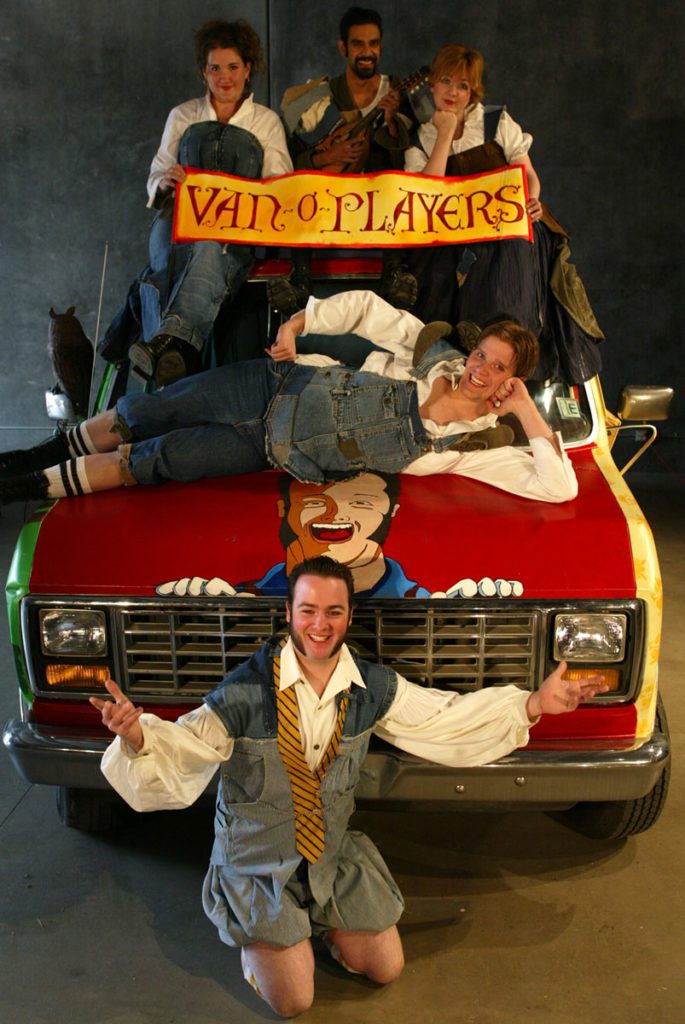
Buntport is a 5-year-old company that presents only ensemble works of its own creation. A glorious musical adaptation of “Titus” performed in a transformational van put Buntport on the local map in 2001.

Last year’s Kabuki-esque “Cinderella,” featuring actors changing form and character before our eyes with a script written entirely in gibberish, helped Buntport win The Denver Post’s Ovation Award for best new work.

“McGuinn and Murry,” its 13th and latest production, is easy to like but nearly impossible to love.

In some ways the play is both spoof and homage to 1940s Raymond Chandler-style film noir. Its malleable magic is immediately evident not only in the way two terrific actors (Brian Colonna and Erin Rollman) slip in and out of the skins of eight (by my count) characters, but more impressively in the way one simple, large office desk spins, splits apart, expands, collapses and unfolds into seven distinct and often surreal settings.

But “McGuinn and Murry” is more clever in concept than in execution. It falters in the one department where Buntport has been above reproach. The writing, so consistently taut and clever in nearly every previous staging, lacks its usual confidence, precision and wit. The dialogue is uncharacteristically repetitive and only occasionally rises to the witty repartee of the period it satirizes (A terrific exception: “Let’s all put our pieces down before someone squirts metal”).

Worse, the constant yelling establishes a tone that goes beyond the tough-talking demeanor of the day and strangely into the realm of the cold and mean.

As a result, we have exasperating characters telling a tiresome story that becomes intricate to the point of oblivion.

McGuinn (Colonna) and Murry (Rollman) are a pair of hard-boiled detectives, partners seemingly patterned in the vein of Nick and Nora Charles, minus the sexual tension. They are so underemployed they make up fictitious crimes to solve. When McGuinn says, “Even our pretend cases are dull, doll,” he’s not kidding.

But one morning, a series of misunderstandings propel the plot on a course that is part “Maltese Falcon,” part “Murder By Death” and part “Three’s Company.” After his wife has gone missing, the whiskey-soured McGuinn comes to believe he may have played a part in her disappearance.

The charm of the production is also its downfall. Audiences watch as the realigned set pieces take us to unexpected locales. With four sticks and some rope, for example, the desktop cleverly becomes a boxing ring. While most settings are grounded in reality (a restaurant, nightclub, park), others are straight out of “Being John Malkovich” in the way they play with spatial distortion.

The desktop rises to become the front door of an apartment where, when McGuinn walks in, he immediately finds himself atop a kitchen counter. In the evening’s extended climax, the desk turns into a miniaturized skyline where, from our faraway vantage point, we see a chase played out with Matchbox cars.

But these brilliant transformations require so many long and choppy set changes that they sabotage the storytelling momentum. The payoff requires far too much patience.

But even on an awkward opening night, it was clear Rollman and Colonna are two of the best and smartest performers working in Denver.

Rollman has the most fun of the two, playing characters such as an uptight Murry, McGuinn’s ditsy wife Budge and an uncanny “Fat Man” – an oxygen-deprived old fight fixer. She also has the best lines, such as when, as Budge, she discovers a letter advising McGuinn to get rid of her. “I don’t think my husband should be receiving a letter like this … not at the house, anyway,” she says in a sublime moment.

Colonna’s Phillip Marlowe-like McGuinn draws somewhat on Humphrey Bogart, Robert Mitchum and Jackie Gleason, but he’s at his best when he’s simply being himself.

There is every likelihood that with pros like Colonna and Rollman, “McGuinn and Murry” might still find the right comic tone. But even if it is not Buntport’s best work, Buntport on an off-night is still better than a night at many other theaters in town.

-John Moore, January 09, 2004, Denver Post

A 1940’s looking detective wearing a fedora hat looks off into the distance dumbfounded with a cigarette hanging out of his mouth while his female partner looks worryingly at him.

Boulder Daily Camera- Noirish ‘McGuinn and Murry’ is clever, but that’s it

Buntport Theater is a group of young theater artists who located to Denver after going to school together in Colorado Springs. The company has carved out a niche for itself locally with a clever brand of comedy and a reputation for prolific output since it moved into its current space in 2001.

And, as evidenced by last week’s opening, Buntport already is an important addition to the local theater scene, if for no other reason than its youngish audience, significant for an art form that tends to rely on an older crowd for its patronage. The opening night sell-out crowd for “McGuinn and Murry,” the company’s 13th original production, was made up largely of people in their 20s and early 30s, most of whom already were familiar with and sold on Buntport’s particular sense of humor.

In “McGuinn and Murry” that sense of humor is equal parts silly and clever. It adds up to an admirable production, but one that doesn’t leave a lasting impression.

The play is done in 1940s crime novel style, a la Raymond Chandler and his noirish stories. McGuinn (Brian Colonna) and Murry (Erin Rollman) are partners in their own detective firm. When they can’t drum up any business they resort to creating some of their own. Murry sends a playful note to McGuinn’s home, but Mrs. McGuinn intercepts it and suspects her husband is cheating on her. Mrs. McGuinn has a lover herself, but nonetheless, her suspicions drive her dramatic accusations, which set the quirky detectives into investigative mode.

While Rollman and Colonna star in “McGuinn and Murry,” the company’s five other members – Hannah Duggan, Erik Edborg, Matt Petraglia, SamAnTha Schmitz and Evan Weissman – also receive writing, design and directing credit.

There’s a vibrancy to the group’s effort, including the writing. The script is as smart as it is whimsical, a mix of postmodern irony and hard-boiled ’40s repartee. McGuinn longs to get “the dust of this dirty town off my feet,” but he’s also aware that his current investigation “folds in on itself in a self-reflective manner,” a wink to the audience that he’s aware of the show’s noirish conventions.

And the genius of the play is that the whole thing – the dialogue, the plot, the characters and even the set – keeps folding in on itself in a self-reflective manner. The main stage piece at first serves as the door and office table for the McGuinn and Murry agency, but the contraption, built with several hidden compartments and attachments, unfolds and refolds into the McGuinn’s kitchen, a nightclub, a park bench, an Italian restaurant, and a boxing ring.

Likewise, the actors play dual characters who are mirror reflections of each other – Murry and Mrs. McGuinn are dead ringers for each other, as are McGuinn and Pauly, Mrs. McGuinn’s lover. And the dialogue is sprinkled with funny little lines where the actors comment on what’s taking place with their characters or the story.

One of the best scenes comes when Colonna and Rollman maneuver the set piece into a cityscape that serves as a backdrop for a road trip. They move matchbox-sized cars along a dirt miniature dirt road that sprawls out before the city while playing seven characters who inhabit the cars.

Overall, Colonna and Rollman succeed at pulling off the era’s style, the sharp wise-guy tone done in that ’40s noirish mode. Both understand where the humor is in the script and play it with ease. And they don’t miss a beat as they work the set into its different configurations, no small feat.

Ultimately though, cleverness is all “McGuinn and Murry” has going for it. Great comedy sheds some light on the human condition, however whimsical. But this show’s creators are content to serve up whimsy and cleverness for their own sake. As a story, it’s too convoluted to make a deep impression, and while the show is good for a laugh, it’s neither a lasting nor a cathartic laugh. It’s like a meal that tastes good, but still leaves you hungry.

-Mark Collins, January 9, 2004, Boulder Daily Camera