Buntport Theater

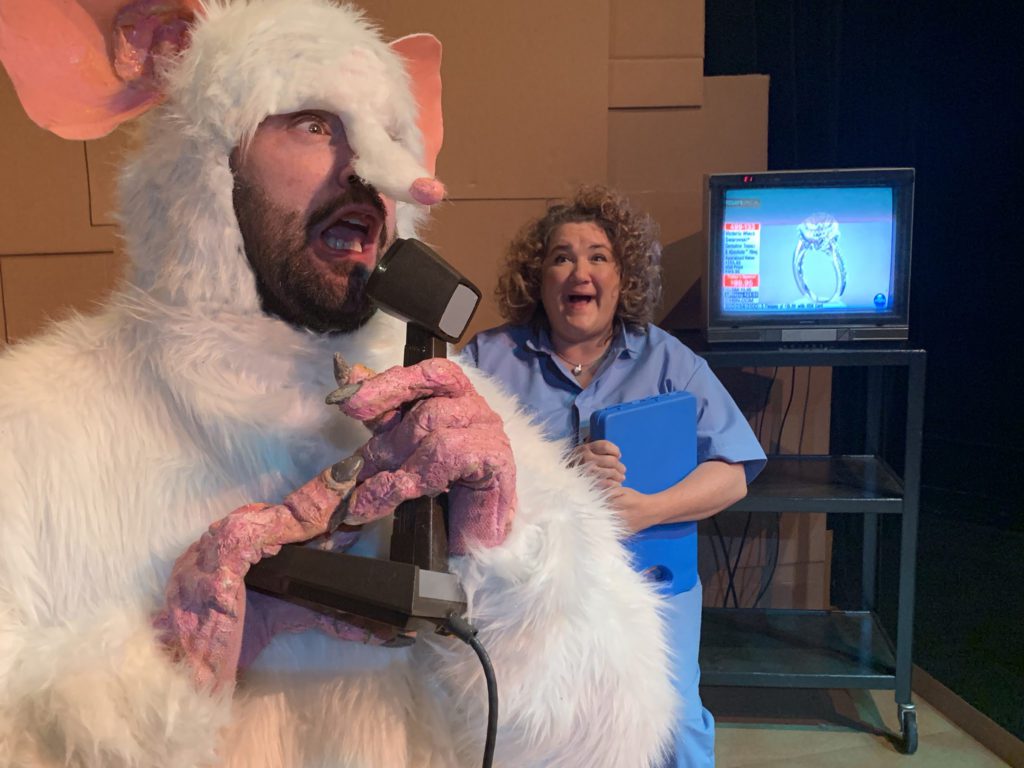
In the foreground a Giant white Rat is yelling into a microphone. Behind him, a scientist wearing a blue jumper and holding a blue clipboard, is smiling. Next to her a television on a cart is showing a ring that is being sold on the home shopping network.

Marlowe’s Musing- UNIVERSE 92 BUNTPORT THEATRE: 9/17 – 10/19

In the Chinese Astrological Calendar next year is the Year of the Rat. We have Buntport Theatre to thank for giving us an early preview and a chance to see 2020 through the lens of their new and original play, UNIVERSE 92.      

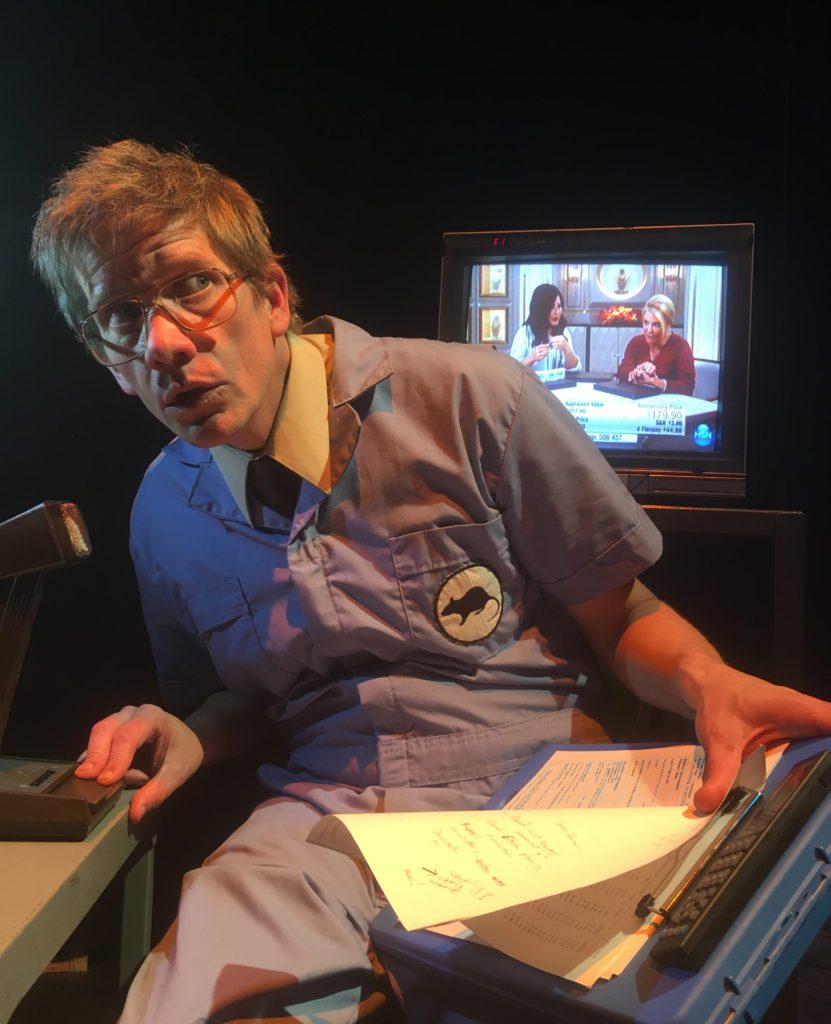
In this work a rodent is observed by three animal behaviorists, who record the animal’s every twitch. Brian Colonna gives a luminous performance as Rat. In the paws of a less talented actor the role might have been cheesier. The three behavioral scientists are played by the other three comic geniuses over at Buntport: Erin Rollman (Dr. Lorelei MacGuire,) Erik Edborg, (Dr. Frank Calhan) and Hannah Duggan (Pamela Hamilton.)     

It’s a bit of a spin on 1984 as in this production Rat sorta kinda maybe has one Big Brother and two Big Sisters who watch over him from the lofty heights of their scientific perch in order to observe his movements and record them in their analytic research. The celery brought in to feed the rat at the performance at which this reviewer was present was just not enough nourishment for a rat that size. You may, as this reviewer did, feel that the rat could have probably used a few more snacks. If one were to criticize the production at all, he might say that there was little realism in the aromatic sensing of the rat by us as audience. (Perhaps the crew cleans the rat cage between performances.)

There is a wonderfully creative use of cardboard for the set and for the bottom of the rat cage! (The newspaper used for sanitary purposes seemed to be especially absorbent and may explain the lack of rat odor. One can only imagine that they must be old reviews from the Denver Post and/or The Thrifty Nickel.) Except for the fact that the rat is made to watch sitcoms on television while lying in his hammock, he/it is treated mostly humanely throughout.  Making a rat watch television and then critique it with however many stars makes one aware of the perils of critics writing reviews from the couch. But I digress. True, the rat is lazy, but it’s always being watched just as Orwell puts forth in 1984. It’s not being given any incentive to find work or even to exercise. 

One feels sad for a rat being forced to lie in a hammock doing nothing for all its life except self-pleasuring and judging new contraptions – presumably from Amazon- that are introduced into its world by self-adulating scientists who misidentify and misapply the tried and true methodology of animal research. At one point in the production a robotic vacuum cleaner – “the sad Roomba” – is introduced into the scenario. Perhaps this may have been a bit ‘de trop’ since the random patterning of its (the roomba’s) search for debris seemed mostly unsuccessful.         

UNIVERSE 92 is silly and just plain fun.

Scamper to get tickets.

David Marlowe September 30, 2019 Marlowe’s Musings

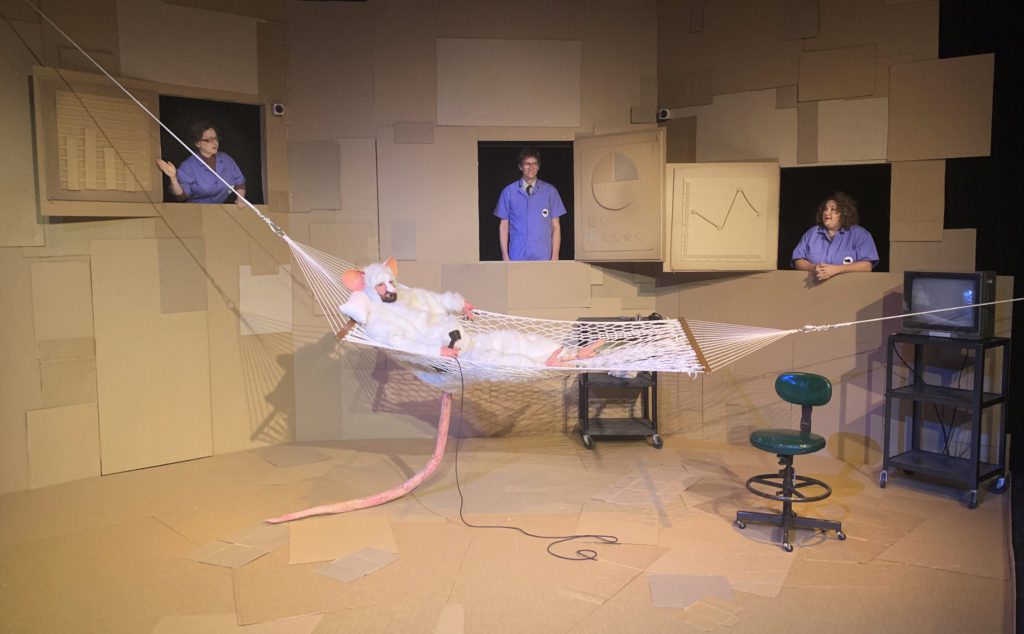
A giant Rat is in a cardboard enclosure laying in a rope hammock with a microphone on his lap. There is a television on a cart, a tall green rolling chair, and another cart with papers on it. In the walls of the cardboard enclosure there are 3 windows. Three scientists are seated in the windows and next to them are cardboard graphs showing weird sciency stuff.

GetBoulder.Com- Theater Review: Universe 92

UNIVERSE 92 – Written and directed by Buntport Theatre Company. Produced by Buntport Theatre Company (717 Lipan, Denver) through October 19. Tickets available at 720-946-1388 or buntport.com.

A new show from Buntport is always a reason to cheer. Some are mostly brilliant; some are really brilliant; and some are brilliantly brilliant. Everyone has their favorite Buntport show and lobby conversations generally swirl around which ones everybody liked the most. A display in the lobby listing every show gets people remembering and laughing at those memories. Their ability to create unforgettable theatre moments is unprecedented. You may not remember how the characters got to that moment, but you will never forget the moment and your reaction to it. There’s also usually one or two laugh till you choke moments in each of their original productions.

This new one is no exception. The main character is a giant rat swinging in a hammock in the infamous Universe 92, the 92nd such universe created for lab rats that are being tested for different things . . . totally stupid things. Like his preference of one over the other episodes of old TV programs. High above and looking down on his cardboard cell are three “scientists” who are watching the rat, asking the questions, posing the situations to determine the rat’s reactions, and arguing among themselves about the value of their work, their treatment of their subject, and each other’s qualifications to do the work. Meanwhile, the rat is being petulant and arrogant, demanding outrageous things just to prove to himself that he’s still the top rat.

Brian Colonna is the Rat with a long tail and his butt sprung hammock. He seems to realize the ridiculousness of the situation, but still plays it for all he can get. Erik Edborg is the most sympathetic of the researchers, even helping Rat escape for a short time. Erin Rollman is the uptight and rigid clinician who doesn’t see anything funny in the situation and is all business. Hannah Duggan is the one who goes along to get along, but still protests over everything. Together they get in each other’s way, never acknowledge the humor in what they are doing and treat the rat like a giant pain in the ass . . . . which he is.

A great deal of the enjoyment is in the attention to small detail and the cleverness of the staging. The entire rat’s habitat is coated in cardboard. Periodically in the course of a conversation or lecture to the audience, one of the players will pull a tab or slide a panel or cut a hole in the cardboard to reveal a flow chart or a diagram to illustrate some “important” point, usually about the value of animal testing. . . in a totally useless way. At one point a whole car made out of cardboard comes out of the wall complete with a small set of dashboard dice also made out of cardboard. The work that went into this complicated and clever set is amazing.

I think just one of the reasons Buntport is so popular with its faithful band of followers – and there are many reasons – but one is that they tackle complex human relationships, complicated philosophical precepts, and both obscure and familiar artistic/literary works and explore them in a new undiscovered way. They do it in a modern vernacular with humor and without taking themselves too seriously. It is performed in such a way that the audience – though unfamiliar with the subject matter – can go right along with them, understanding the conversational dialogue and learning as they go. So at a Buntport show, we are entertained and allowed  – nay, encouraged – to feel smarter than when we came in. We learn while we laugh. Thank you, Buntport.

A WOW factor of 8.5!!

Beki Pineda October 15, 2019 Getboulder.com

Times Call- Buntport Theater’s ‘Rembrandt Room’ offers a retrospective night at the museum

Every great painting should have something to say. But if you spend a majority of time staring at the canvas, you might just miss that the museum guard standing next to the painting also has something to say.

That possibility provides the concept for Buntport Theater’s “The Rembrandt Room,” a one-woman show that follows a day in the life of a museum guard diligently standing watch adjacent to Rembrandt’s iconic “Danaë” painting that’s housed in the State Hermitage Museum in St. Petersburg, Russia. The guard expounds on the history of the painting — as well as her own.

Erin Rollman, who helped write the play along with other Buntport performers, is the only actress to have performed the solo role for the Denver theater company. Buntport is bringing the show to the Longmont Museum for two weekend performances.

But what made a bunch of quirky Denver theater creatives want to base an entire show on a museum guard standing in front of a 1936 painting of a character from a Greek myth in the first place?

Rollman said the play started as an experiment with the Buntport team’s initial interest stemming from its relationship to both real and mythic women. The group saw the possibility that it could be used as a vehicle to explore the treatment of women throughout the painting’s nearly 400 year existence.

Those women include Danaë, whom Zeus showered with gold in order to impregnate, as well as the wife and the mistress of Rembrandt, both of whom served as inspirations for the painting.

The play also comments on the reign Catherine the Great, the Russian monarch who acquired the painting, and how she is remembered more for a myth about her death by copulation with a horse than her achievements as Russia’s longest-reigning female ruler.

“We look back at her whole 35-year reign and kind of reduce it down to some not very nice things,” Rollman said.

Then there is, of course, Rollman’s fictional character as the museum guard who weaves together these stories and comments on the figures all while revealing her own story and experience in the process.

Also looming large is the weighty history of the canvas itself — a history that the audience will come to recognize in the guard’s life.

“In 1985, a visitor to the museum sliced open the painting with a knife that he had found and poured sulfuric acid on it,” Rollman said. “At first they thought it was destroyed, but they ended up being able to fix it after 12 years.”

But while the play mines weighty subjects, its default setting is one of humor, Rollman said.

“There is a lot of comedy and then some moments of real emotional depth, so it’s fun to perform,” she said. “And I have to talk for about an hour and 20 minutes, so it better be fun for me to perform.”

Paul Albani-Burgio March 7, 2019 Times Call

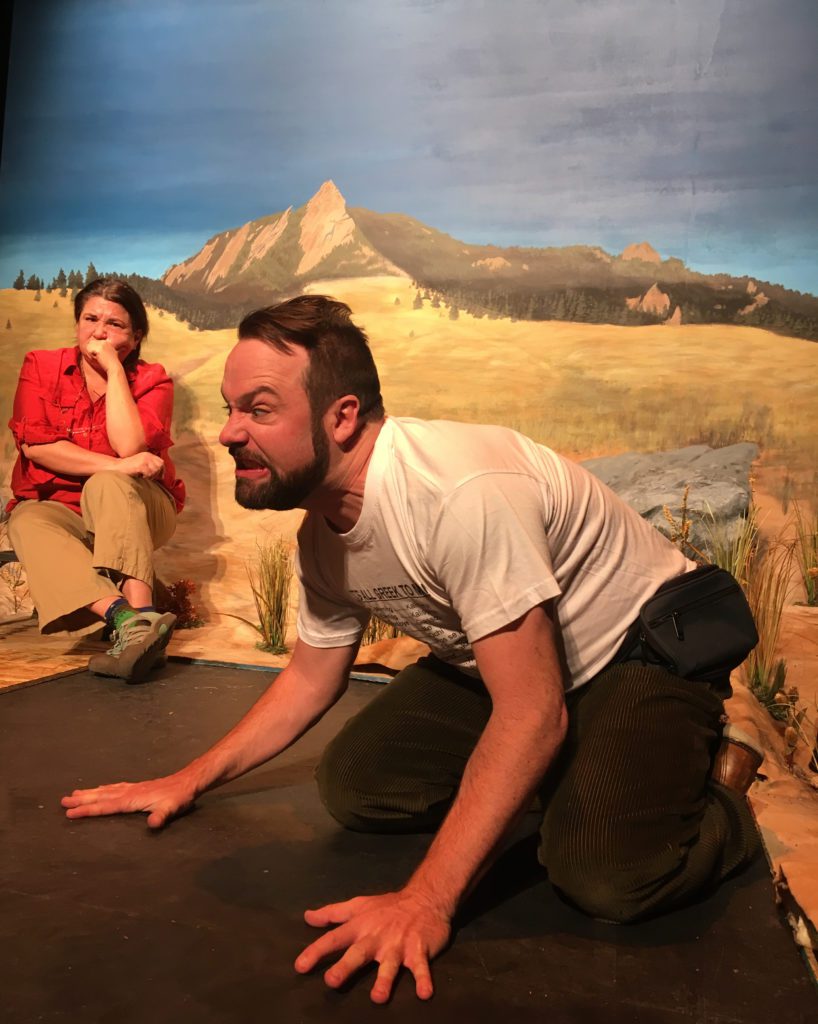
A bearded man is on all fours, his face scrunched up in anger. In the background a woman in a bright orange shirt sits on a small stool looking on, angry or bored or both. Behind them is a painted backdrop with a distant mountain.

Denver Post- Diorama drama and laughs in Buntport’s latest “Coyote. Badger. Rattlesnake.”

3 out of 4 stars

There’s a wily conceit running through “Coyote. Badger. Rattlesnake”– Buntport Theater’s entertaining original production. Cecily the coyote — one third of a museum diorama’s fauna trio — has been sent out for a makeover. Some pests scavenged her and her return, while vital, is not clearly imminent.

Glenn and Carroll work side by side in the diorama, which is also getting a revamp. They craft fake grasses, create a protruding rock formation that adds dimension to the museum display, and arrange the aforementioned badger and rattler in their ersatz habitat.

Theirs is not the most collegial of partnerships. Hannah Duggan and Brian Colonna portray the bickering coworkers. Carroll’s wound a bit tight. She’s prone to anxious huffing (“Cecily is missing a good portion of her face!”) and loud disquisitions on taxidermy, for instance. Glenn’s genial if a little lax on details. Was his snack the invitation nibbling vermin needed to enter the diorama?

Created in collaboration with local playwright Ellen K. Graham, “Coyote. Badger. Rattlesnake” is composed of 14 seriocomic vignettes separated by 14 pauses, a dimming of the lights and minuscule set changes. The turning down of the lights is part of the show’s genius. It adds emphasis to Glenn’s or Carroll’s final word or gesture — be it absurd, ruminative or both. If you are gleaning a “Godot” vibe in the set-up, that’s likely OK.

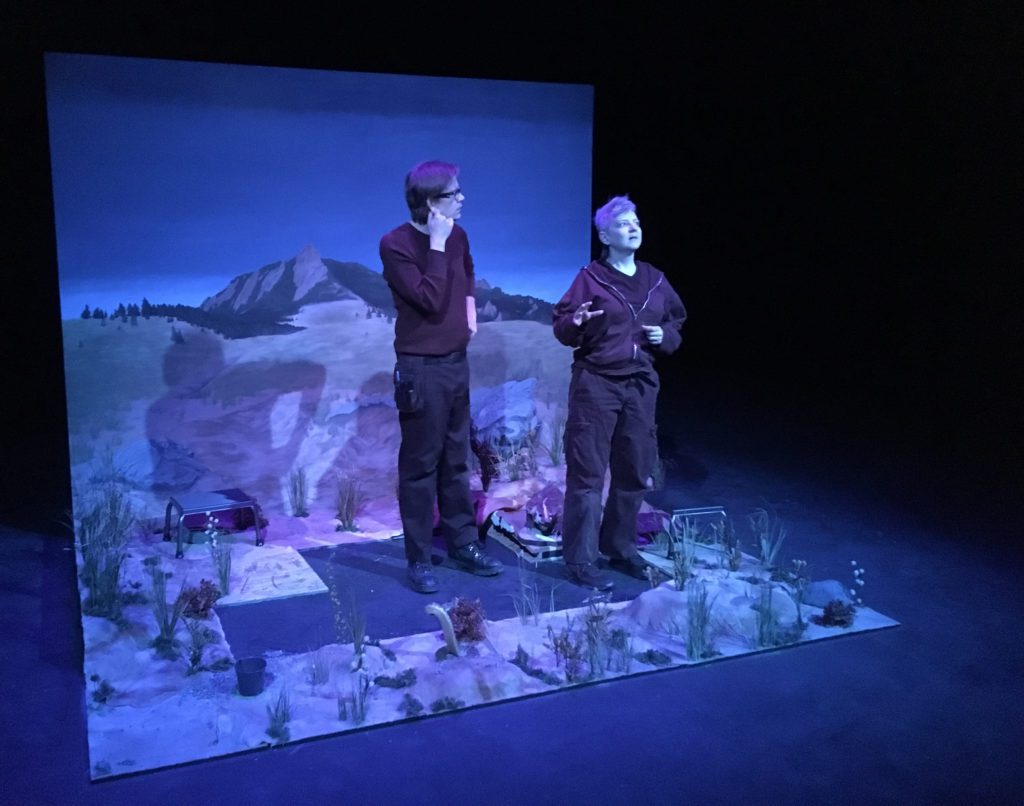
During those breaks, two workers arrive in the not-quite-darkness to add tile-size chunks of set to the floor in front of the diorama’s beckoning backdrop of mountains and sky, prairie grasses and scrub. (Company member Erik Edborg is responsible for the lovely canvas that hangs from the rafters.)

Played by Erin Rollman and Edborg, the duo appear in the show’s credits as “Stagehands.” Consider this further evidence of Buntport’s rather meta-antics. Yes, they’re stagehands. They’re also characters in a play about the staging of the “fake-real.” Stealthily, they add props, rearrange them or accidentally tip something over and rush off. Like Glenn and Carroll, they chat and disagree. Over the course of the play (there is no intermission), their interstitial philosophizing demands more and more of the audience’s attention.

Wit, deft timing and twists — physical and linguistic — are signature stuff at Buntport. “Coyote. Badger. Rattlesnake” has an abundance. It also has a few choice things to say  — or at least I was vaguely aware it did — about “real fakeness” and “fake realness” as the show’s program teasingly puts it.

So, a word about the audience. The ensemble composed of the four performers and company mainstay SamAnTha Schmitz is in its 19th year and has garnered a deserved and appreciative following. Almost as soon as Colonna and Duggan arrived on stage opening night, they were met with titters and guffaws, which continued to punctuate not only the amusing riffs but at times the more thoughtful interludes. I’m not one to judge people for their pleasures, but I couldn’t help but wonder if this made newcomers to Buntport feel like they weren’t quite in on a joke. The ensemble’s agile wit is often outright funny. Just as often, there’s something more nuanced at play in their askew vision of things. The balance in “Coyote. Badger. Rattlesnake” proved slightly elusive.

It would be churlish to complain about Buntport’s steadfast craft and reliable cleverness. Their work is oh-so-canny — with the occasional burst of brilliance. And this show is swift and entertaining. I’d just hate to see the company trapped in a lovely diorama of its own making.

Lisa Kennedy, December 6, 2018 The Denver Post

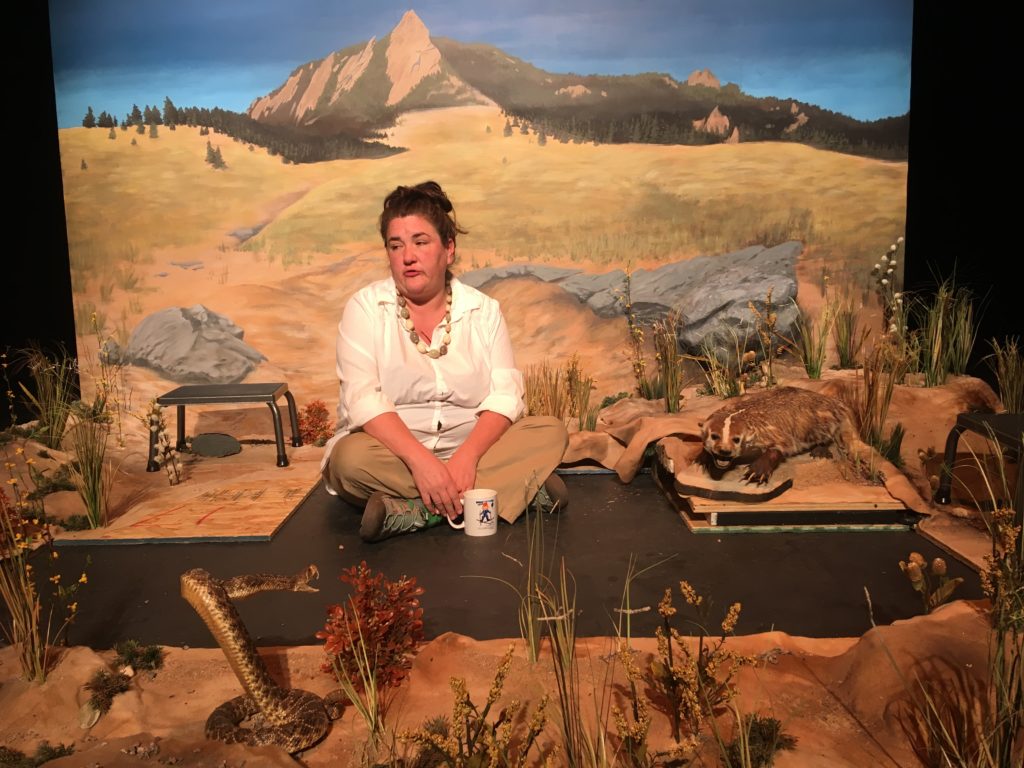
A woman in a white shirt sits cross-legged on the floor, looking despondent. She has a coffee cup in front of her. She is surrounded by an unfinished prairie scene, including a taxidermied badger facing off with a taxidermied rattlesnake. Behind all of them is a painted backdrop with a distant mountain.

Westword- More Hilarious Buntport Hijinks With Coyote. Badger. Rattlesnake.

There’s no point trying to make linear or literal sense of Buntport Theater’s latest offering, Coyote. Badger. Rattlesnake. While that’s true of many of the troupe’s plays, this one skitters even more blithely than usual into absurdist territory and beyond into the ether.

The action takes place in and around a museum diorama featuring the landscape of North America’s Great Plains. Dead center on the set is a large, flat, square picture; on the floor in front of it are puzzle pieces of the same terrain, holding dry grass, rocks and pebbles, along with a rearing rattlesnake and a badger. The badger’s name is Mitchell. The coyote, Cecily, isn’t immediately in evidence, though she shows up later. Sort of.

Glenn and Carroll, played by Brian Colonna and Hannah Duggan, respectively, are in charge of maintaining the exhibit. They have feelings about the taxidermied wildlife, as well as philosophical thoughts about the nature of reality, the way we live in reality and the ways we mimic it. They deplore the fact that nature and animal life are reduced to dioramas like the one they’re working on, with labels and notes that don’t begin to convey the wonder and complexity of the real thing — though I don’t think either of them would use the words “wonder” and “complexity.” They don’t necessarily agree on any of those concepts, and they disagree particularly over anything that smacks of anthropomorphism. Because the badger and the coyote hunt together, Glenn thinks of them as “buddies.” Carroll rebukes him for that word, though her own feelings about Cecily are strong and complex.

Erin Rollman and Erik Edborg are the stagehands: Not museum employees, but Buntport’s stagehands, which means they occupy a different reality entirely from that of Glenn and Carroll. They put pieces of the exhibit in place, sometimes messing things up, and they, too, are engaged in philosophical argument.

Watching, I couldn’t help comparing the Buntporters’ eccentric, sometimes blade-sharp humor with other recent and less successful attempts at comedy where you could see the actors working for their laughs. The four performers here are at the top of their game, functioning brilliantly as an ensemble, and also — and I think this is crucial — never trying to be funny because they’re so immersed in the (unreal) reality of the events they’re living through.

At the beginning of the play, for example, Carroll is very angry. She believes Glenn brought in the bagel from which rose an insect infestation that destroyed much of Cecily’s face. Duggan has proved many times that she’s a genius at every kind of rage: repressed or volcanic, sullen or explosive, but this role allows her greater range than she’s had before. The character is not just terrifying, she’s also vulnerable and complicated; she feels the crazy things she feels very deeply, and there are hints now and then of a passionate empathy — if not for actual humans, then at least for the mummified animals of the diorama. Colonna’s Glenn isn’t cowed, however. His responses are perfect, whether he’s wry, puzzled, momentarily defensive, tuned out or, in a fantastical re-enactment, describing the sad death of Mitchell the badger. Rollman and Edborg hold their own, even though they’re working in half-darkness a lot of the time. Rollman bustles around and uses bits of scientific knowledge to boss Edborg and put him down while he, tall, quiet and kindly, holds the moral high ground.

For this production, the Buntport five (the fifth is SamAnTha Schmitz, who helps create the plays and takes care of tech during performances) worked with an outside artist, playwright Ellen K. Graham. I’ve seen absurdism in Graham’s previous work, though perhaps nothing quite as fanciful as this, and I tried to recognize her influence here, to figure out if there was some difference with Coyote. Badger. Rattlesnake. from Buntport’s usual tone and focus. I thought I sensed a bit more briskness and sharpness to the dialogue, perhaps less repetition — a kind of whizzing quality — but all of that can also be seen as Buntportian. It would have been so much fun to be a fly on the wall and watch these astonishing talents lay out their collective vision and somehow fuse it. But as it is, just sitting in the audience for this hilarious, ridiculous and brilliant piece of theater is enough.

Juliet Wittman, December 4, 2018, Westword

Two people wearing black stand in a partially finished scene of a prairie with distant mountains. Some of the flooring is bare. One person talks out as the other looks at them. Everything is bathed in blue light.

GetBoulder.com- Coyote. Badger. Rattlesnake.

Just as the characters in the newest original Buntport offering were tasked with restoring a damaged diorama in a Natural History Museum, I am now tasked with explaining a Buntport show. Both are nearly impossible. The five members of the Buntport troop create each new piece from scratch based on a subject matter that interests them, an unusual news item, an unexplored or unexplained event in history, or some other random thing that catches their fancy. For Boulder readers who have yet to discover this creative and inspirational group, you have REALLY been missing out. They are as accomplished and honored as the Denver Center, Curious, BETC or CSF . . . but in an entirely different way. Their creativity and humor knows no bounds; they are not afraid to do or say anything to make their point (either for the joke or to express a philosophy); they use primarily the four acting members of the group (the fifth Samantha takes care of all the brilliant technical stuff) with only occasional guest artists. No two shows are even remotely alike. You never know what you’re going to get when you attend a new show. It could be fall-out-of-your-chair funny or it could have you leaving the theatre with a I-never-thought-of-it-that-way frown on your face. The one absolute given is that you can’t wait for the next pearl to drop out of their creative collective thought.

COYOTE. BADGER. RATTLESNAKE. is their newest offering and has only two weekends remaining. It is, as stated above, an involved conversation played out over several weeks between two museum artisans tasked with repairing and restoring a damaged diorama using those three animals. It depicts the coyote (fondly named Cecily) and the badger (Mitchell) working together to make a lunch out of the rattlesnake (Langston). It seems that somehow insects got into the diorama and destroyed part of Cecily’s face and snout. Carroll (Hannah Duggan) blames Glenn (Brian Colonna) for the damage; he had the audacity to bring a bagel into the museum. Not sure what that has to do with anything; neither does Glenn. Over the days that they are working together on putting the prairie grass sections into the new floor of the diorama, we get to  know them, their little idiosyncrasies, and their relationship as fellow workers through their comical discussions of the mundane. But who could have thought that someone could get so upset because the badger couldn’t possibly see the rattlesnake when it was misplaced. Or that one might get a little tipsy and come into the museum at night to talk to the badger.

During the blackouts between scenes, two other “real” workers – stagehands – bring on the new sections of the flooring in order to indicate the passage of time. At first working in silence, they place the flooring pieces and quickly move back out of sight before the “players” return for the next scene. But after about the third blackout, a can of pebbles gets accidentally kicked over and left on stage where it shouldn’t be. But there isn’t time to pick them up before Glenn and Carroll return. It all goes downhill from there for the stagehands. They too start bringing their backstage conversations on stage in view of the audience, blaming one another for the small mistakes that keep being made. Their conversations too become more philosophical and focus on the mundane in their lives – which makes the breaks between scenes longer and longer until they are almost caught on stage when the “players” return. Glenn and Carroll notice that things are moved around and knocked over, but can’t figure out how it keeps happening.

And that’s all I’m going to tell you, because the ending is so freaking funny, I don’t want to spoil it for you. This is one of the “laugh out loud” brand of their shows. The technical aspects of their shows are always impeccably appointed (also all done by the troop) and beautifully lit. Their sound design is clever and appropriate. Your attention is captured from the moment they start; no opportunity for a nap in any of these shows. You can’t wait to see what’s going to happen next. The logical yet illogical playing out of their stories captivates from start to finish.

Just also wanted to let you know that occasionally they bring back a show for a second or third time “by popular demand” as the saying goes. In February, they are remounting “The Rembrandt Room” which was one of the most truly miraculous one woman shows ever seen. Erin Rollman plays a security guard before a huge painting in an art museum who takes it upon herself to explain the picture to a group of visitors, along with her personal relationship with the picture. Comedy Works cannot supply you with more laughs . . . or more thoughtful discourse. Look for it in February. You won’t be sorry.

A WOW factor of 9.5!!

Beki Pineda, December 15, 2018

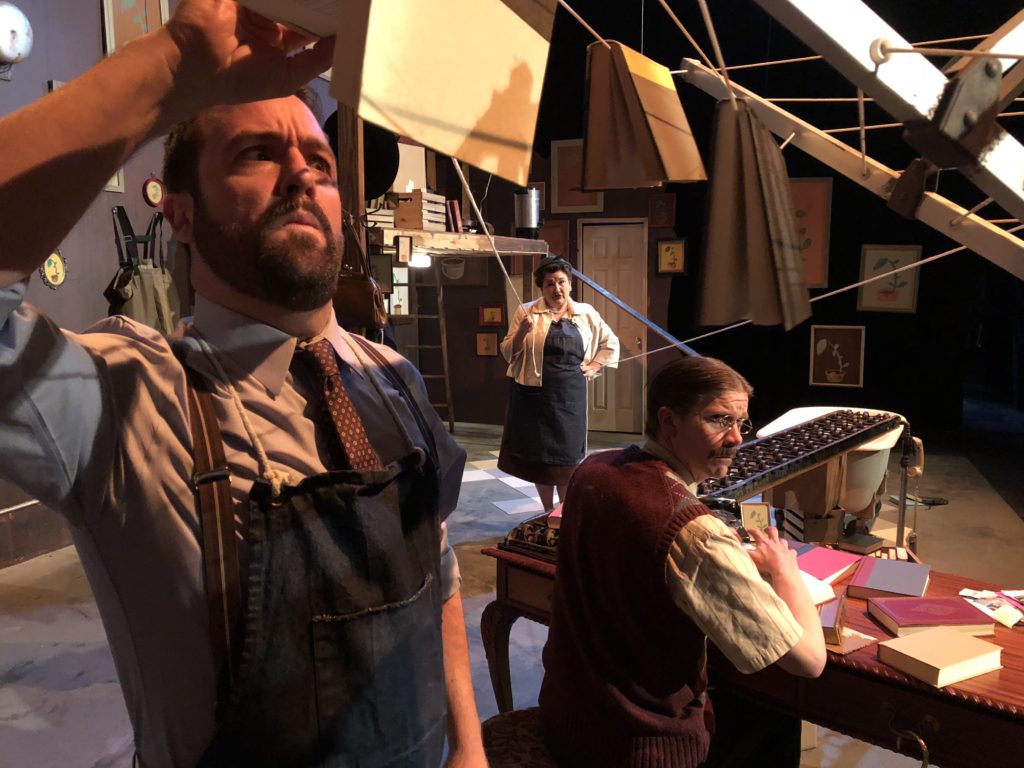
In the foreground, a worker is inspecting a book that is hanging on a clothing line, left there to dry. Behind him, his coworker is sitting at the giant desk, working on books that are piled up there. Just beyond him, another worker is holding two roped that are attached to the clothing line to make it spin, in order to make the books dry faster.

Westword- Buntport’s The Book Handlers Is Cover-to-Cover Brilliance

The five Buntport artists often create a full theater work based on a single eccentric premise: One of them saw Tommy Lee Jones standing in line for the Santa Fe Opera’s La Bohème some years back, and from that sighting emerged Tommy Lee Jones Goes to the Opera Alone, starring a giant puppet figure of the actor. When the group learned that famed scientist Nicola Tesla had been in love with a white pigeon, a kind of hybrid, multimedia play was born, though it enjoyed only a single showing. The gift of a slab of artificial ice gave Buntporters the cue for Kafka on Ice, a biographical piece that incorporated incidents from the author’s Metamorphosis and was performed on skates. But the idea that sparked the current offering, The Book Handlers, seemed on first thought particularly narrow. The Buntporters had encountered a satirical essay by an Irish writer, Brian O’Nolan, in which he proposed a service for rich people: handlers who would mess up the unread books on their shelves to make them look thoroughly perused. From this thread, the actor-writers have spun a glittering web of humor, wit and insight.

Start with the set, which looks like a life-sized Rube Goldberg contraption except for the fifty or so framed pictures — all shapes and sizes — of the same flower all over the walls. I really don’t know what these pictures signify, but I’m sure it’s something interesting, and they do keep Erin Rollman’s Linda busy painting at home and dusting at work. And who knows why the four handlers have set up this complex system of ropes, slides, platforms, racks, dangling buckets and levers to perform their work. Apparently you don’t just employ a little water to dampen a book properly, you don a clumsy wading suit and descend into a water-filled tub. Once there, you choose between complete immersion and flicking water drops onto the pages. While one of the handlers is doing this, the others are scuffing, dog-earing, scribbling notes into margins and, with much brow-furrowed effort, coming up with inscriptions. The period seems to be the 1940s to early ’50s, given Hannah Duggan’s flat little green hat and short white jacket as Connie Diane, and frequent mentions of the Andrews Sisters’ “Chattanooga Choo Choo,” though, Erik Edborg’s John looks rather Victorian. At any rate, time is fluid here, and Susan Sontag gets name-dropped before the evening is over.

The Book Handlers works on many levels. In some ways, the play itself becomes a book — maybe one of those marvelous intricate pop-up books that intrigued us as children. “Dog-ear this moment,” we’re instructed at one point. It also often becomes self-referential, with an actor addressing us directly to deliver a footnote or critique the script we’re hearing. Sometimes Duggan or Rollman will comment on her own character in the third person. Connie Diane doesn’t read much, but she proposes tackling Alfred P. Sloan’s autobiography and writing a memoir about the experience of reading it. The evening tends to evoke the idea of Russian stacked dolls and includes images within images like the intricate folds of a brain. Brian Colonna’s Jard — the only serious reader in the group — discovers O’Nolan’s essay and tells the others about it. This makes them all uneasy. Does it mean their job is satiric rather than real? Eventually, we get a swift exegesis of everything we’ve heard and seen that puts text, footnotes, phrases and key words together in a clear outline. Well, momentarily clear, because trying to recall it later, I found the outline dissolving in a silvery haze.

The primary theme has to do with information, the way we select, process and organize it, how we each individually understand the things we know. And also how apparently unrelated bits and fragments can link or cohere: Offer Rollman’s Linda a cup of tea, say the word “Darjeeling,” and brace for her lecture on colonialism. There’s reference to H.G. Wells’s concept of the world brain: a universal encyclopedia everyone could access and that would help bring about world peace through the dissemination of information. We have something very like this now, of course, but the Internet’s contribution to peace is questionable.

In the context of this play, it’s interesting to think about how the Buntporters put a work together. After seventeen years of collaboration, they must be inside each other’s minds, sorting, stealing and sharing facts and ideas. This play’s odd, unexpected, cunning, apparently irrational yet oddly meaningful set almost serves as a metaphor for the process.

This is a fizzy, heady evening — deeply clever, but not in an intimidating, hey-look-at-me sort of way, in part because the characters are real and specific and the performances so spot-on that you don’t think of them as performances at all, just people going about their business in front of you. Buntport has long been a bright spot for Denver theater-goers, and here the actors are working at the top of their form. Don’t miss it.

Juliet Wittman, March 7, 2018, Westword

In the foreground, a worker is inspecting a book that is hanging on a clothing line, left there to dry. Behind him, his coworker is sitting at the giant desk, working on books that are piled up there. Just beyond him, another worker is holding two roped that are attached to the clothing line to make it spin, in order to make the books dry faster.

Parker Chronicle- ‘The Book Handlers’ is quirky extrapolation

Perhaps it’s less common these days, but there was a time when pretentious, well-off folks would have their decorator fill their built-in bookshelves with rows of colorful, shiny new books, or elegant leather-bound sets in assorted sizes — or a mix. But when one would visit that library, the books had obviously not been read, dog-eared, underlined and loved — they were pristine. And suppose those owners wanted visitors to view them as well-read and scholarly?

Irish author Brian O’Nolan elaborated on that idea for an essay he wrote for The Irish Times, under the name Myles na gCopaleen.

“And so, we wrote a play,” say the members of Buntport Theater, who discovered the essay: Brian Colonna, Hannah Duggan, Erik Edborg and Erin Rollman, who perform as well — supported by multi-tasking SamAnTha Schmitz, who runs sound, lights and other tech processes, plus the box office.

This clever, articulate, energetic crew originally connected at Colorado College and formed a theater company when they graduated — which has remained together since and grown stronger as its members created careers. (A few originals have dropped out.) They write, direct and stage all their own plays on highly creative sets — usually based on someone’s essay, story, play, legend or book from the past. And once in a while, someone has just had a “what if?” idea, I’m guessing.

Per Buntport Theater Company’s program notes on O’Nolan: “He imagined a service in which wealthy people could have the books in their extensive libraries `suitably mauled’ in order to look read.” That seed of an idea was enough. The group went to work, writing individually and piecing it together — and created another of its truly hilarious plays: “The Book Handlers.” It runs through March 17 and is clearly worth the time and effort to score tickets if you can!

Buntport has also performed history-based outreach programs for kids, including those at Lone Tree Arts Center in the south area, as well as regularly scheduled events at the Denver theater for adults and children. But the three or four original plays they produce each year require a visit to Denver’s Art District, where they operate in a warehouse space at 717 Lipan St., two blocks west of Santa Fe Drive.

The Book Handlers’ jumbled workshop fills the stage one sees upon taking a seat in the theater. Desks, of course, ladders to higher levels, swinging baskets and buckets for book-transfer, an old bathtub for “water damage,” specific, annotated, corporate-style processes written in a fat volume, dictating words and actions for annotations, wine and coffee spills and dog-earing corners of pages, etc.

Duggan, as Connie Diane, cheerfully sings “Elmer’s Tune” each day when she arrives through the entryway, while Erik Edborg (John), who’s in charge, manages to be silly and officious at the same time, imaging himself in a Teddy Roosevelt role occasionally, while scholarly Jard (Brian Colonna) knows a lot of stuff from his reading — but not here, of course! Erin Rollman is in top form as fussy Linda, who has lots of issues and a special way with words as she waters plants, and sputters through her workday. Amazing energy.

The routine changes, depending on who’s located where, but rope-borne baskets and buckets swing through the air delivering volumes for special coffee stains, pounding, scraping and dunking. They are sent along a sort of belt-drawn assembly line at times, on a slide at others, and stacked awaiting their next treatment, until “suitably mauled,” then shipped out again to make space for more. And all too soon, the 90-minute piece is over — I could have happily watched longer.

Sonya Ellingboe March 12th, 2018 Parker Chronicle

In the foreground, a worker is inspecting a book that is hanging on a clothing line, left there to dry. Behind him, his coworker is sitting at the giant desk, working on books that are piled up there. Just beyond him, another worker is holding two roped that are attached to the clothing line to make it spin, in order to make the books dry faster.

Go Play Denver- Buntport: The Book Handlers

Like that slow, satisfying burn of your favorite spicy foods, “The Book Handlers” at Buntport lingers with you long after you’ve left the theater and gets even better the more your mind dives into the juicy themes of the play. Seeming to draw inspiration from “The Twilight Zone,” absurdist playwrights like Eugène Ionesco (The Bald Soprano) and existential thinkers like Kafka, this show is a multi-layered piece about everything and nothing. The play centers on 4 characters who distress books in order to make it look like their wealthy owners have actually read them. They clock in each morning, exchanging the same greetings; toil at their tasks; make chit chat at the office; a bell rings to mark the end of the day and they exchange trite goodbyes. Though their work is absurd, the routine of the workplace is easily to recognize and pulls the audience into considering the meaning of life, the purpose of work, the power of words and whether Connie Diane and Jard are really acceptable first names (this is a Buntport show after all!). Masters at blending deep themes with quirky humor, the Buntport troupe, who write all their own shows, have done it again. A triumph! Catch “The Book Handlers” now through 3/17.

March 5th 2018, Go Play Denver

A woman is sitting in her backyard in an old folding chair. Behind her in the basement windows of the house, you can see a man in the window on the right and his best friend in the window on the left and they are in the middle of recording a pod cast.

Denver Post- Buntport’s “Edgar Allan Poe is Dead and So Is My Cat”

There’s high-brow, middle-brow and low. And then there’s the often arched-brow shenanigans of Buntport.

In its latest, “Edgar Allan Poe Is Dead and So Is My Cat,” the wiseacre (emphasis on “wise”) company of five mines a testy brother-sister relationship for laughs more than literary insights. That’s intentional, though, at their finest, they deliver both. But if you’re looking for a larky amusement, seek no further.

Things open on a funeral for a feline friend in Baltimore. In front of a brick facade, on a downward sloping lawn is a tiny rectangular hole, a mound of dirt nearby.

A man stands clad in a brown turtleneck, handsome dress shoes and colorful, rather tight boxer briefs. The pattern on them is the Baltimore Ravens logo. That port city is where the poet (and, for that matter, the cat) of the title met their ends. The oddly clad man’s discarded suit rests on a pile of leaves. He purchased his suit — or as he intones with “get it? get it?” glee throughout the play, “another man’s suit” — at a thrift store.

The show’s program IDs this fellow, played with over-enunciating pleasure by Brian Colonna, as “That One Guy.” You don’t have long to wonder why. He’s that guy who repeats facts and factoids, that guy whose obsessive interests and hardly original insights demand constant affirmation.

Hannah Duggan plays His Sister, the bereaved. She’s not happy that her brother keeps trying to turn the burial into a rite. He even invited His Best Friend (Erik Edborg) to the under-attended non-ceremony.

That One Guy’s penchant for the pedantic isn’t the only thing exasperating his sister. He’s 40, and lives in her basement where he hosts a “Poedcast” on all things Edgar Allan Poe.

In addition to That Guy’s broadsides about Baltimore’s hardly native but very much adopted son, we learn facts about Tolstoy and a tidbit about a toymaker who presented Louis XIV with a particularly inventive mechanical toy.

The set is modest and effective. From the start, the latticed garden-level windows draw interest. The costumes — from the boxer briefs so tight they fit like a codpiece to the convincingly alive Suit to His Sister’s grey hoodie to the assorted Poe-related T-shirts — are humorous in their own right.

Buntport has never feared traversing the space between silly and absurd. For instance, the sister’s brick home has no stairs, a head-scratcher that makes for some fine slapstick exits.

Then there’s the matter of the suit. Redolent of Washington Irving’s Headless Horseman — but so much kinder, gentler, erudite — the suit is voiced by Erin Rollman.

There are moments when “Edgar Allan Poe” resembles an “SNL” — or more brainy Monty Python — sketch, but Buntport is always able to sustain its idea-buttressed lunacy. The troupe — with ace SamAnTha Schmitz behind-the-scenes — consistently works through its heady humor with hearty compassion. In fact, it aimed to deliver a decidedly not-Poe-like romp because there’s more than enough darkness out there.

The writing is often swift, the actor’s delivery even swifter. As the beleaguered Best Friend, Erik Ekborg captures the weird competitive need embedded in the notion of “best friend.” Like That Guy, he tries too avidly.

Early in the 90-minute show, the Suit remarks on its own presence: “it was always going to be awkward … but I hope it was a little magical, I mean at least when I first got up. Or if not magical, I’d settle for surprising.” It was surprising — and magical.

3 stars