Buntport Theater

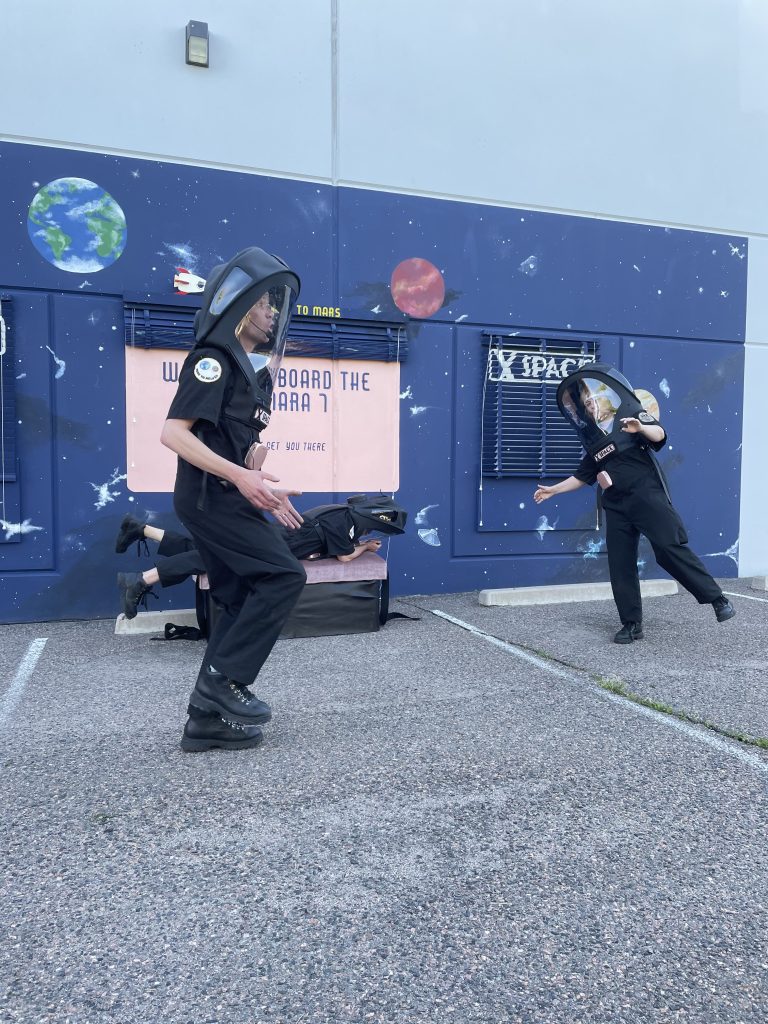
Three space people wearing huge black space helmets are in a parking lot in front of a wall that has been painted to look like outer space. The two people in the foreground look as if they are trying to look like they are floating and a third space person is laying on their belly on a bench as if they are floating.

GetBoulder.com- Space People In Space

I don’t want to lie to you.  I just told you above that there were tickets available, but the truth is that the current performances are sold out.  But if you call and put yourself on the wait list  you might be able to get in at the last minute if there are cancellations.  OR if the kids at Buntport get enough interest, they might be able to add performances.  Trust me, it’s worth it.

This little bit of nonsense involves the four people that are the tour guides/flight attendants for a group in a spaceship (the audience) on their way to Mars.  The audience is like Elon Musk’s tenth shipload of people going to the Red Planet to colonize a new community.  Unfortunately, not all the spaceships make it through the gauntlet of asteroids and space junk that now surrounds Mars.  Most of the crew tries to hide these frightening facts from their passengers, but hints and random remarks slip out that make the situation more obvious.  As usual and as expected, the show is full of the twisted sense of humor and hilarious special effects we have come to expect from this group . . . . from a visual monitor of the flight path to a floating cemetary outside the ship.  Did I mention that this foolishness all takes place in the parking lot of the Buntport space? 

We find ourselves in the no man’s land halfway between Earth and Mars before we are informed that there is no full service meals.  The flight attendants have pretzels secreted in their space suits,  The passengers have nothing.  In order to prepare us for our neighbors on Mars (in case we actually make it), they have a Martian on board that pops up out of a trunk.  Brian Colonna’s character Shirley (I know – don’t ask) misses his father and feels the need to be truthful with the passengers.  Erin Rollman’s character Mindee is her usual bossy self, taking control and trying to keep order.  Erik Edborg has perfected the bumbling awkward Shep while Hannah Duggan gives us a somewhat confused but determined and optimistic Rosie.  They make the most of the parking lot setting and ad lib their way through whatever unexpectedly happens in the outdoor venue.

You never know what to expect with a Buntport show EXCEPT that it will be exceedingly clever, much more intelligent than most scripted comedies, funny in a way that makes you think while laughing out loud, and always too short.  That you can count on.

A WOW factor of 9!!

-Beki Pineda May 31st, 2021 GetBoulder.com

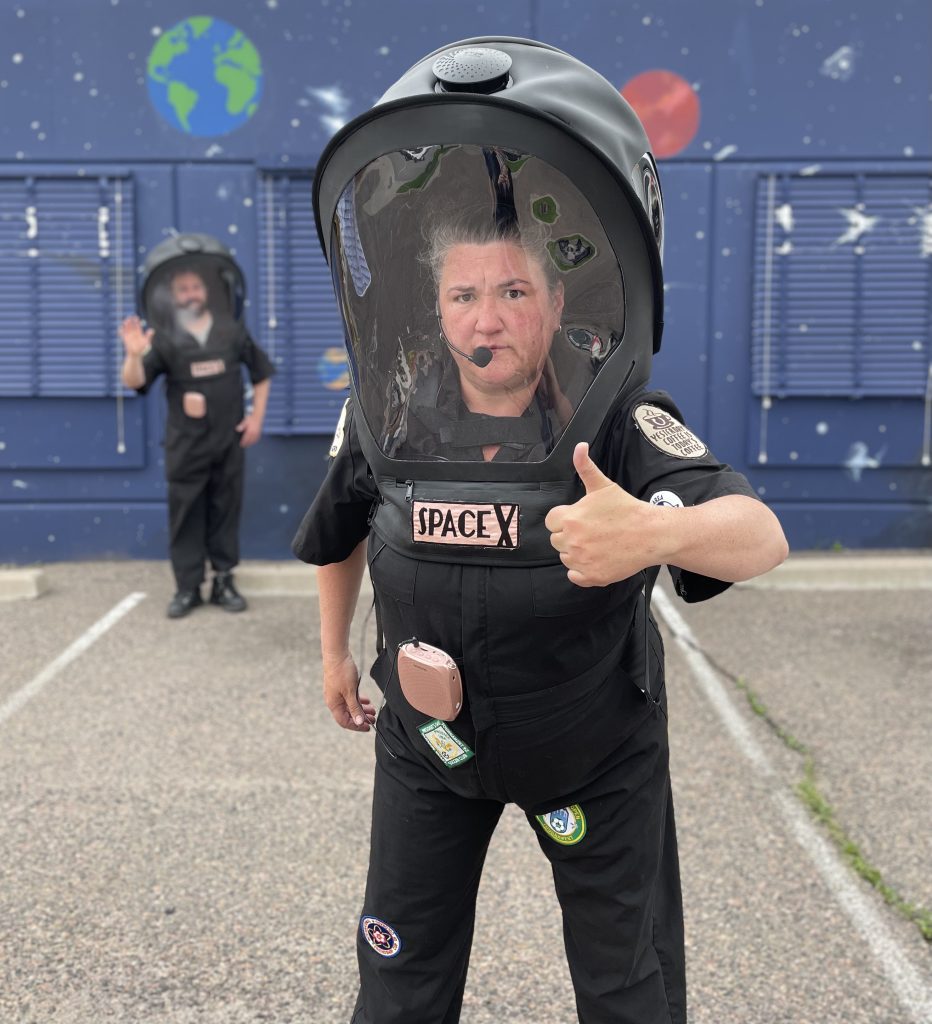
A close up of a space person wearing a huge black space helmet who is bending over and giving a thumbs up to the person viewing the picture. In the blurry distance we can see another space person waving to whoever is looking.

OnStage Colorado- At Buntport, a trip to Mars fuels one wacky ride

Coming this fall on a streaming service near you: Join the crew of the Marinara 7, the latest interplanetary spacecraft from X-Space, as it rockets into the solar system with a nutty crew of flight attendants desperately trying to keep the passengers entertained on the seven-month journey to Mars.

There’s Mindee (Erin Rollman), the exasperated rule-follower fruitlessly trying to keep the rest of the batty crew in line. Meet Shep (Erik Edborg), the bug-eyed nervous Norman always on the watch for pending disaster. And there’s Rosie (Hannah Duggan), the zany singing “stewardess” who takes the mission about as seriously as the next Lauren Boebert Tweet. And don’t forget Shirley (Brian Colonna), the cynical doomsayer unafraid to call out the insanity and inanity of the whole enterprise. In the background, SamAnTha Schmitz is running sound and arguing with the space center about Colonna’s headband wardrobe malfunction.

That’s what Buntport Theater’s latest offering reminded me of: a sitcom in the not-too-distant future capitalizing on the rush to recruit untrained rubes into some billionaire’s ego-driven space project. There are a few differences: The performance isn’t on Netflix or Hulu; it’s in the parking lot of Buntport’s space on Lipan & 7th in Denver — y’know, between the RTD maintenance yard and Movemasters. The special effects aren’t quite George Lucas, but the troupe did manage to scare up some fairly legit space suits. (Although do they need to wear them inside the spacecraft? No matter.) Everything else is bargain-basement – just as Buntport fans like it.

If you’ve never been, Buntport is one of the Denver theatre community’s gems: a group of five fearless, inventive creatives who want to do theatre on their own terms. (Juliet Wittman has a great recent profile of the company in Westword.) With all this talk of Jeff Bezos and Elon Musk and Richard Branson looking to send lesser rich folk to Mars in the next few years, it was only a matter of time before Buntport took a run at such rich material.

It’s fun stuff, with lots of laughs and just the kind of goofy ride we can all use nowadays. My guest said her cheeks hurt from laughing and smiling — what better endorsement is there than than? From the moment the four crewmembers came out the front door of the theatre in slow-mo (The Right Stuff, get it?) until the end when … OK, no spoilers. But it all comes together in an hour-long dork-fest that everyone should see – twice. (Although the small, er, house might make for scarce ticket availability.)

Throughout the pandemic, Buntport has done solid work presenting shows. From the gloriously wack-a-doo Grasshoppers last June (another parking lot extravaganza) to the online Duggan-driven production of Cabaret Profundis, they’ve kept the lights on anyway they could.

So thanks, Buntport, for blowing more on the flame of live theatre in Colorado. You may be thinking you’ll move back into your fancy indoor space sometime soon, but is the parking lot really so bad?

-Alex Miller May, 31st 2021 OnStage Colorado

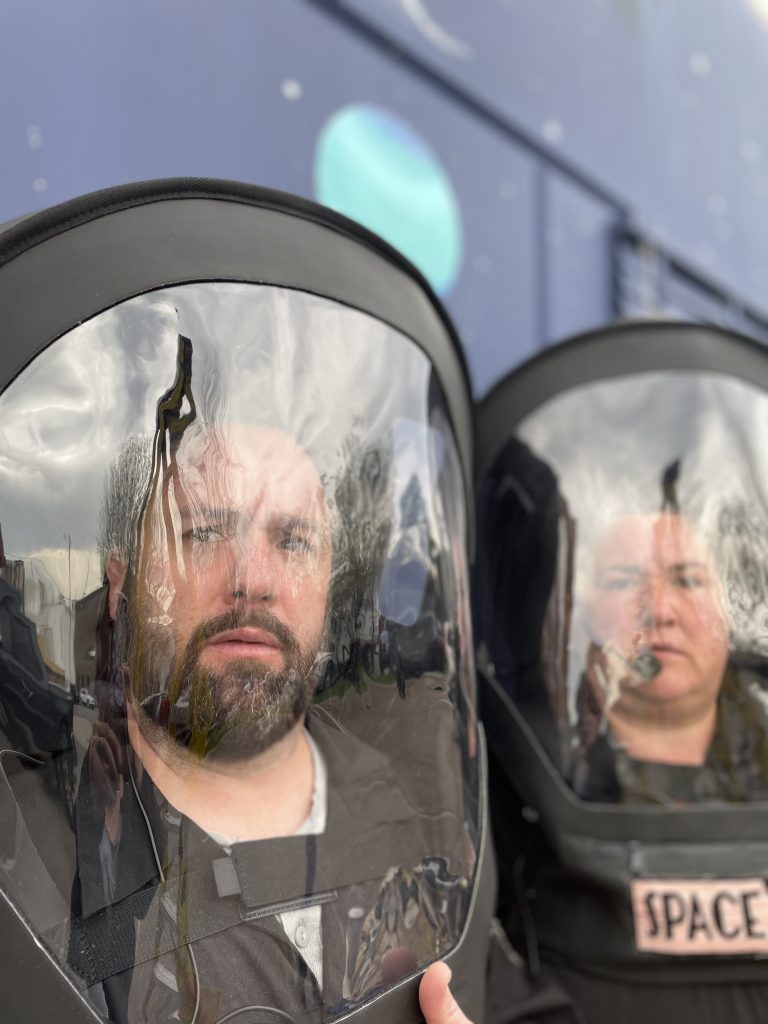
Close up of a man and woman standing outside of a building. They are both wearing black and huge black spaceman helmets. They look concerned and a bit confused.

Westword- Buntport Theater Makes a Case for Space…and Creativity

No theater company in the country is quite like Buntport. This group of five local creatives — Brian Colonna, Hannah Duggan, Erin Rollman, Erik Edborg and SamAnTha Schmitz — stages entirely original productions. The troupe’s members create those productions through discussions, improvisation and eventually writing scripts. Each of the five writes, directs, produces and worries about business matters, though Schmitz prefers not to appear on stage.

Buntport has been in the same converted warehouse on Lipan Street from its beginning in the ’90s. At the time, the cavernous space was so cold that audiences, usually pathetically sparse, were forced to either shiver through a winter evening or strain to hear the dialogue because the available heating was so loud and cranky. In recent pre-COVID years, faithful followers thronged Buntport openings and found the place comfortable and configured in new, different and interesting ways for every show.

On March 13 of 2020, Buntport was scheduled to open a piece called Cabaret De Prefundis, or How to Sing While Ugly Crying, starring Duggan and local musician Nathan Hall.

“That week was very hard,” says Schmitz. “We were rehearsing and getting ready. I think it was Wednesday night the NBA stopped playing. That seemed like a big thing.”

Agitated company discussion ensued. Would spacing the seats for the audience be sufficient? Could they sanitize the building, jigger the script, provide only pre-packaged snacks for the opening party? By Friday, everyone realized that cancellation was inevitable, but “it still seemed maybe we’d open in a couple of weeks,” says Schmitz.

The set for Cabaret remains up. At some point Buntport will doubtless mount the show, but at the moment, the troupe is working on a performance piece called Space People in Space to take place outside in the parking lot from May 26 to June 13. Colonna describes this as “a silly comedy about people traveling to Mars. It also explores the idea of colonizing planets in our solar system.” A previous parking lot play, The Grasshoppers, was put on in September. At the same time, company members are thinking hard about what they’ve learned during a forced year off and how newly acquired insights will help shape the next full-length, in-house production.

Rollman says, “It doesn’t feel like anything is opening up with a bang, and I would say the process of making Space People also falls into that category. It’s a fun show — and I am deliberately not using the word ‘play,’ because I think the most apt comparison to our own work would be a stand-alone episode of one of our live sit-coms. I’m excited to have people come see it and to be performing live for the first time in ages, but it doesn’t fully scratch my theater-making itch.”

The members of Buntport have been together for twenty years, having met in drama classes at Colorado College, and they have somehow managed to keep their anarchic sense of humor, delight in surprise, and fascination with words and ideas intact over those two decades.

Scripts can arise out of almost anything: a phrase, an incident, an anecdote, an experience a member thinks is worth exploring. Kafka on Ice, one of Buntport’s most memorable productions, came about because someone had given the company a sheet of fake ice. Naturally, they all learned to skate. Just as naturally, they decided skating would be the best way to communicate Franz Kafka’s absurdist mournful ethos.

It seems significant that folks around town still refer to Buntporters as “the kids,” though as Schmitz points out, they’ve all now reached their forties, a phenomenon they explored a few years back in Middle-Aged People Sitting in Boxes.

“Everything partly starts when we’re writing,” says Rollman. “We can create the characters’ voices and have some understanding of the overall intention. But it still mostly happens through the rehearsal process, with playing around and bouncing things off each other.” Sometimes the original intention simply fades away, she adds.

“There’s always someone who has the initial idea,” says Edborg. “Sometimes people can’t remember later whose idea it was. The strength of how we work is so many minds coming up with new ideas — given that the brains are all on the same page, to some degree.”

No concrete decisions have yet been made about the next full-length production, though the actors expect it will in some — doubtless elliptical — way reflect the times we’re living through.

“Even these little parking lot shows are largely about isolation,” says Colonna. The new show may be “about obstruction, limitations that force you to make creative decisions. Any creative process requires constant self-evaluation. It’s an organic and always moving thing.”

Over the past year, Schmitz has been occupying herself with thousand-piece puzzles and some gardening. She also joined Black Lives Matter protests. Duggan lost her beloved dog and moved in temporarily with her mother and aunt to help out.

“When the pandemic started, it felt very weird, but there was something novel about it — everybody in the world was navigating something together,” Edborg says. “But by the time winter rolled around, hospital numbers were rising, and it felt pretty dark.”

Rollman, who “used to have a million things to do in a day,” found it hard to adjust to an open schedule — and now says she has “an enormous amount of anxiety about getting back to normal. It feels so overwhelming.”

What everyone says they missed most was their time together.

“It was shocking for a group of people who’ve collaborated for years almost every day,” says Colonna.

“I spent more time with these people than I’ve spent with other people in my entire life,” adds Duggan.

As for arguments and disagreements, Colonna explains that the group has mellowed over the years and abandoned “the dramatic and loud fights we had in our twenties.”

Schmitz agrees: “The show and our art take precedence over our individual egos now.”

“We were friends first,” says Edborg. “We all met in college. We all chose to like each other then. I couldn’t feel luckier that these people decided to like me, even before starting a company. And we were able to do it and watch it grow over time.

“I get to act, but I don’t have to do the awful process of auditioning,” he continues. “My self-esteem wouldn’t be able to take it. I feel for theater people who aren’t in such a secure and loving environment.”

Everyone agrees that the company is pretty secure because of an understanding landlord, along with grants and donations and the fact that all of them took pay cuts over the past year. But there are still some doubts and fears about reopening. Will health restrictions change further? How threatening are the virus variants?

Still, says Colonna, “it’s very exciting, because for the first time in a year, we’re all working together in the same room. We’ve all been vaccinated, and a few days ago, we were able to remove our masks. It all just made me feel more powerfully that there is something magic that happens when people are together.”

“I’m thrilled to be working on something,” says Rollman. “Oh, we’ve got a list of to-dos that’s incredible. On some level, all of us dreamed about this moment in time when we’d be able to have these huge openings, and really, it’s more like we’re going to take baby steps to get there. We have to think about what that means, how to let people slowly back into our space in a way that seems fun and celebratory.”

Having watched many online videos during his year off, Edborg says he understands the value of live presentation more acutely than ever before.

“I feel so lucky,” he says. “I can’t imagine what people do who aren’t family with people they work with. And I’m excited to perform again, even rehearsing. Laughing. No one laughs more at their job than I do.”

-Juliet Wittman May, 25th 2021 Westword

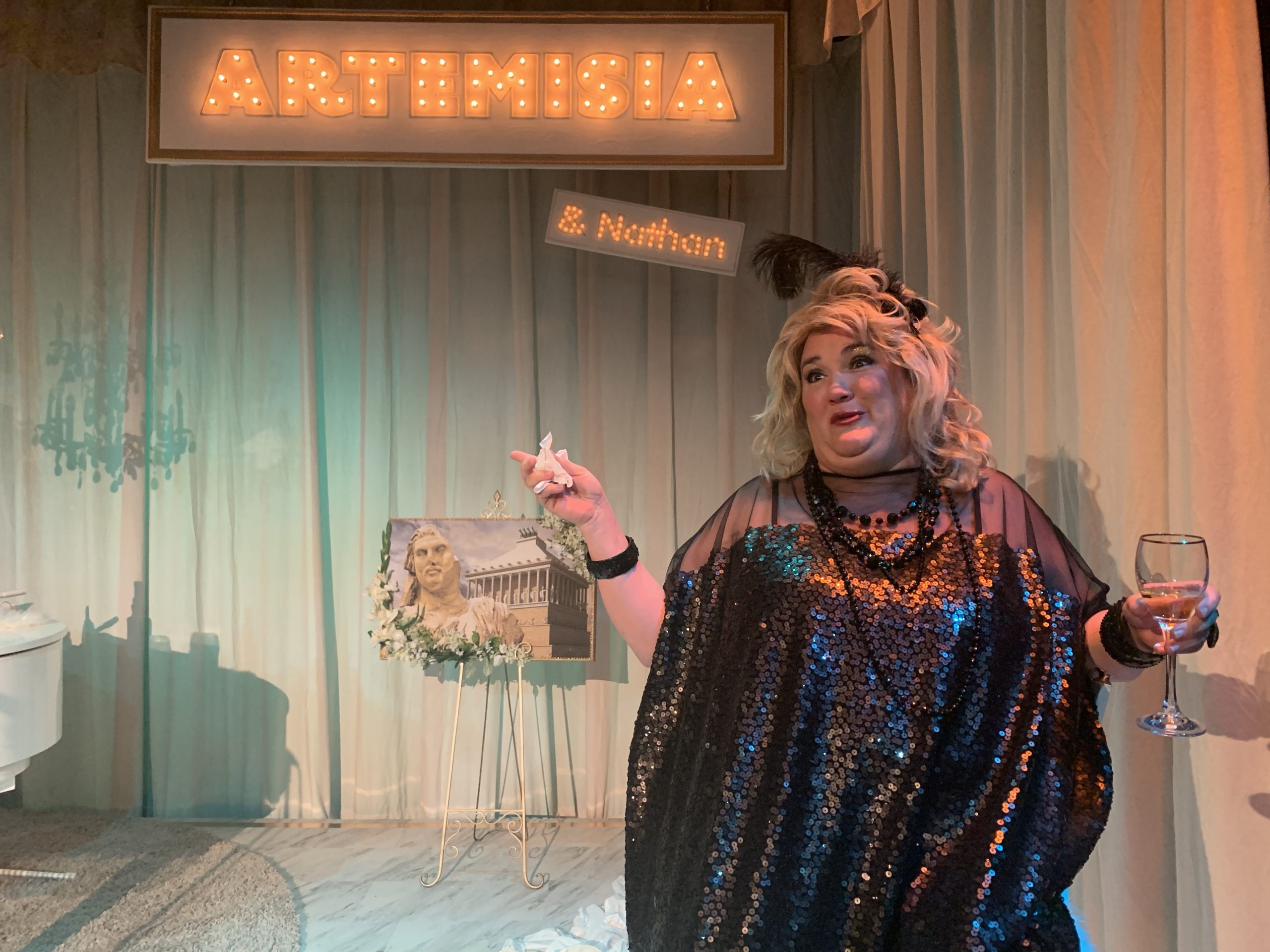
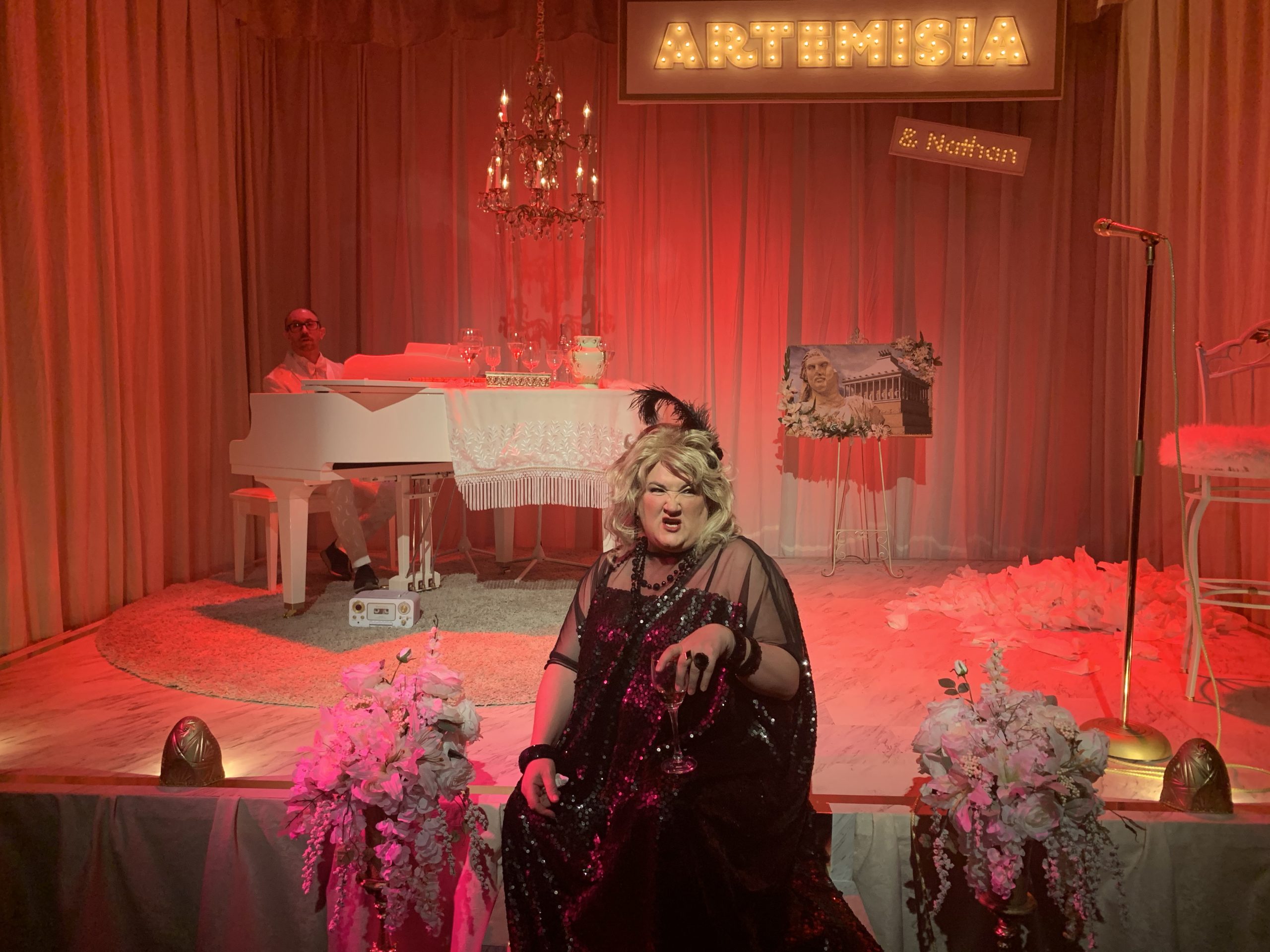
A blond woman in a black sparkly dress makes a goofy face. In one hand she has a crumpled kleenex, in the other a glass of wine. Along the back is a large lit up sign that says “Artemisia” with a tiny lit up sign underneath that says “and Nathan”. On a stand near the back curtain in a picture of a man in front of a building.

OnStage Colorado- A grieving satrap from ancient Greece walks into a cabaret …

Buntport releases video version of its dark comedy ‘Cabaret De Profundis or How To Sing While Ugly Crying’

Imagine you have a batty aunt who fancies herself an accomplished cabaret singer. Who knows, maybe she got a gig at some dive off the strip in Vegas a few decades back and lives off that memory. At family gatherings after a few too many glasses of wine, she commandeers the living room and recruits one of your uncles to play the piano. She then stumbles through a bizarre collection of songs, half songs, and random observations in service to grieving her long-deceased “brusband” as her alter ego, Artemesia.

That’s the vibe from Cabaret De Profundis or How To Sing While Ugly Crying, a recently released video performance from Buntport Theater. Originally set to play live at the theatre last March, you-know-what put the kibosh on that. Instead, Buntport forged ahead and recorded a performance in October, recently releasing it on Vimeo.

Hannah Duggan plays the reincarnated Artemesia, a real historical character from ancient Greece who succeeded her brother (and later husband) Mausolus as the satrap of Caria — a region in modern-day Turkey. (WTF?) Accompanying her on piano is her long-suffering, eye-rolling partner Nathan (Nathan Hall).

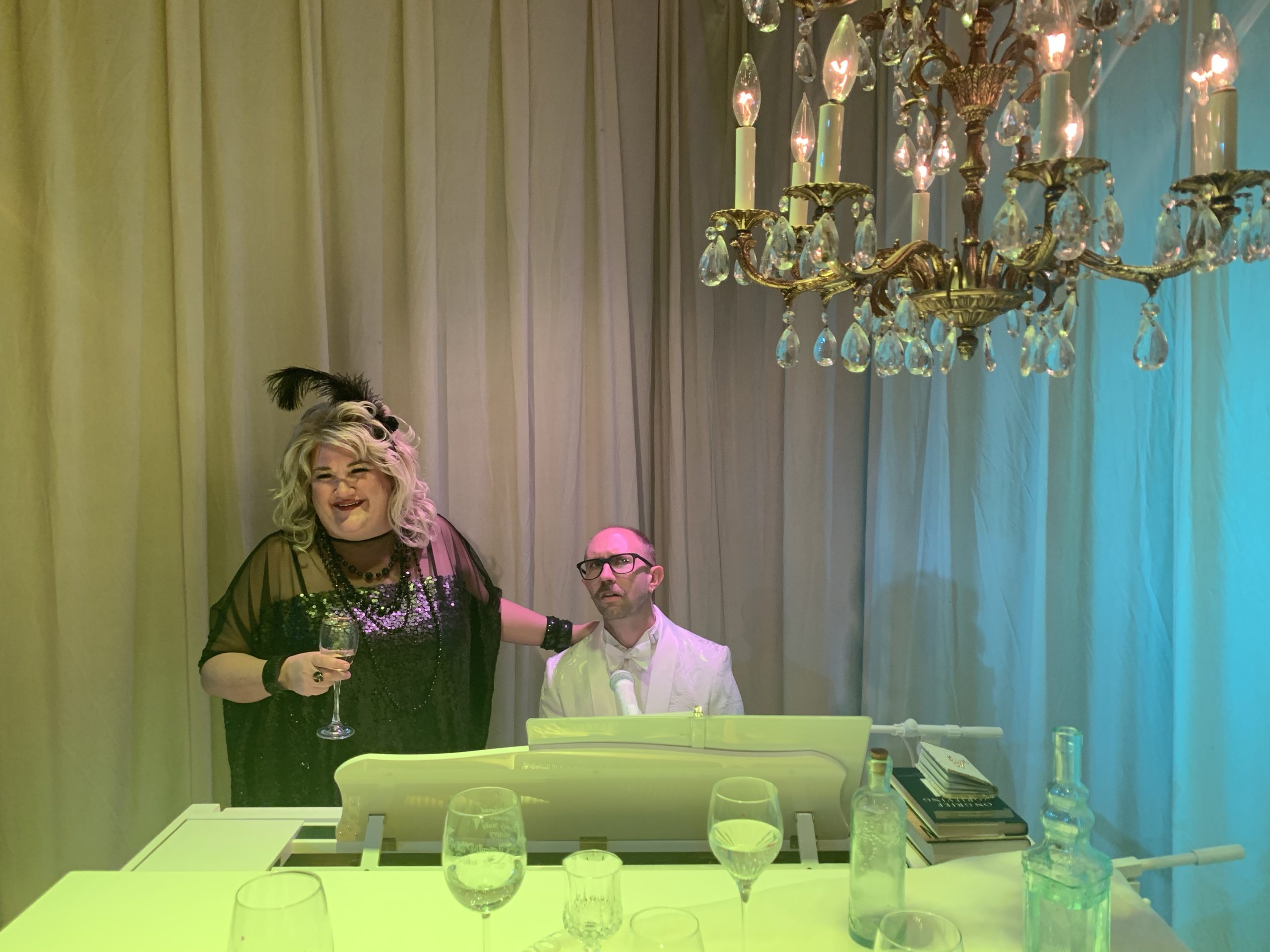
“I’m miserable to be here,” Artemesia announces, describing herself as “the greatest mourner on earth” who’s been moving from body to body over the centuries and is now inhabiting a zaftig woman from Indiana. Dressed in a black, spangled caftan and spilling her guts into a golden microphone, she’s an emotionally raw trainwreck careening from songs to wacky observations, to puns and corny jokes as Nathan plays the straight man trying to keep up. Dressed in a white tuxedo and initially sporting a GoPro on his head and a mustachioed covid mask, Hall is an accomplished pianist who wrote most of the music for the show (most of the lyrics are simply attributed to Buntport).

The ever-inventive Buntport crew paid a lot of attention to the filming, with a variety of camera placements ranging from the aforementioned GoPro (underused, IMO) to one sitting in the bottom of one of Artemesia’s wine glasses. Facebook Live is also employed in a few different scenes, providing an unlikely link to ancient Greece. It’s nicely done, lending both an air of intimacy alongside some jarring closeups and other off-kilter camera angles.

Artemesia tells us that “de profundis” means “from a deep state of anguish,” and as she staggers from one bit to the next, she never loses sight of the main mission of mourning her brusband (even adding some of his ashes to her wine glass, as the real Artemesia apparently did).

Given the freewheeling nature of this show, it’s not easy to discern any kind of plot or easy summary of “what it’s about,” but a few of Artemesia’s lines may offer some clues:

  • “It felt Melissa Etheridge-y to me.” (Nathan shakes his head)
  • Something about starting a Go Fund Me page for the free masons.
  • A capsule review of a Dan Brown novel.
  • “If you’re going to be cremated, please have your silicone breast implants removed.”
  • “Damn you Verizon!” (This after a Facebook call with the ghost of Mausolus [guy in a sheet] is dropped).

A force of nature

Duggan is a force of nature, making up for her lack of singing skills with the ability to own the stage and keep us on the edge of our screen wondering what non sequitur she’ll serve up next. Hall is an excellent partner, both loyal to the mission and equally dismissive of most of her flights of fancy.

While some might have a hard time sitting through an hour and 40 minutes of the trash-glitz deliberate awfulness of Cabaret de Profundis, others will no doubt enjoy watching an actor put it all out there as Duggan does. Utterly shameless and unconcerned what others might think (Can you really have a cabaret if you’re not going to say things like ‘balls’ and ‘pubes’ once in a while?”), she plows through the performance like a tipsy troubadour determined to keep all eyes on her wherever she goes (including, at one point, gone from the stage altogether, leaving Nathan to ad-lib with ancient music until she returns).

What’s missing, of course, is the audience that this type of show truly requires. Artemesia laments this on several occasions, and there’s little doubt a live audience would provide a good deal of laughter to propel this show forward. Never fear, though: Buntport does plan to mount a live production when it’s possible.

-Alex Miller January 17th, 2021 OnStage Colorado

A blond woman in a black shiny dress and sunglasses sits on the edge of the stage, flowers on either side of her. She is scowling and holding a glass of wine. In the background, a man's head peeks above a white baby grand piano with a chandelier over it. The stage is lit in bright reds and pinks.

Marlowe’s Musings- Cabaret De Profundis or How To Sing While Ugly Crying

Buntport Theater Company’s 49th full-length original play, “Cabaret De Profundis or How To Sing While Ugly Crying,” was supposed to open last March in their space over at 8th and Lipan. Like the other theaters in town, Buntport’s doors were closed at that time due to the pandemic.

     Lucky for us the award-winning troupe has filmed the stage production so we can all see this cabaret-style show streamed in the safety of our own living rooms.

     Comic genius Hannah Duggan plays Artemisia II, Queen of Caria. She’s that lady who commissioned the building of the Mausoleum at Halicarnassus, one of the seven wonders of the ancient world, back in 350 BC. She’s also known to have mourned her “bruhsband,” (brother/husband) Mausolus’ death by drinking his ashes in her wine. 

     Identifying with the stages of grief outlined by Elisabeth Kubler-Ross, the actor bemoans the fact that she has become “the Queen of Grief, the Madame of Misery, the Diva of Distress.” 

     Duggan is a brilliant actor, whose performance is as endearing as it is hilarious. Able to turn on a dime from hysterically grieving widow to zany little girl, her blissfully naughty grins will enchant you. 

     The show also features Nathan Hall, who, outfitted in a dashing white tux, accompanies Ms. Duggan on the gorgeous white grand piano with a mix of old standards and new compositions. The deadpan Nathan also serves as the butt of many of Ms. Duggan’s sly jokes.

      This monologue with musical numbers is being described as “a dark comedy with the emphasis on comedy.”

     The scenic design and its accompanying lighting design are eye-pleasing indeed.

     Ms. Duggan’s costumes dazzle us with their eye-popping sparkle and shimmer.

      True, the piece could be improved by a small trip to the editing room.

     Nevertheless … this is a welcome gift in this time of shuttered theatres and house-bound theatregoers. 

     Just FYI the production’s sound recording, and visuals are of the highest quality imaginable. Bravo! 

-David Marlowe January 15th, 2021 Marlowe’s Musings

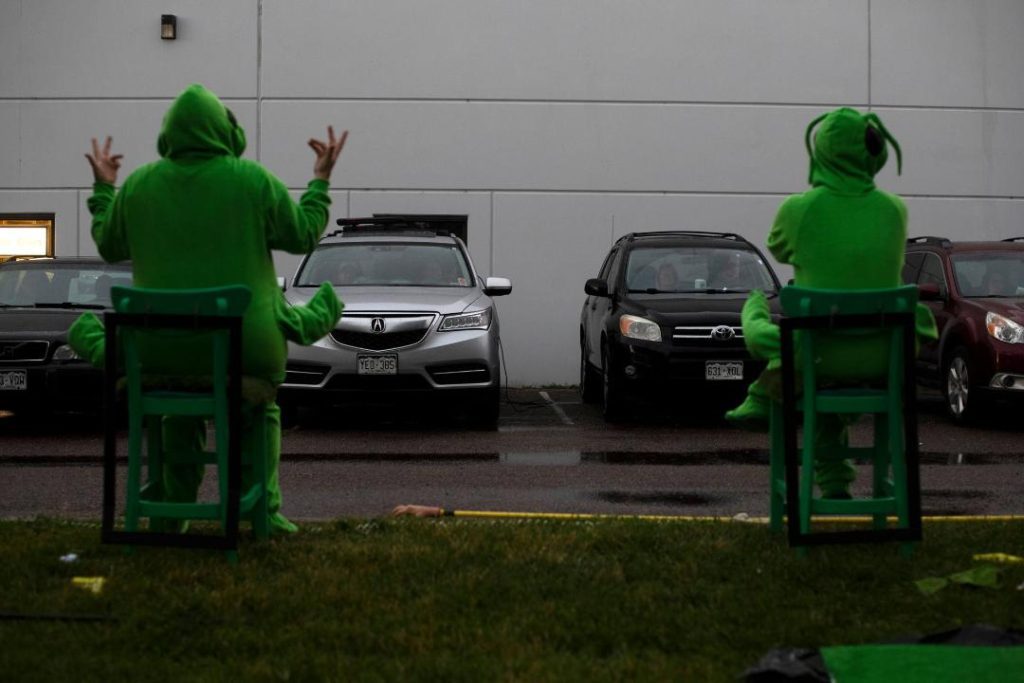
In the foreground, on a strip of grass, two people in bright green grasshopper costumes are sitting in green chairs with their backs to the camera. They are facing a row of cars parked in a parking lot in front of a white building. It is rainy.

New York Times- Beyond Broadway, the Show Does Go On

Photo: Members of Denver’s Buntport Theater, thinking drive-in theater would be pandemic-proof, tried to imagine what kind of creatures belong on a lawn. Their solution: “The Grasshoppers.” Credit…Rachel Woolf for The New York Times

Inside a former firehouse in Richmond, Va., a lone actor performs “The Picture of Dorian Gray” for audiences as small as two. In a Denver parking lot, theatergoers in cars watch, through their windshields, four performers costumed as grasshoppers. On a 600-acre property in Arkansas, a cast of about 130 re-enacts the story of Jesus for several hundred ticket-holders spread across a 4,000-seat outdoor amphitheater.

The coronavirus pandemic has shuttered Broadway through the end of the year (at least), and the nation’s big regional theaters and major outdoor festivals have mostly pivoted to streaming. But even as infections surge in the United States, many theaters are finding ways to present live performances before live audiences.

Of course, there is social distancing. Also, in some places, masks. Temperature checks. Touchless ticketing. Intermissionless shows. And lots of disinfectant. At the Footlights Theater, in Falmouth, Maine, actors will perform behind plexiglass.

But these precautions mean there is dinner theater in Florida. Street theater in Chicago. Drive-in theater in Iowa.

“Our commitment is to do live theater — there’s a huge difference between that and seeing something on a computer screen,” said Susan Claassen, managing artistic director of Invisible Theater in Tucson, Ariz., a state that has emerged as a Covid-19 hot spot. The theater, which has been running a four-character play called “Filming O’Keefe” indoors, installed an air ionizer, allowed patrons in only one-quarter of its seats, mandated that they wear masks, and put on a show.

“Our theater got its name from the invisible energy that flows between performers and the audience,” Claassen said. “Even with 22 people in the audience with masks on, that energy is so strong.”

There are also financial reasons for continuing: Some theaters say they cannot survive a year without revenue.

“We’d rather go down creating good theater than die the slow death behind our desks,” said Bryan Fonseca, the producing director of Fonseca Theater Company in Indianapolis. The company plans to stage “Hype Man,” a three-character play by Idris Goodwin, outdoors, for 65 mask-wearing patrons. “I am hopeful and also very cautious,” Fonseca said, “careful that I don’t create a problem.”

By putting on shows, some theater artists are, in effect, making the case that it is a mistake for the industry to wait for New York to lead the way, given the risks there. “Someone has to be the first to take that cautious step into the dark to see what works and what doesn’t,” said Phil Kenny, a sometime Broadway producer who has a role in “Willy Wonka” in Orem, Utah.

But even in New York City there are signs of theatrical life. Food for Thought Productions, a company that presents staged readings of one-act plays, is planning to restart in a private club on July 13, with Louise Lasser and Bob Dishy performing and attendees required to have taken coronavirus tests.

“If we can prove that we can do this safely, maybe other groups can do safe theater as well,” said Susan Charlotte, the founding artistic director.

The pandemic remains a concern for any of the planned productions.

In Fort Myers, Fla., the Broadway Palm Dinner Theater postponed “The Sound of Music” as the number of confirmed cases surged in that state. In Houston, Theater Suburbia canceled “Daddy’s Dyin’ Who’s Got the Will?” citing a local stay-at-home advisory. And in Salt Lake City, where the Grand Theater was planning a run of “To Kill a Mockingbird” in which all the performers were masked, the theater scuttled the production just four nights before it was to begin, citing rising local caseloads.

But many are persisting. In Jacksonville, Fla., even as the mayor imposed an indoor mask order, the Alhambra dinner theater is continuing to stage “Cinderella.” The theater is selling only 50 percent of its seats; it has installed plexiglass between its seating tiers; patrons must wear masks after they eat; performers wear gloves and face away from each other during any partnered dancing; and, at the end, Cinderella and the Prince share an elbow bump instead of a kiss. (The audience invariably laughs.)

“I feel very comfortable, and I’m definitely not worried about my health,” said Olivia Zeisloft, 18, who is playing the title role (and whose grandfather is the director). “It’s been an amazing experience.”

Actors’ Equity Association has barred its members from performing onstage, and the Alhambra is one of several theaters that have adjusted as a result, deciding for the first time in years to use nonunion actors.

The Salt Lake City production of “Mockingbird” recast the role of Atticus Finch after an Equity actor would not perform. And in western Virginia, the American Shakespeare Center, which normally has both Equity and non-Equity companies, is planning to use only its nonunion performers this summer.

Equity is not happy, and warning that “moving forward, we will shine a spotlight on theaters that decide to make the reckless and irresponsible choice to put the safety of their audience and workers at risk,” according to Mary McColl, the union’s executive director.

Summer is beautiful. But this summer is strange.

Denver’s Buntport Theater, which usually presents work in a 100-seat warehouse, decided to create outdoors, and, like several other theater companies around the nation, looked to the drive-in for inspiration. The result: “The Grasshoppers,” in which four actors wearing adapted onesies perform an isolation-themed piece for patrons in cars. “It both feels like you’re doing theater and not like you’re doing theater,” said Erin Rollman, a company member.

Then there is street theater, getting a new look from artists idled by the pandemic. In Chicago, the ad hoc collective Random Acts of Theater dons costumes to perform for passers-by some weekends. They dressed as seniors, carrying babies, in a work called “The Future is Watching Us,” and marked Juneteenth in oversized masks. Up next: something involving large bird puppets.

“This is a time when everyone feels frightened and weird,” said one of the organizers, Jessica Thebus, who runs the graduate directing program at Northwestern University. “Bringing art to people walking down the street feels really important.”

But there are also pageant-scale productions — big casts, lots of seats — underway in outdoor venues, including the Medora Musical in North Dakota, the Shepherd of the Hills Outdoor Dramain Branson, Mo., and the Great Passion Play in Eureka Springs, Ark.

“It’s been a bit of a challenge to do a play in the middle of a pandemic,” said Kent Butler, who stars as Jesus on Friday nights in Arkansas, and who also leads tours and serves as the production’s spokesman. Attendance, he said, is down, reflecting a decline in tourism and the disappearance of large travel groups.

The Great Passion Play, which has been running seasonally since 1968, takes place on a 500-foot-wide, three-tiered stage, making social distancing easier for actors; all but Jesus are also costumed with face coverings whenever their characters are not speaking.

“When I was playing Jesus last Friday night, a little girl, probably age 3, came up to me and wanted to be picked up,” Butler said. “It doesn’t look good if Jesus ignores a child, and I knew that, but also knew that for her health and safety and my own, it is very wise to use hand sanitizer. So I grabbed her hand in mine and walked her off the set all the way to where I knew there was hand sanitizer available, and was able to clean my hands and made her clean hers as well.”

The American Shakespeare Center will rotate “Othello” and “Twelfth Night” between indoor and outdoor stages, so audiences can choose where they are most comfortable. The acting company has agreed to an “isolation covenant.” And there are few virus cases in the theater’s Shenandoah Valley region.

“We got lucky in terms of geography,” said Ethan McSweeny, the theater’s artistic director. “That gives us an obligation to see if we can try and chart a course.”

There are clearly willing audience members. “Theater is something you crave,” said Jackie Schmillen, an Iowa television anchor who went to see a drive-in production of “Love Letters” in the Des Moines Playhouse parking lot. And Joel Bassin, the producing artistic director of the Firehouse Theater in Richmond, said his productions of “Dorian Gray” are selling out — albeit for audiences of only two, four or six people. “People do want to go out if we can assure them we’re controlling the risk,” he said.

A clutch of actors, draped in white, ran, leapt and danced around an outdoor basketball court in Claverack, N.Y., one recent night, recounting their dreams and re-enacting their visions.

Instead of footlights, there were the beams of headlights surrounding the makeshift stage. Inside the cars were audience members, listening to dialogue and music over their cellphones and radios.

That scene was near the end of a particularly ambitious example of pandemic-prompted experimentation: The director Michael Arden, a two-time Tony nominee, brought 33 theater artists together in New York’s Hudson Valley to develop a piece called “American Dream Study.”

For a few invitation-only run-throughs, masked audience members traveled by car and on foot from scene to scene — watching a woman in a floating canoe, a couple at a condemned mill, dancers at an abandoned oil tank, and the whole ensemble emerging from the woods to sing around a fire pit. They remained distant from the actors and one another.

The company, including the Tony winner Nikki M. James (“The Book of Mormon”), developed the piece while quarantining, with a nurse, at an inn; they remain hopeful but uncertain about whether the show will have a full production.

“We were finding a new mode of storytelling out of an obstacle,” Arden said, “and it really felt incredible.”

Michael Paulson July 4th, 2020 New York Times
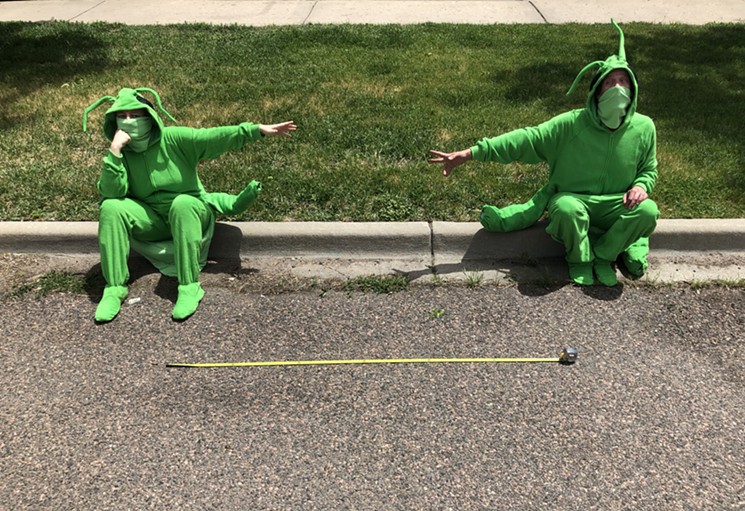
Two people wearing bright green grasshopper costumes are sitting on a curb. On the ground in front of them is a tape measure showing that they are six feet apart. They are reaching a had towards each other. Both of them have a light green handkerchief covering their mouth and nose.

GetBoulder.com- Grasshoppers

THE GRASSHOPPERS – Written, Directed and Acted by the Members of Buntport Theatre Company.  Produced by the Buntport Theatre Company (performed in their parking lot at 717 Lipan, Denver) through July 19.  Tickets available at 720-946-1388 or stuff@buntport.com

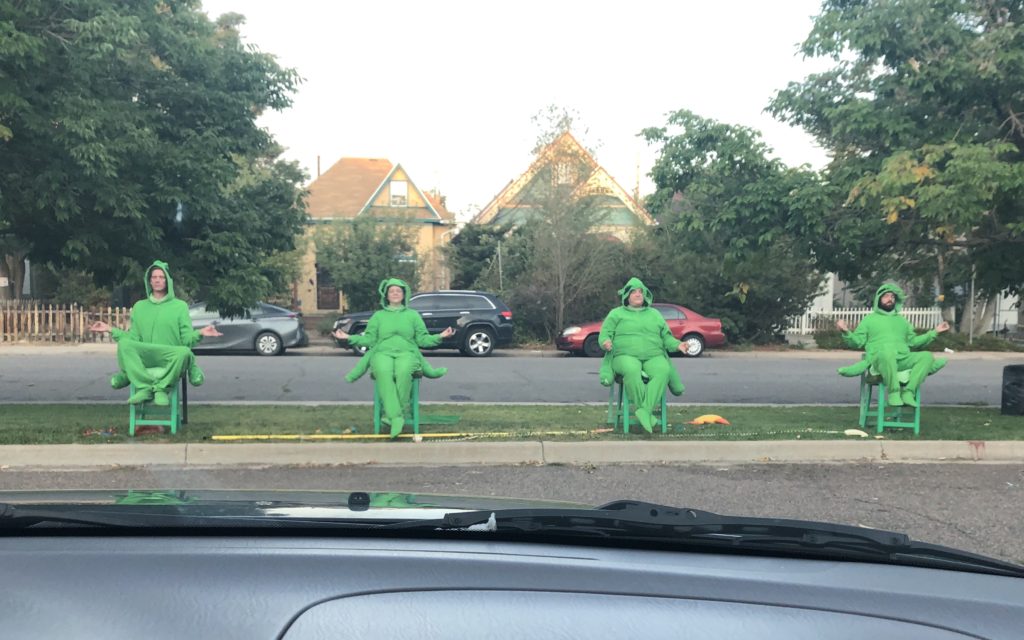
I saw a play tonight!!!  Do you realize what I just said??  I SAW A PLAY TONIGHT!!  And it was so much fun.  Leave it up to the creative folk that make up the Buntport team to come up with a safe and creative way to bring entertainment to their followers.  As you pull into the parking lot, you are directed to park against the building with your headlights pointing out.  A tiny disinfected speaker is provided for each car and you are entertained with “Bug Music” as you wait for your fellow audience members.  Four green stools sit across the parking lot on the grass next to the sidewalk.  When the show starts, Brian, Hannah, Erin and Erik don their green onesies and transform into the grasshoppers in front of us.

THE GRASSHOPPERS is a kind of mockumentary about this particular “cloud”  of grasshoppers full of “fun facts” about these little insects that survive by keeping their six legs six feet apart.  We learn random and authentic information about the amazing creatures that perform in front of us to the voice of the Narrator.  In addition to much factual information, our grasshoppers illustrate their jumping techniques and explain the process by which they turn into a swarm of locusts.  They demonstrate their feisty natures and their jump to anger when confronted by giant humans.  But their bottom line is that all creatures will survive if they stay apart, protect their own and that there is power in the swarm by working together.  Take a leap of faith and keep hope in your heart.

Just as the beautiful people at Buntport have done by finding a way to entertain an audience starved for live theatre.  God bless you everyone.  This first round of shows is sold out already – but call or write in and get your name on the waiting list as they are planning to add performances as soon as they can.

A WOW factor of 9!!

-Beki Pineda June 14th, 2020

A picture from inside of a car. At the bottom of the picture is the dashboard. In the distance, four people dressed in bright green grasshopper costumes are sitting in green chairs with their hands as though they are meditating. Behind them is a street with cars, houses, and trees.

The Denverite- It’s theater! It’s a drive-in! It’s giant grasshoppers! (Actually, it’s Buntport)

The trickster theater troupe will offer “The Grasshoppers” to help get your mind off the coronavirus.

Theater artist Erin Rollman started with the literal.

Rollman was trying to come up with an idea for a show that her Buntport Theater troupe could do after rules imposed to stop the spread of the coronavirus made it impossible to gather audiences and performers inside.

So what’s outside? Grass. And what lives in the grass? Insects.

“I was thinking about the phrase ‘six feet,’” Rollman said, referring to the distance that public health experts advise we keep apart in public to try to stop the pandemic.

Well, kind of thinking about it.

“What little creatures would be out on the lawn that have six feet?”

She settled on grasshoppers. Some might quibble over whether grasshoppers have feet. They definitely have six legs, and a backstory that resonated with Rollman. Grasshoppers are usually shy creatures, but they become ravenous locusts when they’re around their peers. Physical changes accompany the new behaviors, with the creatures growing stronger and changing color.

During the pandemic, Rollman said, humans “can’t get together in big groups without, metaphorically, turning into locusts.”

As is the tradition at Buntport, she turned to colleagues to brainstorm, via Zoom before Denver’s stay-at-home transitioned to safer-at-home orders. Thus was born “The Grasshoppers,” a short play to be performed on a strip of lawn outside Buntport’s theater at 717 Lipan Street in the Lincoln Park neighborhood to audience members watching from their cars. It’s not too much of a spoiler to divulge that Rollman, Erik Edborg, Brian Colonna and Hannah Duggan all will be wearing green grasshopper costumes sewn by Rollman, who is also a Buntport co-founder.

Drive-in style, audiences will hear a pre-recorded script via their cell phones as they watch the four grasshoppers interact. The script sounds like a nature documentary’s narration, but “the learning factor is probably lower,” Colonna acknowledged.

This is, after all, Buntport, whose performers have been described by Denver Post theater critic Joanne Ostrow as “tricksters.”

Colonna said he hopes “The Grasshoppers” will offer a bit of respite from “the monotony some of us have felt in quarantine.”

A performance during a pandemic can’t be all fun. Safety was a priority as “Grasshoppers” developed from an insect egg of an idea to a show. Rollman, Edborg, Colonna and Duggan will keep a social distance on their lawn stage and have minimized sharing of props. Masks will be needed if you plan to roll down your windows during the show because cars will not be six feet from each other. Anyone who would like to see the performance without a car should contact Buntport for details on how that can be done safely (stuff@buntport.com or 720-946-1388). The theater bathrooms will be open during the show, but the performers kept “The Grasshoppers” to 35 minutes in hopes no one will need to go.

The collaborators had to consider whether audiences might be willing to come to a live performance.

Within days of the May announcement of the show’s June 11-27 run, the eight available parking spaces were reserved (on a pay-what-you-can basis) for each of the 12 performances initially scheduled. Buntport is working out a schedule for additional shows, which will be announced on its website.  Still, even if each car holds five people, the response to “The Grasshoppers” doesn’t compare to the 150 seats inside the Buntport.

While shops and restaurants have started to reopen under restrictions, it’s unclear when theaters will be welcoming audiences inside and under what guidelines.

For now, “a closed room with 150 people … doesn’t seem cool,” said Sam Schmitz, another member of the Buntport troupe.

Schmitz said her theater has some loyal fans who are used to coming as often as once a month. While it’s not quite the same as the pre-coronavirus performances, “The Grasshoppers” offers something more than the online material Buntport has recently offered.

“I personally think there is something about live theater you can’t always translate to online,” Edborg said.

Windshields will be between the performers and the audience, and the actors won’t be speaking during “The Grasshoppers.” But without bright theater lights, Rollman expects to be able to see each audience member, something she’s rarely able to do from stage.

“We can connect in a different way,” she said.

“This is its own thing. It’s not a replacement for a show that you can see inside a theater. We’re trying to make it as intimate and fun as we can,” Rollman said. “I suspect that even though we have barriers, it will feel emotional.”

Donna Bryson- June 1st 2020 Denverite

Check this link for great photos with the original article post

Two people wearing bright green grasshopper costumes are sitting on a curb. On the ground in front of them is a tape measure showing that they are six feet apart. They are reaching a had towards each other. Both of them have a light green handkerchief covering their mouth and nose.

Westword- Buntport Theater Hops Back Into Action With The Grasshoppers

The COVID-19 crisis has pummeled theater artists, who were already struggling to compete in a world of Netflix, Hulu and Amazon. Unique real-time experiences shared among actors and audience members have always been the theater’s selling point, but now those in-person experiences are shut down indefinitely. And while many local companies are helping their artists stay active and communicating with audiences through videos and performances over Zoom, most people are longing for something more immediate.

Amid the despair, Buntport Theater, one of Denver’s most cherished arts organizations, has found a way to pull off a live performance.

The Grasshoppers, described as a “short, funny twist on a nature documentary,” will be presented in the theater’s parking lot. The actors will be at least six feet from each other, and patrons will remain in their cars. “This is an experiment,” explains company member Brian Colonna.

But with Buntport, what isn’t?

Like all of the troupe’s productions, The Grasshoppers was created through a group process and inspired by a quirky, compelling fact that inspired one of the troupe’s members: Erin Rollman had read about a species of grasshopper that, because of changes in the environment, morphed into voracious swarms of locusts that infested the Rocky Mountain region beginning in 1875.

Homesteaders faced “a plague of biblical proportions,” says Colonna. “Obviously, it changed the lives and times, including growing practices. Religion was part of it, too; the way the government responded was part of it. You have these settlers experiencing a spiritual dilemma, wondering if they’re being punished by God. And the church had to walk a fine line between asserting ‘Yes, you are being punished’ and cursing the locusts.”

In this production, four actors play the grasshoppers. That’s not a hard thing to do, observes Colonna, since Buntporters have often taken on animal roles. He was a camel in The 30th of Baydak and a rat in Universe 92;  in Jugged Rabbit Stew, Erik Edborg was a giant talking rabbit. And Rollman gave a melancholy performance as Io, the Goddess transformed into a cow, in two productions.

“Clearly, we have a problem,” observes Colonna, laughing.

Although the COVID-19 crisis isn’t mentioned directly, The Grasshoppers does address it: The play explores the juxtaposition as solitary insects become “a gregarious swarm burning through resources like fire,” says Colonna. The production also touches on the way the stay-at-home orders have helped heal our damaged environment, since nineteenth-century settlers noted that fields were often more fertile after a locust infestation.

The theme of separation and coming together is personal for the company, whose members had been working together almost daily since Buntport’s inception two decades ago.

“This week is the first time we’ve all been in the same place since the shutdown — six feet apart, with masks, but together,” says Colonna. “Before that, all the work was online and on Zoom. Just having a rehearsal felt like a revelation. You can’t interrupt anyone on Zoom; it reins in conversations. And we talked today about connecting with the audience, also, letting them know you’re interacting with them and seeing them.”

While the future of Denver theater is unclear, Buntport may be better equipped to weather the crisis than some  groups. The company has a devoted audience, strong connections with other local institutions, and an understanding landlord — though he, too, faces financial uncertainty, Colonna notes. Buntport has saved some money over the years, and has a history with large funders. The nonprofit received a small business loan in the first stimulus round, and the Bonfils-Stanton Foundation allocated funds. Members have taken pay cuts, but they are still receiving checks.

“Right now we are able to continue to have our jobs, which is a privilege,” says Colonna. “It’s been amazing, people coming together to support us. We are also a small company that can change course relatively quickly. We are planning to be able to sustain even if we cannot be fully operational for another year or more.”

In August, The Grasshoppers will take on new life with the release of a video companion piece created in collaboration with Fannypack Films and artist Adam Stone. This is part of the 3×3 Projects initiative created by the Fine Arts Center at Colorado College, which has funded seven projects exploring creative collaborations during the stay-at-home order.

“Still, it’s a big problem,” Colonna concedes. “There’s no revenue in terms of ticket sales, and no knowing when people will be able to come together again. But the bedrock for us has been the community and being here twenty years. We’re still here. We’re hanging in. And we’ll see what happens.”

-Juliet Wittman May, 26th 2020 Westword

A dorky looking scientist sits in front of a microphone. He has a clipboard and papers on his lap and he is sitting in front of a television that shows two women on the home shopping network.

Westword- Rats! Buntport Creates Another Successful Experiment in Universe 92.

Those who love Buntport Theater Company know that this group of five writer-producers tends to seize on intriguing small facts with unseemly relish and pick away at them until they’ve either disappeared altogether or dissolved into laughter. Recently, performers Erin Rollman, Brian Colonna, Erki Edborg and Hannah Duggan, along with offstage impresario SamAnTha Schmitz, discovered that mice sing. And they do: The males sing sweetly birdlike songs to court the females, though the pitch is too high for humans to hear.

Singing mice aren’t at the core of the company’s latest offering, Universe 92, but the mysteries of animal behavior and cognition are, and there is a bit of song. The company has created a large Rat, excellently played by Colonna, who lounges in a hammock and now and then bursts — hoarsely and not at all sweetly — into outdated pop songs. Using a microphone.ADVERTISING

Colonna’s Rat is contained within walls painstakingly made of cut-out cardboard pieces. He’s a lab rat, all on his own and under study. He talks, sometimes makes a clicking-chucking sound. The three other actors are the lab assistants who take care of Rat and test him in various ways — though not in some of the ways you’d expect. They don’t open his head to insert wires into his brain or test his response to GMOs. Mostly, they give him objects and ask him to rate these with either stars or the kinds of faces you get on a pain scale. Rat isn’t very interested in their work. His ratings are tossed off contemptuously or simply not forthcoming. The objects include the microphone — which he loves — as well as a brush he uses to groom his own belly, a bunch of celery (which he rates a complete bust), a turkey knife, and an object that’s a major success, which everyone seems to see as essentially alive: the Roomba. Because if you’re examining the essentially unfathomable boundaries between animals and humans, why not contemplate the meaning of artificial intelligence in robotic objects, too?

We know the Buntporters have their own relationship with inanimate objects. If you can turn Laertes into a Teddy Ruxpin bear and Ophelia into a goldfish in Something Is Rotten, your version of Hamlet, your sense of the difference between animate and inanimate is so weird that of course you can get a roomful of people fixated on a zooming, glitching, bustling little Roomba.

While I can swallow the idea of a giant talking rat, and know that rats are commonly used in experiments because of the similarities between their brains and ours, I don’t understand why Rat is being asked his opinion on things you’d find on Amazon or Facebook ads or popping up in marketing e-mails. There’s a lot of talk about the commodification of all our tastes, wants, ideas and peccadilloes, which are monitored, stored, sold and used to assess everything from who’s most likely to vote in an election to who is searching for sandals right now. But does anyone want to know if their toothbrush would appeal to a rat?

The three researchers are very different in their approach, and — since all of the Buntporters are wonderful performers — they’re each uniquely fascinating. Dr. Lorelei MacGuire (Rollman) is all business. She wants data, data and more data, and she’s deeply opposed to empathetic human-rat interaction, which can mess up the figures. She’s not a true scientist, though, because she has no intellectual curiosity. She doesn’t care what the data actually reveal, just wants them sent to the people who slice, dice and monetize them. Pamela Hamilton (Duggan) has a bit of an inferiority complex because, unlike the other two, she has no doctorate. While she does seem to possess a certain sense of wonder, it’s not about science, and her impulsive and very funny questioning tends to annoy MacGuire and Dr. Frank Calhan, played by Erik Edborg. Calhan is the researcher with soul, a lonely, baffled man who longs to connect with Rat in some way. But if you’re hoping one of those wonderful, off-kilter relationships will develop — the kind that shows up on videos where a cat and an owl play together or creatures emerge from the depths of the sea to nuzzle a woman lying on the beach, you’re not going to get it. Rat is not only surly, but very literal-minded. Except when it comes to Roombas.

There’s lots of food for thought beneath the fizzy pleasures of this show: about science and the virtues of using observation and inference as well as straight-up numbers; the ethics of experimenting on sentient beings; the desire most of us feel to understand animals and all the myths and stories that desire generates. Perhaps central is the paradox of rats themselves, those despised, supposedly filthy creatures that, as people with pet rats will tell you, are in fact smart, interesting and affectionate.

Universe 92 might be even more interesting if Buntport had looked deeper into these things, and into what numerous studies are telling us about creatures we think we understand though they occupy entirely different sensory-psychic-neurological worlds. We now know that rats seem to laugh when they’re tickled. Even stranger, they can be taught to play hide-and-seek with scientists — not for food or to avoid electric shocks, but apparently for the sheer joy of play.  A stronger examination of such intriguing facts could add significance to this intelligent and entertaining production.

Juliet Wittman September 30, 2019 Westword