Buntport Theater

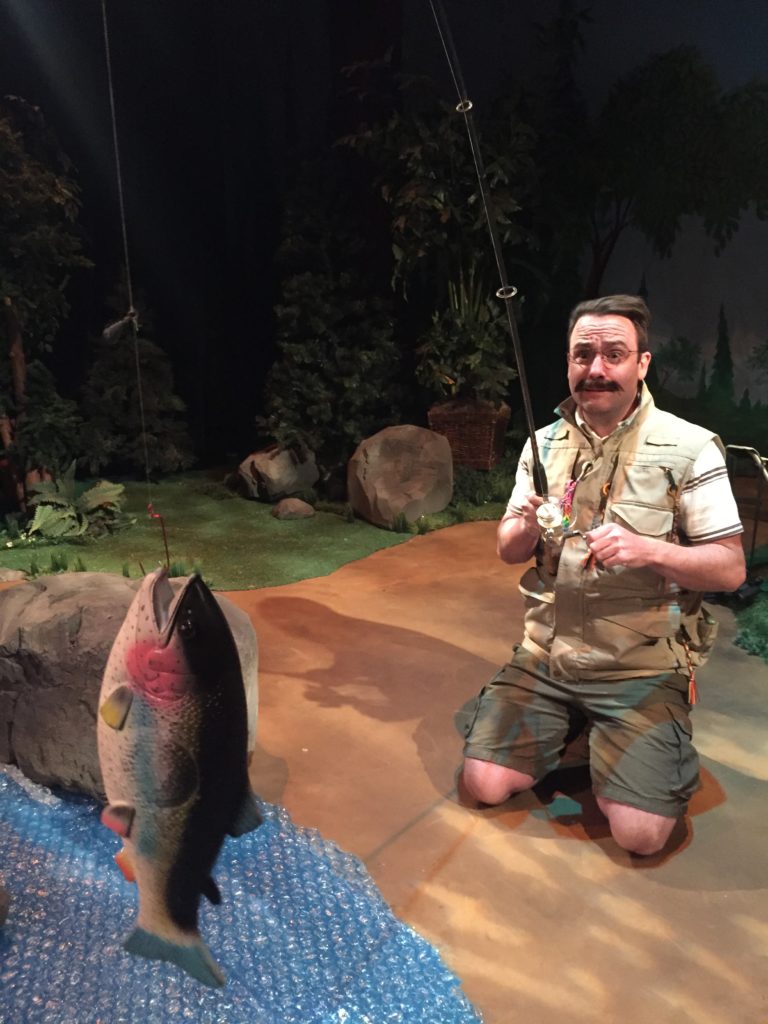
Two male campers relax in their campsite. One sits in a camp chair and reads a book, while the other knells down to contemplate a fake river made of blue bubble pop.

Littleton Independent- Outdoorsy story naturally funny


Buntport refers to mythology in story about summer camp
A red velvet curtain hangs across the stage area at Buntport Theater this month — unusual. What lies behind it?

A scene in the woods appears as lights go up on “Greetings from Camp Katabasis,” with a small tent, trees and shrubbery, boulders, a little stream and a couple of guys sitting in chairs, talking. A whistle blows and it’s the camp counselor, (a loud, emphatic Hannah Duggan) in life jacket and carrying a paddle. “Now, campers …” She talks awhile about canoeing safely, the near certainty of overturning — and decides these guys probably shouldn’t attempt it.

“Don’t go near the water,” she advises as she leaves the scene. Eric Edborg as the mostly relaxed doofus and Brian Colonna, the nervous fellow, who is prepared for every emergency, with sunscreen, insecticide, flashlights, etc. — in his tent — and a plastic, life-sized Resusci Annie used widely for practicing CPR. She sits silently in another chair between Colonna and the tent — and enters into the storyline later!

The campfire plugs in!

Are these two consigned to some sort of hell — or just a stay in the woods?

Edborg finds a feather as the mismatched pair contemplate nature. (Katabasis, in mythology, can mean a trip to the underworld and back. This spot in the woods with poorly matched companions would be a form of underworld for many!)

Duggan reappears with whistle and talks brightly about hiking. “Stay on dry land,” she commands.

With talk about their “journey,” Edborg speculates about a meteor shower the first week, then goes for a walk and meets a bear. “Everything’s harder here,” Colonna’s wimpy guy whines. He suggests singing “99 Bottles of Beer on the Wall.”

“I’m reading a book that was on the New York Times best-seller list,” Edborg replies. “What am I supposed to do while you read a book from New York?” Colonna whines. In addition to the mythological references, the audience members may chuckle over some unfortunate summer camp memories of their own — and/or find additional references to Greek or Roman mythology.

The cast continues talking non-stop, and laughs are frequent in the audience as silly/clever lines continue unabated. Colonna gets in a bit of CPR practice with Annie and catches a fish. Messages from the loud counselor continue. Where are we anyhow?

Buntport Ensemble’s unique form of literary goofiness provides a delightful way to spend an evening. This is the third journey into mythological realms this spring.

The program promises a reprise of the very clever “Middle Aged People in Boxes” to start the next season. Looking forward to that!

-Sonya Ellingboe, May 23, 2016, littletonindependent.net

Two male campers relax in their campsite. One sits in a camp chair and reads a book, while the other knells down to contemplate a fake river made of blue bubble pop.

Westword- Buntport’s Greetings From Camp Katabasis Leaves You Wanting S’More

In Greetings from Camp Katabasis, two campers are out in nature, annoying the hell out of each other, bickering, philosophizing, attempting to bond and mourning the death of a friend called Chuck.

Katabasis, according to counselor Amie (Friend?) — whose hysterically funny monologues frame the action and is probably just a larger-than-life memory the men carry with them — means some kind of descent: whether literal, into the depths of the self; or into Hades itself. We’re guessing Hades, since the men’s tent is beside a strip of river. We’d love to tell you what the river’s made of, but that would ruin the surprise; you’ll have to see for yourself.

The campers are Pete and Jim, aka Brian Colonna and Erik Edborg, a comedy team as zany, gifted and original as any of the historic greats: Laurel and Hardy, Abbott and Costello, the Goons or the Monty Python gang. Jim is a wonder-filled hippie with long hair, sandals and thick gray socks, who insists they’re on an important journey; Pete, gesticulating, excitable and easily bored, has come ridiculously overprepared, bringing a portable eyeball flusher, a Darth Vader Pez dispenser and a plastic doll called Annie to be used for CPR practice, among other things.

Amie, played by Hannah Duggan, is a figure as monstrous and overwhelming as Nurse Ratched, Miss Hannigan or any nursery-story villainess. She’s fiercely bossy and at the same time utterly ridiculous, warning against every kind of danger, from carrion-ripping ravens to tipped-over canoes to poisonous insects. There’s no way that anyone will get out of Camp Katabasis alive, she warns, fixing the audience with her glittering eyes. You believe her because no one can portray larger-than-life and bordering on the supernatural as well as Duggan.

Buntport Theater Company has been exploring issues of myth and loss all season, and there are some deeper meanings running beneath that river, ideas about reality and illusion, speculation on the nature of the universe and our place in it. What, the campers, wonder periodically, lies on the river’s further shore? The CPR doll is called Annie for a slightly creepy reason, too: Rescue Annie is the name given to such mannequins around the world, and the first Rescue Annie’s face was modeled on the death mask of an unknown young woman found drowned in the Seine in the nineteenth century. This apparent suicide had a slight smile, her eyes seemed about to open, and her death mask was venerated as a symbol of mystery and beauty by artists and poets.

But there’s also talk in Camp Katabasis about such trivial topics as how to ball socks and whether “hokily” is an actual word. The best thing about this production, which lowers the curtain on a truncated but profoundly evocative season, is that you get to see the folks of Buntport at play, and marvel at just how brilliant and funny they are.

-Juliet Wittman, May 19, 2016, Westword

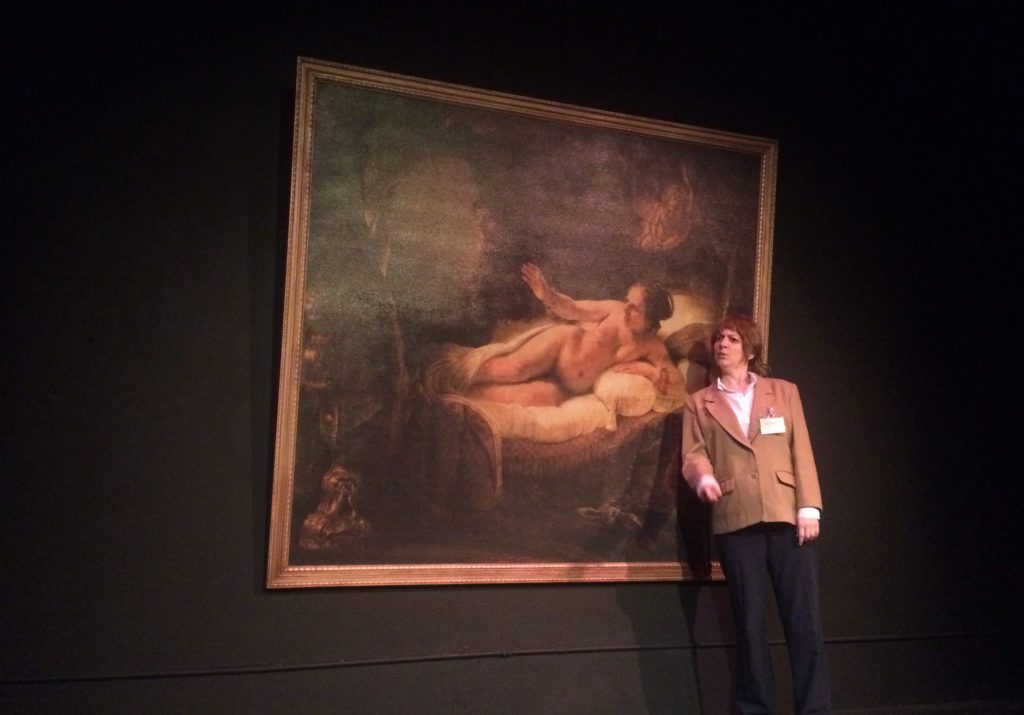
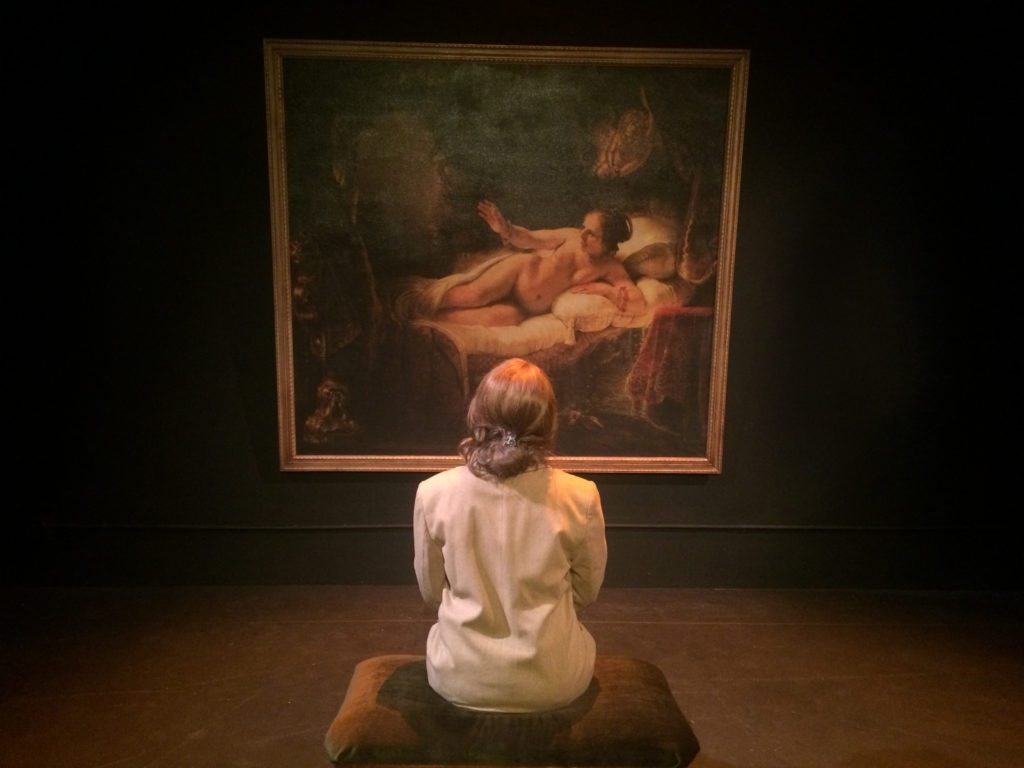
A female art museum security guard stands next to Rembrandt’s painting of Danae. She leans in close and matches the eye line of the painted woman in an attempt to determine what she might be looking at.

Denver Post- “The Rembrandt Room” stars Erin Rollman in Buntport’s first solo show

Erin Rollman is stunning in Buntport’s “The Rembrandt Room”

But, as any good storyteller knows, the bored-looking guard standing beside the painting has a tale at least as interesting as the Greek myth represented on the hallowed canvas.There’s something antiseptic about a windowless gallery housing priceless treasures. The Old Masters are to be worshipped. Paintings in museums are to be revered. Art is untouchable.

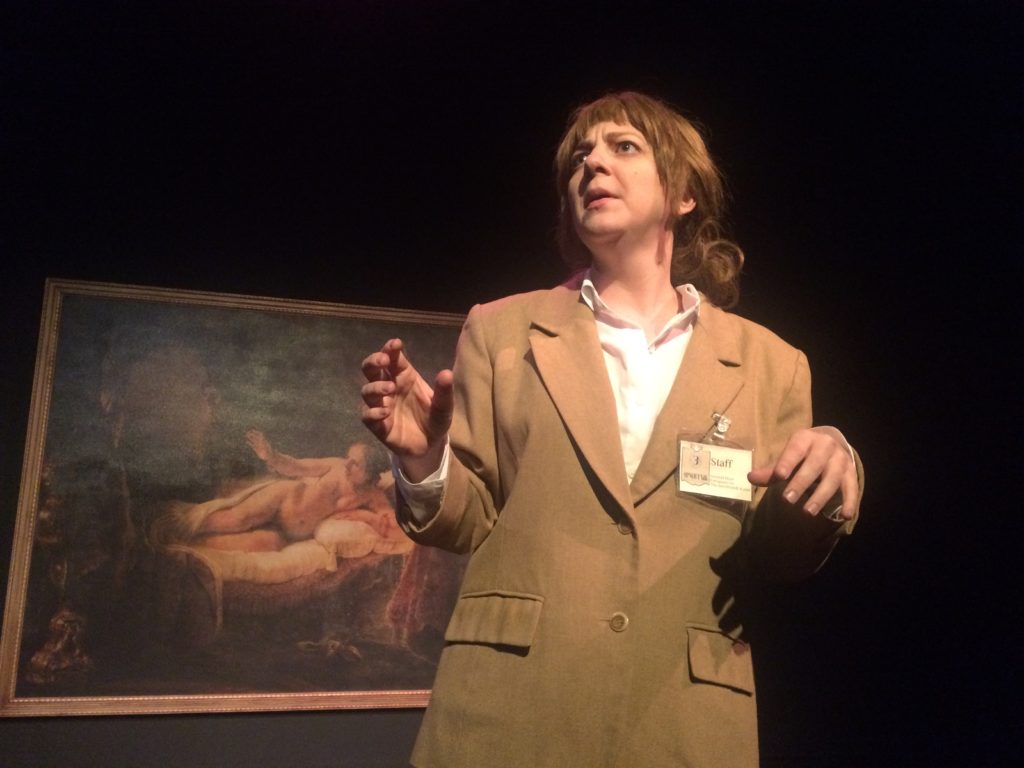
On a blank stage save for an over-sized Rembrandt, we encounter a museum guard. She is detatched, with an itchy collar, bland blazer and comfortable shoes, most often called upon to direct visitors to the rest room. Occasionally she asks them to step back from the paintings and refrain from flash photography. Turns out she is a highly opinionated tour guide to matters of art history and feminism. She also guards a rich personal history.

The Buntport tricksters offer their first one-woman show, “The Rembrandt Room,” capitalizing on the sly talents of Erin Rollman. The play fully draws the audience into the painting in question. Literally and metaphorically, we sit in the dark waiting for light. Beams of light accentuate the action onstage, just as Rembrandt, master of shadow and light, directs our gaze to certain movements and actions within the painting of Danaë.

The renowned painting is a life-sized depiction of the character Danaë from Greek mythology, the guard informs us. The painting hangs in Russia’s Hermitage Museum, where the action is set.

The canvas has a loaded history: it was famously attacked in 1985 by an insane visitor who threw acid on it and cut it with a knife. The restoration took years.

Personal restoration is a slow process, too. But as the guard relates her personal despair, triumphs and oddball observations, we come to see her as she sees the Rembrandt: both are masterpieces and survivors. Both deserve scrutiny and appreciation.

Danaë is depicted as welcoming Zeus, who, according to myth, entered her locked chamber and impregnated her in the form of a shower of gold. Danaë gave birth to Perseus as a result and it didn’t end well: Danaë’s father, the King, had a premonition that he would be killed by a son born to Danaë.

The backstory is equally intriguing: Although the artist’s wife was the original model for Danaë, Rembrandt later changed the figure’s face to that of his mistress. As if that factoid isn’t enough to launch a play.

There’s more.

With detours through Catherine the Great, pregnancy issues, rape and the artist’s self-portrait within the painting, posed peeking around a curtain, the guard slowly reveals herself.

She has a way of touching our most human aspects as she peppers us with questions:

Calamaties befall folks all the time, as predicted in ancient myth, right?

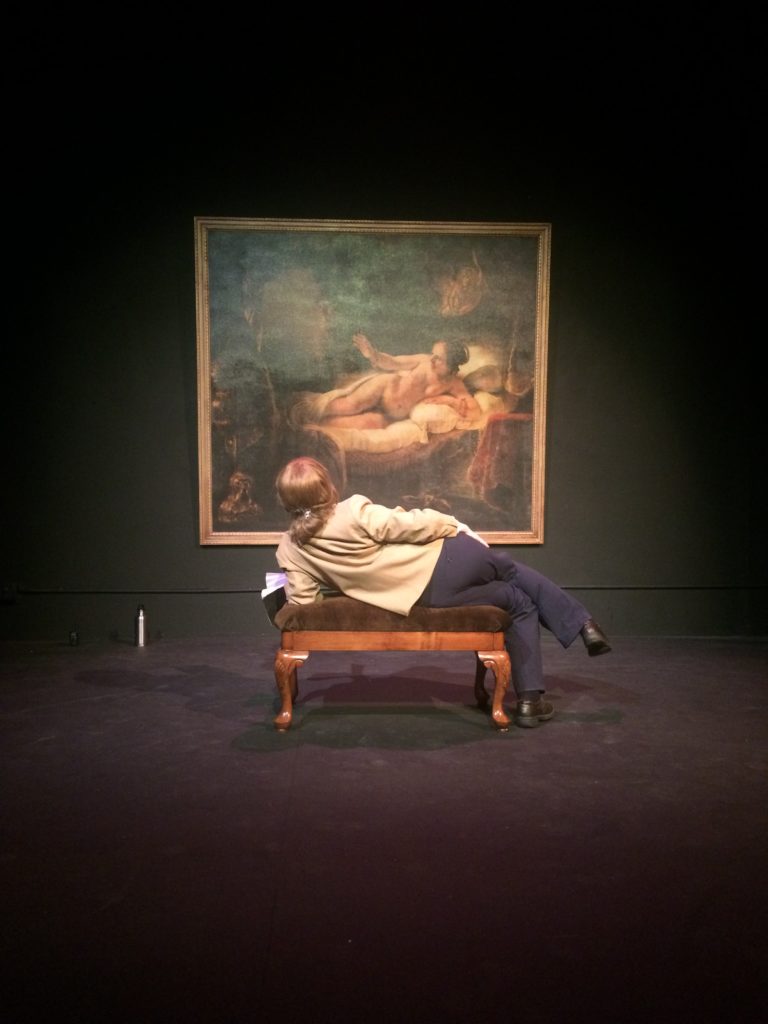
Rollman, a co-founder of Buntport, is riveting throughout, taking us on a wild ride through her character’s tragi-comic aspects. She voyages from asexual and inconspicuous part of the background, to fully sexualized reflection of the nude in the painting (is she nude or naked? It’s a point we’re encouraged to contemplate). She convincingly ranges from hilarious to poignant and reaches depths you don’t see coming.

The interplay of Greek myth, a woman’s emotional rehabilitation and the restoration of a damaged canvas successfully echo and ignite in the 90-minute dark comedy. “The Rembrandt Room” is worth a visit ‐ just remember, no flash photography.

-Joanne Ostrow, April 8, 2016, Denver Post

OutFront Buntport Theater Company’s Rembrandt Room

Buntport Theater Company continues its triptych of Greek-myth-inspired plays with an unassuming dark comedy that throws the cult of simple answers into relief. Relief against what, exactly? The museum attendant (and only cast member on stage) reminds the audience early on that Rembrandt’s lighting is famous not for its clarity but for its shadows. Like the chiaroscuro in the painter’s work, the play is as passionate about epiphanies and revelation as it is devoted to anecdotes, sidebars, and footnotes. Some answers come, some don’t, and most of the way is only partly lit. Every age has its unique forms of simple answers. Ours fits them into 15-minute TED Talks and a regular churn of #helpful discretely numbered lists (6 Ways to Live Again after Your Break Up). We click and share these daily, we repeat mantras like “not the what or the how, but the WHY,” to the point of almost religious practice. We believe, on some level, that elegance can save us, and if we are to be rescued from stagnant jobs or disappointing relationships or poor company performance, why shouldn’t the answer emerge clearly and simply

“Welcome to the Rembrandt Room,” the narrator says, banally directing folks to the bathroom and launching into the standard analysis of the piece behind her. The painting is an intimate depiction‐”practically life size”‐of Danaë reclining on a bed moments before she is raped by Zeus in the form of a shower of gold (not to be confused with a golden shower).

Shortly after this simple introduction, however, we cross into alternate interpretations and counter histories of the work. “The longer you look at something,” the museum attendant tells us, “the more you can see the beauty in it.” Her speech, delivered more personally than a lecture, creates a web of meaning from the nude (or is she naked?) painting subject; the mistress and wife of the painter; the legacy and reputation of Catherine the Great, who originally purchased it from Rembrandt; and the 20th century vandal who attacked the painting with a knife, requiring a 12-year restoration process. Like the narrator, many of these women are waiting and hoping for a simpler answer than they have received, leaving the narrator to revise her original claim: “The longer you look at something, the harder it is to see, and the more real.”

Buntport’s choice to stage this play is incredibly risky ‐ pacing is often a challenge in one-actor pieces ‐ but Erin Rollman demonstrates compelling range and depth as the museum attendant, escorting the audience through art history, monarchies, mythologies, and intimate disclosures with ease and wit. The Buntport team’s dynamic script leaves one wanting more of the monologue, rather than less, and the overall effect is the same buoyancy ‐ always earned through complexity ‐ that they’ve shown in earlier productions.

Though the answers aren’t simple for the women of Rembrandt Room, their paths are marked by light and shadow.

-Paul Bindel, April, 18, 2016 OutFront

A female art museum security guard stands in front of Rembrandt’s painting of Danae. She’s looking at something in the distance.

Littleton Independent- ‘Rembrandt Room’ is art for art’s sake

Buntport one-woman show focuses on museum guard
Soon she’s off on a spiel about the painting. The painter Rembrandt’s wife, Saskia, was the model, but the face is that of Geertje, Rembrandt’s lover, hired to care for the couple’s baby son Titus. She stayed on after Saskia died while Titus was still very small and beyond. (The painter couldn’t remarry if he wanted to inherit Saskia’s money.)Lights go up on a large painting of a reclining nude and a uniformed museum guard, played by the versatile and always engaging Erin Rollman of Buntport Theater’s collaborative quintet of actors, writers and directors, who create all the company’s original material.

“Please stay two feet away from the paintings at all times …”

The painting (1836) is of Danaë, the mother of Perseus, we are told. She is reaching up toward Zeus, who will impregnate her with a shower of golden specks … A shadowy figure lurking outside the entrance to the room is a man with a fist full of paintbrushes ‐ one of Rembrandt’s numerous self-portraits.

“The bathrooms are off the stairs to the left …”

Rollman continues to combine comedy and flashes of humor for about 90 minutes as she lectures about history ‐ Katherine the Great owned the painting and we learn tidbits about the legendary Russian monarch as well as the information that a man had slashed the painting with a knife at one point and it took 12 years to repair it.

Every so often a scratchy radio sputters to life with a message to the guard ‐ or her phone rings …

But for almost 90 minutes, this inventive actress entertains the audience with a mix of mythology, history and goofiness.

Buntport fans and those looking for something new and different will want to visit the “Rembrandt Room” soon.

-Sonya Ellingboe April 15, 2016, Littletonindependent.net

A female art museum security guard reclines on an upholstered bench in front of a Rembrandt’s painting of Danae. The guard reclines in the same manner as Danae in the painting.

Westword- The Rembrandt Room Is a Buntport Masterpiece

Every now and then, an artist ‐ or, in the case of Buntport Theater Company, an artists’ mind meld ‐ seems to pass through a metaphorical doorway. For more than a decade now, Buntport has been one of the bright lights on the local theater scene. With their company-created original works, members are capable of truly inspired goofiness, including a production based on Hamlet in which Ophelia was played by a goldfish swimming circles in a round bowl, giving a whole new meaning to Queen Gertrude’s lament, “Your sister’s drowned, Laertes”; light, laugh-outright comedy like their musical take on Titus Andronicus; grotesquerie; pensiveness; and intellectual inquisitiveness and moments of singular beauty, such as the one in Kafka on Ice when the writer sends a short story to his beloved Felice. In her hands, it unfurls into the paper figure of a man, and she dances with it. “The writing does quite well with her,” Kafka observes

Over the course of the production, the guide talks about many interesting things. How we see and judge art. The difference between nude and naked. Her dislike for Titian’s version of Danaë. The role of Catherine the Great ‐ the powerful patron of the arts who’s primarily remembered now for sniggering and apocryphal stories about the way she died ‐ in the painting’s history. Mythic and cultural views of women. Good as Buntport’s plays have always been, The Rembrandt Room, a long monologue by a guide watching over said room in Russia’s Hermitage Museum, reaches new heights. It’s transcendent, a brilliant work of art. The guide, played by Erin Rollman, stands by Rembrandt’s “Danaë.” She directs people to the restrooms, tells them to stay two feet away from the paintings, forbids the use of flash photography. And she returns again and again to the painting itself, where Danaë is shown naked, reclined on cushions, gazing toward the light falling through a gap in some draperies. The guide tells Danaë’s story: Having heard a prophecy that he would be killed by her son, her father imprisoned her underground so that she could never bear a child. But Zeus, that randy shape-changer, entered her dungeon in the form of a shower of bright coins and impregnated her.

The attack on the painting by a madman who poured acid on it and slashed Danaë’s belly in 1985, and the twelve years it took to get it restored. Rembrandt’s changes to Danaë’s face and changes that might have occurred during restoration. Rembrandt’s use of light, the mysteries of darkness and light. But the guide isn’t just giving us an art-appreciation lesson; she puts her own spin and interpretation on all of these ideas. Certain facts return again and again, and each time the meaning is deeper or a little different. The text is allusive, densely layered; you could keep yourself busy separating all the strands and contemplating them one by one. But you don’t want to get lost in an academic exercise; the point of this display is the nervous, spurty, ridiculous movements of the guide’s mind. She isn’t just anyone; she’s somebody very specific.

And this somebody is a figure that only Rollman, with her unique and considerable talents as an actor, could create. At first the guide seems eccentric ‐ if not quite mad ‐ with her nervous gestures, her weird laugh, the way her voice gets uncomfortably shrill here and there. She’s funny and silly and also tragic, particularly as you come to sense the echoes of her own life she finds in Rembrandt’s painting. But even when she’s most moving, catching at your heart with a moment of profound and mysterious grief, the guide undercuts herself with an ironic comment, tiny joke or apparent non sequitur. I’d call this is a tour-de-force performance, but that implies something flashier and more self-conscious ‐ almost an insult to the deep, clear truth of Rollman’s work.

But Rollman didn’t create this piece of theater alone. The script was written by the entire company, which includes felllow Colorado College grads Brian Colonna, Hannah Duggan, Erik Edborg and SamAnTha Schmitz in a process I’ve never understood; I’d have expected writing like this to require solitude. But perhaps after all their years together, these artists have actually taken up residence in each others’ minds ‐ and the result is beautiful.

-Juliet Wittman, April 12, 2016 Westword

A female art museum security guard sits on an upholstered bench facing Rembrandt’s painting of Danae.

Get Boulder- The Rembrandt Room

If you want to see one of the best performances of the year, run to the nearest phone and call Buntport for a ticket to THE REMBRANDT ROOM. A one-woman show at turns funny, educational, and poignant, this is a tour de force performance by Erin Rollman that will linger in the memory of audience members for decades. She stands toe-to-toe with Laura Norman’s GROUNDED fighter pilot of last season, Deb Curtis’ capricious SHIRLEY VALENTINE and Deb Persoff’s ROSE in years past.

With a bad haircut and dressed in a poorly fitting and obviously uncomfortable uniform, she stands guard in the Rembrandt room in the Hermitage Art Museum. Bored and desperate for action besides directing patrons to the bathrooms, she begins to display her considerable knowledge about Rembrandt’s painting of Danaë in front of which she stands each day all day.

In her lighthearted and self-admitted suspect discourse on the painting and art in general, she manages to touch on a variety of diverse subjects. Her “lesson” becomes more like a conversation full of asides and interruptions. Freemasonry, the life of Catherine the Great, her lover Potemkin, Rembrandt’s lighting techniques, the Greek Danaë myth — all became grist for her script. Her own slight disorder of the mind is revealed through her insistence of a flash of light in the corner that only she can see and her scratchy intercom conversation with Catherine. It is so sweet how all the aspects of her ramblings come together. In addition to explaining aspects of the composition and its history in her own quirky way, she also defends Catherine the Great who purchased the painting in 1772. Small details about her own feelings about the painting and her personal life begin to be dropped into the conversation. She discloses that the painting was vandalized in 1985 by a “madman” who stabbed Danaë in the abdomen and threw sulfuric acid on the surface. It was only put back on display after a twelve year restoration project. As more and more of her sad personal history is revealed, her emotional connection to the work emerges. She, like the painting, has layers stripped away and is still in need of repair. A staff member of the Museum made the comment that “the logic of restoration takes its own course.” We learn that our guard’s restoration is still under way. She bears the same physical scars as Danaë after the man with a knife did his damage.

It is so difficult to understand how a script like this could have been developed. It feels so much like an “off the top of the head” evening. It is as though there is no script; that Erin is just ad libbing random thoughts from her ever-present notebook of factoids. Another Buntport member when asked after the show how the writing developed replied modestly, “It’s what we do.”

Erin’s performance – if you haven’t gotten that by now – is phenomenal. Her boredom is complete (but fun to watch) and accompanied by fidgety adjustment of her clothing; her joy at finding an audience is almost manic; her personal revelations are so subtle and guardedly revealed as to become painful. Her audience laughed with and at her, patiently sat through her periods of boredom as she waited for patrons to leave so she could talk to us again, and shared her personal grief. We were riveted for the full ninety minutes. DON’T MISS THIS ONE!!!

A WOW factor of 10!!!

-Beki Pineda, April, 12, 2016 GetBoulder.com

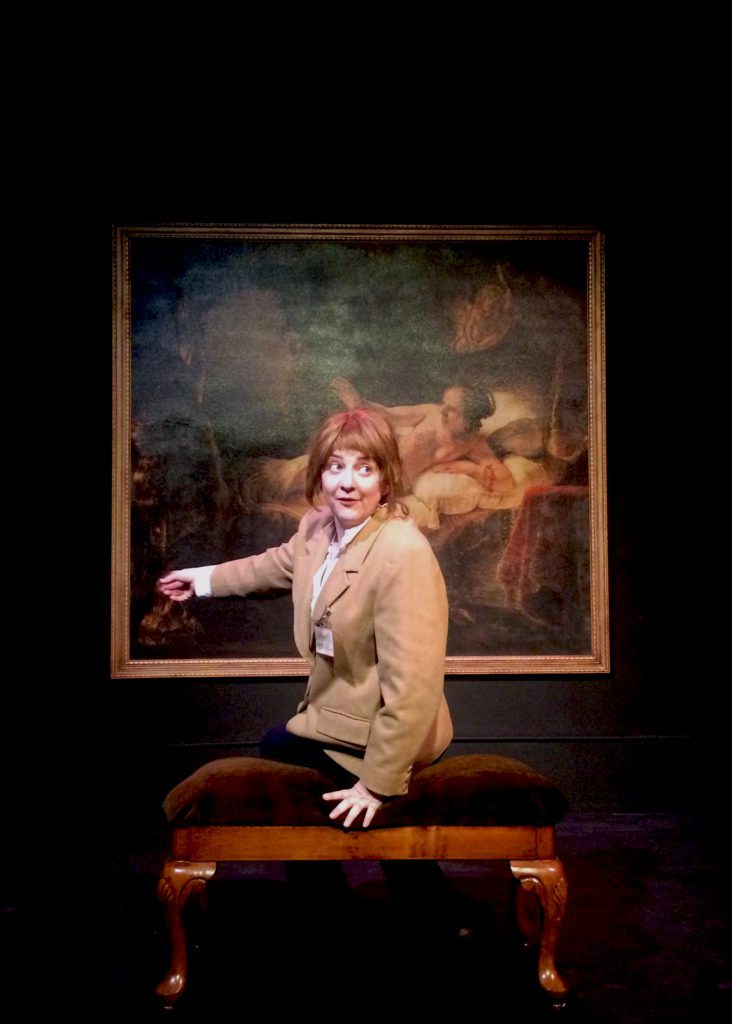
A female art museum security guard sits on an upholstered bench in front of a life size nude painting of Danae (the mother of Perseus) by Rembrandt. She’s speaking out and gesturing back to the painting.

Colorado Drama- The Rembrandt Room

The collection, which began with massive purchases by Catherine the Great in the 18th century, counts among its many treasures one of Rembrandt’s greatest works, which depicts Danaë welcoming Zeus, in the form of a shower of gold, to her bed. A reproduction now hangs on Buntport’s stage, where it is guarded by an introspective woman (Erin Rollman) of curious mind. At the Hermitage Museum (St. Petersburg, Russia), which houses the world’s largest collection of paintings, the guards are generally older women, who wear their own clothes and sit near the masterpieces. Occasionally, they interact with the public, providing historical background and general information.

Rollman’s character, Anna, has, in essence, made the painting her life’s meditation. As we learn, her contemplation goes far beyond the Greek myth depicted on the impressive eight by ten foot canvas of the original, and includes the details of Rembrandt’s life, the history of the models, and the journey of the painting itself. All this is set off by Anna’s insights and opinions on all the matters.

Rollman’s dramatic and comedic range, unlimited in all directions, serves as wonderful springboard for 82 minutes of hilarity, pathos, and opinionated hyperbole.

Imagine, for a moment, the multi-faceted directions your consciousness might take if you spent days, weeks, and years sitting with a master’s painting. At some point, it all becomes personal, as Anna’s stream-of-consciousness monologue increasingly reveals, culminating with life imitating art.

-Bob Bows, April, 10, 2016 ColoradoDrama.com

A bearded person sits on the toilet in a bathroom crowded with beauty products. Another person opens the door to check on them.

North Denver Tribune- Buntport’s 10 Myths a Mashup of Myth, Gender, Loss, and Music

The script, developed by the usual collaborative Buntporters (Erin Rollman, SamAnTha Schmitz, Hannah Duggan, Brian Colonna, and Erik Edborg), along with fellow castmates Diana Dresser and Michael Morgan, and musicians Dan Eisenstat, Miriam Suzanne, and Sondra Elby, is interesting, funny at times, thoughtful, occasionally very sad, and challenging. It uses a contemporary interpretation of the myth of Salmacis and Hermaphroditus, a man and woman who are merged to form one being of both sexes. In this production, this is (thankfully) not a special effects-based attempt to merge two people, but a decidedly low tech fusion, with Edborg and Dresser using proximity and direct contact to portray the combination of two into one. The story confronts the audience with the reality of what this sort of merger could really mean to the two people themselves and to their circle of friends. Buntport Theater creates new work in a way unlike anyone else. When they adapt, or interpret, or, as they say about their latest creation, 10 Myths on the Proper Application of Beauty Products, do “more of an extension.” One intrinsic aspect of Buntport’s approach is to be consistent with the nature of the original. The source in this case is Miriam Suzanne’s novel Riding SideSaddle (published under the name Eric M. Suzanne), a box of 250 randomly ordered index cards, each with a snippet of the story. Watching the performance, it is helpful to keep this in mind, to set expectations appropriately. 10 Myths is a series of short scenes which are connected by characters and are clearly part of the same story, but do not follow a clear, logical, linear time sequence, yet still have a nice rhythm, building to a climax appropriately.

The physical space is crucially important to the story, as it always is with Buntport, and nearly all the action takes place inside a small (about 8′ by 8′) bathroom. The entire cast is always present, with those not involved in each scene off to the sides, but the movement outside the bathroom is in slow motion and dimly lit. The tight space constrains everything, with its restrictions causing conflict and necessitating compromise. It also allows for some humor at different levels, including physical comedy, some (literal) bathroom humor, the reality of day-to-day life in front of a mirror that isn’t there, and a three-piece band in the bathtub. But importantly, it also helps connect the audience with the story, making it much more part of the contemporary everyday world, including helping to imbue it with undercurrents of how we define gender.

The acting is spot-on. A pure ensemble piece, none of the actors stands out or dominates, but each creates a unique character important to the story. Diana Dresser is Sam, seemingly sad, but hopeful, merging, then merged, then anticipating the merger with Erik Edborg as Herman. From the start, both are somewhat (for lack of a better word) hermaphroditic, reinforcing the gender combination. The two are fascinating to watch as their fusion ebbs and flows throughout the nonlinear “story.” Hannah Duggan and Erin Rollman are realistic as Jenny and Jolene, a loving couple dealing with physical and emotional challenges. Michael Morgan is hilarious as Edward, compulsive and wonderfully frustrated by the others, but still cared for and appreciated as part of the group. Brian Colonna, labeled “Narrator” in the program, also adds comic relief, is perhaps the most real of the characters, and struggles to fit in with the others.

As with all things Buntport, the scenery, lighting, and costumes are developed in parallel with the production by the collaborative group. This enables a level of integration rarely achieved by other companies with the occasional exception of those with very significant budgets. The concept of a small, constrained bathroom in a wide expanse of blackness is intrinsic to the production. The details in the bathroom are impeccable, and the darkened areas to the left and right provide the perfect periphery for the primary action.

The band provides an appropriate soundtrack to the dialogue and activity onstage, never dominating, but always enhancing. The members of the band also provide an opportunity for occasional surprises when they unexpectedly interact with the characters in the story.

While 10 Myths on the Proper Application of Beauty Products has comedy, it is not as funny as much of what Buntport has created over the years. The focus is more thoughtful, challenging the audience to piece together the story from nonlinear bits and pieces, and to think about gender, and identity, and relationships, and loss. I think I prefer some of the more outrageously funny past productions, but I also do like to be challenged in this way, and appreciate that Buntport is always willing to try new and different material, pushing audiences in new directions.

-Craig Williamson, March, 17, 2016 North Denver Tribune

CU Denver Sentry- Buntport Theater Hosts Bathtub Of Musicians

10 Myths on the Proper Application of Beauty Products is, in essence, a modern myth. The play is hard to concisely summarize, but that is what makes it so intriguing. Hosted by the Buntport Theater Company, the play’s venue is located far down the Art District on Santa Fe, next to eccentrically decorated homes in a rented out warehouse space. The independent theater is unassuming and humble in its presence, as is their current play.

10 Myths is a cryptic and enigmatic play about an ambiguous group of friends who thoroughly thwart the notions of order, gender, identity, and normalcy. The play is an adaptation of Denver author Miriam Suzanne’s novel Riding SideSaddle. The book is composed of 250 note cards that are not numbered, so it does not have to be read in any particular order. The novel and the play are inspired by the life of Margaret Clap, the first women to open a hotel exclusively for gay men, and the myth of Hermaphroditus, giving the piece its mythological air. Each index card reads a few sentences at the most, some humorous and some leaving readers with a lump in their throat.

Suzanne’s novel is as enticing as the adaptation. Segments of her novel are pinned on the wall before entering the theater; they act as novelized embellishments against the black wall. Note cards reading heart aching things among other eloquent and poetic fragments all tender, harrowing, and bewitching, such as, “He leaves piles of me scattered in corners. I want to wretch, but I can’t.”

The play is a 21st-century myth being relayed from a bathroom. A band sits in the bathtub playing music while the audience enters. The band is Teacup Gorilla, an alternative local band with the bass played by the writer, Suzanne herself. As the lights go pitch black for a minute or so, a woman appears on stage dressed in baggy blue jeans and a T-shirt. “Makeup tutorial number one,” she says, looking out into the audience as if it were her mirror.

Most of the story is told from perhaps one of the most private places in one’s home: the bathroom. Each character appears, providing their own makeup tutorial, which often veers off into a far more captivating story of Greek myths or personal tangents than a tutorial on how to make your eyebrows “on fleet.”

10 Myths is a diamond in the rough‐a play about the absurdity of categories, the sadistic ritual of makeup, and how inaccurately Barbie is proportioned.

It is about the occasional atrocity of humanity, and how “ghosts are dicks, and why can’t they just be dead?” It’s about the farce of 21st-century abbreviations, about challenging the idea of God and tradition, about myth and reality, about the days when you feel crazy. 10 Myths is the 21st-century myth: The characters are humorous and charming, and they are blank slates as clear as dishwater. The play is aching, tender, and blithe, and it leaves the viewer with a sense of a peculiar belonging.

-Sarai Nissan, March, 30, 2016 CU Denver Sentry