Buntport Theater

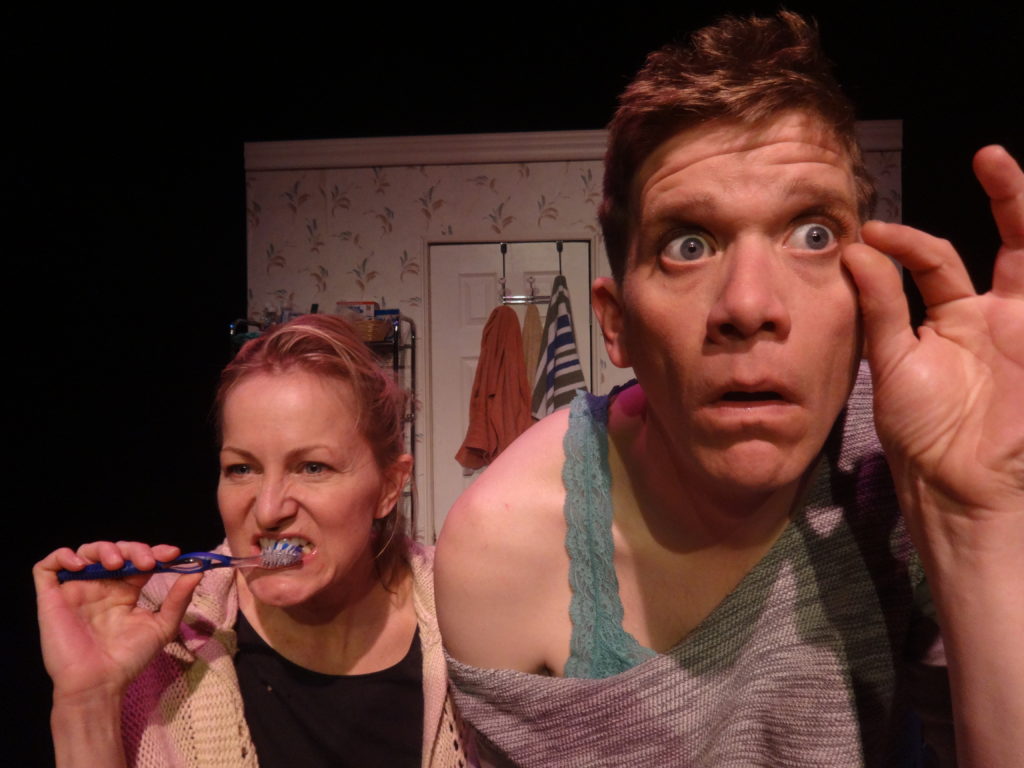
Two people stand at the bathroom sink. While looking in the mirror one brushes their teeth while another checks their eyelashes.

Westword- 10 Myths on the Proper Application of Beauty Products Is a Beaut of a Show

Some things to know before attending Buntport Theater Company’s 10 Myths on the Proper Application of Beauty Products:

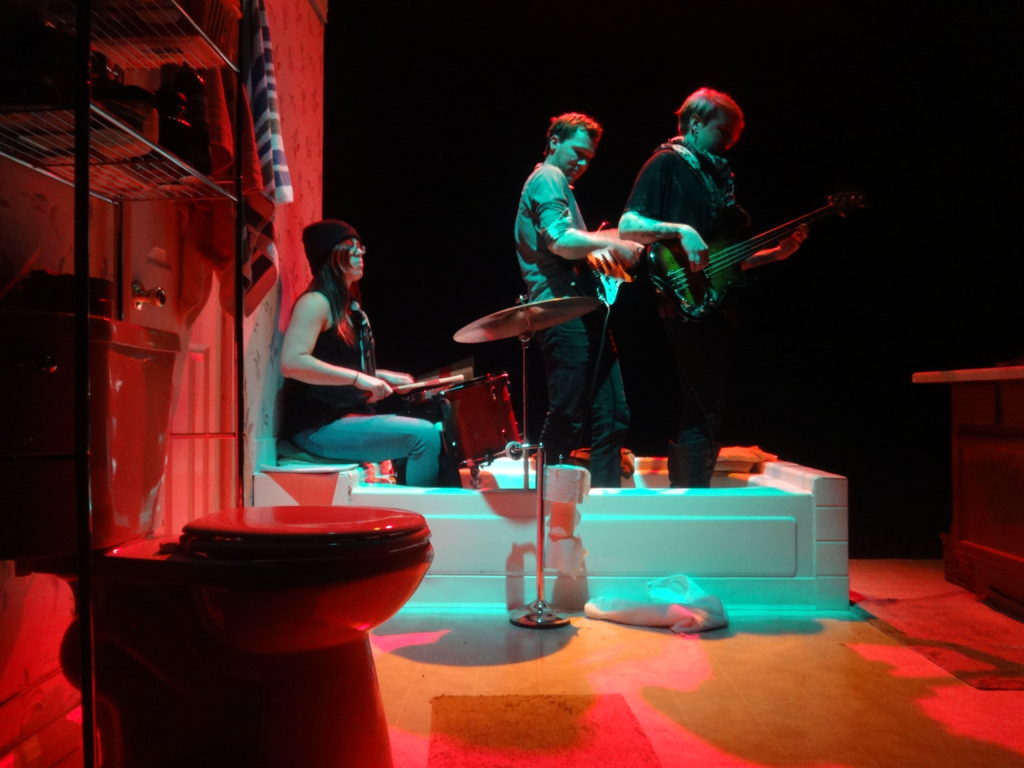
The play is set in a bathroom ‐ a somewhat cramped, lighted square in the middle of the playing space flanked by semi-darkness in which you can watch the characters not currently on stage standing, sitting, interacting or walking very slowly toward the doorway for their entrances. It’s even more cramped because the three musicians who comprise Teacup Gorilla are ensconced in the bathtub, providing the sound. 10 Myths is experimental but not pretentious, and more interested in enlightening than befuddling you ‐ but you won’t learn anything useful here about shampoo, hair gel or makeup.This production doesn’t make sense ‐ at least not linear sense. The piece is based on the novel Riding SideSaddle, by Miriam Suzanne, who’s also part of a band called Teacup Gorilla. The novel is written on 250 notecards, and it’s “open source” ‐ which means, I think, that you can find and modify it if you want. Buntport, a company known for creating original plays based on all kinds of prompts ‐ seeing Tommy Lee Jones in line for a production of La Bohème in Santa Fe; locating a large sheet of artificial ice and figuring it would work perfectly as an underpinning for Kafka’s Metamorphosis; wondering if Shakespeare’s Titus Andronicus wouldn’t be better as a musical ‐ clearly felt free to do exactly that. So the troupe has added dialogue and a kind of goofily mixed-up structure based on repetition of the beauty-products motif.

So now you’re ready.

The characters are a group of people who live together. They’re all misfits, primarily sexual misfits, and none of them are at home in their bodies. They’ve known each other forever, and they’re open about their bathroom habits ‐ except for the guy who can’t pee when anyone else is there. In the persons of actors Erik Edborg, Brian Colonna, Hannah Duggan and Erin Rollman, they’re warmly accessible. These actors work together with comfort and authority, with an almost musical sense of timing that comes from years of creating theater as a team. Two new actors, Diana Dresser and Michael Morgan, have joined them here, and ‐ surprise ‐ they fit in brilliantly and add some wonderful madness of their own.

At the center of the story (non-story?) are Herman (Edborg) and Sam (Dresser), aka Hermaphrodite and Salmacis. They are striving to become one being, male and female, and in front of our eyes, they do ‐ and then they separate again. We learn that Sam has died and Herman is grieving. No one in the house is remotely surprised by any of this; they pay no attention to Herman’s profound grief ‐ less because they’re hard-hearted than because that’s just the way the cards fell.

Jolene (a masculinized Rollman) and Jenny (Duggan) have their own partnership, and they groom each other’s hair a lot. Jolene has only one arm, and the others speculate on the cause, the likeliest suggestion being that she cut it off because she has xenomelia ‐ an irrational obsession in which a person believes a limb doesn’t really belong to them and may even be harmful or hostile.

10 Myths is about our relationship to our bodies ‐ spit and piss, diarrhea and sweat: Someone mentions a woman who sat on the toilet so long her butt grew around the seat. Hermaphroditism is only part of the sexual picture. The play makes us think about the dizzying variety of possible physical variations to human genitalia and their spiritual and psychological consequences; the usual categories of “male” and “female” are just too simplistic. The play isn’t perfect; it’s a touch too long. But what I particularly liked is that it remystifies a world of pansexuality that had begun to feel trite and mechanical. Years ago, when you read about human beings who felt trapped in their own bodies, or thought about the essence of being male or female, profound echoes arose. These days the discussion is just about surgeries and hormone pills, bathroom arguments and the supposed beauty and bravery of Caitlin Jenner.

10 Myths restores a sense of mystery and magic we’d been missing, irrational gods and strange love, the nymph in the crystal water and the boy-man she prayed to possess forever.

-Juliet Wittman, March, 9, 2016 Westword


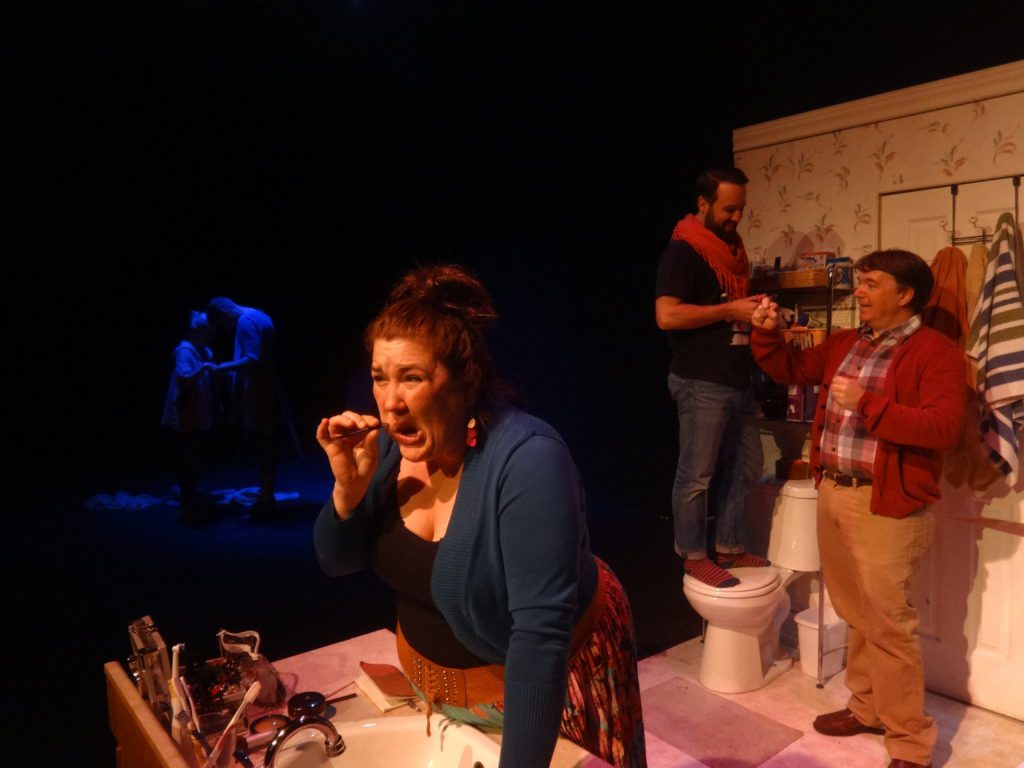
A person plucks hair off their lip at the bathroom sink. Two people stand in the background. One stands on a toilet.

ColoradoDrama.com- 10 Myths on the Proper Application of Beauty Products

Based on Miriam Suzanne’s novel, Riding Side-Saddle‐written on 250 notecards (which are posted in Buntport’s lobby) designed to be read in any order‐the story revolves around a group of friends that share a common bathroom (along with the band, Teacup Gorilla, including Suzanne on bass, who reside in the bathtub). For their 40th home-grown world premiere production in the company’s 16 years, the Buntporters and a few guest artists have bravely gone where few have dared tread, the communal bathroom, to teach us about the proper application of beauty products, the Greeks, and the meaning of life.

To the novel, the ensemble has added their own dialogue and character development. Sam (Diana Dresser) and Herman (Erik Edborg) are in a relationship in which they literally conjoin. The “Narrator” (Brian Colonna) provides the background to the asynchronous storyline, which, in short order, begins to reveal the sophisticated layering that the ensemble has created in their script, improvisational updates, and hilarious details.

As always, character development is the hook to Buntport’s legendary zaniness: Hannah Duggan’s (Jenny) subtle waking dream-state imagery; Michael Morgan’s (Edward) laugh-out-loud funny OCD riffs; Erin Rollman’s (Jolene) gender-bending enigma; Colonna’s sublime psychological observations; and, finally, Dresser and Edborg’s phenomenal symbiotic dynamics and unique love story, based on the myth of Salmacis and Hermaphroditus.

Consider the usual time span involved in writing a play, reading it, making adjustments, repeating the process X times, and then producing it. Now think about what you would learn and hone if you accelerated the process and did this two to three times a year for 16 years with your adult productions, and even more often with your children’s productions. The answer is before us: Nuances that normally take years‐foreshadowing, time-bending, catharsis‐can be achieved in months, and voilà, an hour and forty minutes of non-stop action later, we are ready to talk for hours about our experience

-Bob Bows, March, 8, 2016 ColoradoDrama.com

A band plays in a bathtub. The lighting is shadowy and colorful.

Denver Post- Buntport’s dark comedy “10 Myths” an oddly satisfying one-act

From Greek myth to bathroom mirror, Buntport’s dark comedy “10 Myths”
reflects on bodies, love, loss and humanity
Buntport Theater prides itself on experimental undertakings and its latest, “10 Myths on the Proper Application of Beauty Products,” the first full-length show of its 15th season, manages to hold our attention while stretching the bounds of conventional theater.

“10 Myths” is an oddly satisfying dark comedy, a meditation on bodies, humanity, love and loss.

This is an impressionistic story of corporeal selves, identity and flossing. Even if you are not in need of a makeup tutorial, there are life lessons to be learned. The bathroom mirror, truth-teller and judge of time and gravity, is the centerpiece and a key character. As the set is constructed, the back of the (imaginary) looking glass is to the audience; we become the mirror. We observe as a disparate cluster of characters pile into the bathroom, peer straight ahead and pluck, brush, fluff, tweeze and otherwise attend to their physical selves. It’s crowded, this bathroom, with six actors sharing space, not to mention a three-member band, already playing as the show begins. In the bathtub.

Consider the deeper meaning of morning ablutions: the judgments, the changing selves that peer back, the gender expectations and physical relationships that are apparent there, not to mention a chin hair or smudged mascara, in a tight space dedicated to all manner of bodily functions.

The porcelain throne is just part of the altar to the impermanent human vessel.

Part of the genius of “10 Myths” is the spare set. The play takes place in the small, minimally designed john at center stage, flanked by large black spaces: a video recorder on a tripod on one side, where a slow-motion disrobing takes place repeatedly, and a TV monitor on the other, where slow-moving housemates pick at casseroles and watch the video. Expensive set design wouldn’t tell the story any better.

The videos capture the nightly undressing of Sam (Diana Dresser), a process which she has obsessively labeled and archived for posterity. Sam is a short-timer, or may already have passed; the chronology is intentionally confusing. But we do know that people bring casseroles to comfort those who’ve suffered a loss. Sam is soulfully merged with Herman, and as a he-she combo they practice being physically glommed onto each other as well, in intricately choreographed togetherness. Erik Edborg is riveting as Herman, a gender-bending, leotard-wearing gentle soul. Dresser is a sprite (a water nymph?), landing her comic one-liners. They both let melancholy seep through the humor.

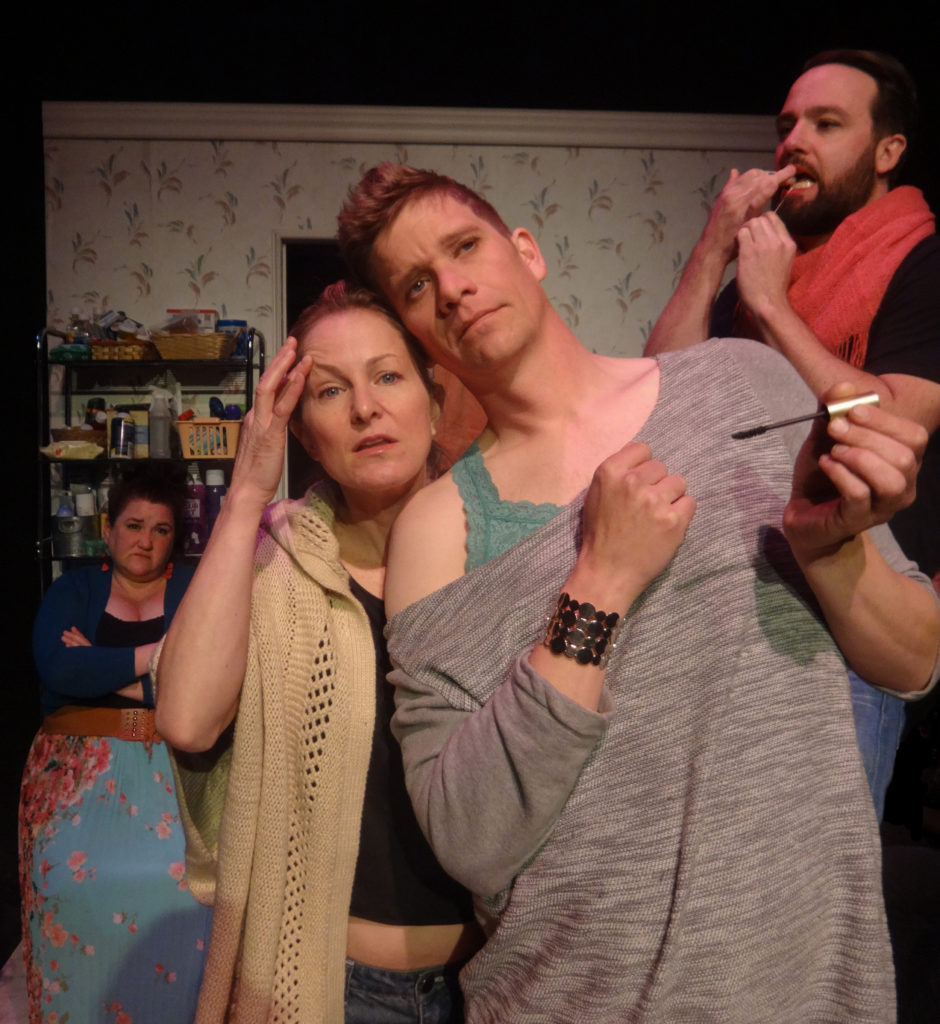
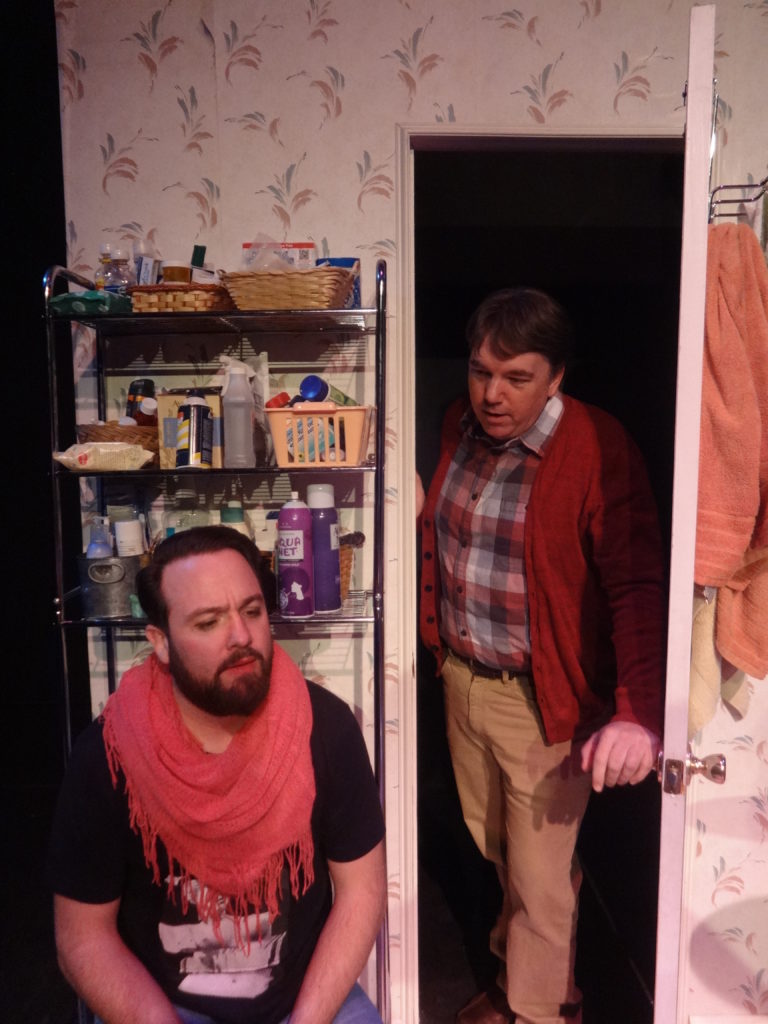
Housemates Jenny (Hannah Duggan) and one-armed Jolene (Erin Rollman) are a witty, verbally adept couple considering having a baby, while Edward (Michael Morgan) is stuck cleaning and the Narrator (Brian Colonna) serves to reign in the sometimes wandering story. Morgan is elastic as the deeply neurotic Edward, physically compounding each line reading. Colonna provides a baseline, the most buttoned-down character despite his flamboyant scarf and eye makeup.

Don’t try to label any of them; these characters resist defining.

The show is an adaptation/rearrangement of local author Miriam Suzanne’s novel “Riding SideSaddle,” which was printed on 250 interchangeable index cards, meant to be shuffled as an “open source” text. It too is more Rorschach test than linear story.

Suzanne sprinkles Greek myth into the mix (notably Salmacis and Hermaphroditus, who merge as one being of two sexes), along with a theoretical “God of Hygiene,” further blurring categories.

The band, Teacup Gorilla, underscores emotions and lines; the effect is appropriately wry.

“We’re not talking about death here, we’re talking about bodies,” Sam says. As the mirror knows, you don’t get one without the other.

-Joanne Ostrow, March, 7, 2016 Denver Post

Two people stare into the mirror. Together they contemplate their eyebrows. Someone is flossing their teeth in the background.

OutFront- 10 Myths

Buntport Theater, in collaboration with Teacup Gorilla presents, 10 Myths on the Proper Application of Beauty Products. Using the novel Riding Sidesaddle by local author Miriam Suzanne, the play works as an adaptation of the novel, which is printed on 250 interchangeable index cards. The play works through dark comedy and wit to challenge ideas of gender and appearance, all manifested into”these absurd carcasses we live in.” The play features six actors, and the three-person band Teacup Gorilla, all within one bathroom. The characters go through their daily routines, while participating in extraordinary conversations between close friends.

The entirety of the play is performed in the bathroom, a traditionally private place. However, we see that this bathroom is anything but. Each character has but a few moments to themselves before another character emerges, and communication is brought about by looking into the mirror, and going through routine hygiene, such as brushing teeth or applying makeup. The characters, in fact, rarely communicate on a face-to-face level, it’s through looking at their reflection in the mirror. It showcases the amount of time, energy, and self-doubt that we put into our appearance. All the while, the band sits in the bathtub, providing the option for the characters to break the fourth wall, and supply emotional depth to the piece.

A heavy emphasis on makeup and its effects are brought about from the opening of the play. Mocking a YouTube “DIY” makeup tutorial, each character provides beauty tips, followed by their own personal musing about the world they live in. Makeup becomes a display, a mask to put on in order to be seen a certain way. As the character of the narrator ponders, he brings up the idea that he wishes to look a certain way, but the only way to look a certain way is to be seen. This begs the question: Is this form of expression for us, or the people who look at us? This play works to redefine the makings of gender and appearance through breaking down their true meanings, and how the routine plays just as large of a role in our lives as the big moments.

Buntport Theater is a non-profit company that continues to make contributions through the donations of their audience. When walking into the box office, I was greeted by smiling faces and a table of refreshments. Although small in size, the theater is large in character and passion. Each actor preforming was talented and evocative, and truly made a connection with the audience. Their personalities shone through the emanation of their characters, which is what made their play truly shine. Diana Dresser plays Sam, who records herself getting undressed before bed, and tells the story of the Greek myth of Salmacis and Hermaphroditus, in which the two sexes are merged into one. Erik Edborg portrays Herman, Sam’s close friend who offers to help Hannah Duggan, playing Jenny, and her girlfriend Jolene, played by Erin Rollman, have a baby. Michael Morgan is Edward, a nervous and avid cleaner of the bathroom. And Brian Colonna serves as the “narrator,” coming onto stage to question reality, and offer counter points to our assumed perceptions of ourselves. A quirky, witty, and thought-provoking play, 10 Myths on the Proper Application of Beauty Products is a dynamic and entertaining social exploration. A tale of friendship, myth, storytelling, and loss, the various personalities of the characters work together to bring out humor as well as heart wrenching reality. Definitely a production worth writing about, talking about, and going to see.

-Berlin Sylvestre, March, 7, 2016 OutFront

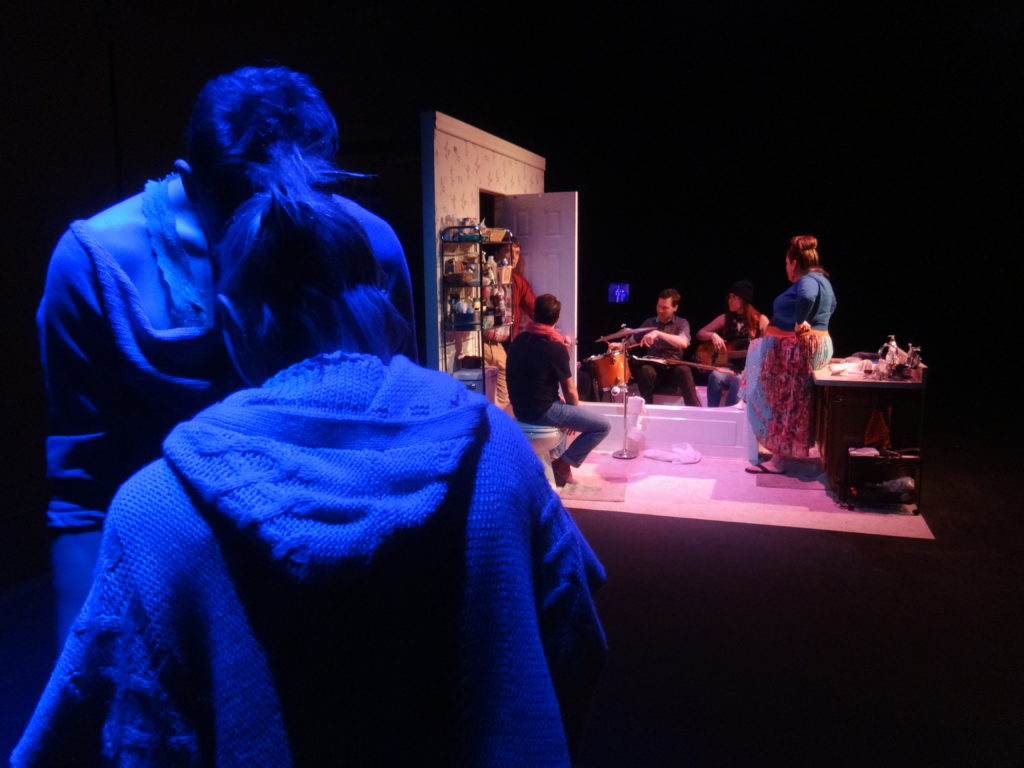
In the foreground two people dance in a dim blue light. Behind them a group of people stand in a small bathroom. A band plays in the bathtub.

Douglas County News-Press Confounding tale staged at Buntport

Open-source story gave inspiration for latest show

It helps ‐ or not ‐ to know that inspiration for Buntport’s latest original production came from a non-linear, open-source tale called “Riding Sidesaddle” by musician Miriam Suzanne, published under the name Eric M. Suzanne. It’s printed on 250 3-by-5 index cards to be read in no particular order. Copies of those cards were displayed in Buntport’s entry lobby on opening night, March 4.

Bunport’s four actor/writer/directors ‐ Erik Edborg, Brian Colonna, Hannah Duggan and Erin Rollman ‐ were joined by two accomplished local actors, Diana Dresser and Michael Morgan, who also participated in the company’s collaborative writing process to create “10 Myths on the Proper Application of Beauty Products.”

“We’ve taken the same characters and many of the plot points and built more of the world,” say the program notes. “Like the novel, the play is about memory, myth and these absurd carcasses we all live in” Six characters alternate brushing teeth, applying eye liner, brushing hair and occasionally trying to urinate ‐ combined with subtle actions in the two far corners, which the audience needs to keep an eye on too. The production, carefully staged as always, takes place in a brightly lit, centrally located bathroom, with shadowy action continuing to each side. Three members of the Teacup Gorilla Band are in the bathtub, strumming, playing chords … including author Miriam Suzanne. Actors peer out through the “fourth wall” as they talk and primp.

Diana Dresser (Sam) appears first, looking in the mirror, grouchy, and applying eye makeup. When she’s not in the bathroom, she retreats to a dark corner where she continually changes clothes, getting ready for bed.

She’s joined by Jenny (Hannah Duggan), who enters from the other side, which has a television showing Sam dressing and undressing and a spread of casseroles for snacking. Sam is joined by an androgynous Herman (Erik Edborg) and they merge into the mythological characters of Salmacis and Hermaphroditus, who become “one being of both sexes.”

The audience sees them acting as one being, but a bit of additional explanation in the notes might have helped. (I found Tracy Witherspoon’s interview with Rollman, Colonna and Suzanne online, which spells it out ‐ –there is a brief mention of Hermaphroditus in the script.)

Erin Rollman’s character Jolene carries a “ghost” arm, which we aren’t supposed to see. Michael Morgan, as Edward, is a bit awkward and has some funny lines and a quizzical air.

In the tub are Dan Eisenstat on guitar, Miriam Suzanne on bass and Sondra Eby on drums. They keep a background thrum going and do burst into song on occasion.

The band’s website describes them as “Americana, Indie, Post Punk … A petite and ground-dwelling band that inhabits the china shops of Denver with angular riffs, twisted stories and obtuse stomping.” (You’ll want to hear them perform at a Denver club, which they frequently do.) They were also involved in creating this play.

“There might be something in the water,” Herman observes near the end. Perhaps that’s it!

While a bit harder to grasp that some earlier productions, a clever and skewed picture of a particular world does emerge, inhabited by characters worth meeting.

Technical support, as usual, is by SamAnTha Schmitz, who handles backstage duties with skill.

-Sonya Ellingboe, March, 13, 2016 Douglas County News-Press

Denver Post- Buntport’s Middle Aged People Sitting in Boxes

It was — and fortunately remains — quite the weekend for intriguing theater.

I was going to say “unusual” theater. And although Buntport Theater’s latest original work “Middle Aged People Sitting in Boxes” is a quirky take on modern identity, doing playfully ruminative work is hardly unusual for this five-person company.

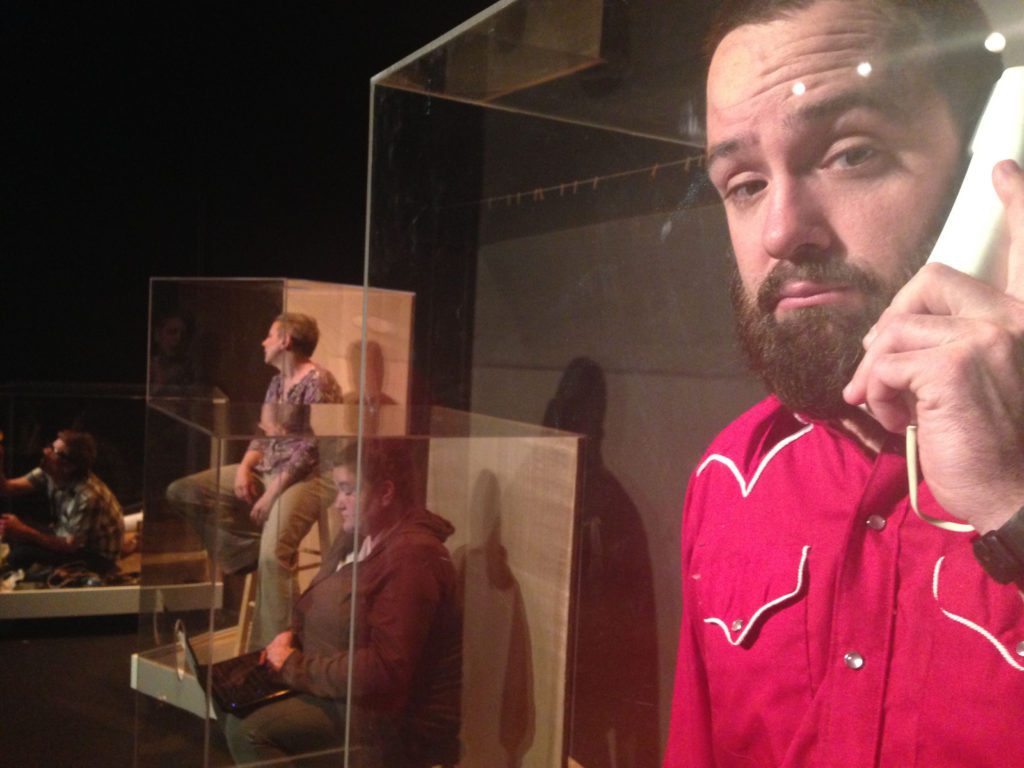
Four large rectangles draped with black fabric sit on the concrete floor of the theater. They are boxes big enough to hold a person; each has three sides and a ceiling of Plexiglass.

As promised, there are people already in these containers. And as the pre-performance music grows faint, each performer pulls at the curtain to reveal themselves.

In this show, the actors go by their own names, which doesn’t mean they aren’t characters. Over the course of the show, Erik Edborg’s box will get cluttered as he unpacks little cardboard cartons of stuff.

Erin Rollman, who’s maintaining the Facebook page for her 25th high school reunion, stands or leans or sits on a stool in her more vertical habitat.

A laptop often in her lap, Hannah Duggan sits typing away on the keyboard. Brian Colonna’s pen has a pile of laundry on its floor. He’s in boxer briefs, a phone in his hand.

There are holes cut into the Plexiglass that aren’t particularly noticeable until a character does something odd: like sidle up to another box or gather laundry from a clothesline stretched across the stage or plug a vacuum in to an extension cord to take a swipe at a rug.

Colonna doesn’t just have a land line, his old-school phone is tethered to a wall jack outside his box. That Muzak-like sound — diabolically imagined by frequent collaborator Adam Stone — is actually the punishing drone of being Colonna on hold.

Familiarity breeds contemplation in “Middle Aged People Sitting in Boxes.”

Rollman starts things off early with questions about what exactly constitutes “middle age”? It’s not a bad quandary in a society that half jest that “50 is the new 30” and so forth. What to make of one’s place on a spectrum between twenty-something and “elderly.”

That this quartet hardly seems “middle age” to this late Boomer is part of the point in this exploration of generational identity.

What are the indicators, the indices that define us? What boxes do we check to claim our space in a overly connected society? And how connected are these characters, really, in a world in which a comforting hug meets Plexiglass?

What are the account numbers and passwords that make a galling, if useful, claim on who we are? Until, that is, they’re misplaced and you must seek the compassion of some faceless, practiced customer service rep, as Colonna experiences in his looping purgatory of hold.

Central to the sly artistry of this ensemble are the offstage machinations of fellow Buntporter SamAnTha Schmitz, who applies layers of light and sound to what appears a stripped show. “Middle Aged People Sitting in Boxes” has deceptively spare staging.

And at times the characters’ riffs have the rhythmic pay-offs of stand-up routines. But four stand-ups weaving their acts is no easy feat. What seems cleverly conversational is highly orchestrated. The casual and flippant serves a philosophy of our quotidian, our daily lives shaped by memories and shot through with way too much information.

That mixture can be amusingly inane It can be magical. Occasionally it can be both.

-Lisa Kennedy, April 23, 2015 Denver Post

Close-up on an unhappy bearded man holding a telephone. He is behind plexiglass. In the distance are three other people sitting in large plexiglass boxes.

Boulder Magazine- Middle Aged People Sitting in Boxes

The Denver Post says that “at the top of their game, nobody does silly like Buntport Theatre Company.” And this show is at the absolute TOP of their game. As is often the case, their seemingly silly pieces of fluff makes you laugh while you are at the theatre and think about it more deeply as you drive home. This one causes you to question the whole concept of “middle aged.” What is the middle age and when are you in it? In my personal case, I wondered all the way home when did middle age end and “elderly” begin?

Taking their cue from Seinfield, a Buntport quartet of players (Erin, Hannah, Erik and Brian) indulge in a 90 minute discourse about … nothing. They ponder the purpose of their ‘jobs,’ the importance (or not) of high school reunions, how to pack to move, what makes up a ‘good’ neighborhood, how can you pay a bill when you aren’t in the system, do you really have to put on your socks before your pants, and on and on. But these are merely diversions as they try to find a solution to the initial problem of defining middle age. Is it when you have to get drunk to clean your living space? Is it when you have a crisis – by definition then, a midlife crisis? Is it when you have lost control of the chaos in your life? Or is it dependent on the mean life expectancy of people of your origins, hereditary background, lifestyle, etc? I’m happy to report that no concrete definition was ever found so we can all continue in the delusion that we are still in our middle years!!

One very interest concept was explored to great length. There is a subclass between the X and Y generations of people born in the late 80’s that are the last ones to use things that are now perceived as ‘old-fashioned.’ They are the group that knows what a telephone book is but has never used one. That remembers record players but never owned one. That used to use a map or a card catalog or a dictionary in book form to receive needed information. An interesting classification that they called “networld.”

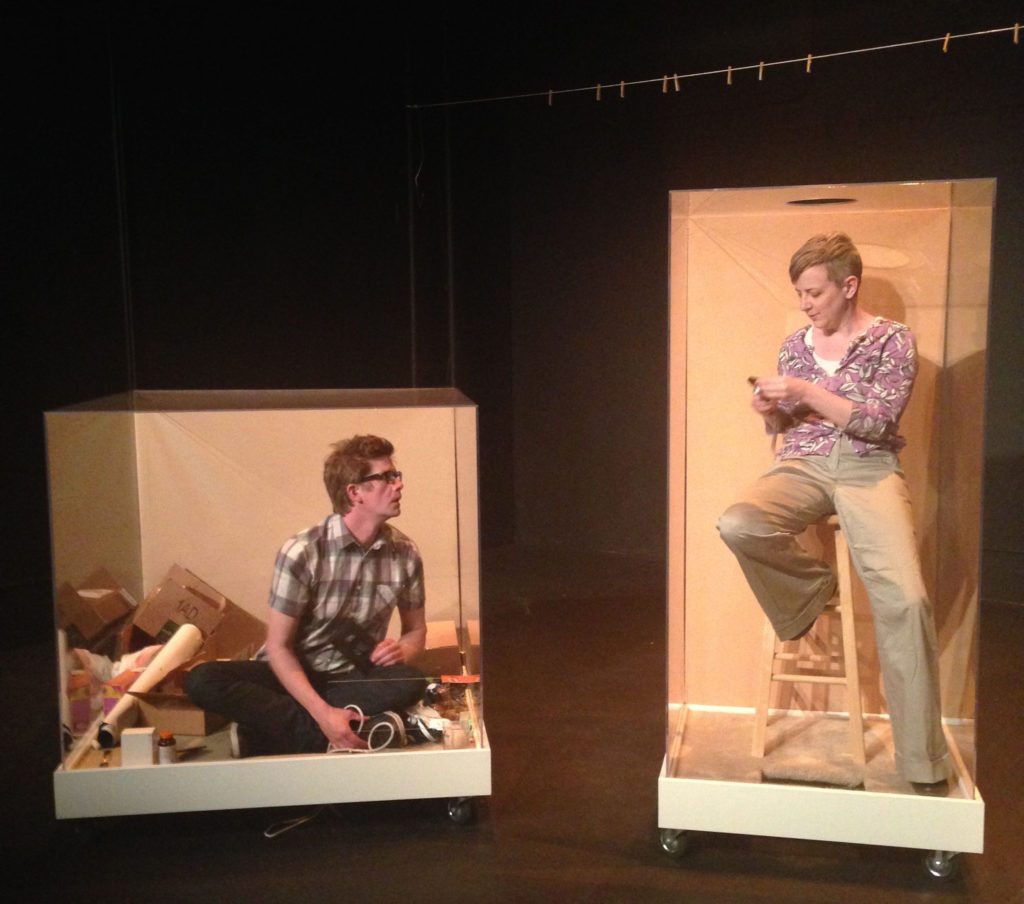
The ‘boxes’ of the title are beautifully made plexiglass units on wheels with artfully placed feet and hand holes that allow the actors to move about (somewhat) and to reach outside the boxes (awkwardly) to grasp other things like the vacuum cleaner and the phone. One of the joys of each new Buntport show is watching how they stage it. Their sets are always simple but cleverly constructed with imaginative sound effects and lighting.

As usual, I’ll be thinking about this one for a long time. Isn’t that the whole purpose???

A WOW factor of 9!!

-Beki Pineda, April 20, 2015 Boulder Magazine (getboulder.com)

Two people talk to each other from inside plexiglass boxes. On the left is a man sitting crosslegged in a short, cluttered box. On the right is a woman sitting on a stool in a narrow box. Above is an empty clothing line.

Westword- Buntport Thinks Outside The Box With Middle Aged People Sitting in Boxes

A clothesline on which tops and bras are hung spans the stage. Other than that, the set consists of four shrouded forms that are eventually unshrouded to reveal four middle-aged people sitting in boxes — if you consider Buntport Theater Company’s Brian Colonna, Erin Rollman, Hannah Duggan and Erik Edborg middle-aged. But as Rollman points out, middle age is a shifting boundary, hard to define, and this is territory explored in the latest Buntport creation, Middle Aged People Sitting in Boxes.

The characters can hear and speak to each other, but they can’t touch each other through the plexiglass barriers of their boxes; they can also stand up and walk these boxes from place to place, creating interesting geometrical configurations. In the box on the right, Colonna struggles with that ubiquitous modern horror: trying to get something done by phone. He can’t access the site he needs online, because it no longer recognizes him. But when, after a long wait, he actually gets a human being named Angela on the phone, she can’t help him, either — because the system says he doesn’t exist. All of this is particularly hard to cope with because he’s tethered to a landline by a long, curly cord and is wearing no pants. Periodically, the others exhort him to please put them on, but he explains that he can’t until he finds his socks — because first socks and then pants is his rule for dressing.

In her box, Duggan occupies herself with her job, which involves classifying data. On the other side of her, Rollman organizes a 25-year high-school reunion on Facebook. And then there’s Edborg, who seems to have moved into a new place and is trying to organize his belongings. This is hard because he’s a hoarder and has also mislabeled his stuff: The box that says “cutlery,” for instance, contains an embroidered pillow. And another box that arrives in the mail labeled “spice rack” turns out to be something else entirely.

What is Middle Aged People Sitting in Boxes about? There are a lot of lists and a lot of attempts on the characters’ part to categorize. This passion for order takes an array of forms, from enumerating all the buildings and businesses in a particular neighborhood to Edborg’s musings about how to use a spice rack when he can name only three spices to how you’re defined by those quizzes that ask what historical personage you’d be or reveal how your favorite fruit exposes your personality. “You’re trying to control the chaos,” Duggan tells Edborg kindly. “That’s what middle-aged people do.”

The idea of order is all mixed up with the idea of data — how we acquire it as well as how we sort it — and that leads to talk about generations: X-ers and Y-ers and Networlders, all of whom view the world in different ways because of the different ways in which the world comes to them. There are references to the usual targets: people’s obsession with their gadgets, the proliferation of emoticons and selfies, the way one generation fails to understand another’s way of using technology — though the cast also points out that dividing human beings into generations with arbitrary cut-off points is deceptive in itself. But the dialogue isn’t obvious: The Buntport crew goes deeper, showing that there’s something profoundly mysterious about the way our brains work, and raising a slew of questions about the ubiquity of facts and the ease with which we can look them up: Does this make people dumber because they no longer know how to research, or smarter because they don’t have to waste time unearthing facts and can use the easily acquired information to deepen understanding?

Since this is a Buntport production, everything is hilariously askew, and the show is both filled with absurdities and dizzyingly clever. The performances are spot-on and the timing impeccable. Middle Aged People does communicate a sense of loss: These people are boxed in, after all, time is inexorably passing, and we’ll never know what’s happened to poor Angela or even if she really exists. Still, there’s a willingness to embrace the unknowable — and even magic in the shape of a little one-horned fairground goat passed off as a unicorn. It may have been just a sad, sickly animal, but there’s something about the idea of a unicorn and our willingness to accept it that transcends lists and data and frees the imagination — just as this play does.

-Juliet Wittman, April 16, 2015,Westword

A woman with short hair sits on a stool in a plexiglass box. She has one leg up on the school and has both hands above her head, holding onto the rim of a hole in the top of the box. Above the box is a clothing lines with only clothes pins on it.

North Denver Tribune- Buntport’s Latest is a Unique, Absurd Look at Who We Are

Buntport Theater’s latest original creation, Middle Aged People Sitting in Boxes, nails the absurdist comedy genre perfectly. While nothing of importance happens in the play, and it presents the “vast swaths of mundanity” that make up most of our reality, the dialogue is engaging, compelling, very funny, and even insightful at times. Many thought-provoking questions are asked, with perhaps the key question coming at the end of the show: “Is that all there is?” This clever, absurd, hilarious production will both challenge and entertain you, in classic Buntport style.

This is the story of four middle aged people (how exactly middle age is defined is the subject of some discourse) living their lives. One is on hold, trying to reach customers service. Another is planning a 25th High School Reunion. The third is checking the supplier websites for Fortune 500 companies and signing up as a WMBE. The last is unpacking after an apparent recent move. Oh, yes, and they are all in large plexiglass boxes on wheels. The four actors quickly establish that this odd environment is normal for them, just a part of life. The boxes function both as the obvious metaphor for isolation, but also a source for some brilliant comic moments.

The language is mundane, everyday stuff, but it is compelling nonetheless. As we watch, we want to know more, we want to know what will happen, even though we know that nothing earth-shattering will occur. Questions are asked and discussed, with much of the discussion about who we are, what labels apply to whom, and what the meaning of different labels is. The formal arrangement and movement of the boxes adds another dimension to the verbal sparring between the characters. Much of the language is delivered in parallel monologues, with the characters sometimes interacting and sometimes in their own worlds, nearly always doing something. The whole show has a lovely rhythm created by the level of conversation, the changes in focus and interaction, and the movement onstage.

The four actors play unique characters, each in their own world and their own reality. Erin Rollman is planning her High School Reunion, interacting with her former classmates via social media on her cell phone. She is flippantly judgmental about those asking questions, making comments that many of us have probably thought at times. Poor Brian Colonna is trying to talk with customer service about his account, but keeps getting stuck on hold. His frustration builds nicely, and he gets to perform most of the show without pants. Erik Edborg is unpacking boxes, genuinely surprised and a little bit amused that the contents don’t match the labels he himself wrote. Hannah Duggan is on her laptop the whole time, researching the websites of Fortune 500 companies. Her work is important to her, and she plugs on and on, without knowing exactly why she is doing it. This may seem very familiar to many of us.

The set, primarily consisting of the four different sized and shaped boxes, is an integral part of the play. The actors can move using the small holes in the bases, and they each have one or two ways to reach outside, but are otherwise trapped. The constraints of the boxes reinforce their separateness, but also create opportunities for wonderful pure silliness. The lighting is consistent and effective, and is used to highlight each nicely in succession during the culmination of the show. Since they are in boxes, the actors use microphones, an element that is necessary and effective. Adam Stone’s sound design includes the notification beeps on Erin’s cell phone, and all the hold music, recorded voices, and customer service reps for Brian.

The four characters are all believable as people, but are in an unrealistic environment (sitting in boxes), doing things that are not completely normal. But we can all relate to what they are doing and who they are. As we watch, we connect with how they feel in their interactions with each other and the world. We laugh both at the craziness of what they are going through (which is really, really funny), but also because we understand and know their experiences. We connect, we laugh, we think, and we are entertained. What more can we ask from theater?

-Craig Williamson, April 16, 2015,North Denver Tribune

North Denver Tribune- Buntport Revives Tommy Lee Jones Goes to the Opera Alone

Only Buntport Theater could create a tight, complete, meaningful, and funny production where the lead actor is a nearly-full-sized puppet of Tommy Lee Jones, operated and voiced by four members of the company, sitting in a diner having a piece of pie. No other company could even conceive of this idea, let alone build the puppet, develop the skills to operate it, and write a script that interlaces a serious conversation about art and performance with comic bits and surprises that no audience member could possibly anticipate. This is a revival of one of Buntport’s most popular shows from the last several years, the brilliant and successful Tommy Lee Jones Goes to the Opera Alone. Several of the shows have sold out, so don’t wait to make a reservation and go see this brilliant and unique production.

Tommy Lee is a puppet, sitting at a table in a diner. As the show opens, the puppet sits alone and lifeless, but soon Erin Rollman, Evan Weissman, Brian Colonna, and Erik Edborg wander in to bring the puppet to life. But first, they turn the convention of “invisible puppeteers” on its head. These are characters in their own right, and in the first moments of the play we learn that Weissman, Rollman, and Colonna, who operate the right hand, left hand, and head of Tommy Lee, are in a love triangle. But just as soon as we meet them, they zip up and are completely covered in black, and the puppet comes to life. Edborg sits at the table with the puppet, ensconced in black like the others, speaking the voice of the puppet. Hannah Duggan plays Jane, the (actual human) waitress that talks with the puppet, brings him pie and coffee, and discusses art, opera, and how Puccini’s opera Turandot “should” have ended. As we watch the remarkably expressive puppet, we are paradoxically impressed with how he is brought to life and frequently reminded that the puppeteers are not invisible, as they silently interact with each other and even the puppet himself. This is all exquisitely and impossibly consistent, and in and of itself is wonderful, but is just the medium that delivers the story.

The five onstage members of Buntport, along with the always-offstage SamAnTha Schmitz, create their productions as an integrated whole. The script writing is not separate from the directing or designing, which results in a remarkably cohesive production. That said, the show is very well directed – the puppeteers step out just enough, creating surprise and intrigue as they do, without overusing the device. The staging is simple, but direct and effective.

The acting, both by the actors and by the puppet, is wonderful. Edborg captures the iconic Texas drawl that we all know so well from many films. The mechanics of the operation of the puppet are fascinating, with the hands, fingers, eyebrows, and eyelids moving and grasping, showing expression and emotion. But the technical functioning of the puppet doesn’t dominate things more than necessary. It is enough to impress and intrigue the audience, but it is still there to deliver the story. Duggan’s Jane is completely natural as she talks with the puppet, and becomes very animated explaining alternate endings to Turandot. And while we do not see their faces very much, Weissman, Rollman, and Colonna clearly communicate the situation and emotions in silence.

The set is simple yet appropriate. The table and chairs capture a diner perfectly. The floor is Formica tiles that blend to black at the edges, with individual tiles hanging in space. The lighting sets the mood well. The costumes include an accurate diner waitress uniform, and neutral black coverings for the four puppeteers, which are used to both conceal them and highlight the moments when their characters are revealed. The sound is effectively integrated as well, with some fun lip-syncing, and the truly lovely music of Puccini integrated throughout.

Tommy Lee Jones (the puppet) states at one point that “art may be the saving grace of our civilization.” Buntport Theater’s production of Tommy Lee Jones Goes to the Opera Alone is a brilliant mix of puppetry, comedy, convention-bashing, grand opera, and thoughtful discussion of art. The play starts by talking about art and opera, and then transforms itself into grand opera. The medium that is used to deliver this story is clever, but it is only the start – the story, the interaction, the exposition, and the climax all combine to make this both meaningful and comic genius.

-Craig Williamson, January 21, 2015, North Denver Tribune