Buntport Theater

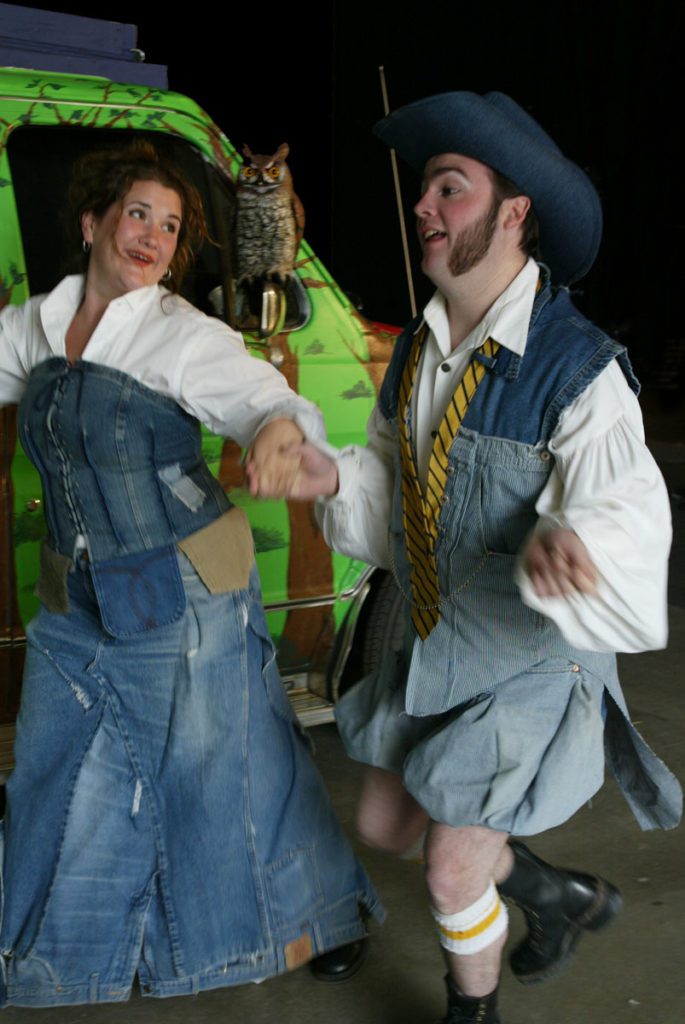
Two people wearing clothes that look Shakespearean, but are made from jeans, are holding hands and skipping in front of a van painted like a forest. There is a plastic owl on the van's side mirror.

Westword- Buntport brushes up on the Bard

I’ve already seen Buntport Theater’s Titus Andronicus: the Musical twice. But with a few honorable exceptions, theater-going has been pretty dismal this fall, so I figure I’m entitled to a little fun.

As we prepare to file in, we see an eccentrically clad woman in the lobby. She’s commenting loudly on the decor, as well as all the newspaper reviews and award plaques pasted on the walls. She does this with such conviction that it’s a few moments before I realize that she’s Buntporter Hannah Duggan, and the play has essentially begun. The conceit is that a wandering troupe of five actors, led by P.S. McGoldstien, is presenting Shakespeare’s bloody and incoherent Titus Andronicus as a musical. There’s lots of plotting here. Saturninus wants to be king, but the people are leaning toward Titus, conqueror of the Goths, who’s just returned to town with four prisoners: Goth queen Tamora and her three sons, one of whom he rapidly executes. Tamora marries Saturninus, and proceeds to plot revenge on Titus — a revenge that includes having her two surviving sons kill Saturninus’s brother, Bassianus, and rape and mutilate Titus’s daughter Lavinia, Bassianus’s love. More plot twists include the framing of Titus’s two innocent boys for murder; Tamora’s affair with the villainous Aaron, which results in an illegitimate baby; Titus’s attempt to save his sons from execution by cutting off his own hand; and a feast during which Tamora is served pies containing the flesh of her own children — that is, the sons who destroyed poor Lavinia.

Buntport actually gets us through the entire plot, and it’s all quite coherent — or at least as coherent as the original. The troupe uses a board with caricatures and lightbulbs to tell us which of the five actors is playing which of the several dozen characters at any given moment. Evan Weissman gets to act essentially the same role every time: “Someone Who Will Probably Die.” There’s also a chalkboard on which the actors keep track of the death toll. The cast makes inventive use of objects and weird scraps of costume, and not all the characters are flesh and blood. One is simply a hat on a stick, and Tamora’s sons are played by a gasoline can and a car radio, complete with ashtray. The scenery consists of a van that is pushed from place to place in the echoing warehouse space by perspiring members of the cast, while McGoldstien exhorts the audience to encourage them. This van has been painted and outfitted to represent different locations: trees on one side for a forest; a table set with plates and other dining accoutrements that pops down when needed. A stuffed owl sometimes perches on the antenna; naked umbrella spokes poke through the roof and open to reveal little green leaves; during one scene, the windows are awash in fake blood. Though I’ve seen all this before, I’m still struck by the ingenuity of the approach, and the jokes are just as funny as ever. I find myself fixing on amusing little things like the blobs of fake blood on Titus’s bare knees, or the watch on the wrist of a severed hand.

In their approach to their roles, the actors have it both ways: They speak and act with complete conviction while also communicating their awareness of the absurdity of the entire situation. They take a few pokes at Shakespeare. “It’s in the text,” one of them says after a particularly ludicrous exchange. “I didn’t make it up.” Brian Colonna is a marvel of energy and good humor as he darts from place to place keeping the entire show together; Erik Edborg manages to be simultaneously puzzled and full of insane energy; Duggan’s silent response to her mutilation at the hands of her rapists — and her tongueless exasperation when her father exhorts her to speak and tell him who they are — is priceless. Erin Rollman brings all her usual assurance to her several roles, and Evan Weissman punctures the action with a series of howlingly funny mini-characterizations.

It’s the Buntporters’ playfulness that makes coming here so pleasurable. Their work contains in abundance what so few productions have these days: exuberance and life. In this, they remind me of Al Brooks’s days at the Changing Scene: Some of the things I saw in that small, colorful space still resonate in my mind, while I couldn’t forget others fast enough. But the unevenness didn’t matter, because the entire place vibrated with energy and surprise.

There are huge differences between Buntport and the old Scene, of course. Al’s take on theater was profoundly idealistic; he believed in the art form’s ability to subvert and in its powers of redemption. He took big risks but could also be downright silly, putting on the work of almost any playwright who requested it, encouraging his dancers to cavort in the mountains naked while he filmed them. I don’t think the Buntporters are motivated by any idea of bettering society or communicating the lofty significance of art. Instead, they keep saying that their goal is to provide cheap, unpretentious entertainment — and this they certainly do.

Sometimes I wish they were more ambitious, interested in deepening and developing their work, since they are quite capable of transcendence. Instead, they seem content to alternate times of wonder and discovery with evenings that are simply amusing, but always — no matter what they’re doing — making us marvel at the good-humored fluidity of their approach and the imagination that lies at the very heart of theater.

They’re saying that this is definitely, positively, absolutely the last Titus Andronicus. I suggest you get over there.

-Juliet Wittman, December 12, 2007, Westword
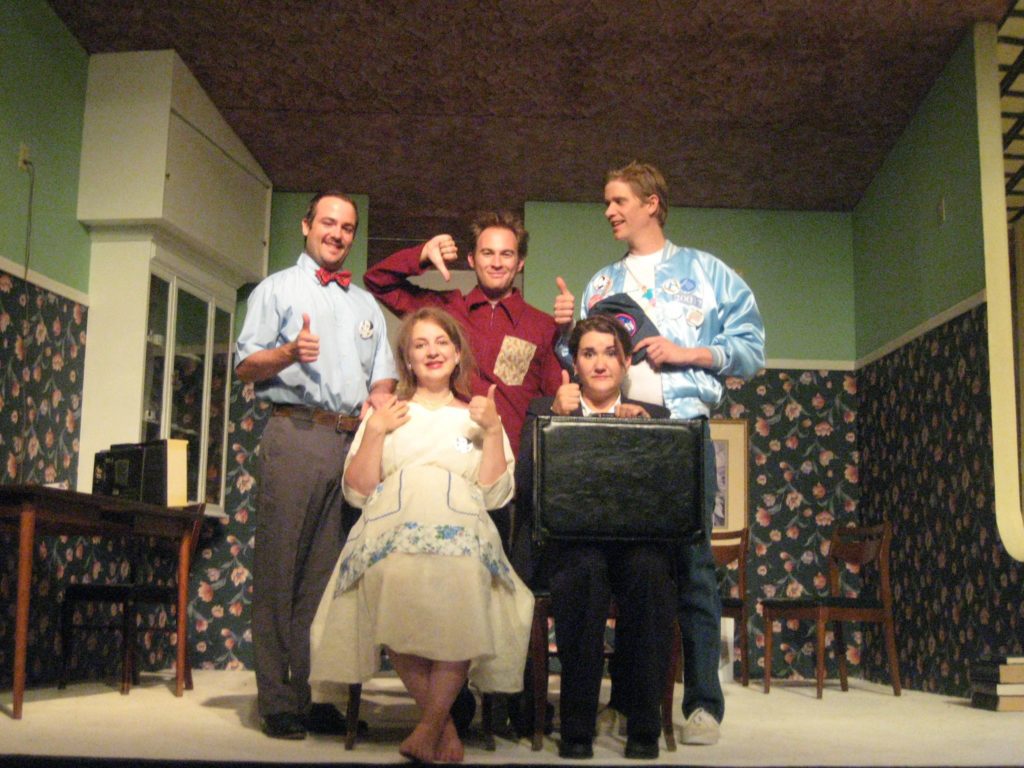
Four smiling people give the camera a thumbs up while one smiling man gives a thumbs down. They are grouped together in the middle of an upside down room.

Westword- Buntport does right by an upside-down world.

From the moment you walk into the theater and see the topsy-turvy set, the central metaphor of Vote for Uncle Marty is obvious. And although the suggestion that we live in an upside-down world isn’t particularly original, the play certainly is, since it arises from the collaborative work of Buntport’s five actor-director-playwrights – Brian Colonna, Erik Edborg, Hannah Duggan, Evan Weissman and Erin Rollman – as well as the sixth, non-performing member, SamAnTha Schmitz.

What else are these characters doing? Well, Colby, very pregnant, is watching Spanish soaps on television, trying to figure out the action though she doesn’t understand the language. Her husband, J.J., has a jigsaw puzzle on the table and is attempting to solve it on a theoretical level without actually manipulating the pieces. Several years ago, Colby’s sister Heather befriended the affable, empty-headed Marty because she believed he would make a good city councilman; she’s been planning his campaign ever since, worrying more about the color of his posters and the need for a slogan than about his complete lack of anything resembling a platform. There’s also Colby’s Uncle Gene – her mother’s brother, and not much older than she is. Gene is the only character who seems troubled by the house’s topsy-turviness. He places himself in various upside-down positions, hangs a mirror above his own nose so that he sees a right-side-up reflection, and rails at the others for their lack of interest in the problem. The final member of this household is Colby’s mother, who remains upstairs and invisible throughout.The company usually makes an art of scene-changing and object manipulation, but this set is remarkably stable and solid. It shows a tightly constructed house interior, with carpet on the ceiling and weirdly vertiginous stairs (to go downstairs, you ascend). The arch of a doorway curves from the floor like a C set on its back. The wallpaper’s floral pattern is upside down as well. The furniture is all right side up, and the inhabitants of the house have set up various objects to serve as steps where needed – a pile of books here, a toaster there. Eventually, two of the characters will get into a heated dispute over a painting of flowers that looks fine no matter how it’s hung.

These activities – Colby’s withdrawal into fantasy, Marty’s ineptitude, Heather’s meaningless political busywork, J.J.’s devotion to abstraction, the patently absurd manipulations of Uncle Gene – are all intended to represent the American public’s response to the current political situation; that much is clear. Even the complete inactivity of the absent mother figure is meant as a protest. (During the Vietnam era, John Lennon said that he and Yoko Ono intended to stay in bed until the war was over. As explained by Uncle Gene, the mother’s gesture is just as dopey, but a good bit more entertaining.)

As I watched, I couldn’t help but think about Ionesco’s 1959 play Rhinoceros, in which one person after another metamorphoses into a thick-skinned, lumbering, snorting beast. Everyone in Ionesco’s original audience would have understood that this was a warning both of the dangers of fascism and of the kind of mindset that allowed fascism to prevail. But in this interesting, evocative piece, the Buntporters never tell us why they feel our world is upside down. Perhaps they assume that in a time of endless war, secret imprisonment and torture, not to mention government propaganda unquestioningly parroted by the mass media, the answer is apparent. Still, while no one wants to sit through a political polemic, I’d have liked more of a clue.

Uncle Marty is far more than political satire, however. There are other currents at work here, and lots of wit in the writing. And the characters are truly fascinating: Edborg’s hapless, good-natured, oddly soulful Uncle Marty; Colonna’s squeaky, jerky J.J.; Duggan’s campaign manager, who keeps storming off the job only to return again, and who hides a pathetic insecurity beneath her businesslike saleswoman’s exterior. There may still be a few folks around who haven’t figured out that Rollman is one of Denver’s most accomplished and original actresses; if so, her performance here should clear the wool from their eyes. Colby is more hugely and monstrously pregnant than any woman has ever been before; her great swollen mound of a belly seems to control her every action, while she peers around it like a toddler carrying a beach ball. Despite her increasingly dark-ringed eyes and ever-lanker hair, Colby is trying to be sweetly maternal, but flashes of demented rage keep piercing her mellifluous exterior. Weissman hurls himself both physically and mentally into the role of Uncle Gene, and even though he’s ridiculously funny, you can feel the real desperation at his core.

The Buntporters have worked together for several years now in a way that few other theater artists can match. They know each other’s tics and rhythms, passions and ideas, and the resulting inventions are wonderfully wry and entertaining. Although I still think the time has come for someone, somewhere, to revive Rhinoceros.

-Juliet Wittman, September 13th, 2007, Westword

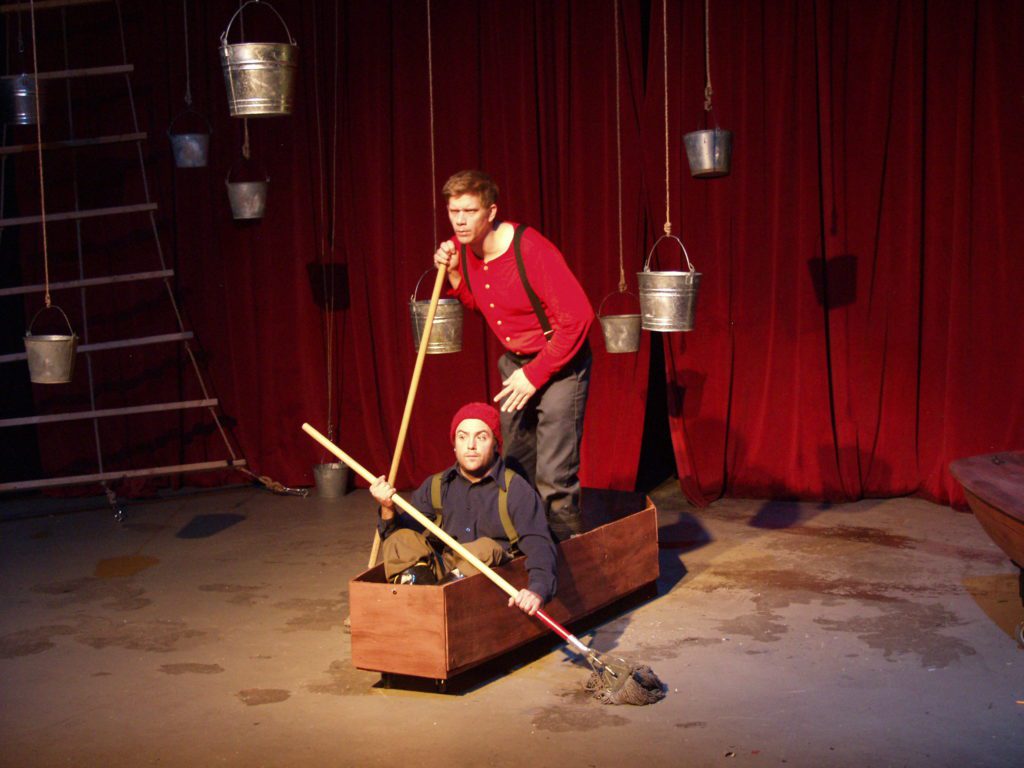
Two men, one seated and one standing, are “rowing” in a wooden coffin, using mops as oars. In the background is a red curtain, a rope ladder, and several hanging buckets.

Westword- Moby Dick Unread • Buntport presents a whale of a tale

One of the perils of an English education is that it leaves gaps. While I and any of my old school friends could discuss Shaw, Shakespeare, Jane Austen, George Orwell and Virginia Woolf at some length — and on a more contemporary note, I’d be happy to talk your ear off about Zadie Smith and Salman Rushdie — I’ve read very little of Steinbeck, Hemingway and quite a few other American heavyweights. Of Herman Melville, I know only “Bartleby, the Scrivener.”

When members of Buntport Theater promise that you don’t have to have read Moby-Dick in order to enjoy their Moby Dick Unread (in fact, they suggest that you see the production, then impress your friends by pretending you’ve read the novel), they’re telling the truth. I did enjoy the play.

Most stage and film adaptations of novels emphasize the story line, streamlining the action and trimming away minor scenes, the author’s digressions, sometimes a subplot or two. But the Buntport team announces proudly, “This is Moby-Dick with all the fat.” They linger lovingly on Pip’s ordeal alone in the vast sea and the arcana of an actual historic London court case on whale fishery that made a careful distinction between a “fast fish” and a “loose fish.” The result is a kind of serio-comic glossary, a meditation on Melville’s masterwork. It’s also as inventive as everything Buntport does, making clever use of space arrangements and objects (a rope ladder, buckets of water suspended from the ceiling) and combining parody and homage.

As always, the actors create their low-tech special effects with what seems like touching earnestness while their faces and bodies offer ironic comments: Look, we’ve drawn a large chalk whale on the back wall. Laugh all you want, but notice that it’s also resonant with meaning. Perhaps even mythic. Think of the vastness of the sea, the mystery of these huge creatures. Think of Job. Oh, come on, folks — don’t get that serious. It’s just a chalk drawing. “We’re making do,” various members of the cast keep telling us after particularly iffy or unexpected pieces of business. Because the style is so unpretentious, the heavy subject matter seems light and palatable, yet it’s never trivialized. Rather than coming between you and Melville’s world, the Buntporters — Brian Colonna, Hannah Duggan, Erik Edborg and Erin Rollman, with Evan Weissman and SamAntha Schmitz working off-stage — illuminate it. And Edborg’s prologue, which uses an aquarium and a wind-up toy whale to give you the entire action of the play, is worth the price of admission on its own.

But though I had the promised good time, I couldn’t help noticing that my friend, Jim, who had studied the book in college, was more deeply mesmerized by the production, and hugely exhilarated afterward. When he talked about what we’d seen on the way home, I realized that he’d found all kinds of echoes and subtleties that I’d only partly glimpsed, and Moby Dick Unread became thicker and richer in my mind. My response to the idea of actually reading Melville’s swollen, portentous, 650-page epic has always been quite unequivocal: I would prefer not to. Buntport not only provided a fine evening of theater, but it inspired me to pick up the damn thing and begin. That has to count for quite a lot.

-Juliet Wittman, April 12, 2007, Westword

A man in a pinstriped suit clasps his hands in his lap, staring out wistfully.

Westword- Winter in Graupel Bay • Our Town meets our town in Buntport’s latest

When you enter Buntport Theater, you find yourself facing what looks like the front of a long, low, open dollhouse with rooms on two floors. These spaces are inhabited by various eccentric characters. There’s Polly, the little girl who serves as narrator; a pair of gossiping old crones;

the hapless and perennially unemployed Andrew Fromer, with his dreams about a vaudevillian grandfather who played the rear end of a horse and longed to play the front. Bruce Bentley is a man with a single passion, photographing snowflakes; the town drunk, Toothy Bill, has the soul of a poet; the proprietor of the local shop fondles an imaginary pet – Snowflake, her deceased and beloved cat. And we also meet Lady Fergus, a delusional elderly woman who believes she’s an aristocrat and has persuaded the local banker to serve as her butler.

The day is the winter solstice, and the tone of Winter in Graupel Bay nostalgic and tinged with melancholy. There’s a touch of Thornton Wilder’s Our Town, or such pastiche, multi-voice pieces as Dylan Thomas’s Under Milkwood and Edgar Lee Masters’s Spoon River Anthology. Polly grieves for the lengthening nights and shortening days; later, we learn that it’s possible to celebrate darkness.

With each of the five Buntport actors playing more than one role, the action flows easily from space to space. Some of the characters are more convincing than others. Erin Rollman is charming as the precocious Polly; her shop proprietor and befuddled Lady Fergus are funny but less grounded. You feel for Hannah Duggan’s lovestruck Peg Muford and Brian Colonna’s sad-sack Andrew Fromer. Erik Edborg’s Toothy Bill, with his kick-stamp walk and wolfish grin, is quite wonderful – as is the enigmatic persona Edborg presents at the play’s end, despite the fact that I never figured out who he was supposed to be or what he represented. Something to do with the moon, I think.

Winter at Graupel Bay contains so many of the elements I love about Buntport – the humor, intelligence and originality; the ingenious use of space; the lively, expressive music and appealing performances – that I hate to say it doesn’t quite work. But alas, it doesn’t. While the production is pleasant to watch and often humorous, it’s neither consistently comic nor consistently evocative. A lot of the dialogue is literate and interesting, but other parts are flat. The character of Bruce Bentley, for example, is clearly based on nineteenth-century naturalist Wilson Bentley. According to Kay Redfield Jamison’s wonderful book, Exuberance, Bentley brought such passion to the photographing of snowflakes that he mourned for years over one crystal, broken while being transferred to a slide. Evan Weissman renders Bentley’s quiet depth perfectly. But the script calls for Bentley, frustrated by a dry spell, to simulate a snowstorm with flour, creating a model of the town and deploying a large sifter. The result is clever, but the entire concept struck me as too self consciously whimsical. As did the ever-present dead cat, although Rollman’s mime as she stroked and cuddled it, and at one point tried to avoid being scratched, was very amusing.

Like all of Buntport’s plays, Winter in Graupel Bay was developed entirely by the seven-person company. (In addition to the on-stage actors, Matt Petraglia and SamAnTha Schmitz contribute their creativity and expertise.) What they’ve created here is charming and soulful, but it needs more work and a stronger, clearer contour.

-Juliet Wittman, December 14th, 2006, Westword

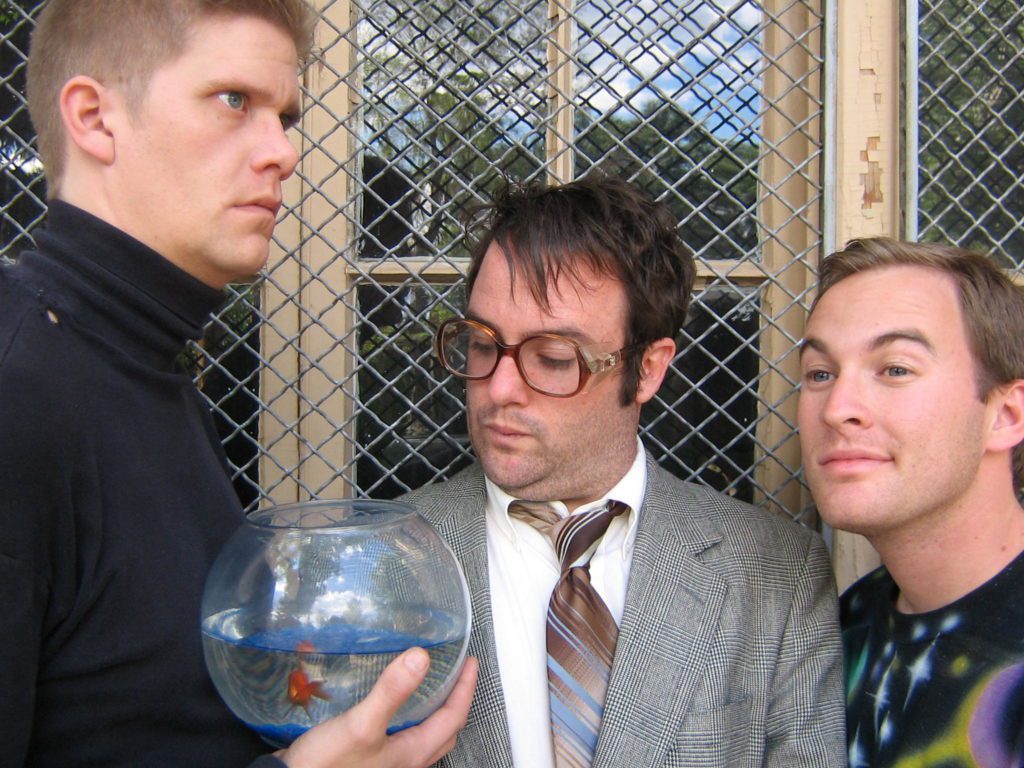
Three awkward men in front of a window grate. On the left is an intense man with a buzz cut and black turtleneck, holding a fish bowl with a goldfish in it. In the center, a man in a suit and large glasses purses his lips. On the right is a smiling man with a space t-shirt on

Westword- That’s Entertainment • Buntport makes magic with something is rotten

The action of Hamlet all hinges on an injunction by the ghost of Hamlet’s father, who appears on a bitter cold night to tell the prince he must kill his murderous and usurping uncle. Everything that happens in Something Is Rotten is also set in motion by a ghost — in this case, the ghost of a pink striped sock that insists the three performers mount a production of the Shakespeare play.

Julius, the weirdly smiling, dim-witted but steel-willed owner of the sock, who’s played by Evan Weissman, bullies two friends, Harold and George, into fulfilling the command. But Harold is doubtful. Erik Edborg gives Harold the stern expression and deep, haunted eyes of Samuel Beckett, though not the intellect. He’s basically puzzled and resentful through the entire evening. The cast is rounded out by the star of the play, Brian Colonna’s George, a temperamental, hypermanic Hamlet whose approach offers a telling contrast to the subdued — though very different — performances of the other two. That is, when he’s not dropping into sudden narcoleptic trances.

We never really know exactly who these men are or why they’re on stage. George is clearly an actor – or at least someone who wants to act — but Julius and Harold are stumbling amateurs. They discuss their roles and argue about how to act them, bicker, shush each other and improvise when panicked.

Since this is a Buntport Theater production, the show is as ingenious as it is low-tech, and a lot of intensely clever and hilarious things happen. Edborg plays both King Claudius and Queen Gertrude, often at the same time. For the king, he wears a huge mask, the mouth of which he’s forced to manipulate with his hands. This means that Weissman has to provide his gestures, pulling on a pair of elbow-length gloves to do it. For the queen, Edborg undergoes a costume change that you simply have to see for yourself.

Ophelia is played by a goldfish — a real goldfish in a bowl — which makes the queen’s line “Your sister’s drowned, Laertes” particularly poignant. Ophelia’s father, Polonius, is a Teddy Ruxpin bear with a tape of the lines in his furry back. The family scenes can get tricky. “Sometimes the fish doesn’t look at the bear,” one of the actors complains, and for the next several minutes, we in the audience twist our necks to see which way Ophelia is facing. This is hard to do, since she’s quite a small fish and does a lot of aimless circling.

Laertes is a Tonka truck. A bright-yellow Tonka truck. There’s a forklift in the front that comes in handy when Laertes is forced into a duel with Hamlet.

Though only three Buntporters appear on stage, Something Is Rotten was written by all seven company members — Matt Petraglia, Erin Rollman, Hannah Duggan and SamAnTha Schmitz, as well as Edborg, Weissman and Colonna — and they are as agile with words as with their visual jokes. There’s also a pre-play warmup by Janice Haversham, who looks and sounds exactly like Hannah Duggan but cannot, in fact, be Duggan, because we all know she left for New York some months ago. Haversham shows off her musical instruments, which include a tambourine and a triangle, and provides smooth, folksy singing and an introduction to Shakespeare for those of us who have trouble understanding his work — an introduction that includes the information that ants are known to count their steps and it’s hard to make a pie crust.

You’ll be reassured to know that the requisite catharsis-providing pity and terror aren’t absent from this interpretation. The shrieks of grief and rage that rend the final scene would move a statue to tears — albeit tears of laughter.

Thaddeus Phillips of Lucidity Suitcase, who trained at Colorado College with the Buntporters and shares their anarchic humor and innovative relationship with objects, has also tackled Shakespeare, but took a different approach. Phillips used his versions of King Lear, The Tempest and Henry V to illuminate cultural or political issues or to tell us something we might not have thought of about the play itself (although in a strange, eccentric and sideways manner). In earlier seasons, Buntport staged Titus Andronicus and Macbeth with the primary goal of provoking laughter, and they do it again here, sending waves of giggles and belly laughs rippling through the house, punctuated by the occasional surprised snort.

But Something Is Rotten isn’t just great entertainment. It also tells us something about the process of making theater. The Buntporters go about their work in the same way that a four-year-old creates a game — focused, intense, playful, pursuing an idea until it dead-ends, then making a swift turn and dashing off down another pathway. Or just hanging on and babbling until something new springs to mind. Except that these players are highly sophisticated, and the apparent artlessness of the production masks the meticulous work that shaped the final version.

There’s not a boring moment in Something Is Rotten, even though the company is unconcerned with narrative and forward momentum, at least in a conventional sense. The play mocks these elements. An actor stands on the stage and stares at us as he tries to figure out what to do next. Two of the performers rush off stage to buy ice cream. It’s clear from the pace of the show the relaxed tension of the actors that Buntport has mastered its medium. These guys don’t have to hit you over the head with what they’re doing, get loud and jittery, try to underline the cleverness of their inventions. They’re not worried about losing the audience. They take their time, and they know exactly what they’re doing. On an almost empty stage, using nothing but their minds, voices, bodies and a few props, they’re making theater magic right in front of your eyes.

-Juliet Wittman, September 14th, 2006, Westword

A down shot of a woman and three men all dressed in black and grey 1800s funeral attire are looking up and out seriously while standing on a wooden floor. Behind is a red curtain. To the right of them, in the shadows, is small side table with a glass and gold tray next to a wooden chair.

Westword- A Cut Above • Buntport reaches new heights with A Synopsis of Butchery.

To be buried while alive is, beyond question, the most terrific of these extremes which has ever fallen to the lot of mere mortality. That it has frequently, very frequently, so fallen will scarcely be denied by those who think. The boundaries which divide Life from Death are at best shadowy and vague. Who shall say where the one ends, and where the other begins? We know that there are diseases in which occur total cessations of all the apparent functions of vitality, and yet in which these cessations are merely suspensions, properly so called. They are only temporary pauses in the incomprehensible mechanism. A certain period elapses, and some unseen mysterious principle again sets in motion the magic pinions and the wizard wheels. The silver cord was not for ever loosed, nor the golden bowl irreparably broken. But where, meantime, was the soul?
— Edgar Allan Poe, “The Premature Burial”

The Victorians’ fascination with death — their spiritualist groups and seances, their widespread fear of being buried alive — seems quaint to us now, when medicine and technology provide fairly clear markers of the end of brain activity. But have we really come so far? While her doctors and husband believed that poor Terry Schiavo was functionally dead, thousands of Americans — including Senate Majority Leader Bill Frist — insisted she was fully conscious, trapped in her rigid, comatose body. This is surely a nightmare as ugly as anything Poe could have imagined. Some years ago, a spate of newspaper articles told of patients who had been too lightly anesthetized and awoke in the middle of surgery, paralyzed and unable to alert the surgeon to the terrible pain they were suffering. There may be truth to these fears — we still don’t completely understand comas — but they are also expressions of something primal, something we experience in those nightmares where we’re desperate to escape an engulfing danger but are unable to cry out or move.

Like Poe’s prose style, the Victorian attitude toward these terrors has a certain dark gorgeousness, and Buntport Theater captures it brilliantly in A Synopsis of Butchery, an elegant production that manages to be lush and spare at the same time. Buntport’s home base is a cavernous warehouse, but for this play, the acting area has been reduced to a lighted box representing an ornate, old-fashioned, steeply raked stage. The story concerns Washington Irving Bishop, a mentalist who was subject to fits of catalepsy during which his body became rigid and his breathing seemed to stop. He collapsed after a strenuous New York performance, and two men — a doctor and a shoemaker — promptly performed an autopsy on him. Bishop’s mother, Eleanor Fletcher Bishop, was convinced that her son had been cut up while still alive, murdered by the doctor’s curiosity about his brain. She wrote a book called A Synopsis of Butchery of the Late Sir Washington Irving Bishop (Kamilimilianalani) a Most Worthy Mason of the Thirty-Second Degree, the Mind Reader, and Philanthropist by Eleanor Fletcher Bishop, His Broken-Hearted Mother, and dedicated her life to the search for justice and the prevention of similar catastrophes in the future. (There is only one certain proof of death, she informs us sternly in the play: putrescence.)

Buntport’s production is based on Eleanor Fletcher Bishop’s book and other sources. In this version — and I don’t know how much of it is historically accurate — Eleanor has hired three actors and taken her account of events on the road. The piece is an amalgam of her observations and outbursts; tantalizing historical tidbits, such as the description of the breathing tubes and signaling devices placed in some nineteenth-century coffins; scenes from the trial of the doctor — not as they actually occurred, but as Eleanor thinks they should have; and re-enactments of the fatal autopsy itself.

Erin Rollman gives a tour de force performance as Eleanor. Sometimes she’s squeaky and absurd, sometimes full of matronly dignity, but at every moment she’s deeply immersed in the part. She makes Eleanor’s arguments, her warnings that any one of us could end up buried alive, so forceful and heartfelt that we almost believe them, as well as the spiritual powers she ascribes to herself and her son — who was, in fact, a bit of a fraud. It’s clear that Eleanor was one of those engulfing, child devouring mothers, and Rollman fully communicates both her bullying and her hucksterism (at one point, the actors take collection baskets into the audience). But she also reveals the woman’s profound sorrow.

Brian Colonna, Erik Edborg and Evan Weissman each play several roles. The script veers from funny to disturbing, and one of this production’s most impressive features is the entire cast’s control of the tone. The first time the autopsy is mimed, it’s cartoonish. But the final, equally stylized re enactment approaches real horror, as Washington Irving (played by Weissman) rises three times from the slab, crying out, “Mother!”

Last year, Buntport experimented with two forms it had never tried before, realism and horror — not as splattershock, but as a way of examining the world. While last season’s offerings worked well enough, A Synopsis of Butchery seems a large step forward. It retains the sense of play and experimentation we expect of Buntport, but the work is more unified, with a heightened sense of artistic control.

-Juliet Wittman, May 18, 2006, Westword

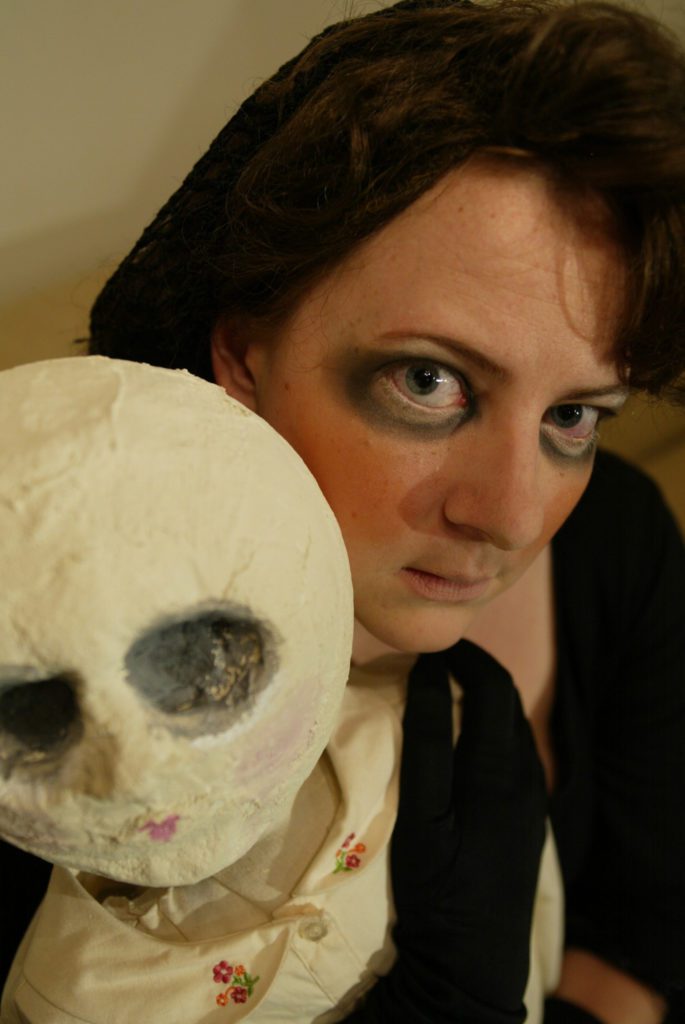
Close-up of a woman's face. Her eyes look sunken in, thanks to heavy makeup. Next to her face is a large creepy doll's face. Its eye sockets are empty in its white round head.

Westword- Mind Puppetry • Horror: The Transformation, though flawed is still moving

Buntport’s Horror: The Transformation is based on Charles Brockden Brown’s Wieland, a novel published in 1798, and inspired by the true story of a farmer who killed his wife and children. It’s not done as a period piece, though the clothes and setting aren’t strictly modern, either; At one point, a character puts a record on a turntable, which would set the date somewhere in the mid twentieth century. A lot of the dialogue retains Wieland‘s eighteenth-century focus and rhythm.

Although the acting is somewhat naturalistic – at least in spots – the production has many stylized elements. The actors all wear gloves; their eyes are heavily shadowed. Two children are represented by ingeniously-constructed puppets. There are long periods during which we, the audience, sit in absolute darkness, and often the theatre is filled with odd and insinuating sounds; Music. Panting. A low, breastbone-vibrating rumble. Footsteps. Instrumental shrieks.

It’s difficult to scare audiences these days, with films routinely providing rivers of blood, grotesquely splintered bodies and realistic brain splatters. It’s particularly hard for a theater group that lacks the technical resources of, say, the Denver Center. In addition, the plot of Brown’s novel doesn’t entirely hold together, and concepts that would have spooked people a couple of centuries ago – ventriloquism, the practice of magic, spontaneous combustion – don’t have the same impact today.

The play’s ending left me confused. It wasn’t just that I couldn’t figure out whether the impulse that drove the protagonist, Theodore, to murder was supernatural or only the workings of his own religion-maddened mind – that ambiguity was obviously intended. It was that I wasn’t sure what had actually happened until I got home later and Googled: “Brown. Wieland. Plot.”

Despite this, the Buntport production does succeed, both as an extended rumination on the first Gothic novel ever published in America, and in creating a real sense of fear and unease in a contemporary audience.

Theodore is forever talking with the members of his family – his sister Clara and her friend Henry, his wife Catherine and their two children – about science and belief and the role of God in human affairs. Those who lack belief, the play suggests, also lack any reason for action in the world. But those who do believe risk illusion, illogic and even madness.

Theodore and Clara’s father was a highly religious man who built a temple where he worshiped alone. One night he was found there, naked, bruised and burned; the play suggests that he had spontaneously burst into flame. This man’s own father had thrown himself over a cliff. Somehow, these deaths seem to pre-ordain Theodore’s murders. Buntport communicates all this in a series of scenes that move backwards and forwards in time and are punctuated by flashes of light, periods of darkness and retina-teasing images.

The violence, when it finally comes, is well-staged and -acted, but also almost anti-climactic, far less troubling than the thoughts and feelings the production has already aroused. We know that children are killed by parents who think they’ve heard voices far more often than most of us like to think about; we know also that these horrors are ultimately incomprehensible. Yet I couldn’t help wanting more coherence between the evening’s earlier hints and portents and the actual murders, and a greater understanding of the link between Theodore’s religiosity and his killings.

There are elements I just didn’t get. Whenever someone on stage performs – a child dances for the adults or the magician, Carwin, shows off his tricks – the other actors turn and stare at the audience, instead of watching the performer. Why? And the phrase “When people come to look at something, there must be something there for them to look at” is frequently repeated, but I have no idea what it’s supposed to mean.

Yet many of the tricks are brilliant. At one point, Carwin magically creates a pretty, oval image of a garden against the back wall. When Clara approaches to examine it…well, you’ll have to see for yourself. And although the moment doesn’t quite work, I was impressed by the conceptual daring of having the two children play with dolls representing their grandparents, so that what you see is puppets manipulating smaller puppets. The puppet-children are eerily effective throughout. Kate, the little girl, says several times that she’s afraid monsters will suck out her life force through her fingertips. At the moment when she’s about to be killed, the Kate-puppet stretches out her arms to her murderous father. As she does, you see the white gloved hands of the puppeteer above her. It’s a moment of genuine sadness.

Horror: The Transformation places us inside a disintegrating mind. It creates the sense of dislocation you feel waking up in the gray, predawn light, utterly alone, divorced from the habits and distractions that steady your daylight hours, aware that death has stepped one increment nearer and that if your mind starts sliding into oblivion, there’s nothing in the wide, empty universe to stop it.

-Juliet Wittman, November, 3, 2005, Westword

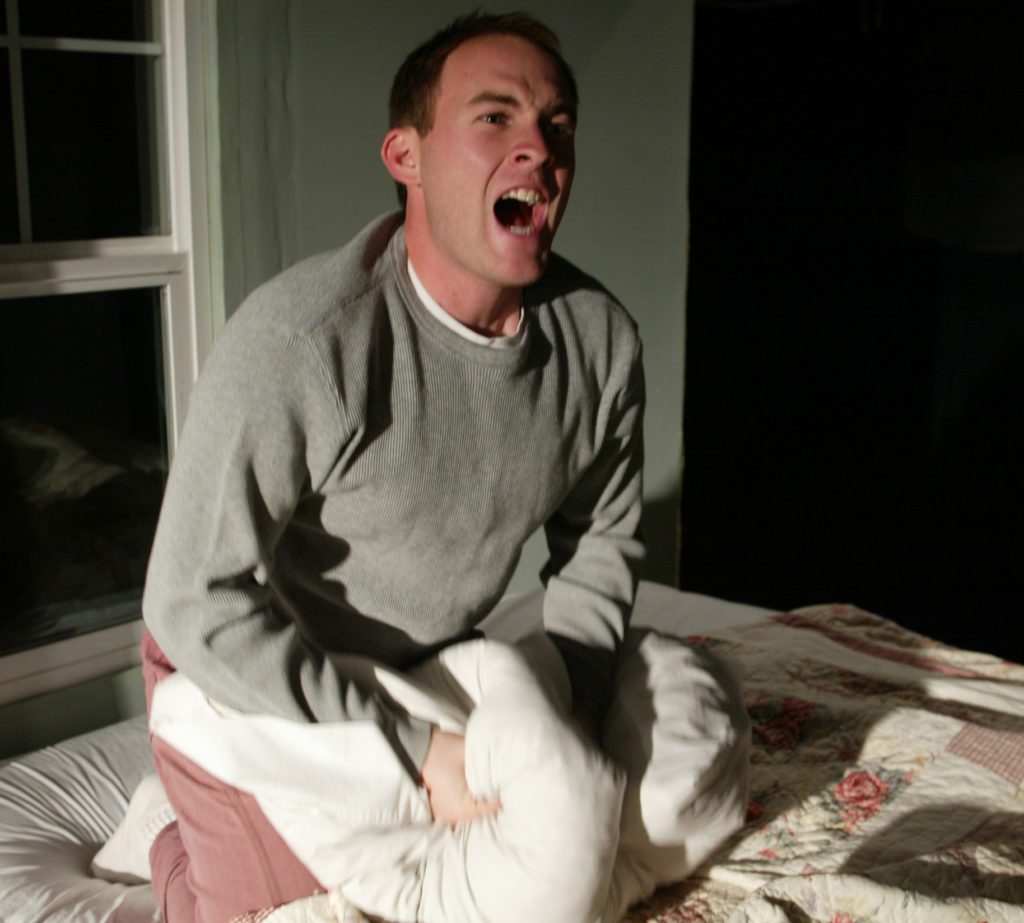
A blonde man in a grey sweatshirt, white socks and purple pajama bottoms is sitting up on his knees on a bed and yelling angrily outward and to the right. He is clenching in front of his lap a white flower-patterned blanket. Behind him is a white wall with a partially open double-hung window.

Westword- Beyond Belief

Buntport’s Realism: The Mythical Brontosaurus teases out the truth

The seven founders — and also writer-designer-director-performers — of Buntport Theater are exploring new territory. Known for a prankish and highly literate experimentalism, the team is currently showing Realism: The Mythical Brontosaurus, which, as the title suggests, is pretty much a realistic play. There are no lopped-off limbs here or absurdist twists of plot. No one bursts into song. You won’t see anyone skating on artificial ice. Unlike Buntport’s previous pieces, Realism, though communally written, could be performed by a completely different group of actors.

As always at Buntport, the set is ingenious. The audience is seated on two sides of the cavernous theater space. Between the groups, there’s a structure showing the first and second floors of a house. You can see right through it, and into all the rooms at once — a living room and kitchen on the bottom floor, two bedrooms with a bathroom between them above. It feels a little like peering into a backless dollhouse. When one of the characters opens the kitchen’s gleaming refrigerator, you see that it’s a clutter of cartons, bottles and containers, just like your own and everyone else’s.

On the upper floor, Jack lies on his bed, alternately reading and staring into space. Although he seems calm enough, we soon learn that he’s suffering a crisis of faith centered on the status of the brontosaurus. Jack has just learned that “brontosaurus” isn’t the creature’s rightful scientific name — though brontosauri do, in fact, exist as a taxon, or species group. Furthermore, scientists have been screwing up museum reconstructions of brontosauri for over a century, equipping them with heads far larger than we now believe they possessed. Or would have possessed, if they existed.

Okay, I said Buntport was assaying realism; I didn’t say they were completely abandoning their off kilter worldview.

Into Jack’s house blunders his sister Fiona, with her fiancé, Michael. Once she realizes that Jack is closed in his room, Fiona tries everything in her power to get him out. Michael, meanwhile, just wants to take a dump and is interested only in some quiet time alone in the bathroom. As the play progresses, we begin to understand Fiona’s desperation. She and Jack used to hide from their abusive father together until Fiona, the older of the two, left home, forcing Jack to face the violence alone. She’s particularly concerned because Jack has been suicidal in the past.

Jack isn’t keen on Fiona’s explanation; he finds it intrusive.

His feelings and thoughts, he insists, are his own. Poor Michael is left squirming, and the tension between the siblings threatens to destabilize his relationship with Fiona.

The quartet of performers is rounded out by Ben, Jack’s calm and commonsensical lover, who is far more willing than Fiona to allow Jack to untangle his skein of twisted emotional and philosophical speculation on his own. Ben relaxes with the newspaper and periodically slips tortillas under Jack’s door.

The play touches on heavy themes, but the writing is light, deft, witty and completely lacking in sentimentality. And it turns out the Buntporters are skilled and appealing straight actors. Erin Rollman is just as absorbing to watch as Fiona as when she’s inhabiting the bratty teenage personae that routinely leave Buntport audiences in stitches. She’s very funny here, but she also does full justice to the sadder moments. I’ve always been a fan of Evan Weissman, and his Jack has a dotty, blandly underplayed sincerity that works perfectly. Who’d have guessed how effective Brian Colonna could be as a regular guy? And the usually hyperkinetic Erik Edborg displays his range, too, with a Ben who’s calm, strong and rather kindly.

Of course, Realism boasts moments of complete insanity. This wouldn’t be Buntport otherwise. There’s a running joke about the objects slipped under Jack’s door, which finds its apotheosis when Jack agrees to pass Michael a roll of toilet paper. You really have to see for yourself the touching earnestness and concentration with which the two actors manage this feat.

The question of what’s real and what isn’t keeps raising its non-brontosauran head. Fiona finds her own yearbook picture unrecognizable; her childhood memories differ from Jack’s. There’s talk about the Shroud of Turin, and we learn that Ben is a practicing Christian. Finally, one of the characters arrives at a solution to a world of uncertainty: “I have to believe that what I believe is what I believe.”

-Juliet Wittman, October 20, 2005, Westword

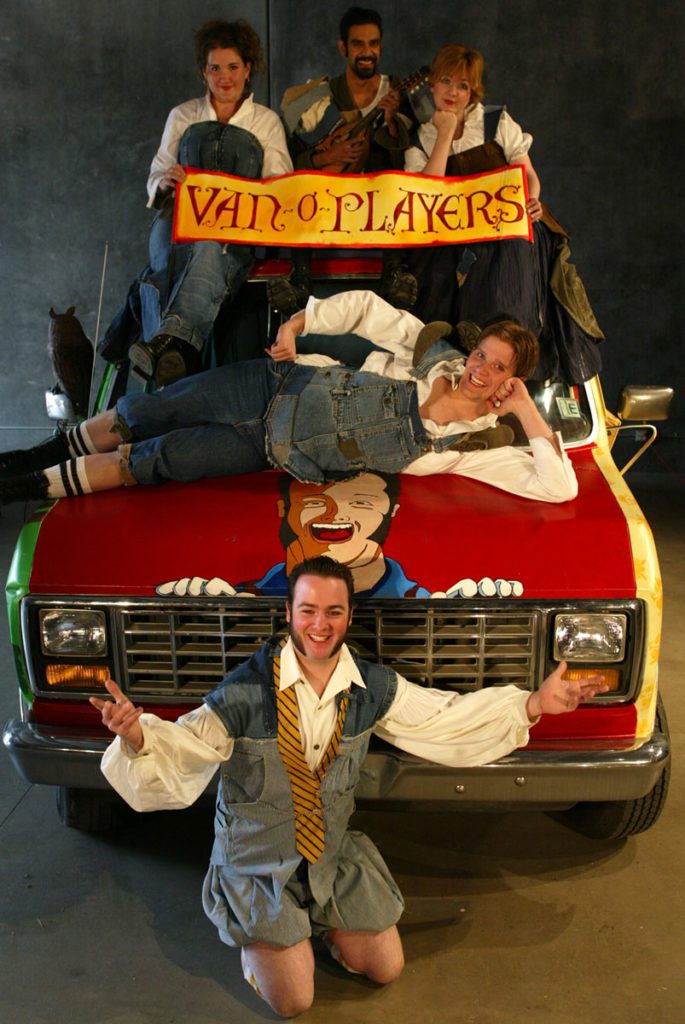
Five people are draped on and around a painted van. They all wear makeshift Shakespearean clothing. In front is a smiling man with his hands out. The hood of the van has a large smiling portrait of him. One smiling man is draped across the hood. Sitting on top of the van are three more people holding a banner that says “van-o-players”.

Westword- Bloody Good Fun

Buntport’s Titus Andronicus! The Musical still kills.

Going to the theater alone is depressing, so part of my job as a reviewer involves coaxing, bribing and seducing friends and family members into accompanying me. Over the years, I’ve come to rely on these companions — wise and perspicacious people all — even when their opinions clash with mine. They provide a sorely needed outside perspective, moments of insight, a salutary reminder that not everyone sees the world in the same way that I do.

It takes some thought, figuring out who should be invited to what. So-and-so likes big musicals; someone else is drawn to British comedy; this friend is in love with language; this one admires spectacle. If a friend has seen too many clunkers in a row, I try to sweeten the pot with a production I expect to be excellent (though predicting excellence is harder than you might think). Then again, many of my friends don’t mind a bad show, because we have so much fun slicing and dicing it afterward.

It’s telling that everyone who’s ever accompanied me to Buntport wants to go again. For Titus Andronicus! The Musical — a restaging of the hilarious production the Buntporters mounted a couple of years ago — I invited Linda, who had never before visited this cavernous theater warehouse space on the outskirts of town. Within minutes of our being seated, amid the general cachinnation of the audience, I heard her low, musical peals of laughter. “They’re really clever,” she murmured.

Titus Andronicus is a Shakespeare play so awful that for centuries, many scholars refused to believe that Shakespeare had actually written it. Forced to concede the point, they scrambled for explanations. It was co-written with someone else. It’s not really that bad. It’s a parody.

The plot alone is a howler. It involves the Roman conqueror, Titus, and his captive, Tamora, Queen of the Goths. There are lots of sons — Titus’s, Tamora’s, the sons of Saturninus, himself son of the Emperor. You also get lust, hate, revenge, rape, murder, mutilation and rivers of blood. Each unbelievable plot twist seems to exist solely for the purpose of ushering in more mayhem.

In the Buntport version, five actors play all of the characters, using minimal costumes and scenery. There’s a board to one side of the stage adorned with caricatures of the actors’ faces. Beneath each face is a list of names, and above each name is a lightbulb. At the beginning of every scene, someone runs to the board and rapidly illuminates the relevant bulbs so you know which character the actor is supposed to be at that moment. Some characters, like Tamora’s sons, are represented by objects — in this case, a gas can and a radio. Evan Weissman plays only one role throughout — actually, multiple roles wrapped into one. This guy is called Someone Who Will Probably Die. Like Kenny in South Park, Weissman gets knocked off over and over again; unlike Kenny, he does it with a certain sneering élan.

In addition to the helpful character board and a second board on which the corpse score is noted in chalk, there’s a van in the middle of the space, painted to represent a house on one side and a forest on the other. This van is rolled from place to place by the actors as needed, while Brian Colonna, who plays Titus with insane energy, urges the audience to help by yelling, “Push, push.” Pretty soon it sounds as if you’re in an obstetrics ward with a horde of prospective fathers. And, yes, we do ultimately get a newborn on stage — Tamora’s son, who, because of his resemblance to her evil Moor lover, Aaron, she — Lady Macbeth-like — wants killed. (Aaron isn’t a Moor in the Buntport version; what gives away the child’s paternity is the fact that he’s inherited his father’s black mustache.)

The action is punctuated by song. At one point, Titus is convinced that he can save his two kidnapped sons by cutting off his hand. He, his brother and a third son compete for the honor of mutilation in a warbling trio. There’s also cheerful singing as Tamora instructs her sons in how to rape and mutilate Titus’s daughter Lavinia, played by Hannah Duggan.

The acting is frantically funny. Erik Edborg prances and weaves about the stage like an animated cartoon figure; Erin Rollman is a smoothly evil Tamora. No one can do silent exasperation better than Hannah Duggan: Her expression when Titus asks her to reveal the name of her assailants after the rape — she’s dripping blood and supposedly missing both hands and tongue — is priceless.

There’s no attempt to make a statement here, just a fast, effervescent evening of fun. “You’ll let me know when these guys do another production?” asked Linda as we left.

-Juliet Wittman, January 27, 2005, Westword

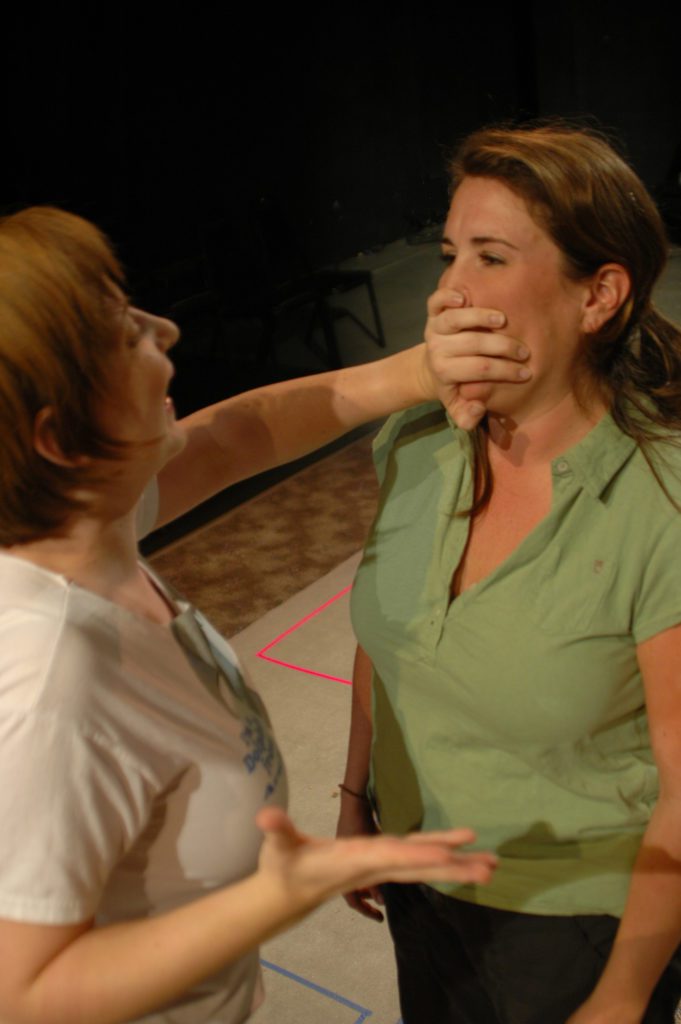
One woman holds her hand over the mouth of another woman.

Westword- Sketchy Stuff • Buntport’s Macblank, while funny, feels like an extended skit

In putting together their original comedy Macblank, the folks at Buntport relied on the theatrical superstition that there’s a curse on Shakespeare’s Macbeth and that those performing it are in danger of unknown catastrophe. There really are actors who refuse to speak the play’s title in a theater, and it’s well known in theatrical circles that if the name has been spoken, the speaker must turn three times and spit over his left shoulder. Or quote a line from A Midsummer Night’s Dream. Or something like that.

Macblank involves a company of five that is developing an experimental version of “The Scottish Play,” and their curse is Beth, played by Erin Rollman, who’s both the most superstitious and the most murderously ambitious member of the cast. Beth is blind, self-righteous, a whiner and a bully. She’s followed everywhere by devoted Greg (Evan Weissman), who’s given to quoting outworn proverbs and uttering strange non sequiturs. Hannah Duggan’s Miranda tries to serve as the voice of reason, but she only becomes genuinely animated and involved when describing her own life, whose turns and twists mirror several of Shakespeare’s plots. Brian Colonna is Rob, who lives a typical actor’s life. That is, he works six jobs, arriving at the theater exhausted to watch in horror as everything falls apart. And, of course, there’s the company star, the guy with the phony British accent: Ryan, as played by Erik Edborg.

These are smart, inspired and highly original comics, and their audacity alone has the audience spluttering with laughter. Beth recites, with profound satisfaction, example after example of problems attending Macbeth productions (she knows, because she’s Googled the topic); consults her horoscope in Cosmopolitan for hints that she, not Ryan, should be playing the lead; ignores lovelorn Greg; and wields a baseball bat with fiendish determination. Miranda glows as she describes a boyfriend “hung like a donkey,” a cousin who was served gerbils baked in a pie, and the time she accidentally made out with “a girl dressed as a guy.” The best monologue is delivered by Greg, who describes his childhood performing experiences in a meaningless mishmash of sense and sentiment that includes memories of his grandmother’s gifts of packets of saccharin. This is the kind of odd, discursive humor pioneered by the late, lamented Andy Kaufman — except that where Kaufman, under his mask of innocent passivity, was clearly a hostile character, Weissman’s Greg is all shiny eyed ignorant sweetness.

Buntport opened two shows in tandem this season. The first, Kafka on Ice, is brilliant, while Macblank shows signs of being hastily put together. Edborg, in particular, seems to only half inhabit his role. Ryan is fascinating at the beginning, and Edborg certainly rises to all the big comic moments, including a brilliantly uninhibited rendition of Puck’s epilogue in Midsummer Night’s Dream, but the English accent comes and goes, and when Ryan sustains a leg injury, Edborg can’t even be bothered to limp, climbing onto a chair with the supposedly injured limb taking all the weight — an Acting 101 mistake.

Macblank is more an extended comedy sketch — albeit a sophisticated one — than a play. After a while, the humor begins to feel a little repetitive, and you want a trace of plot and some character development. Still, even though this show lacks the inventiveness of Kafka on Ice, it makes for an entertaining evening.

-Juliet Wittman, October 28, 2004, Westword