Buntport Theater

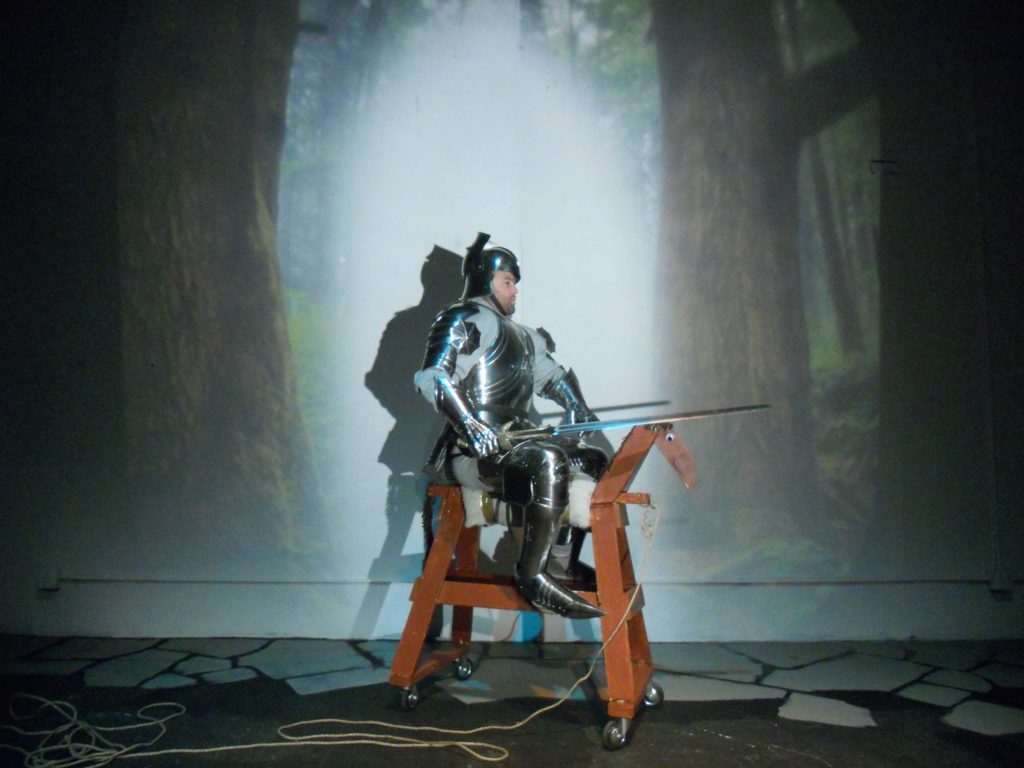
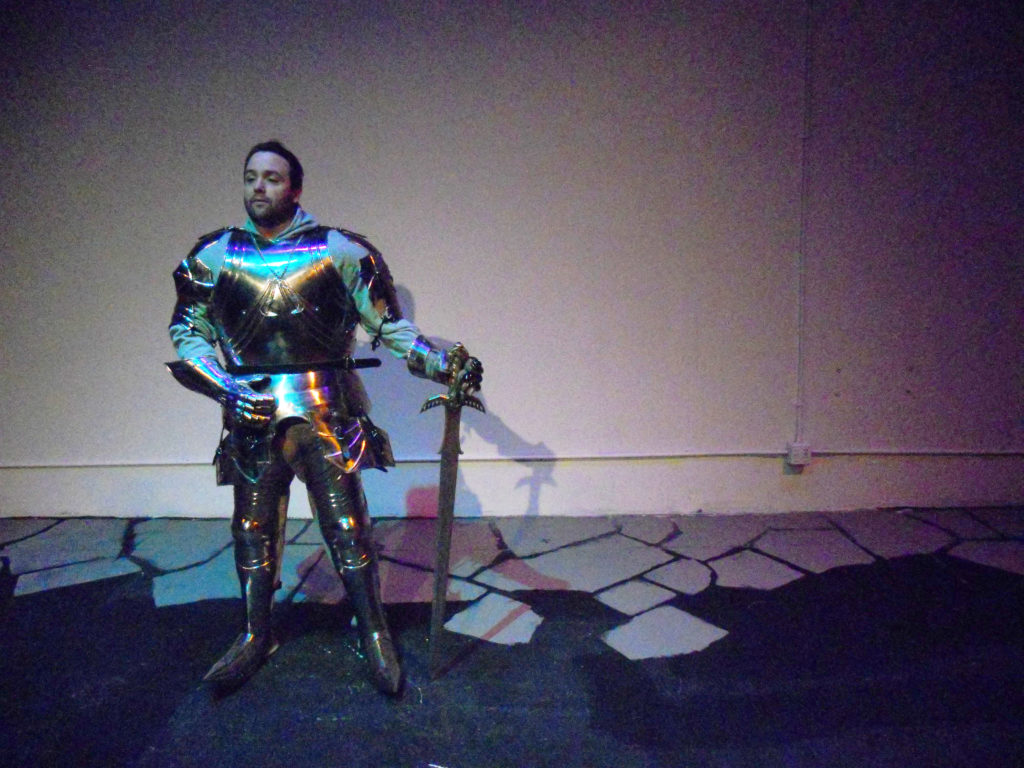
A man stands in front of a white wall dressed in a suit of armor. He holds a large sword by his side.

Westword- The hilarious A Knight to Remember is a metaphor for its creators

Buntport Theater Company put several peculiar messages on Facebook before A Knight to Remember opened. These implied that the theater group – known for the creative synergy of its members – was divided on this piece about Brian Colonna’s childhood fantasies of knighthood. Erik Edborg would not be involved, the messages said, nor would SamAnTha Schmitz, Buntport’s off-stage tech impresario. We shouldn’t expect to see Evan Weissman, either – though he has had one foot out the door since founding the political-activist organization Warm Cookies of the Revolution. We learned that Hannah Duggan would be doing the tech, which she promised to mess up, and that Colonna himself would take tickets at the front desk. Did this imply a serious schism within the company?

But A Knight to Remember turns out to be a lighthearted, entertaining and thoroughly Buntportian evening of theater.

The tech consists of Duggan sitting on the floor wearing a gigantic bean bag strapped to her bum (why? Because sitting on the floor for an entire evening is hard) and slipping photos and sketches into a trio of the kind of overhead projectors teachers used in the tech-bereft olden days. But Duggan – as those of us who know and love her realized ahead of time – was never going to perform her services with selfless devotion. She bitches and kibbitzes as Colonna attempts to re-create his memories, which include bits of old books about chivalry, memories of a trip to the Renaissance Fair, and a crush on a classmate called Danielle. Required to take the role of a knightly opponent, she corners Colonna and won’t stop whacking him until the entire scene implodes into a welter of blows and childish recriminations.

Erin Rollman plays many figures, from teacher to squire to dentist, often in hyper-quick succession. Like Duggan, she has no compunction about interrupting the proceedings, particularly in a long segment where she demonstrates her versatility by going from the evil Ursula in The Little Mermaid to the Hunchback in Hunchback of Notre Dame and then complaining when she’s prevented from playing all the characters in the final scene of Fatal Attraction.

But funny and talented as these crazy ladies are, the evening belongs to Colonna as he acts out childhood scenes, attempts to eat a cup of noodles with his sword and informs Duggan that she’s supposed to shut up when she actually has no lines. His performance is honest, masterful, modest and just plain charming, with moments of genuine sweetness and nostalgia. Of course, the gleaming, clanking suit of armor he wears (courtesy of Chris Weed) is almost a character in itself, and certainly helps.

Though the script and basic structure were put in place ahead of time, the actors are making up a lot of the play as they go, feeling moments of real irritation, pushing each other to the limit, and periodically coming back and reconciling like kids who’ve been told sternly to stop fighting and get along. So I can’t tell you if what I saw on Saturday night will be anything like what you’ll see when you go. In fact, Rollman at one point informed us they were skipping a scene that had worked brilliantly the night before. This company really does invent with the kind of freshness and vitality you see in children playing games and just making up one thing after another as they go along; in this way, their work illustrates the creative process itself.

Knight also hints at the dynamics within the company. I have no doubt that Colonna – who often seems to take a back seat – got a bit pushy about his idea, and I imagine the others really did give him grief, with Duggan and Rollman perhaps agreeing to help more out of friendship than conviction. But if their on-stage balkiness is real, it also turns out to be hilarious theater. Rollman’s big monologue about how she loves the limelight is doubtless as true as it is self-mocking. So A Knight to Remember works as comedy, theater, an evocation of childhood hopes and dreams – and a metaphor for the company’s communal creativity. Perhaps it also works to explore and expiate some real tensions. And it definitely proves that the Buntport troupe can always bring things together in the end. Long may this quest continue.

-Juliet Wittman, April 18, 2013, Westword

blogspot.com- Wake

Whether it’s a wake for Prospero or a wake-up call for us all, “Wake” leaves lots of head scratching in its wake.

The reason this reviewer is so late with this review is that every time I sit down to write it a whole new level of interpretation arises and I begin to ponder that one.

So I will just tell you, dear reader, that this work is rich and can be mined at a number of different levels.

When a patriarch dies leaving only fragmentary instructions on the living of life on the island on which his daughter and slave abide a sense of malaise sets in. Miranda is lonely and bored. Caliban is tethered and tantalized by an invisible (to him) spirit named Ariel.

The boat the late patriarch predicted does not arrive. The skies don’t “pour down stinking pitch.” Nothing ever seems to happen according to the mysterious words of the old one.

Prospero is now a ghost who haunts the island. His words instructing his daughter Miranda that all things are ordered in Life forbid her to listen to the end of his soliloquy-now only on tape in the tape recorder he has smashed. These final words are only audible in an incomprehensible garbled gibberish when the tape is pulled through this broken tape recorder.

“Is it real or is it Memorex?” runs through one’s mind. (sorry!)

This amalgam of Shakespeare and Beckett and Buntport is engrossing to say the least. There is more than a little of “Godot” within its borders and a solid undergirding of Sartre as well.

The show is punctuated with electrical noise and electronic music as well as illumined periodically by a star-swept ceiling that appears with the flip of a switch.

The metal runway that stands overhead turns into a sort of slide from which the actors descend to a patch of astroturf that covers the top of Caliban’s cage.

Invisible to the eyes of Caliban, Ariel tantalizes and provokes him by dangling physical objects above him in the way that one might tease a dog or cat.

The viewer finds himself in a sort of awe-struck wonder, then dips into ennui and somehow winds up at a thrilling glimmer of hope. Perhaps it’s a hope that will end in disillusionment but it’s an anticipation born of the self rather than of external authority. It’s a hope that’s founded on the realization that the stories one tells oneself are as important if not more so than those told by those who came before. The piece feels a bit Sartrian since Miranda’s freeing of Caliban by untying and unmasking him allows both of them to take responsibility for their island. That acceptance of responsibility allows for their freedom to discover a Brave New World as they leave safety behind and step into the unknown.

Observing the final moment of the play one can’t help remembering the words of Federico Fellini: “Everything is beautiful to innocent eyes.”

-David Marlowe, February 9, 2013, david-marlowe.blogspot.com

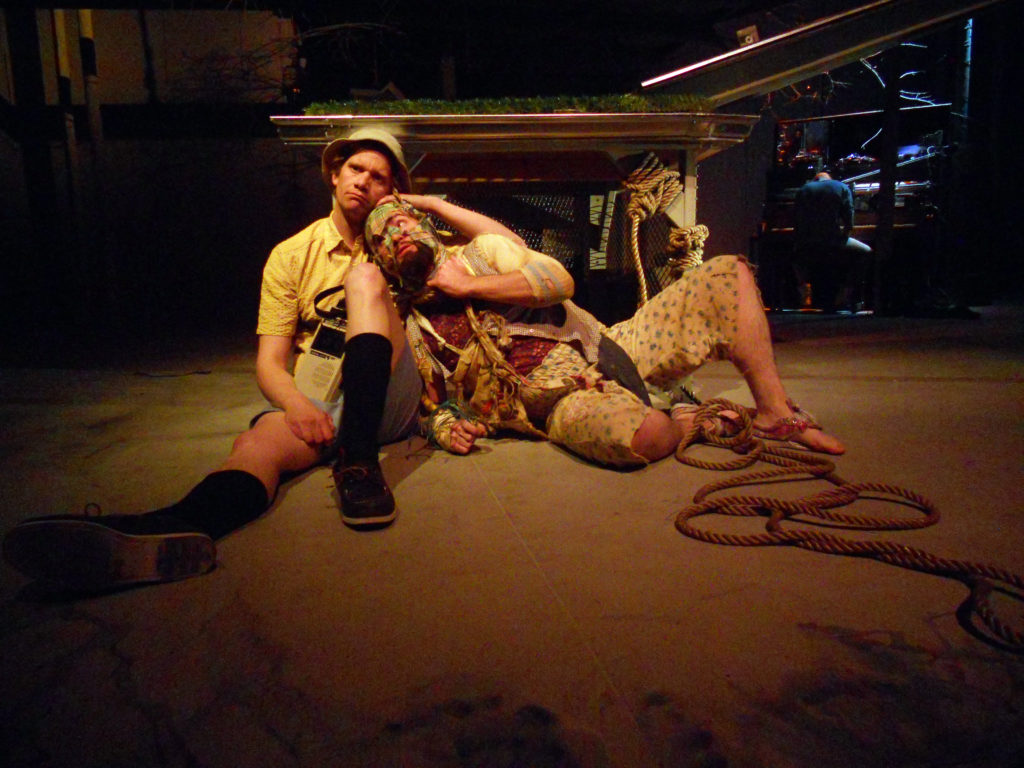
A man dressed in rags and tied with thick rope to a platform is comforted by a man carrying a tape recorder who is dressed for summer holiday.

North Denver Tribune- Buntport Asks “What Would Happen if the Ship Never Came?

Buntport Theater always moves beyond not only what anyone else has ever done, but also what they themselves have done before. With their new production, Wake, they present an alternate universe to Shakespeare’s Tempest through a collage of sounds, visuals, dialogue, and emotion, asking “What if the ship never came?”

Buntport creates a world where Prospero, Miranda, Caliban, and Ariel face interminable waiting, always looking for a ship, knowing Shakespeare’s lines to say when it arrives, rehearsing for a performance that never happens. In this universe, Prospero can control the weather, but cannot bring his enemies to him. In Caliban’s words, “the future holds nothing … just like the past.”

With a beautiful, functional, and integrated set, and creatively adapted electronic audio elements incorporated throughout, nothing in this story is as expected. Buntporters Erik Edborg, Erin Rollman, Brian Colonna, SamAnTha Schmitz, Hannah Duggan, and Evan Weissman, collaborating with composer Adam Stone, weave a tale growing out The Tempest, seizing particularly on one quote, creating an alternate view of that world that is both consistent with and completely unlike the world of Shakespeare’s play. The story is told nonlinearly, jumping between times, slowly revealing both what happened and why.

Ships leave a wake when they pass. With Wake, Buntport looks at the wake of a ship that never passes. The play is intriguing, the sounds are multi-dimensional, Shakespeare’s words are used and twisted, and the acting (particularly Rollman as Miranda) is phenomenal. This is challenging stuff, and at the end and probably long after, you’ll be thinking about what you have experienced. Lastly, after the show, stay and ask Stone to describe his amazing electronic creations — but don’t touch!

-Craig Williamson, February 7, 2013, North Denver Tribune

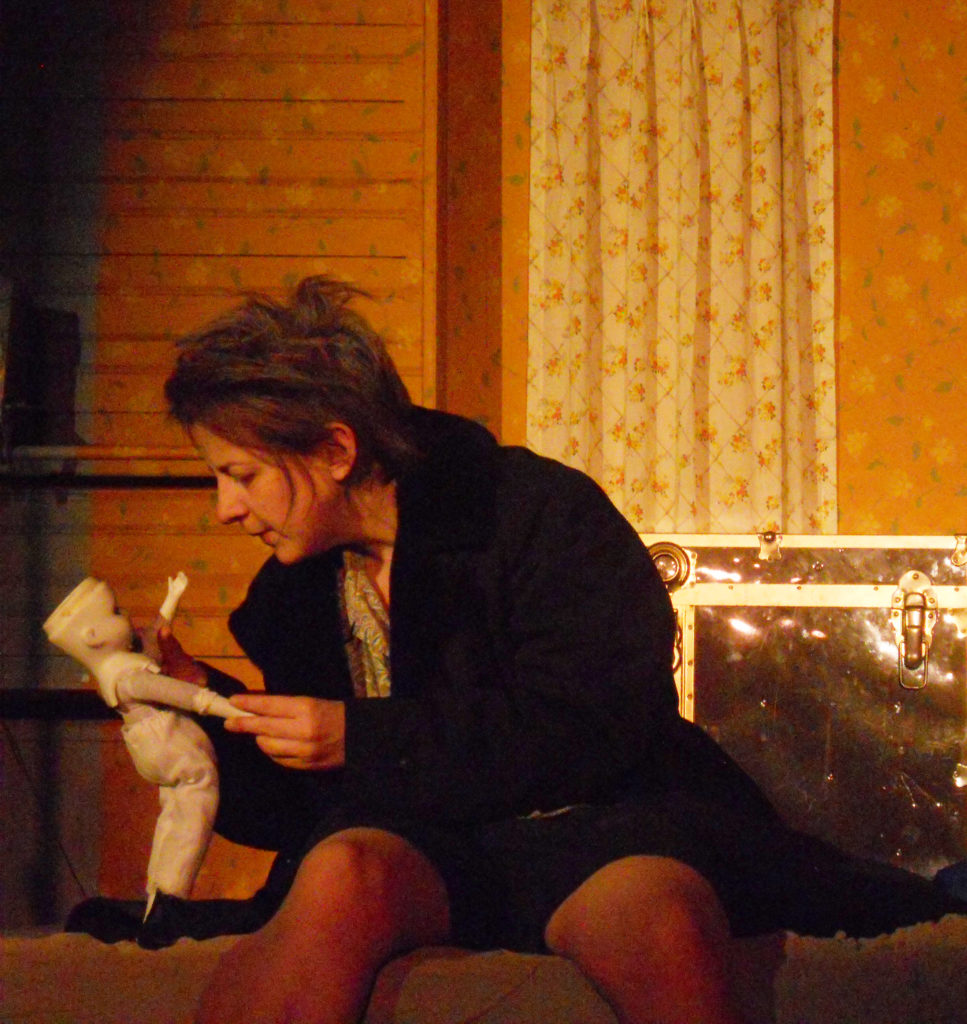
A woman talks to a porcelain doll next to a trunk in a wallpapered room.

Westword- Wake’s take on The Tempest is suggestive and evocative

Early in Shakespeare’s The Tempest, there’s a longish scene of almost pure exposition as Prospero, a powerful scholar and magician, explains to his daughter Miranda why they are stranded on an enchanted island. Prospero had been the Duke of Milan until his brother stole his dukedom and sent them both out to sea on a rickety craft. By a miracle, they survived and arrived at the island, which they share with Caliban, a half-human creature who supposedly represents the basest and most earthy human instincts, and a creature of pure spirit, Ariel. And now, Prospero tells Miranda, he has called up a storm that will shipwreck his evil brother, his nephew Ferdinand and much of the court so that he can exact his revenge.

It’s from this scene that Buntport’s Wake: A Corruption of The Tempest by William Shakespeare derives its inspiration. Prospero is long gone here, but because he’s so present in the minds of Miranda, Caliban and Ariel, and because the story he told Miranda provides the structure for their lives, he haunts the stage. Except that what he described never happened: no storm, no ship, no prince for Miranda, no revenge, no forgiveness. All the three characters have to give their existence any shape is a cassette tape of Prospero’s that tells the ending of the story, but they’re forbidden to listen to it. On a set consisting of ramps, white tree branches, an upper room and a grass-topped cage containing Caliban, they wait. This Miranda is no beautiful princess-to-be, but a wild, mucky girl with haystack hair who — as Caliban points out to her — now smells as bad and fishy as people in The Tempest used to say he did.

Miranda’s relationship with Caliban is intense. Sometimes they’re a pair of children exploring or squabbling; sometimes she bullies him, teases or pulls rank; sometimes she’s tender. And as Caliban alternately whimpers, threatens to attack, mocks her or himself, it’s clear that he’s in love with her. Caliban was always a complex character — Shakespeare gave him some of the loveliest speeches in this play — but in Wake, everyone is trapped inside Prospero’s story, and to Prospero, Caliban was nothing but a brute. Meanwhile, ethereal spirit Ariel has become an ambiguous, gray-clad figure, someone Miranda summons with an imperious gesture when she wants something and who — as Prospero’s representative — intervenes when chaos threatens.

Prospero renounces his magic toward the end of The Tempest, breaking his staff and drowning his book. This is a late Shakespeare play, and it’s believed that Prospero represents the playwright himself bidding goodbye to his work and the multifarious worlds he created. In Wake, Prospero’s exit is less poetic and more despairing. It shatters what might have been a genuine moment of transcendence and jolts the action into fast-forward.

The acting in Wake is absolutely astounding. Erin Rollman gives herself completely to the role of Miranda, and lives it with passion and intelligence. Brian Colonna’s Caliban is rich and full — strong, squirming, ironic, childish and evocative. We’ve all seen many Prosperos: They have power and dignity; they tower over the action; their statements are grave and significant. But in his big gum boots, Erik Edborg’s Prospero is unique — loving with Ariel, hectoring Miranda and bullying Caliban — and he delivers the best-known lines in The Tempest in ways you’ve never heard them before. The Buntporters collaborated with musician Adam Stone on Wake and in addition to creating the island’s soundscape, Stone plays Ariel. He’s anything but the elfin character we might expect, but there is something ethereal about both Stone’s music — unearthly sounds, dissonances, snatches of song, bits of melody — and his quiet, intense presence.

Wake is imagistic, suggestive and evocative rather than logical. Irresistibly reminiscent of Samuel Beckett’s Waiting for Godot, the play is also completely original. It’s about the way artists shape reality and narrative shapes worlds. And also about music, waiting, being half-mad with boredom and — in an unexpected moment as brief and radiant as a firefly flickering in the darkness — love. Like Vladimir and Estragon, Miranda, Caliban and Ariel find ways to pass the time — which, as Estragon commented, would have passed anyway. Like Beckett himself, the Buntporters find a music in nothingness and in the search for meaning where meaning can’t be found.

-Juliet Wittman, January 31, 2013, Westword

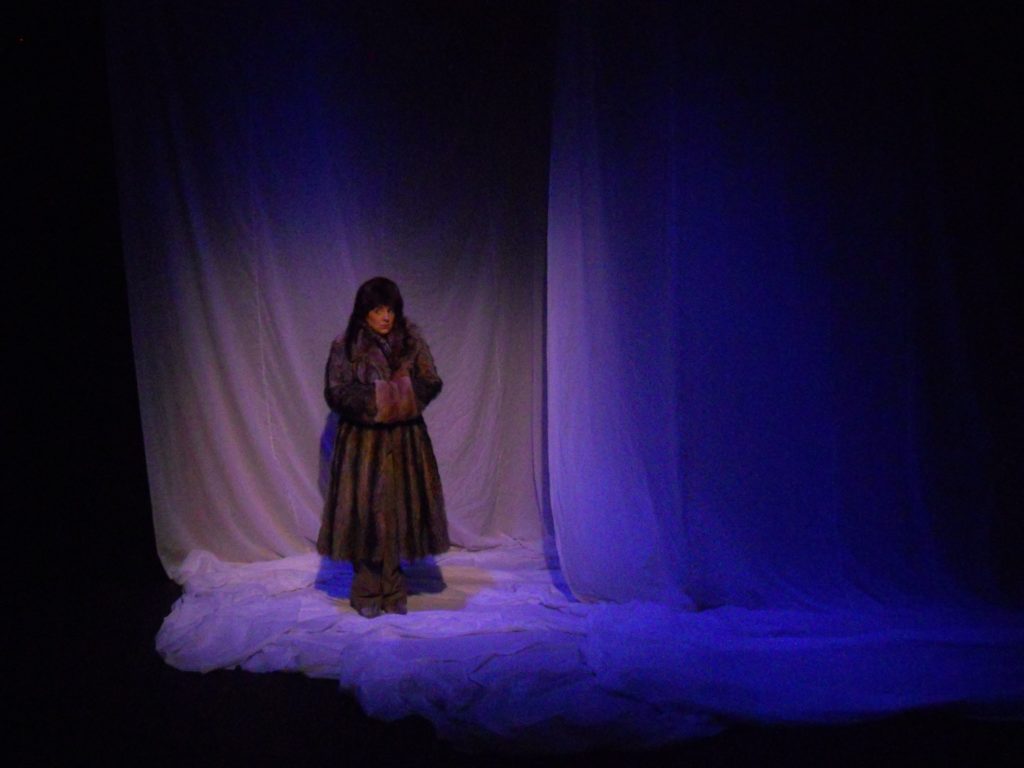
A woman dressed from head to toe in furs stands on a stage draped in white fabric. She looks cold.

Westword- Buntport’s dazzling Sweet Tooth hits the spot

The opening scene of Sweet Tooth is mesmerizing: a bare stage, a woman in a fur coat standing in front of a white sheet and singing “It’s cold.” A hand appears from behind the sheet offering a glass, sprinkling water on the woman, and then the sheet is removed to reveal a rose-colored living room filled with various strange portraits of this same woman. We discover she isn’t really cold.

Des Esseintes did much the same. Inspired by reading Dickens, he decided on a visit to London. But having gone to an English restaurant in Paris where he found the clientele repellent (“laymen with broad pork-butcher faces and bulldog muzzles, apoplectic necks, ears like tomatoes, wine-sodden cheeks, bloodshot, foolish eyes”), he decided he didn’t actually need to experience the island itself; it was represented sufficiently by the restaurant and a guidebook. George and her people read Dickens, too, though they don’t really like his work, and their approach to life is similar.She’s George, a wealthy eccentric who has retreated from the world like Jean Des Esseintes in Huysman’s Against Nature, a quintessential work in the decadent-aesthetic turn-of-the-century tradition (think Oscar Wilde). George has decided to create a hermetically enclosed, aesthetically perfect little universe for herself, one in which artifice is elevated above nature and a simulated event is superior to the event itself. With the help of two devoted followers — Hortense the maid and the artist George calls Mister (because there’s no male equivalent to the word “mistress,” and she doesn’t like “gigolo”) — she invents fake interludes to appreciate.

Pastry being about as artificial as cooking gets, the three eat a lot of desserts, and the result is predictable. George gets a toothache — meaning she has to deal with a very real, pressing and painful reality. A dentist is called in, a practical, low-key guy called Dr. Manette (another Dickens reference), and the group invites him into its shared fantasy life. Will he break through the enameled craziness with his forceps and angled mirror, or move deeper and deeper into the rosy-tinted trap following a trail of poisoned sweets?

There’s a lot of wit and ingenuity here, and also guts: When the Buntport Theater actors come up with an original concept, they tend to ride it through to the bitter end, not shying away from the craziest implications, exploring every possible crevice. Which makes Sweet Tooth as intellectually stimulating as it is lively and funny.

The theme goes beyond ideas about art versus reality. George isn’t just a solitary aesthete like Des Esseintes. She’s a monstrous and destructive narcissist, a controller and manipulator, a deeply sick woman with the power to draw others into the depths of her sickness. She can get Dr. Manette to see a mouth full of inflammation and decay as beautiful, persuade Hortense to sacrifice her very self, and play poor Mister like a sad little puppet. “The dark parts give me trouble,” George observes early in the play, and soon enough, those dark parts threaten to swallow the light.

Sweet Tooth is a collaboration with musician Adam Stone, and he provides a series of strange, passionate and funny songs on such topics as abscessed teeth and Pear William cake.

This is a generally dazzling piece of work. But while Hannah Duggan’s Hortense is unpretentiously self-effacing and Erik Edborg does a sterling job of portraying an ordinary dentist caught in an extraordinary situation, as George, Erin Rollman comes across like every movie diva you’ve ever seen in an old film, and Brian Colonna is all fluttering mannerism as Mister. These are both excellent actors — it’s Rollman’s stillness and gravity that makes the opening scene such a stunner — but rather than playing people who behave artificially, they play the artifice itself, unleashing a horde of tics, shticks and pecadilloes we’ve seen from them too many times before. It’s enough to make your teeth hurt.

-Juliet Wittman, November 1, 2012, Westword

A woman sits in a large red rocking chair and smiles at the camera. She’s dressed entirely in red. Everything in the room is red. Her portrait, painted in red, hangs on the wall.

North Denver Tribune- Buntport Nails Another Gem with Musical Sweet Tooth

Developed from scratch (as always) by the six brilliantly creative Buntporters and collaborator Adam Stone, Sweet Tooth is the story of a woman, George (“because that is what she should be called”), and her two companions, or more aptly “enablers.” George is obsessed with the artistic and aesthetic. Because the real world can never live up to her standards of beauty and art, she has isolated herself in her home, with her maid Hortense and her “Mister” to immerse her in “experienceless experiences” which emulate reality, but with complete artistic control. This strange existence would continue unabated if not for the reality of a painful abscessed tooth, which becomes so severe that a dentist is brought in, abruptly bringing the real world with him. The results of this clash are unexpected, and the second act brings a resolution and an unsettling integrity to George’s life.How do they do it? Sweet Tooth, Buntport Theater’s latest original creation, is a fully developed two-act musical that builds an absurd world that seems reasonable, and then injects reality into that world, with unexpected results. There is the usual Buntport humor, but it is not as dominant as in past productions, and is imbued with thoughtful and challenging content. The music is fully integrated into the production, with some more traditionally structured songs, and other sections of sung dialogue, adding another dimension to the performance throughout. I was moved, intrigued, entertained, fascinated, and fully engaged throughout this amazing production.

Normally in a review, I summarize the premise of the story, then talk about the director, cover the acting, and then the design. Buntport completely messes that up. Everything is integrated into a whole, and there are never lines between the different aspects of the production. That said, the elements normally attributed to the director were well coordinated and fit perfectly with the story. The formal staging and blocking throughout reinforced the aesthetic focus of George’s world. The choreography carried that even further. The attention to detail and internal consistency throughout was remarkable — much of it in the background, not clearly noticeable, but always there.

Erin Rollman is George, “smitten by unreality.” The story and show revolve around her. Rollman brings complete credibility to this absurd role. We watch her, and her actions and reactions make this strange situation believable. She can emotionally turn on a dime, and she uses her very expressive face wonderfully. Hannah Duggan is Hortense, George’s devoted maid, and the enabler of the staged experiences. When the level of that devotion is raised in the second act, Duggan makes the unbelievable seem almost natural. Brian Colonna is Mister, George’s lover, companion, and personal artist. His character is less completely drawn into George’s world, and has real world concerns because of his love for her. Erik Edborg brings the real world into the sanctuary as Dr. Manette, the dentist called in for a house call. Edborg initially presents a start contrast and reminds us how strange George’s world that we had become used to really is. But then like us, he is drawn into it, but as we watch him change, we realize that the stakes were higher than we thought.

Buntport develops the sets and costumes in the same way they do everything, and this show highlights the benefits of that approach. The show opens with flowing white drapes indicating a vast expanse of cold and snow, but they are then ripped down to reveal an oddly proportioned very red room, which impeccably captures how a room in George’s home would look, unnatural though it is. The caving scene is an example of the unique yet brilliant effects of Buntport’s collaborative design approach — it was remarkable. As an experienced lighting designer, it is difficult for me to admit this, but no traditional lighting designer could have conceived anything as unique and effective as the lighting for this scene.

The Buntport actors are not professionally trained singers, and musically, they are not pitch-perfect all the time, but that is not a problem. They have added vocal amplification while singing, which really helps balance the voices and music, and makes it easier to understand the lyrics, which is important for following the story. Rollman’s singing voice is very good, and the others do not try to do more than they can, keeping the music consistent. Adam Stone’s music has variety and is integrated well into both the plot and the overall production concept.

It continues to amaze me that Buntport Theater can consistently create fully developed productions from nothing in a few months. Sweet Tooth is the latest proof of this, but even more so. This musical is brilliant, funny, challenging, and unsettling.

-Craig Williamson, October 31, 2012, North Denver Tribune

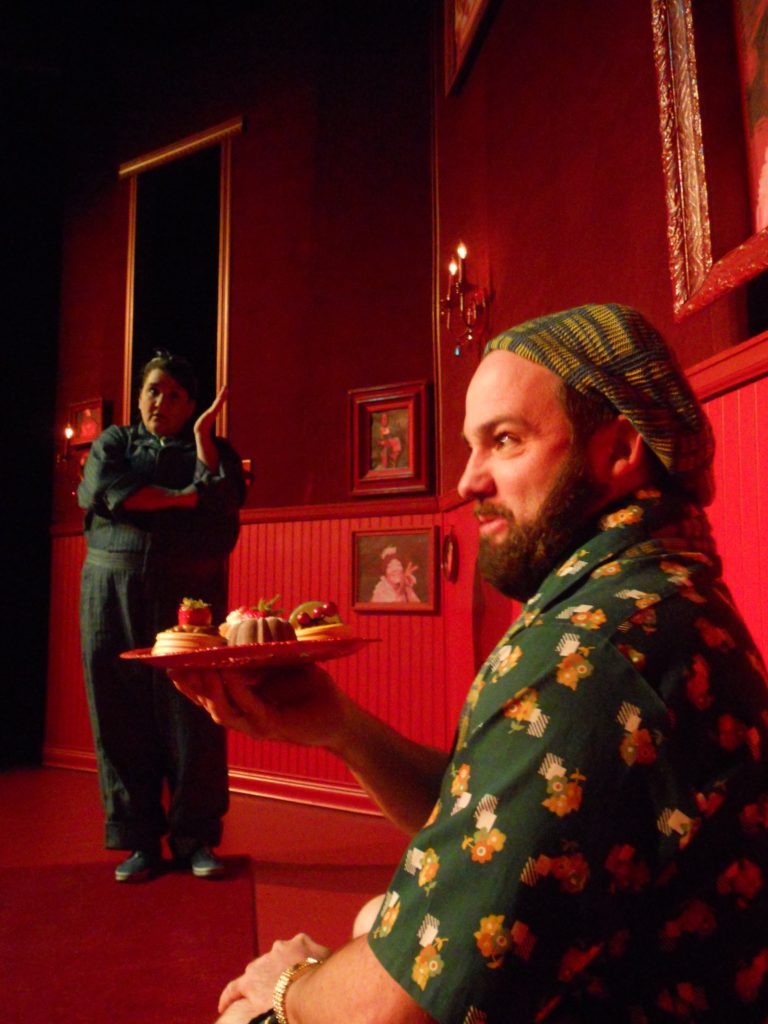
In the foreground a man contemplates a plate of pastries. A woman dressed in work coveralls looms in the background. The room is well decorated and entirely red.

ColoradoDrama.com- Sweet Tooth

Having introduced us to their own school of opera last spring, with Tommy Lee Jones goes to the opera alone, the inimitable ensemble follows up with an intriguing confection, Sweet Tooth, a Buntportesque operetta (music and lyrics by Adam Stone, additional lyrics by Chessy Normile, book by the ensemble), the company’s 32nd world premiere.

Opera buffo was never like this! The queen of theatrical voguing, Erin Rollman stars as George, a reclusive and eccentric patron of the arts. Much like the Archduke Ferdinand purportedly said of Mozart’s eternal celestial compositions — “… too many notes!” — George has it in for Charles Dickens’ plethora of words (written in serial form, to maximize commercial sales), because his touchstone novels keep her from being the chronicler of her own life, in the moment, every moment.

George has a point, that life can be art, much like Zen, we suggest, which practices mindfulness in many forms — just sitting (Zazen), flower arranging, gardening, baking, archery, tea, etc. — with the goal of expanding these meditative states to all waking and dreaming consciousness.

Only, in this case, George’s art has taken a fatalistic turn, like Jehovah’s Witnesses who watch their children die rather than allow emergency medical care. But George has her reasons, and a penchant for being the observer, not the subject, begging the question: If the highest erudition of life is metaphor, what place do our instincts (including those related to survival) have in such a cerebral universe?

Unlike the Jehovah’s Witnesses, George is imposing restrictions only on herself — and, to a degree, on her personal assistant, Hortense (Hannah Duggan) and her kept man, Mister (Brian Colonna), a painter, who humor their compelling, independently wealthy sponsor.

Duggan shines as the gatekeeper to George’s red-saturated world. Perhaps this is all a dream engendered by some indigestive experience of Mark Rothko — while listening to opera as he painted — though the clashing green patterns worn by Mister argue for an alternate interpretation involving Matisse. Who knows what free-associations pass through Buntport’s gray matter?

If there is a surrogate for middle-of-the-road bourgeois sensibilities in this alternate universe, it is Dr. Manette (a circumspect and then delightfully transformed Erik Edborg), a dentist contracted (by George!) to provide a visceral, yet third-person, experience of what to expect when dealing with a problematic sweet tooth.Colonna’s eclectic affectations as Mister are a send up from a newly discovered dimension lying somewhere between naughty British humor and the flamboyant excesses of the French court before its abused subjects made the guillotine famous.

While Hortense takes the hit for George, and George begins her passage to another world, we are left examining the nature of this self-described “dark musical comedy,” in this case a genre-bending brew of sophisticated intellectual jokes and commentary wrapped in a post-modern series of settings and arias that recall the psychological introspections of Brecht/Weil and Sondheim more than the tragic and comedic portraits of Verdi or Rossini.

Within such a world, one wonders, sometimes, where the cathartic experience takes place. This was one of those “sometimes.” As Aristotle noted, catharsis is de rigueur in tragedy, though we can only extrapolate what the great philosopher might have said about comedy (the manuscripts having been lost). We assume he would concur that “laughter is the best medicine.”

Where that leaves us with Sweet Tooth is digging deeper for a cathartic thread. If we wrap all of the musical’s multifaceted genre elements within a larger envelope of “theatre of ideas,” we find an intellectual catharsis somewhere in the sparsely populated aethers, among overlapping subsets of various Platonic forms. Shaw was the master of this, of course, but he was able translate philosophical idealism into characters with whom theatregoers could identify, and thus share in the transformative moments (his introductory essays to his plays provided an excellent means of defining topics from which he created character relationships in which topical discussions found natural expression).

Applying this Shavian approach to George, we land in Limbo — not an unfamiliar place for the human race. If you’ve seen The Three Penny Opera (an excellent rendition at Miners Alley Playhouse closed on October 21st), you may recall that Brecht inserted a “substitute ending” to send the audience home on a high note after deftly mocking and eviscerating the state of civilization. Isn’t this ambiguity in The Three Penny Opera‘s finale much like the coma in Sweet Tooth‘s coda? Perhaps, though Sweet Tooth‘s tenuously extended intellectual themes would likely reveal more harmonics by reading the script — of which, ironically, Dickens would approve — rather than hearing it pass quickly in dialogue a number of decibels below the soundtrack.

-Bob Bows, October 25, 2012, coloradodrama.com

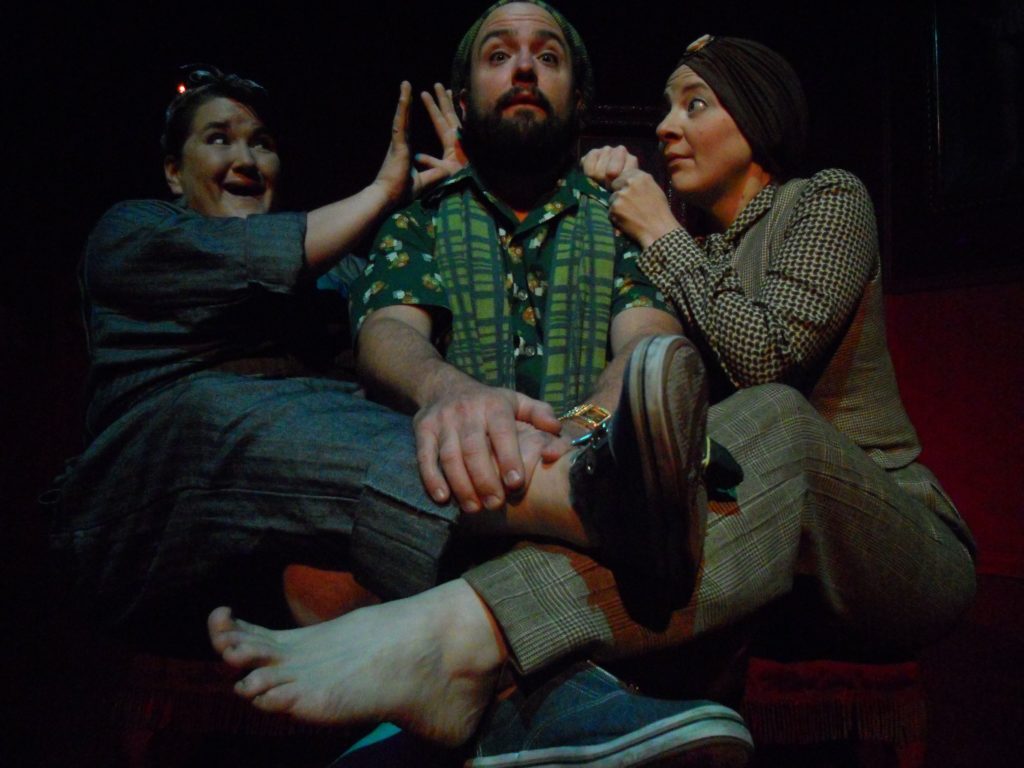
A man sits center wrapped between two women. The women seem to be having fun. The man looks worried.

Denver Post- Buntport’s “Sweet Tooth” is a blast of intellectual nitrous oxide

Yet, I can’t help but celebrate the happy occurrence as being, if not divine, at least cheeky, providence.Granted, the opening of the delirious musical “Sweet Tooth” and the arrival of a newly gussied up Blu-ray of “Sunset Boulevard” to my mailbox are purely coincidental.

Because Buntport Theater’s latest collaboration with composer-lyricist Adam Stone features a character who bears more than a passing resemblance to Gloria Swanson’s in Billy Wilder’s classic. And yes, perhaps there’s a touch, too, of Carol Burnett’s hilarious skit about Norma Desmond.

With her red turban, her vivid red salon and her ready-to-do-whatever-it-takes devotees, George (Erin Rollman) is quite a piece of work. The question that eats at her is: Is she the piece of artwork she desires to be?

You see, George is so bent on curating reality, making it perfect, that she becomes a recluse. She never leaves her home, not even for a medically necessitated emergency.

Instead with game assistance from her loyal servant Hortense (Hannah Duggan) and her sometime paramour and portrait painter Mister (Brian Colonna), she re-creates adventures — from North Pole travel (“baby, it’s cold inside”) to a spelunking foray that plunges the stage and the audience into darkness.

The first musical number “It’s Cold,” finds George decked out in fur — hat, coat, muff — trying her darndest to create a frozen tundra. Hortense mans a fan and splashes her with ice water.

Only George’s attempts are starting to fall short of the aesthetic perfection she hopes for. On top of that, she has a tooth in need of a dentist.

Will a dental emergency nudge our eccentric friend back toward reality or instead provide her an opportunity to achieve her grandest creation? Will Dr. Manette (Erik Edborg) bring a dose of common sense and a shot of Novocaine to the zany proceedings or get drawn into George’s feverish endeavor?

Such is the hilarious set-up of “Sweet Tooth.”

“Sweet Tooth” is Buntport’s third collaboration with talented and evolving composer-lyricist Stone. In their second, 2010’s”Jugged Rabbit Stew,” an angry bunny contemplated his destiny. It won the Ovation Award for best new work that year.

The Buntport collective has made a bold habit of ginning up absurd scenarios that take on quandaries that have been the stuff of philosophical head-scratching for ages. For instance, can a brilliant simulation — a.k.a. “art” — be better than the real thing?

This sounds heavy. Instead, with perfectly timed performances by a remarkably attuned ensemble and rich work from Stone, it’s spry, at times silly and always smart. Consider it intellectual nitrous oxide. It won’t hurt a bit.

-Lisa Kennedy, October 25, 2012, Denver Post

A group of four clowns in multi-colored and patterned clown outfits surround another shrugging clown, who wearing all white.

Berkshire Fine Arts- Buntport Theater Roasts Beef Censorship Knocked Out in Denver

Buntport Theater was founded by six graduates of Colorado College in the 1990s. When they went to the dean of Denver theater, Henry Lowenstein, for advice he said, “This will never work.”

The Henry (named after Lowenstein) annual awards nominations were announced on June 15th, and Buntport was nominated for outstanding production of a play, two supporting actors and one supporting actress, two outstanding new play nominations, and one outstanding costume design. This would be a knockout season for any company, and for Buntport, it happens year after year. Lowenstein recently admitted he had been wrong.

Buntport ended a smashing season with The Roast Beef Situation. The play, or perhaps riff, is a new invention, and visits the age old problem of censorship.

The company makes you think thrice or quadrice and quince about this subject of nagging, monumental importance for which neither the state nor artists have yet come up with an answer.

Jumping off from a famous and silly ditty by Henry Fielding about the eternal importance of roast beef in English life, the exploration is deliciously novel. Roast beef enabled the English to eat and fight, “without it they’re good night.” Theater audiences customarily sang about roast beef before and after new plays. The Royal Navy still dines to the tune. You don’t need this background, however, to understand how important roast beef is to the history of censorship.

Carlo Delpini (Brian Colonna) said the word ‘roast beef’ on stage without musical accompaniment, a requirement of the 1737 Licensing Act designed to muzzle political protest in any form. Naked words are banned. This may be why feisty opera composers struggled to have words spoken in their scores.

Delpini was thrown into jail with three equally horrific villains who had bludgeoned their victims to death. You could imagine the three murderers singing out, “Tough Tittie,” as the jailor arrivers with Delpini. Instead they launch into a diatribe on the inevitable inequities of the law. The jailer (Evan Weissman) is the only character with a visible prop, a mallet he uses to call the inmates to attention and also to summon the court when he acts the judge.

All are stock characters from Commedia dell’Arte and ask, “What to do with stock? How do you make stock lively?” The answer is in these tart performances.

In one stage dimension, Delpini is Pierrot. Erik Edborg, the classic love interest Harlequin, joins Duggan, Rollman and Weissman done up in colorful Commedia regalia. Full of humorous physicality like a leg which becomes a shot gun (Delpini cheats at this one, as his shoulder meets his knee) the show is a visual feast.

Themes of theater life erupt. Delpini is jealous of his rival Joseph Grimaldi who played his Friday in a production of Robinson Crusoe. The perils of performance, the danger of language, and even the necessity of repetition are tossed around with wit.

SamManTha Schmitz contributed lighting which softly went from vignette to vignette and was stark at a scenes’ conclusion. Her sound was apt, music provided by a cupped hand, rattling and banging by mallet and other clever devices. Interjected scenes from the Robinson Crusoe production are evoked with images of an island paradise projected flickering on cell bars.

The company is committed to a thoroughly ensemble approach. There is no hierarchy. Written in concert, directed and performed in concert, this clever troop comes up with moments you have never seen before, or even thought about.

We were not able to see another production, Tommy Lee Jones Goes to the Opera Alone, but it was a huge success. It will be reprised for three days at the end of June.

The American Theater Wing honored the Buntport group with a grant last year, noting that Broadway stretches three thousand miles across the country. Broadway could well take a page from this inventive and highly theatrical troop.

-Susan Hall, June 19, 2012, berkshirefinearts.com

In the foreground a clown that has a puff of white feathers for hair looks into the camera like they don’t know what’s going on. The clown right over their shoulder looks as if they are sneaking into the picture. The clown in the background holds a finger to their chin as if they are posing for senior portrait.

Westword- Buntport takes on centuries-old entertainment law in The Roast Beef Situation

The six members of the Buntport Theater Company like taking up strange facts, historical anomalies and odd and eccentric bits of information and working them into their communally created plays. After one Buntporter spotted Tommy Lee Jones standing in line for tickets to La Bohème at the Santa Fe Opera, they came up with the inspired idea of turning the actor into a giant puppet, seating him in a coffee shop with a chatty waitress and a piece of pie in front of him, and having him muse on life, art, music, performance and Puccini in Tommy Lee Jones Goes to the Opera Alone. The marriage of symbol, action and words was potent (and will be returning to Buntport for three days at the end of this month). Some years ago, in The Mythical Brontosaurus, they created a character who had to be coaxed out of near catatonia because of a crisis of faith: He had found out that the brontosaurus was no more, that it was only a juvenile specimen of a previously discovered lizard.

So when they learned that an eighteenth-century clown named Carlo Delpini had gone to prison because he’d said the words “roast beef” on a stage unaccompanied by music, thus contravening a meaningless and idiotic law laid down by the Lord Chamberlain, they were inspired.

Absurdity and humor definitely flavor The Roast Beef Situation. The costumes — evocative of commedia dell’ arte, with Delpini in the traditional white clown outfit with a soft shape-changing hat and the others sporting bald heads with curls of various hues, some of which are used periodically as facial hair — are brilliant in their shape, color and detail. There’s a loaf of French bread in the hand of a prison guard that turns out to be amusingly rubbery rather than stiff. All of the personalities are clownish, and there are scenes that repeat like a leitmotif.

But unfortunately, the repeating scenes don’t add the resonance they should, and the piece just doesn’t work. Jokes get repeated too often. When Delpini first gets to prison, he finds that every one of his fellow inmates has bludgeoned a man to death, yet they’re all shocked by his crime — not the words “roast beef,” but the fact that he’s an actor. Yes, actors were once considered vagabonds and trash, and, yes, the joke is mildly funny at first — but not funny enough for the number of airings it gets. Delpini’s envy of the famous clown Grimaldi, who redefined the entire concept of clowning, likewise gets mentioned a couple of times too often. (Still, clowning is a topic I’d rather like to see the Buntporters explore sometime, given their own entirely original form of it.)

Mockery of absurd laws is an obvious theme, and Erin Rollman carries a long list of them, which she periodically unfurls from her breeches — another comic touch that works for a while but gets overused. But the play doesn’t have much new to say about censorship or persecution — though the Lord Chamberlain actually continued to control what was seen on England’s stages for more than two centuries. In 1963, the crazed comic genius Spike Milligan was told he could only mount The Bed Sitting Room, a post-apocalyptic satire of London nine months after World War III in which the protagonist had turned into a bed sitting room and Prime Minister Harold Macmillan into a parrot, if he made several cuts and changes, including the following: “The mock priest must not wear a crucifix on his snorkel” and “Omit ‘the perversions of the rubber….’ Substitute ‘the kreurpes and blinges of the rubber.'”

This being a Buntport production, there are still some very funny moments, of course. In an inspired piece of mime, Brian Colonna as Delpini demonstrates a comic bit in which he raises his right leg and uses it like a gun — not very effectively — and Rollman promptly shows how it should be done, finishing with a loud and convincing gunshot. Colonna’s highly physical description of a traditional Punch and Judy show is also terrific, and so is the discussion that Evan Weissman initiates about the difficulties of living up to his name, Plausible Jack.

But the semi-serious points the company wants to make feel fragmented and unconvincing, and the moments of high-flying absurdity aren’t quite frequent enough to carry the evening.

-Juliet Wittman, June 13, 2012, Westword