Buntport Theater

A large rabbit wearing a ratty robe and bunny slippers slumps in a lazy boy recliner. The floor is covered in newspaper.

Westword- Jugged Rabbit Stew is a hare-raising experience

Last produced four years ago, Jugged Rabbit Stew is one of Buntport’s best shows, a startling and peculiar mix of comedy, sadness, magic, craziness and erudition that only this troupe could produce. And this revival brings back Evan Weissman, a longtime member who left – sort of – a while back to create a political organization called Warm Cookies of the Revolution. “The plan would be if there are any remounts, we’ll try to have me involved as long as that’s possible,” he says. “It’s not like a clean break; I’m still around all the time, but I’m not working on the next show. I won’t write for that or be in it. It’s kind of like breaking away from family – even if you want to, you can’t. And I don’t want to.”

As for Warm Cookies, it’s “a civic health club,” he explains. “You go to a gym for physical health or church for spiritual health. This is a place to exercise your civic health, to discuss vital issues in a fun way. I think Buntport is a part of that. We’re trying to engage people; theater and art does that. But with Warm Cookies, it’s a little less abstract, and I’m interested in trying it out right now because I feel we’re on the precipice and need to push back pretty hard to create the world we want.”

Buntport has created quite a world in Jugged Rabbit Stew. Weissman plays Alec, the Amazing and All-Powerful, an impotent magician with rock-star delusions who can’t actually can’t perform a single trick without the help of the real creator of magic – Snowball, a scruffy, mean-spirited rabbit currently on strike. Snowball (Erik Edborg) spends his time stealing objects that have no meaning for him but whose loss will upset their rightful owners: a video of a student’s high-school graduation, for instance. He lives in a strange, bare place with an array of stolen objects suspended from the ceiling, a wall covered with overlapping newspapers, and several televisions on which he watches home movies – video of rabbits, that is. In addition to the inanimate objects he’s filched, he has stolen the legs of Marla, the magician’s assistant (Hannah Duggan), replacing them with the overall-clad limbs of a workman so that she can no longer dance. Also missing is Alec’s right Arm (played by Brian Colonna) which, detached from its owner, now wanders the world on its own. Snowball’s kleptomania has reached such dangerous levels that among his acquisitions is a cheerful young Woman (Erin Rollman) he spotted in the audience, fell in love with and spirited away to his lair.

Weissman says he’s glad he returned for this play “because it gives us the opportunity to be really silly and have a few genuine moments. And every actor wants to be a rock star, and this is my opportunity to fake that.” He likes the segment when the Arm falls in love and sings a duet (composed, like all the scintillating songs in the show, by Adam Stone). “That’s pretty great,” Weissman says, “the idea that this disembodied thing has thoughts and feelings of its own and a sense of fate and love. And I like the concluding bit when my arm gets put back on me, which is sad for Arm and his love, but kind of magical.”

All the action revolves around Snowball, who – despite his depradations on their persons – is profoundly loved by both Marla and Alec. He’s as complex a character as a man in a scruffy white bunny suit can be – constantly vengeful, but also terrified by the threat implied in the play’s title. While Arm, having found his love, proudly assumes the role of hero in an old-style Western, Snowball ponders his fate as tragic hero, and Woman prattles chirpily about Aristotelian heroes, Byronic heroes and anti-heroes. Each member of Buntport brings a unique and specific quality to the stage; Weissman has often been, paradoxically, both the most sincere and the nuttiest. It’s a delight to watch his Alec, dauntless and cheerful despite the missing arm, prancing around in yellow shoes and singing his heart out about “That Special Hare.”

“It feels great to be on stage with each other,” he says. “We have a common aesthetic; we think the same things are funny. We’ve worked together so long, there’s something seamless about it.”

-Juliet Wittman, February 27, 2014, Westword

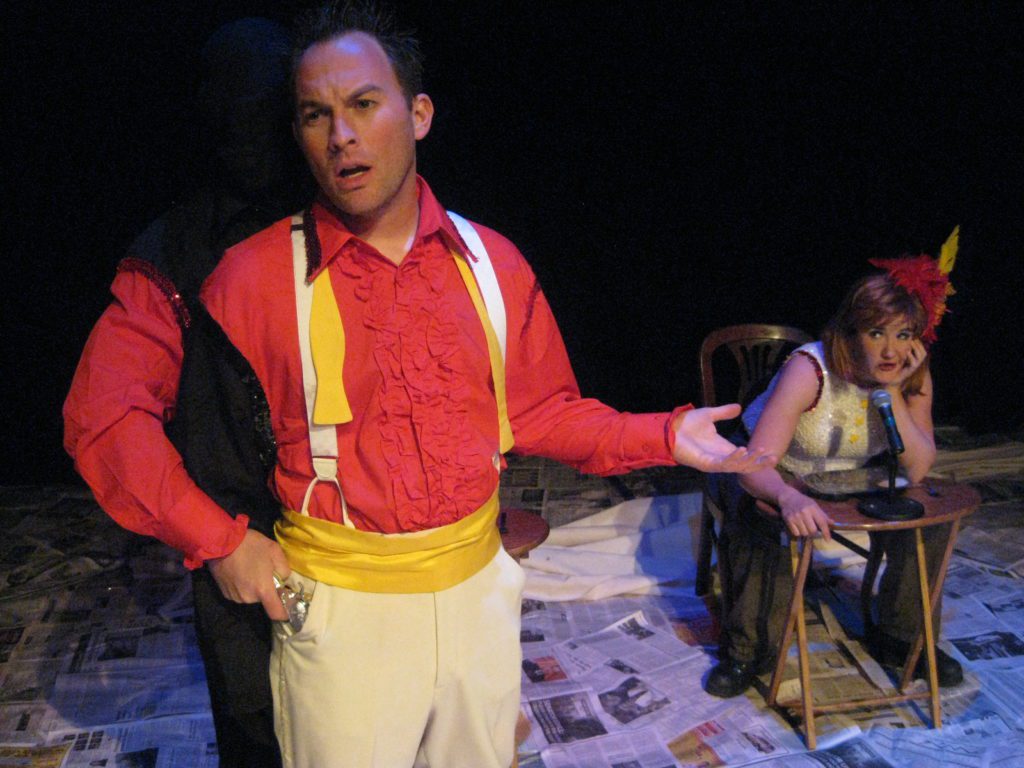
A man in a brightly colored suit stands talking. One of his arms appears to be separated from his body and is putting a toy gun in his pocket. Seated in the background, a woman dressed as a magician’s assistant but wearing mechanics pants looks unimpressed.

Denver Post- Buntport Theater’s Jugged Rabbit Stew, a bit overcooked but tasty

The Buntport Theater ensemble members are among the smartest folk in the room. No, not in some superior and arch way. Instead, the inventive group – now in its 13 season – engages the lunacy of the world, literature and theater from an often absurdist, very meta remove. There’s a generous humility to their twisted undertakings.

There are hits. There are moments ever so slightly off the mark. There is never a shortage of ideas.

Through the next two weekends, Buntport revisits its 2010 “Jugged Rabbit Stew.”

The tale about an angry, brooding bunny named Snowball was their second musical undertaken with composer/lyricist Adam Stone.

“Jugged Rabbit Stew” is at times a little chewy, a bit overcooked, but there are many moments of earned pathos, dark humor and jagged music.

When we first meet Snowball, he’s in a foul mood and a dirtier bathrobe. Actor Erik Edborg does edgy work encased in the grungy bunny costume. Think the Grinch, only more self-aware and meaner.

His deep funk has put the kibosh on Alec the Amazing and All Powerful and assistant Mystical Marla’s magic act.

Evan Weissman portrays the hapless magician. How out of sorts? Let’s just say that Brian Colonna is amusing as Arm.

Pilfered goods hang from the rafters of the captivating and eerie set. An Electrolux, panty hose, an umbrella, Victrola phonograph and Woman.

Erin Rollman spends the play on a chair suspended in air. Her character Woman hasn’t fallen down a rabbit hole, exactly, more like a hovel. And yet, she’s full of sweet wonder at her good fortune. Before being added to Snowball’s cache, she was a fan, an avid audience member.

By the way, there is a reason a tattered copy of James Joyce’s “Ulysses” also hangs from the rafters. Our hero – who is not, we repeat, not a hare – will get his full measure.

Will we learn what makes him ticked off?

Sure he’s astoundingly flawed. But is he also tragic?

-Lisa Kennedy, February 21, 2014, Denver Post

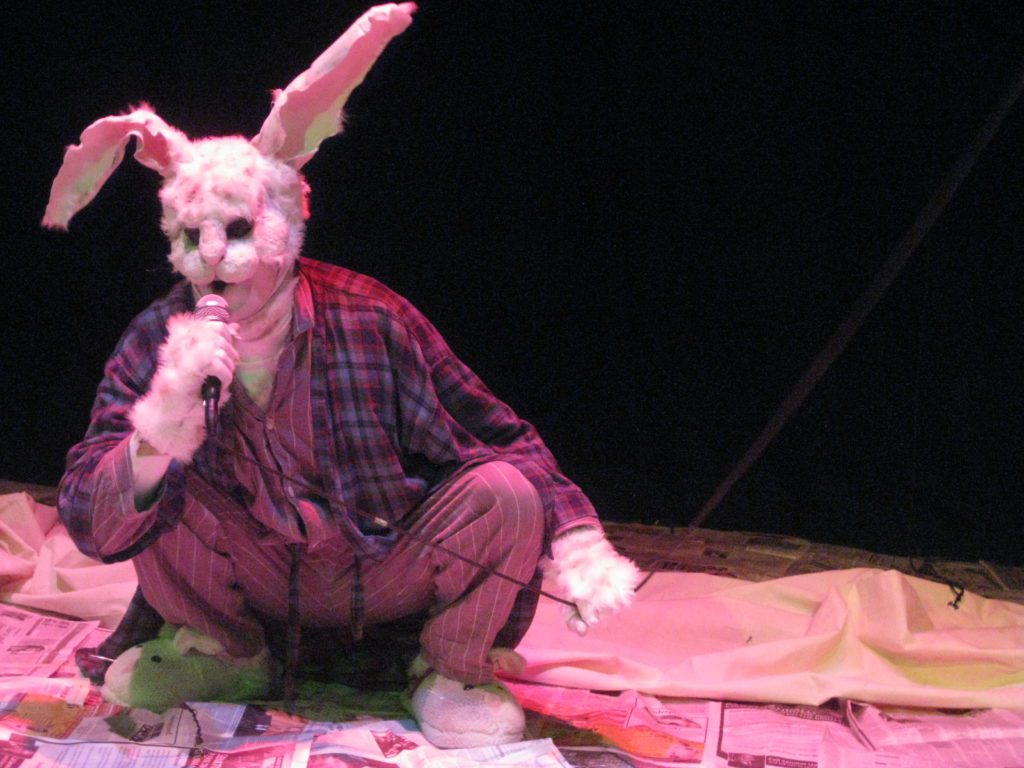
A large rabbit wearing a ratty robe and bunny slippers squats on a floor covered with newspapers. The rabbit holds a microphone and sings.

Lowry News- Jugged Rabbit Stew

Theatre of the Absurd is alive and well at Buntport where the talented, clever cast and crew have revived their original production, Jugged Rabbit Stew. As created and performed by actors Erik Edborg, Hannah Duggan, Erin Rollman, Eric Weissman, and Brian Colonna along with their talented crew, this musical comedy has all the elements of true absurdity theatre. The characters are caught in a hopeless situation where they engage in dialogue filled with cliches, wordplay and nonsense. The cast sings and clowns getting the audience to laugh as the meaninglessness of the human condition and man’s animal nature and cruelty are exposed.

Snowball, played by Erik Edborg, is a rabbit with magical powers. Not a kindly “Harvey”, this rabbit is in an alcoholic slump that is wreaking havoc on the magician Alec, the Amazing, and Mystical Maria, his assistant. They both struggle with certain physical changes Snowball has perpetrated upon them. Nevertheless, they continue to love him and try to bring him back to sobriety and to make him become the sort of rabbit they want him to be. Snowball, increasing fearful of entrapment and death, circumvents their attempts to change him. He focusses on his collection, an odd assortment of items that he has “gathered” from others in an effort to make their former owners unhappy. Among this assemblage of stuff is Woman, artfully performed by Erin Rollman. Suspended above the stage along with the other items in the collection, Woman sits in a chair for the entire play. In spite of this limitation Ms. Rollman skillfully creates a complex character. She ultimately becomes the agent of change that Alec and Maria have been seeking.

Hannah Duggan and Evan Weissman are very funny as Mystical Maria and Alec. Brian Colonna, as Arm, is so good that one begins to believe that Arm is actually human. Erik Edborg’s costume and his sure acting abilities lend credibility to his role as the tragic hero. The entire cast gave spirited and professional performances. Their singing was flawless – fun to watch and to hear.

The music, while tuneful and even toe tapping, seemed to parody much of the music in the musicals of the last thirty years. Kudos to Adam Stone for mocking the likes of Schonberg, Boublil, and Webber. The theater at 717 Lipan is small and intimate enough that amplification is unnecessary and whenever Mr. Edborg was singing, the amplification was distracting. Snowball either held the microphone too close or was singing too loud. Often it was difficult to understand the words he was singing. Overall the musical was excellent from start to finish.

-Nancy A. Murphy, February 12, 2014, Lowry News


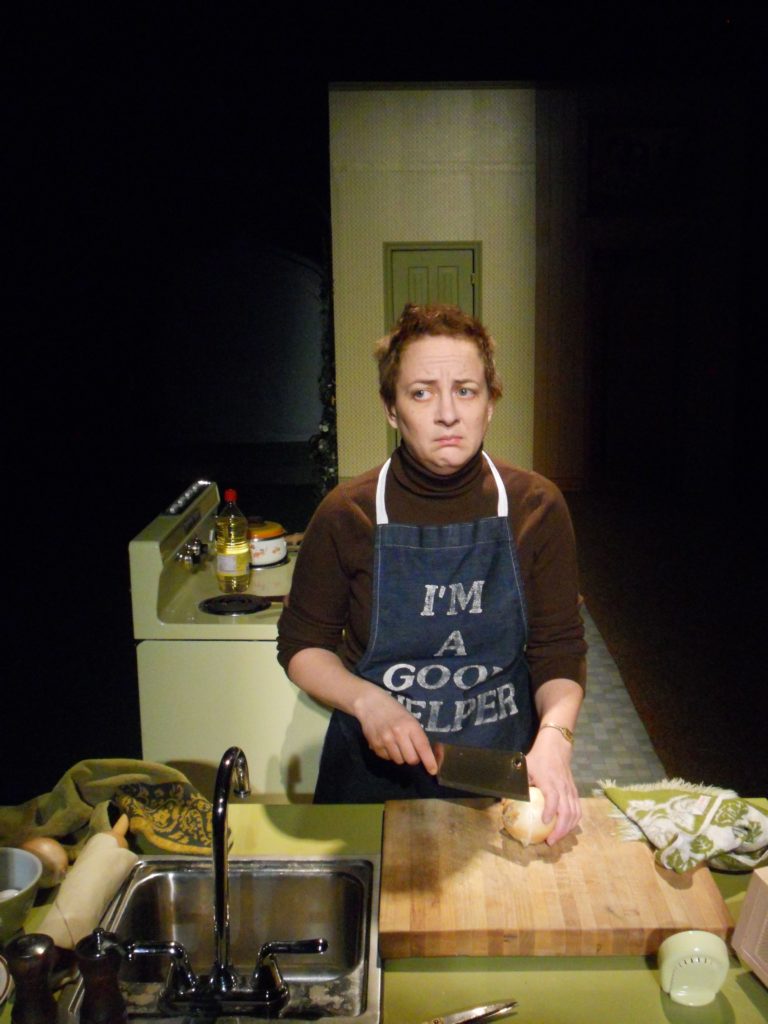
A woman with short, choppy hair is cutting onions next to a sink. She wears an apron that says “I'm a good helper” and she looks miserable.

Denver Post- Buntport’s “Electra” chops up onions and Greek tragedy

Buntport’s “Electra Onion Eater” is smart, tight and witty, easily within the reach of people who’ve never studied Sophocles’ “Electra” and enormously rewarding for anyone who tackled classic Greek tragedies in college.

All the action takes place on a stage implicitly divided into a side yard, a kitchen and a middle-class living room. Electra (Erin Rollman) stands at the kitchen sink, chopping onions and weeping as she contemplates her miserable family situation.

The play begins after her mother, Clytemnestra (Hannah Duggan), has murdered her father, Agamemnon (Brian Colonna, offstage), who in turn has dispatched Electra’s sister.

As she waits for her brother Orestes (Erik Edborg) to return home, Electra (wearing an apron announcing “I’m a Good Helper”) dreams of murdering her mother as she makes onion pies as offerings to the gods. Viciously chopping onions, she weeps tears provoked both by her losses and the volatile sulfur compound that her knife releases.

“As with cutting onions, there is more than one way to end a man’s life,” Electra observes with weepy optimism.

In their separate rooms, she and her mother are absorbed by soap operas, occasionally exchanging a few words with their unctuous, platitude-spouting neighbor Bruce (Andrew Horowitz). After one of his particularly egregious generalizations, Electra snaps, “THEY do not say that, Bruce! YOU say it!”

Tension is fraught between Electra and her smug mom. Electra glares daggers at Clytemnestra, who smirks back.

“Do you smell something?” she asks her daughter, and sniffs Electra’s shoulder.

“I do! It’s … party poop!”

Electra seethes, barely reining her homicidal instincts while she awaits Orestes. But a rumor of Orestes’ death sends Electra into despair underscored by her mother’s complacent reaction.

“I’m not going to pretend that this isn’t a mixed blessing,” Clytemnestra says cheerily, swilling another drink.

Anyone who paid attention during World Lit knows that things will not end well for Clytemnestra. Buntport’s reimagining of the story is acutely funny. A cremated cat is involved along with a terminally bad hair day and a dream about a giant killer tree.

“Electra Onion Eater” may be Buntport’s most brilliant revision since its seminal and hilarious “Titus Andronicus! The Musical!” It’s a shame the run ends this weekend because so many Great Courses students would absolutely love it.

-Claire Martin, November 22, 2013, Denver Post

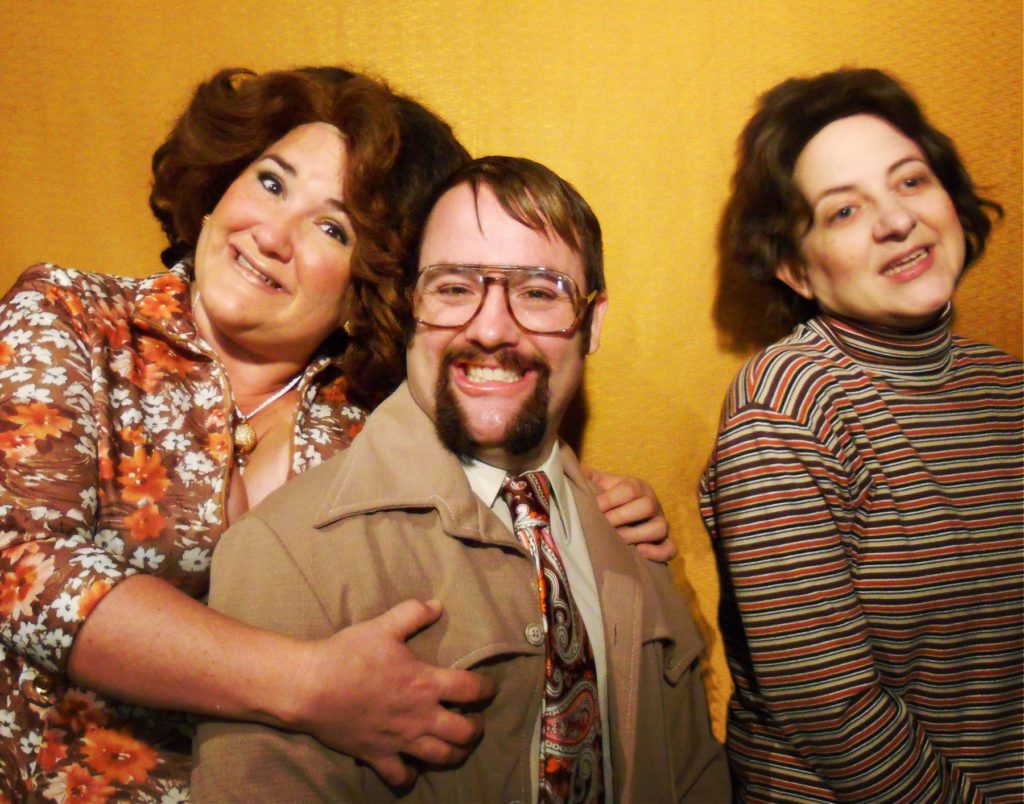
A 1970s family portrait, all in shades of brown and mustard. Everyone smiles are strained. The daughter is separated slightly from the parents.

Our Parker News- Buntport tackles Greek tragedy in oddball style

Inventive Buntport Theater members have again taken a literary classic and skewed it in their own inimitable manner. Perceiving similarities between Sophocles’ Greek tragedies and today’s soap operas, they chose to produce a “modern” version of “Electra” by Sophocles — a violent tale of murder and more murder.

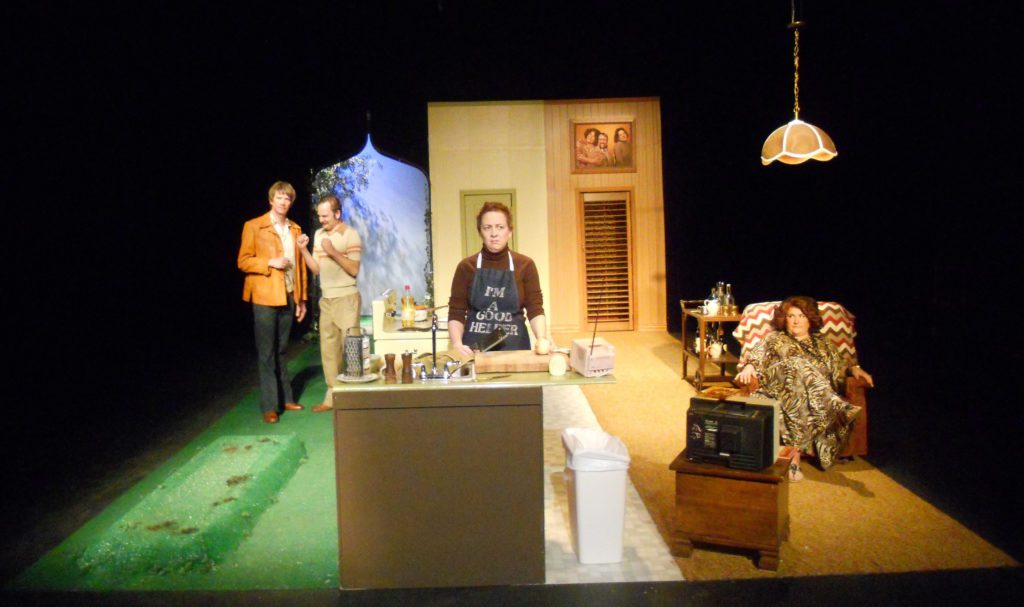
The “Electra Onion Eater” set includes a kitchen, an outside green area with a grave and a den-like space with easy chair and TV.

Electra weeps a great deal in the original as she mourns her late father, Agamemnon, who was killed by his wife, Electra’s mother Clytemnestra, so she could marry Aegisthus.

Buntport’s writing team has Electra (Erin Rollman) constantly chopping onions for pie to ensure copius crying, while evil Clytemnesrtra (Hanna Duggan) watches soaps on a TV in the next room.

Electra longs for her brother Orestes (Erik Edborg) who wanders home from his travels, accompanied by a guy named Bruce (Drew Horwitz).

Characters intersperse lines from the original play with new dialogue and pretty much follow Sophocles’ melodramatic plot, as they watch/listen to the cast of “Search for Tomorrow” (taped by Karen Slack, Michael Morgan, Jessica Roblee and Brian Colonna) — and plot to eliminate Clytemnestra.

There will be blood!

As audiences have come to expect, the production is clever and silly. Leave preconceived expectations at home and come to enjoy the work of a very original theater company. Members have worked together in Denver for more than 10 years since they graduated from Colorado College together, using classics as source material as they write their material — and at times creating new works, including musicals, from scratch.

(I found it useful to look at a summary or two of Sophocles’ original play prior to heading for the theater, just to get the names straight!)

-Sonya Ellingboe, November 20, 2013, Our Parker News

In the center is a miserable-looking woman standing at a sink wearing an “I'm a good helper” apron. To her left, two men stand outside on some astroturf talking. To her right, a woman in a leopard-print caftan sits in a Barca lounger watching TV.

Westword- There’s no deep meaning under the layers of Electra Onion Eater

The best part of Electra Onion Eater, which opens Buntport Theater Company’s thirteenth season, comes at the beginning, when Erin Rollman stages a television show called Cooking With Electra and proves yet again that she’s one of the top comic actresses around. Poor Electra is aiming at Julia Child-style chumminess and cheer, but her output consists solely of onion tarts, and her sorrow is overwhelming. She chops and chops, but her anguish breaks through in great howls. She picks up a vicious-looking cleaver and tries again, uttering a cry of vengeance with each chop — Hah! Hah! Hah! — as the blade comes down rhythmically and you fear for her fingers. Periodically she breaks off for more shrieks and moans, or to calmly explain the biology of tears. The warring expressions on Rollman’s pale face are priceless, and this scene is completely original, howlingly funny, almost frighteningly intense.

Television dominates this original play based on the story of Electra and written by members of Buntport and Drew Horwitz. The action is set in the 1950s, and Electra has a small, clunky television set in her kitchen. When her favorite soap starts, she pauses in her endless chopping and leans in to watch. In the living room, her mother, Clytemnestra, played by Hannah Duggan, is ensconced in a cozy chair in front of another television. You can hear the soap they’re both watching. It’s the work of musician/sound artist Adam Stone and concerns a doctor, the blind patient to whom he wishes to donate his corneas in an operation he’ll carry out himself, and an obsessive, stalking lover — and in a twisted way, it shows that the melodramatic imaginings of classical Greek tragedy are still with us today…or our view today of the ’50s. These moments when they’re absorbed in the same program represent the only time that Electra and Clytemnestra are remotely in sync with one another. We’ve seen some intense theatrical mother-daughter pairings recently, but this is the most intense yet: These women hate each other with a black-hearted, icy fury.

Electra plans to kill her mother because Clytemnestra is responsible for the death of her father, Agamemnon, and, like Gertrude in Hamlet, is now happily cohabiting with the man who helped in the deed, Aegisthus. The murder was motivated by Agamemnon’s sacrifice of Iphigenia — Clytemnestra’s other daughter and Electra’s sister — to appease the gods and cause them to smile on his military ventures. Electra is hoping her long-lost brother, Orestes, played by Erik Edborg, will return to help in her task of vengeance. Why the onion pie? Because sometimes even the most dedicated heroine of a Greek tragedy needs a little help in summoning the endless supply of tears she’s required to shed.

Agamemnon is buried in what looks like a narrow alley behind the kitchen, and Orestes does indeed come back — wearing a snappy cordovan leather jacket that matches his orange-brown shoes and accompanied by a friend named Bruce (Horwitz) — to venerate the grave. He knows Electra is longing to see him, but he won’t reveal himself to her just yet. His plan involves spreading fake news about his own death to lull Clytemnestra into a false sense of security. Then — presumably because he’s unaware of the existence of that lethal cleaver — he’ll kill her with Bruce’s pocket knife. So Electra and Clytemnestra fight. Bruce and Orestes plot. Offerings, mostly of tufts of hair, are made on the grave. In moments of deep joy or sorrow, the protagonists sing commercial jingles.

Electra Onion Eater showcases, once again, the comic inventiveness of the Buntport troupe, but the rest of the play doesn’t live up to the inspired lunacy of the beginning. Peeling off the layers of this Onion may be entertaining, but reveals no deep meaning.

-Juliet Wittman, November 14, 2013, Westword

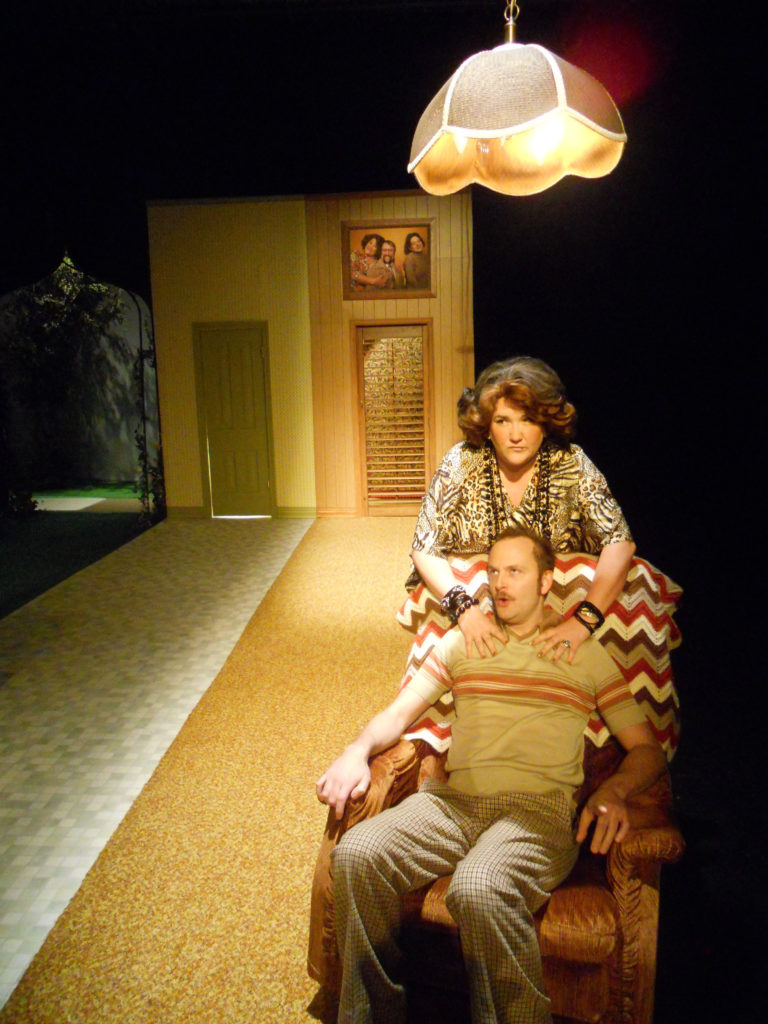
A man sits in a Barca lounger with a 1970s crocheted throw over the back. A woman with big hair stands behind him, rubbing his shoulders. Above them is a lamp. In the background is a wall with three sections: the living room, kitchen, and outside.

Marlowe’s Musings- Electra Onion Eater

Buntport Theatre is a gift of the gods! Their lampooning of Sophocles’ Greek tragedy “Electra” is a delectable ambrosia.

“Electra Onion Eater” proves once again that the demigods over at Buntport have the recipe for turning the most tragic tale into an evening of theatre that’s an Olympian laugh riot! Anyone who saw their send-up of Shakespeare’s “Titus” knows that.

The genius of this troupe is that they are able to sublimate ego (Really? I know!) and collaborate in the writing and directing in order to bring forth shows that are somehow sublimely smart and sensationally silly.

This one is sort of a tragedy of the geeks that gives us a mash-up of contemporary sit com and advert jingle while providing a nudge and a wink to the mask which uneasy wears the frown.

Hannah Duggan is the magnificently breezy and carefree matriarch, Clytemenestra. Erin Rollman is her hysterical (and hysterically funny) daughter Electra who, continues to grieve for her dead daddy Agamemnon by cryin’ like a rat eatin’ onions. Erik Edborg is Orestes, Elektra’s long lost bro.

In this glimpse into the dirty laundry of one of the original dysfunctional families of Greek theatre the Buntport crew has brought in guest artist Andrew Horwitz as friend of the fam, Brucey-Goosey.

Even if you have never heard of Sophocles’ “Electra” … No Worries! The show’s so tight you get it all right from the start.

This show comes with the highest of recommendations from this reviewer’s desk.

— David Marlowe, November 8, 2013, Blogspot.com

A woman with short, choppy hair is cutting onions next to a sink. She wears an apron that says “I'm a good helper” and she looks miserable.

North Denver Tribune- Buntport Blends Greek Classic, Soap Operas, and Onions in Electra Onion Eater

Buntport Theater opens their 13th season with their latest original creation, Electra Onion Eater, a comic retelling of Sophocles’ classic Greek tragedy Electra. The play is set in the 1970s, and interacts with a televised soap opera that two of the characters are watching, but somehow still manages to keep most of the basic plot elements. This is vintage Buntport — taking an existing story, twisting and reinterpreting it, infusing it with silliness and irony, but staying true to the essence of the original.

Electra Onion Eater is a play about revenge and onions. Electra is (understandably) upset that her mother, Clytemnestra, has killed her husband Agamemnon, father to Electra and Orestes. Like any good Greek tragedy, oracles and gods direct the action, and not much makes rational sense. Suffice to say that Electra impatiently awaits Orestes return, anticipating that he will then kill Clytemnestra and her lover. In the midst of all this, Electra engages in conversation with the characters in the soap opera she watches every day, getting their advice and perspective on things. The script simultaneously pokes fun at the ridiculousness of the original story and honors it, a strange contrast reinforced by individual incongruous juxtapositions scattered throughout. Electra wails and cries frequently, usually blaming it on the onions that she chops and cooks into pies, with an actual oven onstage, using smell to bring the audience more into the action.

As usual, the Buntport collective directs the show. They have made the blocking formal at times, with characters slowly striding downstage in parallel, each in their own “lane.” The set imposes restrictions on movement that force a lot of upstage-downstage movement, further enhancing the overall formality. Throughout the show, everything consistently combines the classic and the contemporary, but does so in a way that fits together.

Erin Rollman is quirky and disturbed as Electra, incessantly preparing onion pies, beating her chest in anguish. She opens the show by herself, building the context and her character clearly, covering a wide range of emotions credibly. Her preparation of onion pies sets a new level for “stage business” that may not soon be equaled. Hannah Duggan is Clytemnestra, the superficial mother, clearly impatient with Electra’s constant wailing. She is also a flirt, trying to seduce poor Bruce, played by temporary Buntporter Drew Horwitz. Horwitz’s Bruce tries (unsuccessfully, of course) to bring sanity and a voice of reason to the story, questioning whether there really needs to be still more killing. Orestes, played by Erik Edborg, is unable to act on his own, following the oracle’s instructions to the letter. The recorded voices of an impressive group of local actors, including Karen Slack, Michael Morgan, Jessica Robblee, and Brian Colonna deliver just the right amount of melodrama for the soap opera.

The set design combines formality with a 1970s period look, including a functional kitchen for preparing onion pies. The stage is split into three lanes, allowing for some fun formal movement. The costumes are delightful, hitting just the right tacky 1970s look. The lighting is basic but sound, providing good illumination throughout. The sound, by frequent Buntport collaborator Adam Stone, particularly the recording of the soap opera, is detailed and accurate, making the interaction between those on stage and the soap opera characters both more real and surreal. The design elements are well integrated into the overall production, something that Buntport, with their comprehensive collaborative approach, does consistently very well.

Electra Onion Eater is a lot of fun. It constantly juxtaposes opposites, is filled with comedy, and still stays true to the original. Each time I go to Buntport, I expect comic and creative brilliance, and even these high expectations are often exceeded. While Electra Onion Eater was not quite to the level of genius that some of their shows have been, it is still very entertaining and creative, and well worth seeing.

— Craig Williamson, November 7, 2013, North Denver Tribune

blogspot.com- Marlowe’s Musings: A Knight To Remember

“A Knight to Remember” relates the tale of a young man who now 35 has never been as happy as he was in fourth grade. Brian Colonna’s autobiographical illumination of his memories of his fourth grade crush on a girl who didn’t know where to put her hands touches. Even the orthodontist from his childhood gets into the mix by way of a tee shirt bearing the inscription: “Stainless Steel Sex Appeal.”

Simplistic-seeming yet saucily savvy, Colonna’s script allows for the intervention of other cast members who take HUGE pleasure in deftly breaking all theatrical rules with childlike abandon. Only the audience takes more pleasure in their antics than they do! Examples of these are: When you don’t have lines you don’t talk. Or if you are not in the scene then you don’t stick your head out from the side curtain in view of the audience. “A Knight to Remember” is a return to childhood with reminiscences based on a book about “Knights.” It’s part “Fellini- Amarcord”(“I Remember”) and part The Marx Bros’ “A Knight at the Opera” … without a lot o’ Spam. (Sorry!) There is grandiose movie music that gives the auditory illusion of Hollywood chivalry at its most florid.

In one scene Sir Brian appears as Sirs Lionel, Sagramore, and Dinadan in projections of various lobby fotos of Vanessa Redgrave’s Guinevere singing “Take Me to the Fair.” As we listen to the voice over of Julie Andrews from the Broadway version of “Camelot” we get one of the most hilariously correct similes in the show. “Her voice is like a clean white shirt drying in the sun.” Beyond that there is an amazing suit of armor and a chivalric mount that will make the producers of “War Horse” weep.

A pencil experiment in which the adorable Hannah Duggan raps :”where’s my PENcil, where’s MY pencil, WHERE”S my pencil” while strutting around with a plush black chair pasted to her butt stuns. Duggan’s hilarious turn as the show’s onstage technical director for sound, lights and constantly changing and deliciously fluid set design is a hoot!

Erin Rollman is her usual brilliant self in numerous roles including both of Brian’s parents, his fourth grade teacher and his fourth grade squeeze as well as a thoroughly minimal and delightfully innovative Lady of the Lake.

Although I didn’t guffaw a whole lot in this one … even after the show I had to sternly tell my happy face to stop smiling because it was getting EXTREMELY painful and I was starting to fear that the tragic face of the critic would never again be mine. Happily the tragic has returned and all is in critical condition again.

To paraphrase the Bard’s “Midsummer Night’s Dream”: “The short and the long of it is – Buntport’s show is preferred.”

It’s comic caviar on crackers!

(“Not much of a cheese shop tho!”)

-David Marlowe, April 29, 2013, www.blogspot.com

A man sits on a wooden horse in a suit of armor carrying a large sword. A forest is projected on the wall behind him.

Denver Post- “A Knight to Remember” embarks on a slightly goofball quest

The title of Buntport Theater Company’s latest – “A Knight to Remember” – is a clever if mildly hazardous title. It teases a smirk at the pun, but also raises expectations of a theatrical experience that aren’t fully met in the company’s final show of the season.

The subtitle of the play is: “My quest to gallantly capture the past by Brian Colonna,” which gives more than a hint at its first-person ambitions. But Buntport being arguably the most inventive ensemble in town means Colonna is not alone on his journey to understand his boyhood.

Hannah Duggan, or “DJ Hannah Duggan,” as she’s credited, operates overhead projectors, lights and sound. She also makes absurd forays into the action.

Erin Rollman joins Colonna “as everyone else,” Though there comes a time when the deft, aware performer bristles cleverly at her place in this recounting of the life of Brian.

“A Knight to Remember” is, in part, about how things capture our imaginations, especially our young, hopeful, heated imaginations. An idea: about chivalry. An accessory: A shiny coat of armor. Another human: in this case, a girl who clasps her hands in the strangest way during one of those class portraits. You know the kind, the one where the teacher stands to the left and there are at least two risers of children, beaming or not.

Like many memory-oriented works, this one moves between details peculiar to the teller (the family trip to Germany, the serious orthodontics, the schoolboy crush) and those that bind us to a moment in time. Here, that would be the ’80s. There’s a funny bit about Colonna hijacking Rollman’s graduation year, because it was just a more interesting year.

Actually, there is a fair amount of onstage bickering about the very undertaking. And it is this notion of an ensemble performing a one-man show that provides the most Buntport-ian “in.” It is the type of meta-playfulness they do so darn well: taking on a simple (sometimes outlandish) idea and exposing layers existential and theatrical.

Alas, quests can be ragtag. (Just ask Don Quixote.) This outing is a bit ragged for a company whose work is more often fluid, funny and taut.

-Lisa Kennedy, April 27, 2013, Denver Post