Buntport Theater

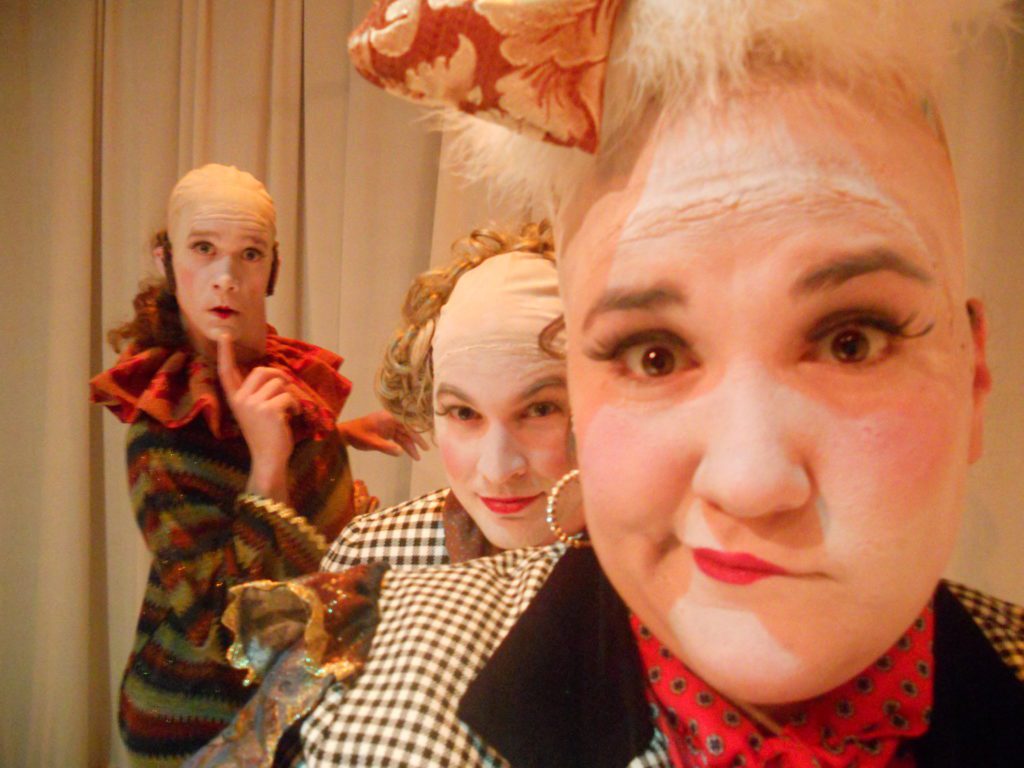
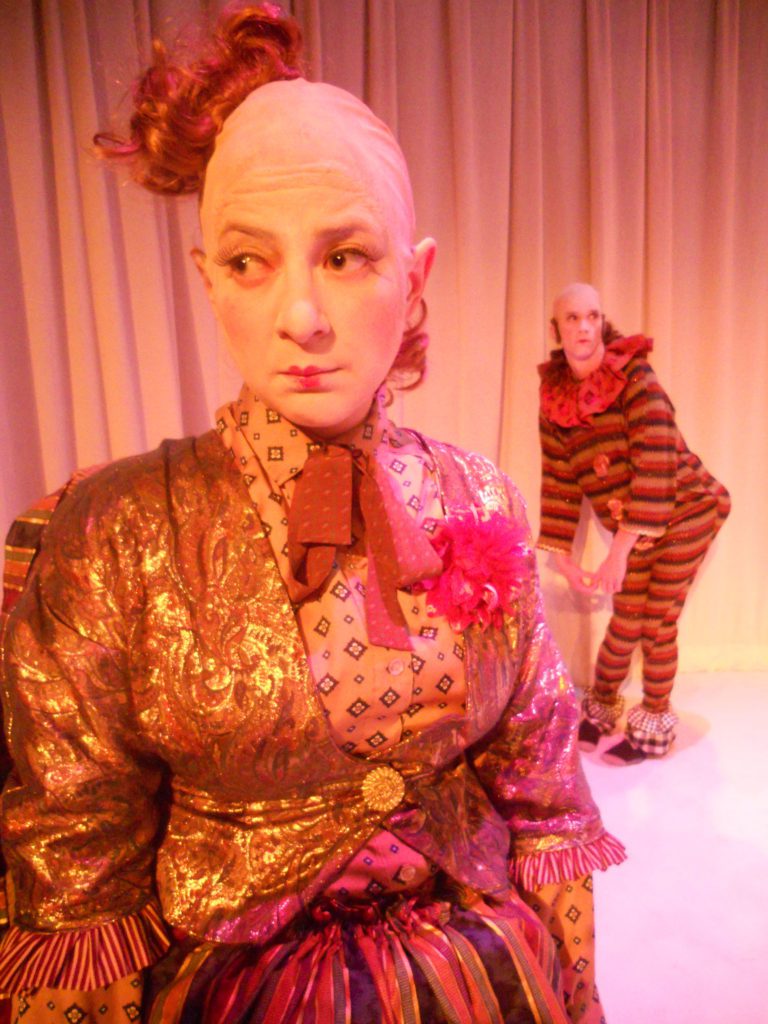
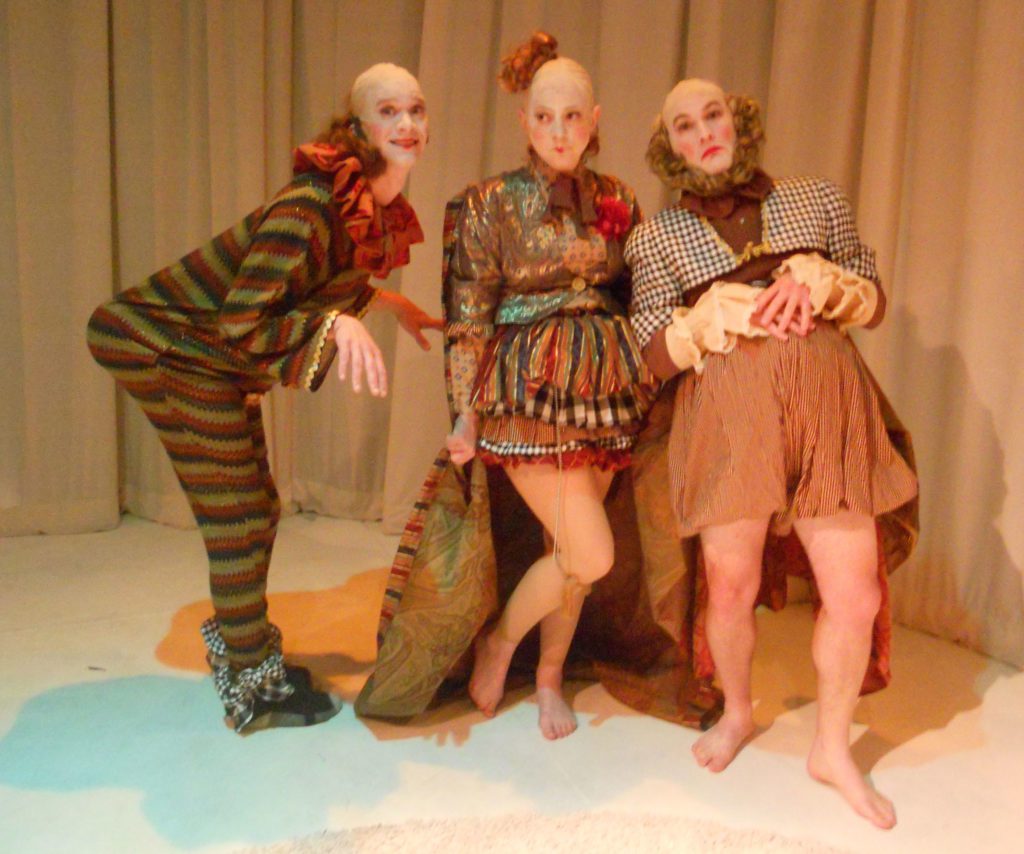
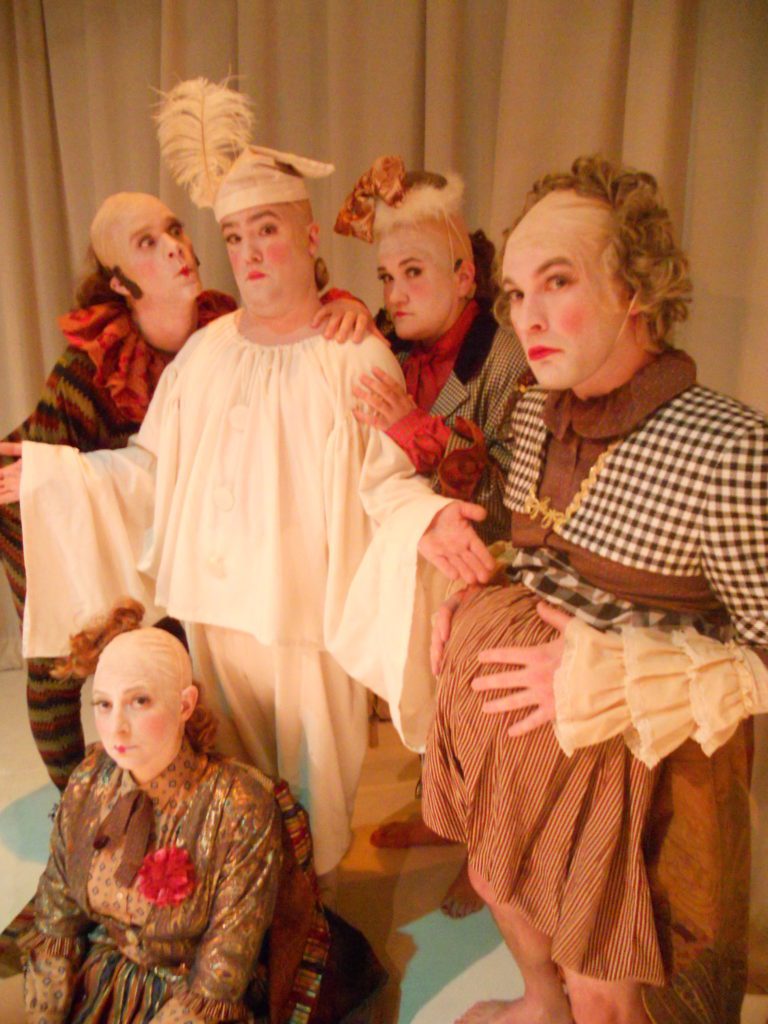
A clown with a poof of fabric for hair, looks off cloyingly in the foreground, while another clown behind them sticks out their big fake butt looking as if they had just farted.

Boulder Magazine- The Roast Beef Situation

There is something both ludicrous and noble about the notion of one man or woman speaking out alone in protest against what s/he considers unfair, either for just him/herself or for the community in general. Remember the famous photograph of one man standing in front of a tank in Tiananmen Square. Remember the names of famous whistle-blowers: Deep Throat (against Nixon), Jeffrey Wigand (against the tobacco industry), Sherron Watkins (against Enron), Gary Webb (against the CIA). And then there is Carlo Delpini, the most noble and most ludicrous of them all. One man speaking two words made it possible for the great traditions of theatre to continue.

As Buntport tells the tale, the emphasis is put much heavier on the ludicrous than on the noble. But nevertheless, it took ba—well, guts, to stand up and perform an act that was sure to land him in jail. Though as he tells it, he just sort of forgot and spoke out loud by accident at the end of a song about roast beef. But land in jail he did and was there subjected to a mock trial conducted by his fellow inmates – also portrayed by Commedia del arte characters such as himself.

The end result is funny, challenging to the audience, brilliantly staged and acted. It is ripe with those flashes of genius and intelligent (but bent) turns of humor we have come to expect in a Buntport production. It is impossible to explain everything that is going on in a Buntport script. They truly defy explanation; you have to be there and see them for yourself. A special pat on the back for this particular production must go for the costuming, lighting design and sound design. Sound effects add a dimension not possible with the spare staging of this show. The del Arte costumes are authentic and multi-functional, bright and ridiculous.

For some, Buntport is an acquired taste; you may not care for or understand the first show you see, but if you go to a second or third, you are hooked. I truly think it has to do with the first show you see. They are all so unique that if the first one tickles your fancy or challenges your understanding, then you will come back again and again. I was lucky – my first two shows were The Odyssey: The Walking Tour and Titus Andronicus: The Musical – two of the funniest and most cleverly staged shows I’ve ever seen. For those of you who have yet to acquire the Buntport addiction, get on the bandwagon. What’s wrong with you???

A Wow factor of 8.5!

-Beki Pineda, June, 2012, Boulder Magazine

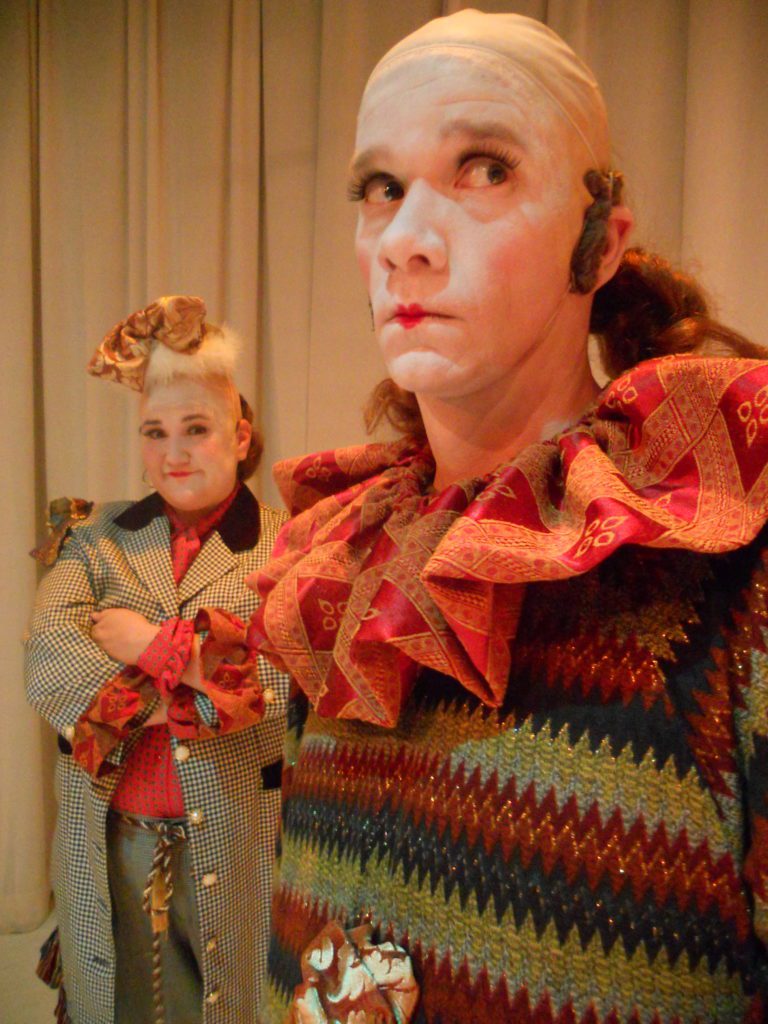
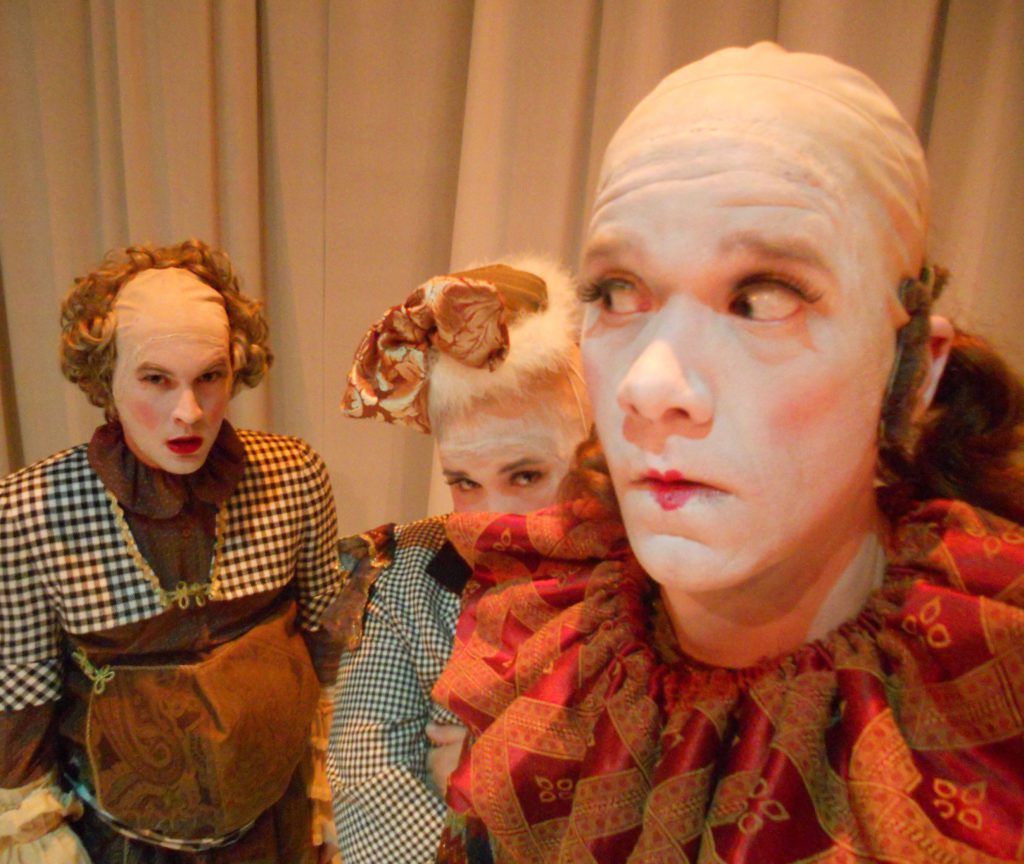
In the foreground, a clown wearing a huge ruffle collar looks off in the distance while another clown in the background looks into the camera with a smile on their face and arms crossed.

Theater Colorado- “The Roast Beef Situation”

It doesn’t happen often, but every once in a while a production is so innovative, so creative, so inventive, that I hardly know how to describe it. And with “The Roast Beef Situation,” words fail me. It is unlike anything I’ve ever seen. And that, frankly, is a good thing.

While the plot confounds, the premise is clear. The Licensing Act of 1737 censored all theater productions in England. Plays had to be approved by the government before they could be performed. One of the more draconian requirements of the law required that theaters could not use any dialogue that was not accompanied by music. That’s right. No dialog without music.

Carlo Delpini, a professional actor, clown, and pantomimist, was imprisoned in 1787 for violating The Licensing Act by uttering the words “roast beef” without music. It was, in his words, a “mistake.” That “mistake” (“misteak?”) is the premise for “The Roast Beef Situation.”

Buntport casts Delpini as the jailed protagonist, trying to rationalize his captivity and escape it in any way that is both possible and legal. (It turns out that it’s legal to escape from prison in a boat, but it’s not possible.) As for the lesser lunchmeats, well, you’ll have to see “Roast Beef” for yourself.

“The Roast Beef Situation” asks the obvious question: does this law make sense? And it also answers that question, with a random poll of 500 Londoners who think it does not make sense. As Delpini says, “quelle surprise.”

The performances are engaging, exaggerated, and thoroughly entertaining. The period costumes and makeup are surprisingly effective. The white face makeup and the lipstick focus our attention on the facial expressions. And those faces, at times, are as essential to the story as the script.

If we take “The Roast Beef Situation” simply as “food for thought,” one would quickly come to the conclusion that The Licensing Act of 1737 is misguided but irrelevant in 2012.

Do we dare ask the contemporary question “do these laws make sense?”


  • Foreign law has been banned in Kansas courts.
  • Pregnant women in South Dakota must be told that they have an “existing relationship” with the fetus before going through with an abortion.
  • It is illegal for undocumented immigrants in Alabama to get water in their homes.
  • Various states have enacted voter suppression laws, despite a lack of evidence of voter fraud.
  • The Wisconsin governor is attempting to prevent same sex couples from having hospital visitation access.


A lot has changed since 1737. Unfortunately, silly, senseless legislation has not changed. “The Roast Beef Situation” is a timely reminder of how the Ship of State sometimes veers far off course.

I was “plausibly perplexed” at times. In the end, though, I was dazzled by the concept, the performances, and the challenge of “The Roast Beef Situation.” This production is a unique experience that I recommend highly to all theater enthusiasts. You will laugh, you will scratch your head, but you will not be disappointed.

-Bill Wheeler, June 8, 2012, theatercolorado.blogspot.com

Two clowns in the foreground look as if they have done something bad. The clown behind them looks nervous.

blogspot.com- The Roast Beef Situation

The creativity involved in the conception and execution of Buntport Theatre’s new show, “The Roast Beef Situation,” is inventive genius par excellence. This is no surprise since it has been conceived, directed and acted by some of the brightest comic lights in this theatre community. They are: Erin Rollman, Erik Edborg, Brian Colonna, Hannah Duggan,and Evan Weissman. It is an honor to get to see the works with which these artists are blazing trails of comedy and dram-edy here and now in Denver.

This latest in a series of comic plays gives censorship a well-deserved comeuppance! And that is why you should go. This piece makes us see how actors and clowns who survive on their audience’s sometimes-fickle good will are often the victims of laws such as the one that caused Carlo Delpini to be thrown into an English jail in July of 1787. Delpini broke the law that forbade unlicensed theatres to use dialogue that was unaccompanied by music. In a moment of weakness he spoke the words “Roast Beef” rather than sang them.

Censorship has been with us always. This was true at the time of Shakespeare and Christopher Marlowe. The deposition scene in Shakespeare’s “Richard II” caused more than a little eye rolling and Christopher Marlowe’s work came under the scrutiny of Elizabeth I’s Star Chamber for many reasons. Marlowe barely escaped experiencing its secret brutality first hand.

At that time theatres were closed by Puritans, and actors blamed for lewdness. (In all honesty one must say that only occasionally were actors to blame for such things.) For the most part the closing of theatres was due to ecclesiastical sanctimony, political power mongering and public alarm resulting in mob panic. Many times these maledictions came about because of the much feared and widespread epidemics. Whether it was the resurgence of the Plague, which was feared by everyone or some other societal scourge feared by those in power such as a political uprising of one kind or another, the afflicted community many times blamed it upon the theatre.

The Commedia del’Arte and its presentation is – whether this reviewer is its greatest fan or not – magnificently put forth. In this show the renowned Buntport humor, which so deftly demolishes funny bones, takes a back seat to historical research regarding the persecution of actors and the satirical evisceration of those ne’er do wells who hurt the theatre by living by the letter of ridiculous and nonsensical laws.

Commedia del Arte is this company’s style of choice in producing this new work. It’s a valid choice and those who find an endless stream of pratfalls and baguette whippings, accompanied by repetitive clangs and whistles palatable will find this aspect of the proceedings delightful. This reviewer has nearly always found the initiation of such theatrical expressions enjoyable. However… after the hundredth repetition thereof he tends to find them tedious.

That said, one may find exceptional work in the muggings, sly transitions of hairpieces to beard and moustache and many other sly subtleties in the theatricality of the very correct stylistic presentation of this play. The costuming and makeup of the actors in their portrayal of these eighteenth century thespians is superb and indelible. It puts one in mind of the costuming and also the depiction of the facial landscape in films by Federico Fellini such as “I Clowns”, “Casanova” and “Fellini/Satyricon.”

SamAnTha Schmitz’s lighting design plays games with the viewer’s subjective and objective points of view. The shifts in her lighting design make one feel as though he were viewing an actual moment in theatrical history one moment and pulled back into a modern theatrical depiction thereof the next. “The Roast Beef Situation” is a blood-rare and gently mooing serving of existential theatrical Truth.

See it!

-David Marlowe, June 4, 2012, david-marlowe.blogspot.com

Denver Post- “Roast Beef Situation” is well-done, smart fun

The ridiculous gets the sublime once over as Buntport Theater Company performs its devilishly original play “The Roast Beef Situation,” through June 16.

The collaborative, idiosyncratic company (whose most recent show featured a Tommy Lee Jones puppet) has cooked up a fine slice of Commedia dell’Arte. The Italian-born, theatrical tradition gave audiences the sad fool Pierrot, his nemesis Harlequin as well as the bickering pair Punch and Judy to name but a few of the stock characters that populate the form.

The play’s goofy title gives a vigorous nod to just how absurd the law — especially in the hands of miscreant politicians — can become.

Based on a historical event, “Roast Beef” tells of the jailing of actor, dancer, clown Carlo Delpini in 1787. During a performance, Delpini (Brian Colonna) strays from a willfully sentimental ditty written by Henry Fielding about a cut of meat and utters two words without musical accompaniment.

You know actors and their disregard for hewing to the writer’s words, but the wrath wasn’t Fielding’s. Actors were prohibited from performing plays with spoken dialogue unless approved by the government.

Britain’s Licensing Act of 1737 granted the Lord Chamberlain the right to approve, or not, all plays with dialogue. (It wasn’t until a Parliamentary act in 1843 that this changed.) The act was a way to muzzle satirists and others craftily poking fun at politicians.

“The Roast Beef Situation” becomes fleet fun as Delpini and his cohort find themselves in the clink. With a little help from SamAnTha Schmitz’s spare lighting design, ensemble members Erin Rollman, Erik Edborg, Hannah Duggan and Evan Weismann play Delpini’s clown posse — Morey, Grub, Stan and Plausible Jack — as well as stand-ins for other characters in the tale’s priceless recounting.

Deliciously layered, “Roast Beef” is a romp with “meta” implications: about censorship as well as the role of the actor in society. It is silly and smart simultaneously. How often does a clown comedy send one on a quest to learn about Georgian-era jurisprudence?

The uses and abuses of laws and taxation are given a hard and hilarious gander. There’s even a bit of slapstick mischief around professional jealousy: Delpini is aggravated by Giuseppe Grimaldi’s popularity. After all, wasn’t it he, Delpini, who cast Grimaldi as Friday to his Robinson Crusoe in the pantomime performance on Drury Lane?

The laws regulating theater are so arcane and legion that Morey keeps them tucked away on a scroll, which is consulted again and again. This becomes just one example of the expert physical comedy buoying this linguistically nimble ride.

The costumes are impressively outlandish (when Grub portrays “the love interest,” his rump becomes a rack). So, too, are the variety of bald wigs. In addition to lights, Schmitz is also responsible for the sly sound design.

For those with Coulrophobia (a fear of clowns), Buntport’s troupe feels your pain. Or at least acknowledges your condition, even as they tease it boldly, brilliantly.

-Lisa Kennedy, June 1, 2012, Denver Post

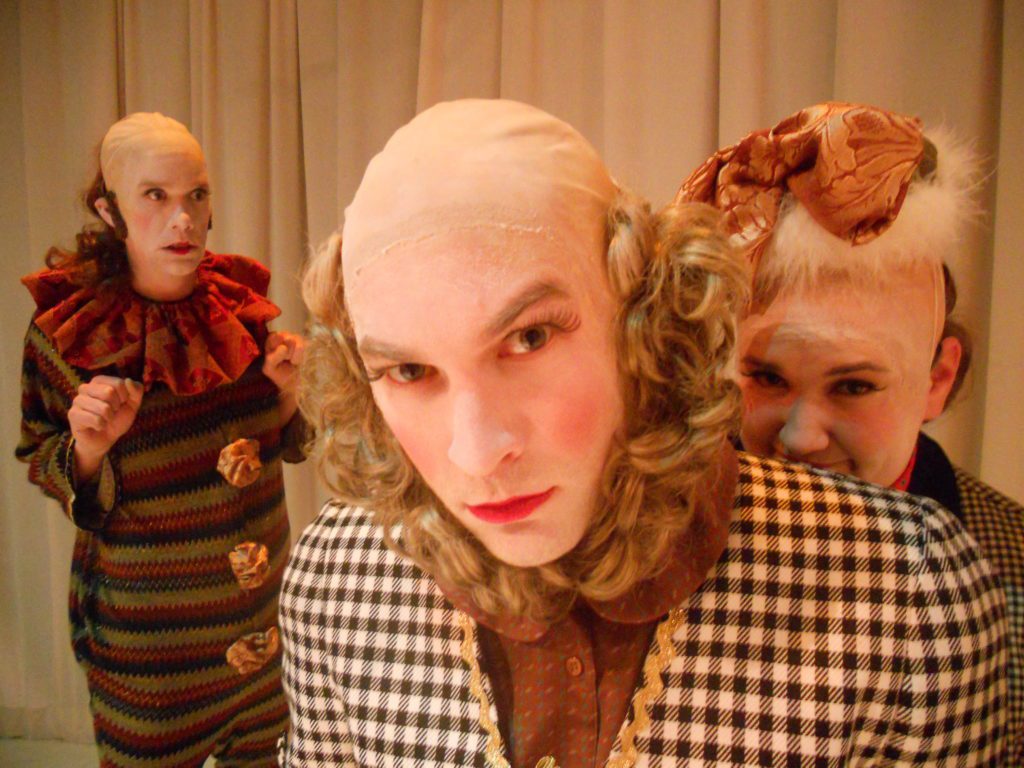
Three clowns stand in the line looking into the camera. The one on the left is turned to the side pushing their obviously enhanced giant butt out. The clown in the middle stands as if they are innocent and the one on the right sticks their belly out and holds it with their hands as if approving and surveying things.

echnorati.com- Roast Beef vs The Wrath Of The Titans

Entertainment companies demand that Google take down listings promoting their new movies. A clown is jailed in London for saying the words “roast beef” on stage.

Which seems the most likely to be true?

Both.

Denver’s raucous Buntport Theatre’s latest production, “The Roast Beef Situation,” premiered during the holiday weekend.

While the 32nd production of the Buntport in its 11 years might not seem so bizarre, after all the six-member cast has no director and has done shows like “Kafka On Ice,” the takedown notices from Hollywood either show how incompetent studio lawyers are or how far they are willing to go to make viewers pay as many times as possible for the same content.

Google reported the DMCA notices in its latest transparency reports. The Internet giant wants people to know what it is being asked to do. Torrent Freak and others reported on the latest actions.

Although “The Roast Beef Situation” is based on the dilemma of the clown Carlo Delpini 225 years ago, the cast demonstrates that copyright issues can simply be another way to control what is said in public. In the 18th century, the British government sought to strictly regulate what could be said in its theaters, the Internet of its day.

Brian Colonna, who plays the clown thrown into a jail full of murderers who bludgeoned their victims, wants to know if the spoken word can be owned. First he has to convince his jail mates that he deserves to be in the same cell with them.

Mark Twain didn’t think so. He thought all ideas were second-hand and therefore not actionable

“The kernel, the soul — let us go further and say the substance, the bulk, the actual and valuable material of all human utterances — is plagiarism,” he wrote in a letter.

Spanish surrealist Salvadore Dali, whose most famous painting was “The Persistence of Memory,” followed Twain by a couple of generations.
“Those who do not want to imitate anything, produce nothing.”

Perhaps if a more friendly word, recycling, was used, it wouldn’t sound so bad. Mozart did it.

-Robert Weller, May 29, 2012, technorati.com

A clown in the foreground looks off to the side as if the two clowns behind them may be up to something nefarious. The two clowns do, in fact, look up to no good.

Westword Blog- Buntport’s The Roast Beef Situation blends Commedia dell’arte and satire

Tommy Lee Jones Goes to the Opera Alone is a tough act to follow, but Buntport Theater Company is going for it with the last show of the season, The Roast Beef Situation. The play, which opens at 8 p.m. tomorrow, is old- — as in eighteenth-century, clown-troupe-style Commedia dell’Arte old — school comedy, with a fresh satirical take on censorship.

The Roast Beef Situation begins with a true story, which goes like this: In 1787, a clown named Carlo Delpini was thrown in jail, along with the rest of his company, for speaking the words “roast beef” on stage without any music playing in the background. Per Lord Chamberlain’s Licensing Act of 1737, only licensed theaters performing approved material could perform words on stage without music.

Buntporters stumbled on this piece of trivia in an arts and culture magazine based out of New York, called Cabinet. From there, they brainstormed and collectively penned The Roast Beef Situation, their 32nd production together. “In the process of him being in jail with all the people in the show, he kind of takes back ‘roast beef’,” says Brian Colonna, the Buntport collaborator who will play Delpini. “We kind of just blew it up right there, based on that little story about the clown going to jail.”

The Roast Beef Situation is layered with a condemnation not just of the act of censorship that sets the play in motion, but of the absurdity of the law and government enforcement of it. The levity of the clown comedy is interrupted by political barbs directed at authority. With the theater emerging as an art form, says Colonna, “the establishment is a bit concerned people would get to say things they wouldn’t approve of. Performers were starting to do that. The Lord Chamberlain, who made the law, was being satirized at the time.”

While creating clown comedy, Buntport had to deal with the dimension of creepiness that clowns have taken on in recent years, thanks to Pennywise, John Wayne Gacy and Poltergeist. “I feel like people hear ‘clown’ and they’re like, ‘Yeah, I don’t think I’ll go see that,'” Colonna admits. “Poltergeist ruined clowns for everyone.” But these are not modern, conventional circus clowns; they are designed largely in the Commedia style, with Delpini dressed as stock-character Pierrot, with a white buttoned frock and cap. There is nothing creepy about them; they’re just ridiculous.

“They’re inspired by the real outfits,” says Colonna of the costume design. “Erin (Rollman) made them, and at the moment they’re one of my favorite aspects of the show.”

There is always humor to be found in laughing at the inadequacies of others. The common themes of competition and self-doubt among artists did not escape Buntport as places to find humor. “We mention Grimaldi, who is probably the most famous clown from that era,” Colonna notes. “Delpini is only a footnote. His friends bring up Grimaldi constantly.”

And, as always with Buntport comedy, the company hopes for more than just laughs. “There’s a line that goes, ‘To know what is ridiculous, you must know what is sublime,'” Colonna says, drawing a connection between the text and the experience he and his collaborators hope to create with this show. “I think people will mostly get the ridiculous, but hopefully, for one second, the sublime will pop up.”

-Shaughnessy Speirs, May 24, 2012, blogs.Westword.com

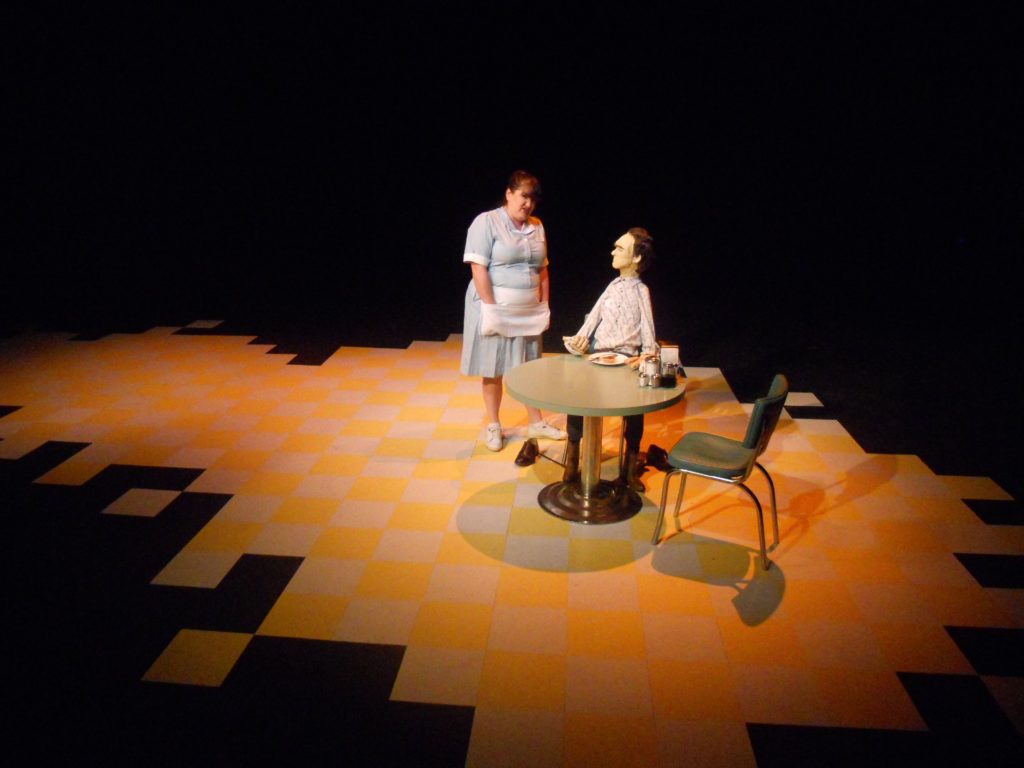
A life-size puppet of Tommy Lee Jones sits at a diner table that is surrounded by a yellow and white checkered floor surrounded by darkness. A waitress stands next to the table as if she is about to take his order.

Westword- Buntport’s Tommy Lee Jones Goes to Opera Alone is brilliantly original

Buntport Theater Company has always had a creative way with music: The ensemble’s choices for openings, accompaniment and intermissions are spot-on, and some of its shows have included fruitful collaborations with local musicians. So when two Buntporters spotted tough-guy movie star Tommy Lee Jones standing in line at the Santa Fe Opera for tickets to La Bohème, it got their speculative juices going. The result is a brilliantly original piece of theater called Tommy Lee Jones Goes to Opera Alone, with a large puppet Tommy Lee Jones at its center.

This puppet is around five feet tall, pale and thin-limbed, with imposing eyebrows and large, highly articulated hands, courtesy of Denver puzzle-box master Kagen Schaefer (robotics teacher Corey Milner helped rig those hands for action). But if the hands are eloquent, the mouth is permanently shut tight. Four actors, all wearing black suits and masks, provide the animation: Brian Colonna works the head, Evan Weissman and Erin Rollman the tricky hands, and, sitting almost completely still, his features obscured, Eric Edborg serves as the puppet’s voice.

The action is set in a coffee shop where Tommy Lee Jones goes regularly for coffee and pie. He has a longstanding teasing and affectionate relationship with waitress Jane – Hannah Duggan, the only troupe member who gets to be an actual, freestanding human being. Jones wants to talk to us, the audience, and he has a lot to talk about: cowboy boots, movies, his background, how human speech evolved (and the price we paid for it) and, of course, opera – the grandest use to which those evolved voices can be put. He shares his ideas about the quality of Elvis’s singing, Puccini (“sincere and at the same time counterfeit”) and live performance (“You are always seeing…something that will never happen again”). He’s particularly fascinated by Turandot, the opera Puccini left unfinished at his death. Periodically, he activates a gold pocket watch from which arias emanate.

Buntport has always made a point of bridging – or rather, completely ignoring – the line between high and low art, so it’s no surprise that this production humanizes and demystifies opera. Tommy Lee Jones explains that the melodies of many popular songs come from opera, and shows that opera belongs to everyone – him, us, and irrepressible waitress Jane, who feels free to sing along and contribute her own ideas about plot.

Puppets have been in Buntport’s DNA from the beginning: In this company’s hands, anything from a stuffed bear to a car antenna can become human. And puppets also hold a strong fascination for the rest of us, from bloodthirsty horror-movie mannequins to child-mesmerizing Muppets. Much of the play’s meaning is imagistic rather than verbal, and there’s something deeply evocative in the three black-clad puppet manipulators, who look sometimes like nurturers and sometimes like bringers of death. The puppet isn’t realistic, and yet by the end of the evening, it has acquired some strange semblance of life. Which means you have to ponder what it signifies when a man’s body parts assert emotional and physical independence, when his right hand is at odds with his head. No wonder the poor man has dreams in which he’s trying to fit his boot over his ears. And when these figures desert the puppet to fold in on himself, we feel real sadness.

There’s a sense of continuous recursion, boxes within boxes, stacked Russian dolls. At one point, Jane mirrors the action by staging her own mini-puppet show, using a ketchup bottle, a fork that morphs from a character in Turandot into a pie-eating utensil, a syrup bottle. Turandot supposedly reflects events in Puccini’s own life, and the plot of the opera in turn gets re-enacted here – in a very unexpected way.

The acting is terrific, reflecting the company members’ deep commitment to the work and each other. Duggan, in particular, adds irresistible sparks of life and humor with every entrance.

Part of Buntport’s mission is to make art transparent. There’s no attempt at illusion or concealment: All the transitions and manipulations happen right in front of your eyes. Tommy Lee Jones is, among other things, a meditation on the process of creation, the relationship between artist and audience, and the fact that a great work of art changes over time and is therefore never finished.

-Juliet Wittman, April 3, 2012, Westword

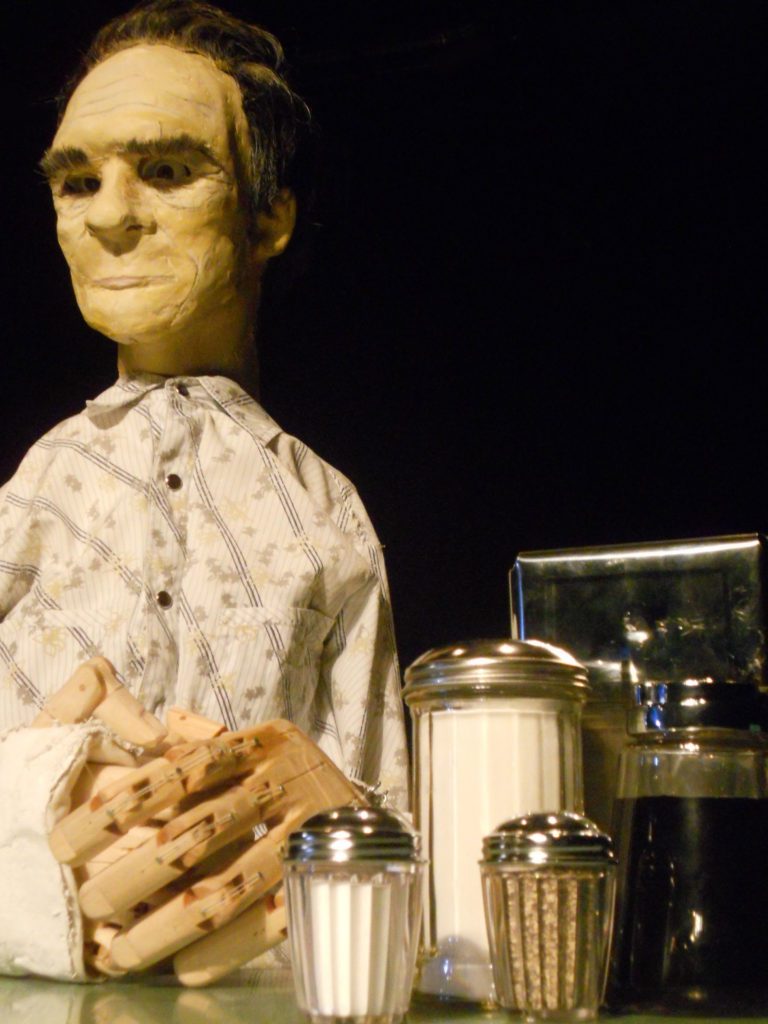
Close up of a life-size puppet of Tommy Lee Jones sitting at a diner table. He looks out into the distance holding his wooden hands in front of him. One of his arms is in a cast, like his hand is broken.

ourCastleRocknews.com- Buntporters in fine form this spring

“Tommy Lee Jones Goes to Opera Alone” is the newest original creation of the exceedingly clever Buntport Theatre Company – and it’s really a winner. Who would think that a Tommy Lee Jones sighting (in the ticket line, alone) at the Santa Fe Opera last summer would lead to a theater piece?

Admittedly, it’s a stretch to imagine the movie characters Jones has played as opera buffs. But this accomplished actor has many facets.

We meet him this time, sitting in a cafe, eating a piece of pie.

A life-size puppet replica of TLJ waxes poetic about cowboy boots, life as a movie star and love of opera as he sits with three Buntporters, while a fourth one (Erik Edborg) voices the actor in a relaxed Texas style.

The puppet was created by Kagen Schafer, who made a head that really resembles TLJ and jointed hands that work amazingly well to pick up things, reach in a pocket and more.

Hands were mechanized by Corey Miller, according to the program and the eyes and eyebrows move on the head, although the mouth does not.

The cast list reads: Hannah Duggan – Jane, the waitress; Erik Edborg – voice; Brian Colonna – head; Evan Weissman – right hand; Erin Rollman – left hand. The latter three have now or previously had experience in puppeteering.

The jointed fingers pick up items and the eyes and brows are expressive. Fine wire from the fingers fits into the gloves of Weissman and Rollman for operation, while Colonna has some levers on the back of Jones’ head to manipulate.

Watching them walk him to the phone in the next room or simply cross his knees is an event.

Duggan, a skilled comic actress, is dressed as a frazzled waitress. She has a fair number of opinions and is acquainted with Jones.

The other four wear black suits that cover body and head – most of the time, so they fade into the background as a good puppeteer should.

Then there’s Jones’ gold watch that starts operatic arias when opened, spurring the actor to talk about his favorite, “Turandot,” and “La Boheme”– and Elvis’ potential and more. “I go to opera a lot. Usually alone,” he tells them, as he asks June the waitress for more coffee. And there’s a reminder from his wife to get a piece of pie to go. …

“Artists take molehills and make them into mountains,” he says about the creative process, speculating about Puccini and the end of the “Turandot” story.

The conversation draws to an end and two of the puppeteers come to blows – also cleverly staged. After 75 minutes with no intermission, the audience departs chuckling. Don’t miss this one.

-Sonya Ellingboe, March 26, 2012, ourCastleRocknews.com

Denver Post- Buntport Theater’s wildly original “Tommy Lee Jones”

In a show that sets a new bar for innovation, insight and breathtaking equality – the Buntport ensemble has figured out a way to let everyone, and no one, star in “Tommy Lee Jones Goes to the Opera Alone” – the original Denver troupe has conceived a brilliant commentary on culture and celebrity.

The latest show by Denver’s most collaborative theater company was inspired by a chance encounter in New Mexico: Buntport’s Brian Colonna and Hannah Duggan spotted Jones, solo, in the box-office line for the Santa Fe Opera’s “La bohème.”

It’s not hard to guess their immediate reaction. Agent Kay from “Men in Black” at the opera? The crusty man on the moon from “Space Cowboys”? The grave robber from “The Three Burials of Melquiades Estrada”?

Well, why not? Who’s to say how Tommy Lee Jones spends his own time? Except … if you’re Tommy Lee Jones, and you’re out in public, are you ever really offstage? If you’re Tommy Lee Jones, or anyone else with an instantly recognizable name and a tail of paparazzi, do you actually have a private life?

All that hovers between the lines in “Tommy Lee Jones Goes to the Opera Alone,” which features a puppet stunningly evocative of the Texas actor known for his taciturn characters.

The puppet Tommy Lee Jones has no mouth, but expressive eyes and eyebrows, and fantastic outsized hands. Each of the three movable parts requires a separate Buntport actor to manipulate, creating what may be the most droll cast credits ever: Colonna as Head, Evan Weissman as Right Hand, Erin Rollman as Left Hand and Erik Edborg as Voice.

All the action takes place in a cafe where Tommy Lee Jones is seated with a piece of pie, a glass of water and a cup of coffee. He’s clearly a regular and on good terms with the waitress, Jane, played by Duggan, the only durably recognizable Buntport member.

The other actors are hidden within Bunraku- style black suits and face masks. They almost (but not quite) fade into the background as they animate Tommy Lee Jones, who pontificates on (among other things) opera, the transience of live performance, “Turandot,” seppuku, Elvis Presley’s operatic potential, pie and breaking the fourth wall.

The audience first glimpses the actors in black as they stroll on stage to stretch and don their gear like scuba divers. There’s a frisson of unrequited love from Weissman to Rollman, and from Rollman to the impervious Colonna, creating a humming tension underneath Tommy Lee Jones’ rambling discourse.

Try to sit in one of the first three rows for the best view of the remarkable mechanics required to energize Tommy Lee Jones. You’ll want to see how the puppeteers coordinate when Tommy Lee Jones ambles off stage to take a phone call, and the gymnastics involved when he crosses his extremely thin legs. (His jeans came from the girls’ department.)

Those fantastically detailed wooden hands, carved by puzzle maker Kagen Schaefer, who also made the expressive face, are worked by wire filament threaded into gloves that Rollman and Weissman manipulate. The dexterity required to pick up a glass of water or a fork is a complicated task that only another puppeteer, or a Craig Hospital patient, can fully appreciate.

“Tommy Lee Jones Goes to the Opera Alone,” which runs for 75 minutes with no intermission, is smart, challenging, witty and may be Buntport’s best collaboration yet.

-Claire Martin, March 23, 2012, Denver Post

ColoradoDrama.com- Tommy Lee Jones goes to opera alone

Once again, we are taken by the infinitely fertile minds of the Buntport ensemble, where a real life chance encounter seeing Tommy Lee Jones alone in line at a Santa Fe Opera production of La Bohème turns into an astounding and heartwarming piece of theatre.

A near life-size puppet of Tommy Lee sits, lifelessly, at a table in a diner, we assume to be in San Saba, Texas, near one of his ranches, not far from where the actor was born. Across from him sits a mysterious figure, in a black jump suit with a hood that includes screening over the face. The lights dim, an operatic overture fills the theatre, and, one by one, enter the actors who will animate Tommy Lee’s Left Hand (Erin Rollman), Right Hand (Evan Weissman), and, to great fanfare, his Head (Brian Colonna), wearing matching black jump suits, just like that of the mysterious figure, who turns out to be the Voice (Erik Edborg).

This is no ordinary puppet. The hands were carved by Kagen Schaefer, a Denver wood artist extraordinaire, and mechanized by Corey Milner, a talented local robotics teacher. The head was a group effort detailed by Rollman. The coordination of Tommy Lee’s gestures and actions – including opening and closing a musical pocket watch that plays arias, plus eating a piece of pie and drinking coffee, rolling his eyes, walking, etc. – is reminiscent of the equines in War Horse, which required three people to bring each of them to life.

Jones’ fourth-wall monologue – astounding in scope and maturity, and genuinely humorous – covering everything from the pie and philosophic musings on life to the finer points of Puccini’s operas, is interrupted by occasional forays back to three-wall artifice, where he and the waitress, Jane (Hannah Duggan), trade small talk as well as high-brow speculation on possible endings for Turandot, which Puccini famously never finished. Edborg’s does great emotive work as the Voice, well nuanced, with just a twinge of Texas twang.

Despite his rapture over Rudolpho’s arias and the adaptations of melodies from La bohème into hit songs in the ’50’s (great pantomime by Duggan on “Don’t You Know?,” a big hit for Della Reese in 1959), Tommy Lee is most fond of Turandot, since it has the most potential to be different every night, which is a clue that the ending of this piece is going to be a total surprise.

As usual, the Buntport players find wonderful low-tech solutions to enthrall and surprise us; for example, Jane explains in detail the plot of Turandot using the silverware and the condiments at Tommy Lee’s table. We’ll avoid a spoiler alert and let you try to imagine how this might go.

As Tommy Lee Jones points out, there are three types when it comes to opera: those who consider it the “o” word, and assiduously avoid it; those who have never thought about it; and opera snobs, who have no time for Puccini. Granted, Puccini can be seen as cloying and manipulative, as Tommy Lee points out, but he also wisely notes that if you can’t handle it, you’ve probably never been in love. As an example, the play offers us clips from Jussi Bjõrling singing one of the most cherished arias of all time, “Nissun dorma,” from Turandot. Who is Jussi Bjõrling? The late great Luciano Pavarotti once remarked, when someone compared him to Björling, “Please, I’m only mortal!” Listen to this rendition (wait a few moments for it to start). Be sure to catch the ending. Have you ever hear a tenor reach these heights? And this is an old, low-quality recording. There are some recordings that include the chorus, but …

-Bob Bows, March 20, 2012, ColoradoDrama.com