Buntport Theater

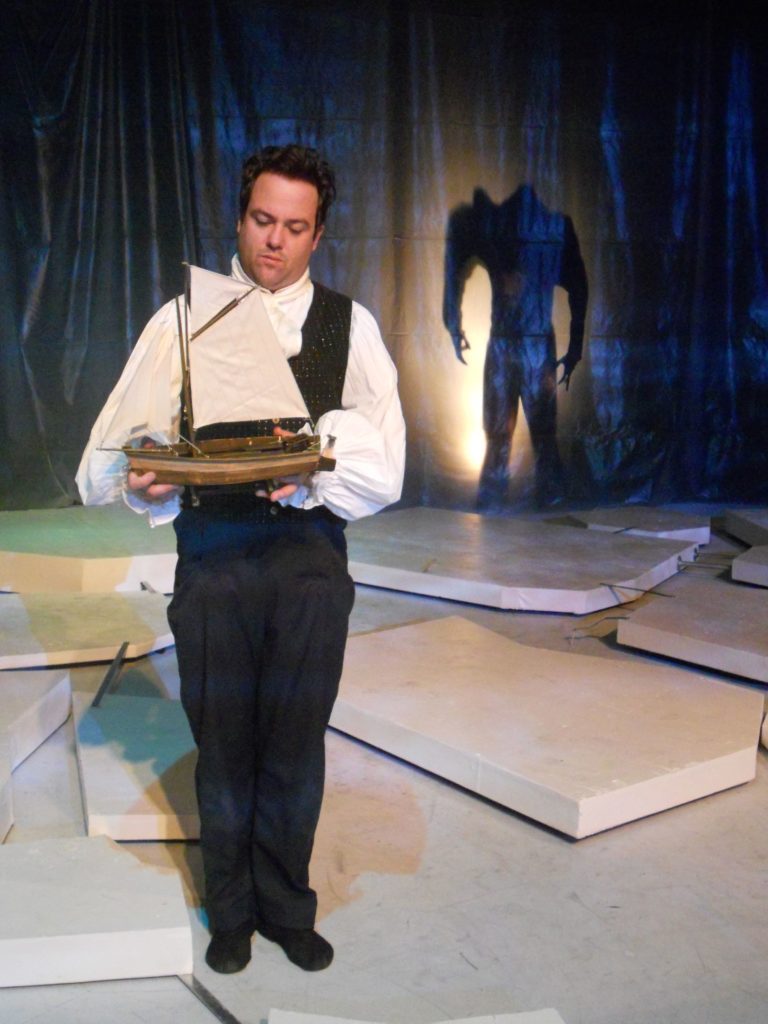
Percy Shelley stands in the middle of a sea of icebergs holding a small sailboat while in the background the shadow of a large monster looms over him.

Denver Post- The hideous loveliness of Buntport Theater

In tale of Mary Shelley, creation and death, gods and monsters take on new meaning.

Anyone with a passing interest in Mary Shelley has heard the story of how the famous Gothic novelist created “Frankenstein” as part of a party-game challenge.

It’s a romantic notion that in 1816, she, her husband Percy, vampire inventor John Polidori and others sat around in a Dorothy Parker-like circle, wittily one-upping one another’s ghost stories.

But that’s not the horror story Buntport Theater is now staging.

Buntport takes a much more surreal and humanistic approach in presenting for the world its own rather strange and compelling new creation: The deliciously titled “My Hideous Progeny.”

The title refers, of course, to the mad doctor of Mary’s imagination who ignited the spark that created life from death. Only here it also refers, much more sadly, to Mary losing four children.

The story opens with a delirious Mary (Erin Rollman, in her most demanding role to date) lying fully clothed in a bathtub filled with ice – her doctor’s advice for how best to recover from a miscarriage. Thinking of those poor dead children as Mary’s true inspiration for the random body parts Victor Frankenstein stitches together to create his misunderstood monster not only sets us on a discombobulating theatrical course, but forces us to reconsider our deeply engrained notions of the famous novel.

This play is a mental sea voyage of its own, and the bathtub, which Rollman never leaves, is the ship the ensemble of six navigates through both literal and figurative icebergs.

This entire tale plays out as a fever dream, and not just Mary’s. The dreamer shifts between heartbroken Mary and her sleepwalking poet husband, who was plagued by laudanum-induced hallucinations of his own.

It’s weird, no doubt; at times it’s as cold (as ice) as its premise. But it’s fantastic and indefinably lovely, as well.

The Buntport team creates all its own work in collaboration. “My Hideous Progeny” launches its 11th season, but is its first new offering in a year. And it makes up for lost time by firing many creative and verbal synapses at us, some that hit the heart directly and others that streak by like shooting stars and land with more nebulous impact.

“My Hideous Progeny” ranks among Buntport’s most melancholy works, earnestly avoiding the ample available satire and ghoulish humor of the genre that, say, Mel Brooks found so irresistible. “Young Frankenstein,” this is not.

This is instead a sincere character study that tells the scandalous love story between Mary and Percy (Brian Colonna), one that was said to drive his first wife to drown herself. Evan Weissman plays the boorishly vain Lord Byron, who concocted the famous “let’s all make monsters” party game, and Hannah Duggan is Mary’s contrastingly quite pregnant stepsister, Claire.

The notion of creation – whether of children or monsters, real or imagined – dominates this sad rumination, which is set against a kind of virtual visual plasma that flows over the clear plastic walls of the set like a Flaming Lips video, occasionally revealing other monsters lurking in the recesses of the Shelleys’ collective brain.

Quick quotes from “Frankenstein” begin each scene as kind of live chapter titles. And as we navigate further inward, “Heart of Darkness”-style, the play becomes a foreboding philosophy on the living dead – and the dead living.

Water is everywhere, from the ice cubes eerily knocking against the walls of Mary’s tub, to Percy’s fatal obsession with it. It’s easy to see how nature’s literal spark of life is supplanted by a more unnatural current in Mary’s famous novel.

This quick, confounding evening centers on the remarkable Rollman, who delivers an open and necessarily restrained portrait of a woman who possessed the literal omnipotence to make life out of death on a page, but not so easily from her womb (though one child survived).

This is a Mary steeped in historical fact – but never brought to life so lovingly and hauntingly before.

-John Moore, September 30, 2011, Denver Post

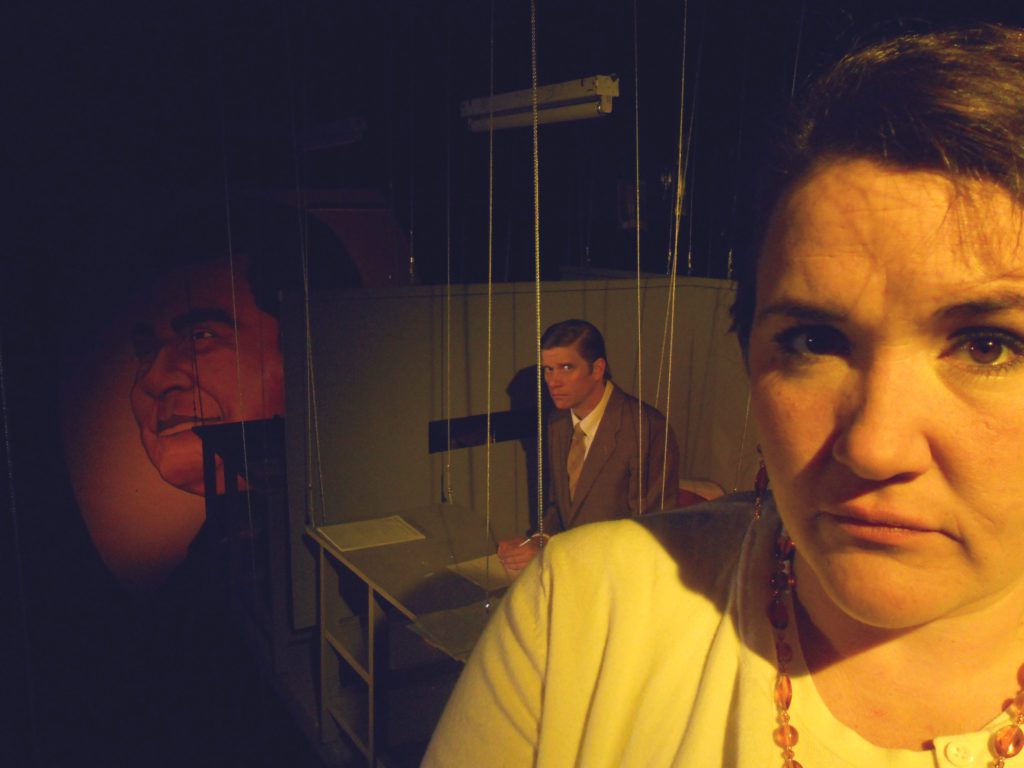
In the foreground is a woman’s face looking forward and frowning. In the distance a man sits looking concerned. He is seated at a very small desk that is suspended by wires to the ceiling. Behind the man is a large mural portrait of an imposing man on the wall.

Westword- In The 30th of Baydak, small moments of hope and defiance stay with you

The 30th of Baydak is a small, sweet, gentle play about a large, ragged and ugly topic: dictatorship. And since this is a Buntport production, bringing back a show it originally presented in 2003 as part of the company’s ten-year retrospective, naturally it tackles a particular kind of dictatorship. When Niyazov became president for life in Turkmenistan after the fall of the Soviet Union, he turned out to be as dotty as he was terrifying. He filled the country with huge, ludicrous statues of himself, banned gold teeth and suggested that his subjects chew on bones to strengthen their natural choppers, changed the names of planets to honor himself and his mother, and also remade the calendar. January became Turkmenbashi (Niyazov’s honorary title); Baydak was February – which can only have a 30th in the kind of topsy-turvy universe depicted here. (Niyazov died in 2006; it’s unclear how much, if at all, his successor, Berdimuhamedow, has liberalized things – a question of some interest to the United States because of Turkmenistan’s plentiful gas and oil reserves.)

The action stays away from anything large or lurid. What we see is an office drone named Yousef, quietly excising the now-forbidden former month names from official documents. A huge photograph of the dictator graces one wall (what is it with ruthless dictators and jet-black hair?); smaller photographs of him are visible elsewhere. A bustling woman brings Yousef an armload of papers and spouts cheery clichés; a co-worker arrives late, gesturing his defiance as he passes the portrait – and this entire sequence of events repeats, as if Yousef’s life is some kind of Groundhog Day. Then one morning a young woman, Meret, arrives to occupy the cubicle next to his. She places a small plant carefully on her desk. She and Yousef can’t see each other, but they regularly pass papers through a slot in the wall, and pretty soon they’ve wordlessly fallen in love. But then the regime tightens its grip.

This is territory we know from George Orwell’s 1984, where the protagonist spends his days at the Ministry of Truth, sending all photographs and documents that contradict the government’s frequently changing official version of events down a chute called the Memory Hole and into flames. How do you survive in a place where your life and work are meaningless, where history can be changed or obliterated at the will of the powerful? You keep your head down, allow yourself small but meaningful acts of defiance, try to maintain a sense of the absurd, look to art or love to free your soul. And if you’re imaginative, you escape into magic. Yousef – who spends his evenings conversing with an affable camel and who undertakes a portrait of Meret made up of torn-out months – tries all of these.

The small, telling gesture with which The 30th of Baydak concludes is a little disappointing. Obviously, a hyper-dramatic ending wouldn’t work, but if this world can’t end with a bang, you’d like at least a deeply resonant whimper. Still, the production’s significance doesn’t really lie in the script or a lot of overt action, but in image and metaphor. The title is telling: When you’re confused about your situation in time, you’re lost; nothing coheres, and there’s no ground under your feet. So it makes sense that most of the set is actually suspended rather high above the usual acting space by wires, and that the catwalks leading across the theater to the office cubicles sway under the feet of the actors. The rhythms are telling, and also unhurried – no one here is afraid of pauses – and small objects like Meret’s living plant carry a great deal of meaning. There’s also a surprising and absolutely beautiful moment when Yousef shows his artwork to the camel.

The performances of Erin Rollman as Meret and Eric Edborg as Yousef are one of this production’s most impressive aspects. Almost any actor can command a stage when he’s called on to yell, kiss, grieve loudly or fight, but it takes deep skill to hold audiences rapt while actually saying and doing very little. We know everything we need to know about Meret’s character – her gentleness and generosity, the kind of stubborn, low-key courage she possesses – through Rollman’s economical gestures: her calm smile, the way she arranges her legs just so under the desk. Edborg’s Yousef is more loquacious, but his performance is equally restrained: no raging or kicking against the pricks, just small moments of hope, resignation or despair that lie quietly in your mind for some time after.

-Juliet Wittman, April 12th, 2011, Westword

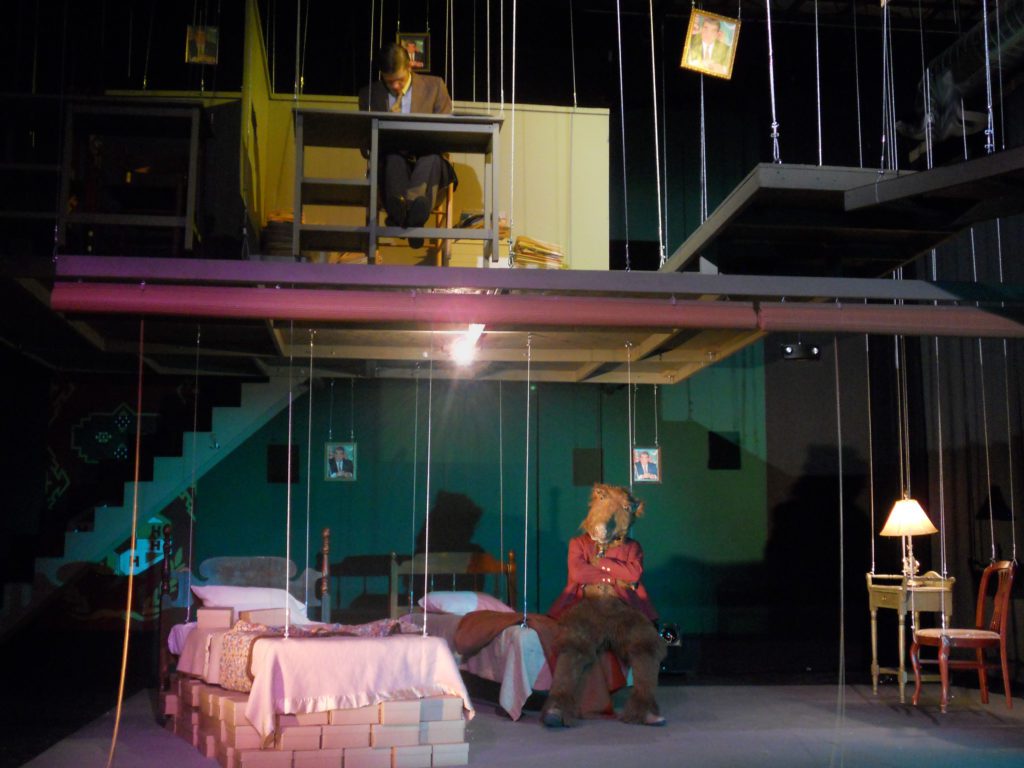
There are two rooms one directly above the other in which all furniture and walls in both rooms are suspended by wires. In the top room a man leans over a small desk. To his left is a walkway supported by wires. In the room below a person in a camel costume sits on the front edge of a wire-suspended bed. The room is cluttered with boxes.

Denver post- Buntport’s “Baydak”: Think “Metropolis” meets “Office Spac

e”

Any evening at Buntport requires a suspension of both belief (you won’t believe your eyes) and any adherence to theatrical convention.

So why not have a full production that is, in essence, suspended in air?

“The 30th of Baydak” is an off-balance little play performed on a two-level set that hangs from dozens of ceiling cables down to just a few inches above solid ground. Walkways, beds, desks – all essentially floating, as if all aboard are floating through life.

This stark yet sweet comedy is part political protest and part sentimental ode to all the world’s losers. Set in the real Central Asian nation of Turkmenistan, it follows a compliant government drone named Yousef (Erik Edborg) who spends his workdays performing mind-numbing tasks, presumably as part of a larger master plan to keep the masses distracted from the meaninglessness of their lives. They toil amid a preponderance of cables that make this workplace look like a prison cell.

Think “Metropolis” meets “Office Space” … without as many laughs.

This play is instead a serious rumination inspired by Czech novelist Bohumil Hrabal’s “Too Loud a Solitude,” as well as actual events in Turkmenistan, a formerly Russian-controlled state about the size of California bordering Iran and Afghanistan.

Turkmenistan became an independent nation in 1991 but was ruled by a ruthless and wildly eccentric dictator who renamed himself Turkmenbashi, wrote his own bible and banned everything from lip-syncing to newscasters wearing makeup. He also changed the number, lengths and names of all calendar months – from February, for example, to “Baydak.”

And all that wacky stuff was true even before the Buntporters got their creative hands on this absurd story.

Despite the play’s foreign setting, the characters in Buntport’s play are identifiably American, which adds a chilling “this could happen to us” subtext. We follow the lonely Yousef to work, where chirpy office manager Ogul (Hannah Duggan) burdens him with office gossip and the inherently ridiculous (but necessary!) task of carefully cutting out any reference he finds to an outdated month.

Disgruntled rebel Farzad (Evan Weissman) tries unsuccessfully to recruit Yousef into the political resistance. But the arrival of an unseen new podmate (Erin Rollman) awakens his creative spirit.

While “Baydak” plays like a timely new commentary on political oppression given the recent uprisings from Egypt to Libya, it was first performed in 2003, just after the U.S. went to war with Afghanistan.

This “remount” is part of Buntport’s 10th-anniversary season revisiting favorite works. “Baydak” made for a curious choice, given that it wasn’t overwhelmingly received in ’03. The ninth of now 28 original efforts came across then as intriguing, but murky and a bit rushed, without building to a strong ideological conclusion.

That’s a problem the times have fixed: As we’ve watched so many thousands stand up against their oppressors from the Middle East to West Africa, we are soberly reminded that insurgency brings casualties, both innocent and not. Now the ending seems emphatic.

There are welcome bits of Buntport’s signature magic, namely the appearance of Turkmenistan’s most sacred animal … on two upright legs and wearing a business suit.

That said, the plot still turns on an uncharacteristically clumsy twist. And a promising foray into the redemptive power of art, and its role in personal and political rebellion, remains an unfinished tangent.

It’s curious that “The 30th of Baydak” is a day that never existed – even when the month was called February. This play remains something of a riddle, with a warm but ultimately unknowable heart.

-John Moore, April 8th, 2011, Denver Post

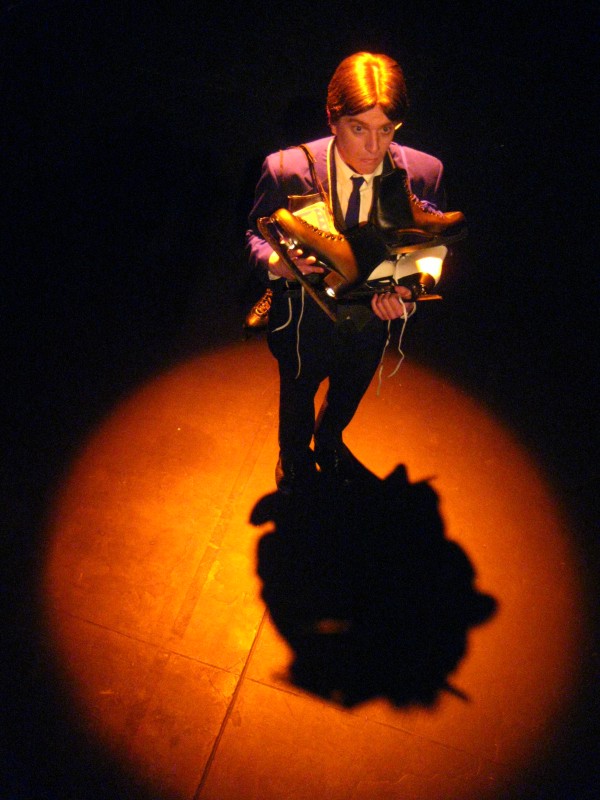
Close-up of an unhappy looking man in stark lighting. He has many pairs of ice skates draped over his shoulders.

Denver Post- Buntport at its best with “Kafka on Ice”

Even when Buntport repeats itself, it’s the most original theater company in town.

“Kafka on Ice,” first staged in 2004, takes the standard device of a stage biography – and a mighty depressing one at that – and presents it with artistry, intelligence and a wonderful kind of whimsy.

Buntport and Kafka go oddly well together – they’re both known for different kinds of metamorphoses. Kafka is the dour Czech master of despair who in 1912 famously turned a human drone into a big old bedbug – and no one even noticed the difference.

And Buntport, which last week won a 2010 Mayor’s Award for Excellence in the Arts, routinely transforms simple objects on a stage in ways that have us watching along like slack-jawed children taking in our first Ice Capades.

The ice has something to do with that. The synthetic ice, that is, that’s been laid down on Buntport’s warehouse floor. Guest artist Josh Hartwell, playing Kafka, is the only actor who does not wear figure skates. Instead he slips, slides and struggles to find his balance while the expert Buntport ensemble, playing all the important people in Kafka’s life, gracefully camel-spin and salchow all around him. A gimmick, to be sure. An absurd juxtaposition. But for a valid creative purpose.

The play opens with a young Kafka writing at his desk, an enhanced audio effect making his scribbling motion sound not unlike a bug scurrying from light.

Soon the figure-skating five dart to and fro at speeds that suggest Kafka is not living in the same rhythm and time as those around him. There’s Hannah Duggan as Kafka’s determined grandfather, schussing across the ice with a burlap sack in his teeth (just to show how tough he was!). Evan Weissman as a parasitic Kafka mentee who would later recycle their talks into a mangled libertarian dogma – for his own (capitalistic) profit. Later, Weissman again as a maid performing a curiously elegant (and risque!) Olympics-style skating routine.

As a doe-eyed Kafka, Hartwell’s portrayal is more Chaplin’s sad clown than an embodiment of the real Kafka. That’s by design, in keeping with a presentational style that figure-eights from vaudeville to slapstick to WWF (there’s an interspecies wrestling match that, well, you’ll just have to see). Hartwell has come to be Denver’s go-to Kafka, having played him in the LIDA Project experimental theater company’s considerably more paranoid and political “Joseph K” in 2009.

“Kafka on Ice” is more personal. It focuses on the writer’s many foiled, failed relationships – from his disapproving parents to the women he kept at a distance, to the opportunistic managers who profited from his words (such as Brian Colonna as best friend and leech Max Brod).

The story plays out with a stream-of-consciousness, dreamlike quality not unlike Kafka’s own works, which blurred the line between the real and the surreal. Comic snippets of “The Metamorphosis” are interspersed, further fogging the line between Kafka and his iconic human vermin, Gregor Samsa.

It’s ridiculous and lovely, while still elucidating the sad and melancholy story of an isolated writer who, ironically, lived one of the world’s most examined and misunderstood lives.

More than that, this musically infused play gleefully, but never too pointedly, raises questions that have been bandied for a century – and gently mocks them. The most absurd: Erik Edborg, as “Lolita” novelist Vladimir Nabokov, debating whether the insect in “The Metamorphosis” is in fact a beetle or a cockroach. As if that matters.

Later, Kafka finds himself sitting in a modern-day American college English class led by an overmatched teacher (a perfect Erin Rollman) hilariously bluffing her way through Kafka’s text with the help of an online lesson plan – and a cheat sheet.

In 2004, I called this scene tangential. But I’ve come to see it as the signature moment in the play. Because the lasting questions from “Kafka on Ice” are really those that tease the fabrications, exaggerations and ridiculous misinterpretations that have followed famous people into the afterlife since the Stone Age. It’s possible, Kafka might say of all this, that a bug is just a bug. In fact, that’s the point.

-John Moore, February 3, 2011, Denver Post

Looking down on a man in an orange spotlight. The man has many pairs of ice skates draped over his shoulders.

North Denver Tribune- Buntport Ices Kafka

Buntport Theater is presenting a revival of their look into the life of Franz Kafka, presented on ice (literally). While this would be inconceivable for any other company, for Buntport it makes perfect sense. While Kafka on Ice may sound like the latest beverage offering from Starbucks, it’s really a wonderful show that combines the meaning and depth of Kafka, extreme silliness, thoughtful humor, and surrealism.

Kafka on Ice creatively merges elements of Franz Kafka’s life and his most famous work, mixing in a lot of comedy, some thoughtful commentary, and a few invented details. Created collaboratively from scratch in 2004 by the then seven members of Buntport (Matt Petraglia has since moved on to other things) and local actor Gary Culig using their usual blend of research, brainstorming, and their intrinsic comic brilliance. The story follows Kafka through some important and some obscure times in his life, and parallels them with the characters in his Metamorphosis. And all the characters except Kafka himself perform the entire show on ice skates on an artificial skating surface. Buntport normally creates unusual situations for their productions, but this is probably the most appropriate, putting the whole thing in a context that Kafka would have appreciated, if he could have gotten past the fact that it was about him.

As with all things Buntport, the directing is collaborative, and works very well. Presented in the round, the action most often moves along the diagonals (at times quite quickly – they are on ice skates, after all), with scenes set center stage or in the corners, balancing the view from all sides. Another aspect of theater in the round that really fits this show well is that while watching the show, you also see the audience on the other sides, usually laughing heartily. You never forget you are in a theater. The show is chock full of clever and funny devices, including a prize fight between two bugs, a wonderful silent movie sequence, and several other surprises that I won’t reveal here. While the show is very funny, it is not just silliness – there is thought as well.

The acting is exception. Josh Hartwell takes on the role of Kafka, anchoring the show with genuine sympathy for his character. While he is certainly idiosyncratic, Hartwell does not ridicule the character, he elicits sympathy and understanding. And while very strange things happen around him, he never loses the sense of Kafka. The Buntport actors adopt a variety of rolls. Erin Rollman covers the range from the mother to incidental characters to a variety of love interests well, making each unique, but she is best as a modern teacher talking right at the audience. Erik Edborg is stern and domineering as the father, adding humor with his descriptions of how hard it was when he was young.

Brian Colonna is Kafka’s friend Max, sympathetic to a point, but also pragmatic – he is the one who disobeyed Kafka’s strict instructions to destroy his writings after his death. Hannah Duggan covers many small roles well, including compassionately playing the one woman that finally makes Kafka happy near the end of his life. Evan Weissman is fun as Janouch, the young man who allegedly remembered many conversations with Kafka long after the writer’s death.

The set is minimal by necessity, dominated by the large square of artificial ice. Kafka’s desk is an important element, changing at times to meet the needs of a scene, and the large almost cartoonish book of his writing is woven throughout in different and creative ways. The lighting works well, providing good illumination enhanced by the light-colored floor surface. The select use of projections was very effective, too. The costumes are creative and appropriate, ranging from figure-skating attire to historical fashion, all able to be changed with skates on. Sound is also an important element, with particularly effective bug noises integrated into several scenes.

Buntport’s brilliance is to take an idea or a concept, and tell a story around that idea or concept that is first and foremost true to itself, but also incredibly funny and thoughtful. Kafka on Ice is further proof of this brilliance, presenting Kafka’s life and work in a Kafkaesque way – on ice. This show is a must see for Kafka fans, for Buntport fans, for theater fans – okay, for just about anyone.

-Craig Williamson, February 3, 2011, North Denver Tribune

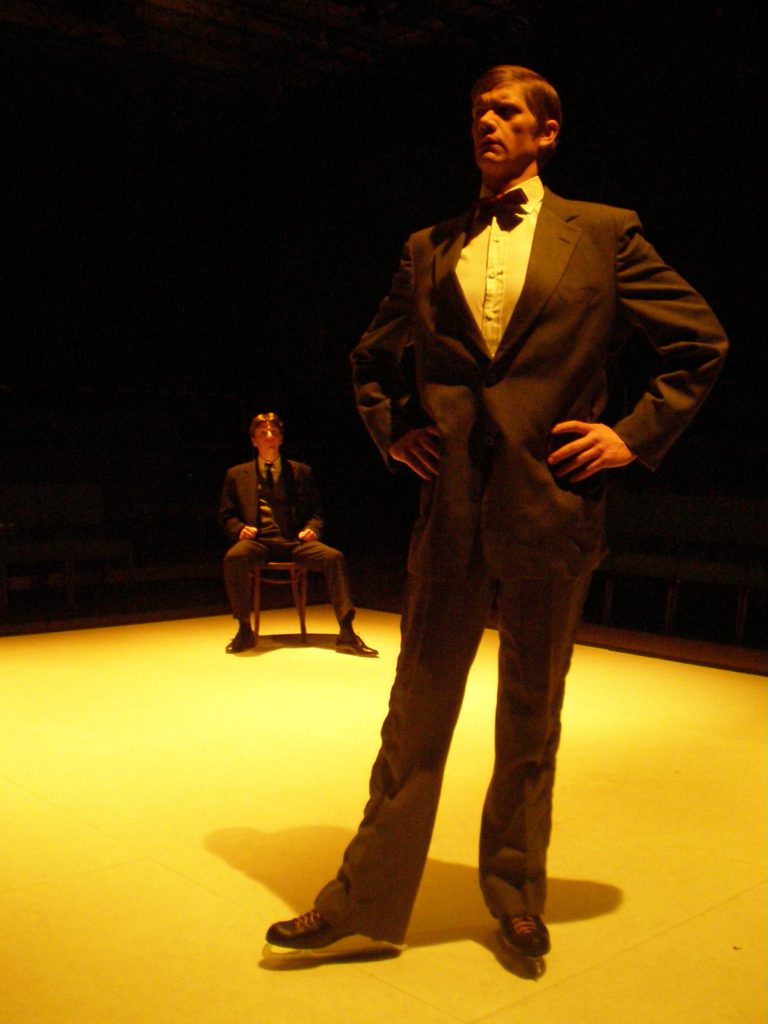
A man in stark lighting poses in the foreground while wearing ice skates. In the background, another man sits in a chair staring at him.

Westword- Kafka on Ice succeeds in this slick go-around by Buntport

How perfect that Buntport is reviving Kafka on Ice – first produced in 2004, and one of my favorite of the company’s many inventive works – as part of a citywide celebration of all things Czech. First, because Franz Kafka is the Czech author best known in this country, with legions of schoolkids guided every year through his novella, The Metamorphosis, in which the protagonist, Gregor Samsa, wakes up one morning to find himself transformed into a giant beetle. And second, because the Buntporters’ sensibility, humor, use of objects and puppets, bare-bones tech and ways of playing with physical size and perception are so very Czech. When, for instance, Kafka sends one of his stories to a woman he loves, in her hands it unfolds into the paper figure of a man, with which she then dances. “The work does well with her,” he observes. The beetle itself takes many forms in this show, from an elongated shadow to an actor in a big, huggy felt costume. In one frenetic scene, it morphs from a hand puppet into a plastic remote-controlled toy that skitters frantically around the stage.

There’s a brilliant mix of genres and parodies on show as well, from a flirty, meet-cute, silent-movie-style ice-skating scene (oh, yes, everyone except Kafka himself skates through this) to a high-stepping parody of the Yiddish theater the author attended with a friend.

The script of Kafka on Ice is unchanged from the first iteration, and yet the show felt different this time around – still intensely funny, yet sadder, too. Critics talk about how the plight of poor Gregor – trapped and isolated in his ugly carapace, terrified of his father and reliant on the intermittent kindness of his sister, slowly sickening until, to the relief of his family, he quietly expires – reflects Kafka’s despairing view of his own existence. Buntport intertwines this plot with pieces of Kafka’s other writings and events from his life, and while I remember some glimmers of transcendence last time, they now seem to have vanished. Perhaps in part because Josh Hartwell has taken over the role of Kafka from Gary Culig and makes him more baffled, gentle and unhappy; perhaps because the entire ensemble – all the other performers are the same – has matured and changed in indefinable ways.

But with this production, I was more aware of a parallel theme, one that carried a fragment of hope. An author’s work is never really his own, nor is his life. Kafka on Ice explores the transformations and permutations Kafka’s work and reputation went through in the years following his death – including this production itself. In one hilarious scene, Erin Rollman plays a somewhat dim teacher trying to explain symbolism with the aid of a soulless educational cheat sheet. In another, lepidopterist and major literary figure Vladimir Nabokov (Erik Edborg) gives his scholarly opinion on just what kind of creature Gregor Samsa transformed into. But there’s also a quietly powerful interlude in which a voice in the dark simply reads the beginning of the story. The lights come up, and we see a schoolboy walking slowly across the stage, book in hand. Every now and then Kafka/Gregor’s existential loneliness gets broken – by a sudden embrace from the charlady, for example, outrageously played by Evan Weissman in a maid’s outfit. (I took this as a manifestation of Weissman’s essential kindliness, since the charlady in the actual book is a pretty rough character.)

Before he died, Kafka asked his close friend and literary executor Max Brod to destroy all of his work. Brod didn’t – an obvious betrayal. But what I’d missed before and definitely noticed this time around was a certain depth to Brian Colonna’s Brod, and words that justified an action that not only preserved Kafka’s priceless literary legacy, but in some sense rescued his soul.

-Juliet Wittman, February 2, 2011, Westword

Close-up of an unhappy looking man in stark lighting. He has many pairs of ice skates draped over his shoulders.

Westword Blog- The Buntport Theater was looking good at Kafka on Ice’s reopening

More than once during the Buntport Theater’s Kafka on Ice, the character of Franz Kafka (played by Josh Hartwell) comments on how stupid it is to stage an ice-capade revolving around his life and work. “It’s inappropriate!” he protests. As justification, toward the end of the play, another character offers up an aphorism once penned by Kafka himself (most likely about himself): “He runs after facts like a beginner learning to skate, who, furthermore, practices somewhere where it is forbidden.”

It’s an interesting way to tie it together – but it’s telling, and pretty awesome, that the Buntport troupe didn’t dig up that quote until after they’d decided to put Kafka on ice.

The inspiration for the play, it’s fairly well known, was actually the ice itself. “We were teaching a class, Evan [Weissman], Erin [Rollman] and I,” says troupe member Hannah Duggan, who helped adapt the show an plays several characters in it, “and one of our students was like, ‘I have a skating rink in my back yard,’ and we’re like, ‘no you don’t.'”

As it turned out, that student’s father was a manufacturer of synthetic ice, which Duggan describes as “plastic with Armor-All sprayed on it,” and the Buntport decided they had to do something with it. “So we thought, well, what could we do on ice? And Kafka just seemed like the best choice. Just because it seems so not on ice. It really couldn’t be less.”

In a weird Buntport way, this makes perfect sense.

That was all back in 2004, when the production was first staged – soon after, the fake ice, along with all the production’s setpieces and costumes, was stolen, and the show was gone – but not forgotten by anyone that got to see it or even hear about it. For good reason: It’s bizarre, hilarious, heartbreaking, brilliant and silly; as Westword own Juliet Wittman wrote back when it was first staged, “It’s safe to say that no one else – anywhere – is doing theater like this.” And that’s still pretty much true. Now, with the help of some generous benefactors who helped the company acquire a new sheet of ice, it’s back. And you’re a fool if you don’t go see it.

A big part of what makes this play so striking and different is the way that it’s set up. The set design is bracingly minimalist: Just a room with the fake ice in the middle of it, a desk and a couple of creative props: Memorable ones include a tiny model of a bedroom, a remote-control cockroach (you really just have to see it to understand how great this is) and the startlingly beautiful use of a large sheet.

Like Kafka, the Bunport spends this show running after the facts of his life like beginners learning to skate – literally: When they decided to do this show, nobody could skate. “We still don’t really know how,” Duggan jokes, “but we do anyway.” Still, while it’s interesting, that quote is hardly a necessary justification. After all, Kafka had a famous penchant for the bizarre and the surreal, for placing straight-man characters in the middle of absurd insanity – and if the play’s underlying argument that Kafka’s characteristic straight-man character was really Kafka himself is true, then maybe Kafka would have appreciated these proceedings more than even the play itself admits.

-Jef Otte, January 31, 2011, Westword Blog

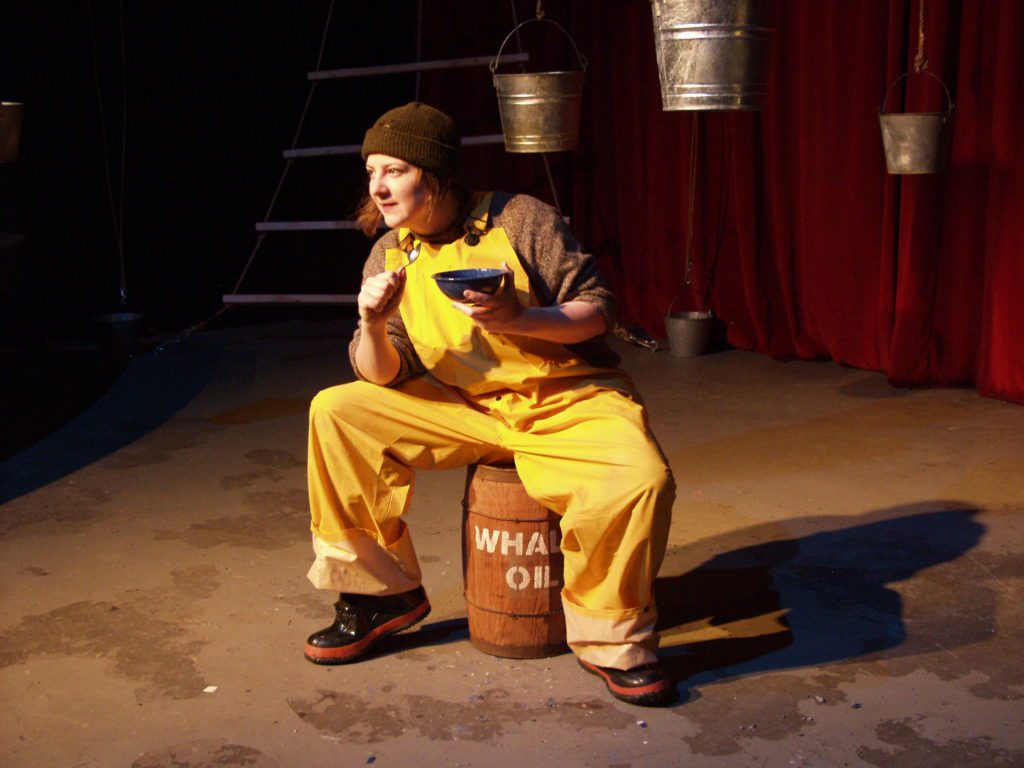
A sailor wearing bright yellow overalls and boots sits on a barrel marked “whale oil” while holding a spoon and a metal bowl. In the background is a red curtain, a rope ladder, and several hanging buckets.

Westword- The floor gets very wet in Moby Dick Unread

When I first attended a Buntport Theater Company production and found six people in the audience – myself and my friend two of them – I’d never have predicted that the troupe would make it ten years. Other smart and talented companies have fallen by the wayside, but the six Buntporters, who met at Colorado College, moved to Denver and create all their material collaboratively, just keep on going. For this anniversary season, they’ve chosen to remount some past productions and do staged readings of a couple of others. Some might see this as a copout or a year-long semi-vacation – and I’m sure it’s partly that. But it’s also an opportunity for the members to examine past material and get a sense of where they might yet go. And for viewers who haven’t yet experienced their quirky, experimental brand of theater, it’s a chance to catch up.

The company has done a lot of exploring in ten years. Buntport has created spoofs of well-worn genres; rock musicals; horror; a serious, low-key domestic play; and another that’s upside-down political. Everything it does testifies to the power inherent in objects – which sometimes become people – as well as the crazy malleability of the physical universe and the centrality of the actor, who creates entire new realities with nothing but his mind, voice and body. The sets are cheap and inventive, the scripts a mix of brilliance and silliness. Among the shows Buntport will reprise this year are Seal. Stamp. Send. Bang., a ridiculously funny takeoff on the postal system; Winter in Graupel Bay, a bittersweet evocation of small-town life; The 30th of Baydak, which reminds us of the grim reality of life under dictatorship; and perhaps my favorite Buntport show ever, Kafka on Ice, a play I thought would never come back because some nasty human had stolen the artificial ice on which the action takes place.

The first revival, Moby Dick Unread, opened last week. The inspiration is literary, and the tone veers dangerously between satire and homage. Someone in the troupe – or perhaps everyone – loves Melville and wanted to spend weeks immersed in his great novel. But what caught Buntport’s attention was not the overarching story of Captain Ahab and his nemesis, but all the quirks and diversions. Where producers usually streamline novels, the Buntporters focused on Melville’s disquisitions about carpentry, whether the whale is or isn’t a fish, Garnery’s paintings of whales and whaling, and the difference between a fast and a loose fish. They found humor in Moby Dick, and also moments of poignance – such as Pip’s near-drowning and subsequent madness. Inevitably, this means there’s a shagginess, even formlessness, to the production, but it’s faithful to the discursive nature of the book. Mercifully, it’s also much, much shorter.

Other Buntportian hallmarks include self-mockery. The actors frequently draw our attention to the artificiality of what they’re doing. They switch roles by donning a hat or doffing a sock. The sea is a group of buckets suspended by ropes, the harpoon a spoon, Jonah’s whale a chalk drawing. “We’re making do,” everyone keeps assuring us. But we only need a chalk outline or a toy to represent the whale, since it’s the concept of whaleness that Buntport is evoking.

When I lived in New York, experimental theater was contemptuous at the core. You – the audience – were the bourgeoisie, and you were there to be scorned and made uncomfortable. The actors might yell in your face, or jump over you, or release live rats among the seats. The Buntporters are exploring some artistic edges, but they’re doing it in the most genial way possible. The floor gets very wet in Moby Dick Unread. So at the end, after the applause, the actors walk forward and – almost before you can figure out what they’re holding under their arms – unroll strips of carpeting so you can get to the exit without slipping. How can you not love these guys?There are also moments of unexpected beauty: The prologue is performed by Eric Edborg, who summarizes the entire plot by chasing a wind-up white whale around a tank of water – but then he suddenly sends a long arc of glistening spray from one end of the playing area to the other. The other performers – all energetic and delightful – are Erin Rollman, Hannah Duggan and Brian Colonna.

-Juliet Wittman, September 23, 2010, Westword

A man in a brightly colored suit stands talking. One of his arms appears to be separated from his body and is putting a toy gun in his pocket. Seated in the background, a woman dressed as a magician’s assistant but wearing mechanics pants looks unimpressed.

Colorado BackStage- Jugged Rabbit Stew, the musical

When the magician pulls the rabbit out of his hat, no one thinks about the rabbit. It’s the magician who basks in the gloried applause. After all, he pulls a rabbit out of an empty hat.

Therein lies the problem.

Who is this rabbit? Isn’t he part of the magic? Or is he, after all, the magic itself?

The collaborative Buntportians, along with Adam Stone composer and lyricist, decided it was about time to seek out the rabbit and oh what a surprise they let themselves in for. The result is Jugged Rabbit Stew, the musical playing at Buntport through June 19. Charming, delightful, poignant, thoughtful Jugged Rabbit Stew is couched with humorous entanglements of the serious and even with just one-week left, should not be missed because of its electrifying creativity.

Discovering Snowball, eagerly and delightfully played by Erik Edborg, although there is no sign of Edborg anywhere to be found, there is a magic rabbit that has had it with the hat trick. After all, who gets the credit and glory? Not Snowball. It’s Alec the Amazing and All-Powerful, deliciously played by Evan Weissman.

Schlepping around in pajamas, robe, and bunny slippers, Snowball falls into a deep depression. Eating only mashed potatoes, wanting to be left alone to watch home movies over and over again.

Mystical Marla loves Snowball, and begs him to return to the magic show. Hannah Duggan takes on Mystical Marla with good reason. Magical as Snowball is, sometimes he doesn’t always complete his eye-popping stunts. In sawing off her legs during the last show, he re-connected Marla with a pair of man’s legs. Having trouble controlling them, they don’t always do what Marla wants them do.

All Alec ever wanted to do was to be a magic man. He wanted to be appreciated and loved. Nothing worked, until he found Snowball in a cage by a dumpster. The magic belonged to Snowball, and Alec ate it up knowing full well, deep inside, he “needed someone to complete him”.

Alec and Marla would do anything for Snowball, they’d become whatever he wanted them to become, and they’d be whatever he wanted them to be.

Snowball could care less.

Not only did he connect Marla with the wrong legs, he made Alec disappear. In the reappearance Alec was missing his right arm, which independently appeared on its own. Dressed in black from head to foot except for his right arm, Brian Colonna plays The Arm with delectability. It’s The Arm, dressed in red that is seen, heard and paid attention to. Unbelievable as it sounds, the Arm richly becomes a character all to its own. You hear him, see him, believe him, and, oh, the arm has much to say.

In his cock-eyed upside world of confused Fate, Snowball takes great delight in collecting objects and hanging them from the ceiling. And he does this because? That’s what Marla wants to know. Why?

The latest acquisition just happens to be a woman in a rocking chair. Alec’s biggest Fan, she attended many of the magic shows. For a while she even gave Snowball hope. Something went sour, and she ended up hanging from his ceiling.

Erin Rollman stuns the senses with her professionalism, sitting in a rocking chair, hung by cables for the entire show, Gaa Gaa over Alec, finding a wondrous sense of love with The Arm, playing a bright-eyed simplistic little girl in a woman’s body awed by the magic of an insolent broken hearted rabbit and a starry-eyed magic-less magician competing for attention from The Arm.

Buntport’s enchanted imaginative world draws in the audience with exquisitely defined characters expertly brought to life by imaginative, definitive artists.

As Marla presses Snowball for the why of the collection, this encased world explores questions of love, defining identity, fate verses destiny verses choosing one’s own path, and what happens to the self when a person wishes to become whatever anyone else wants them to become. And what happens when someone who has no magic, but hungers for it, steals the magic in one’s life for credit? Intriguing how this make believe world coincides with today’s society.

Jugged Rabbit Stew is simply a brilliant piece of work that amuses, tugs at the heartstrings, and with clever lyrics points the thought process into bold directions.

With his grouchy, self-annihilating, depressed self, one still wants to reach out and hug the rabbit. He, who hates to be petted since a little girl who just wanted to love him, petted him once too often.

Snowball can’t forget his mother and father. In a clever piece with rabbit marionettes he finds himself singing with them, Oh father you look so free. Oh mother, am I what you thought I’d be? His mother responds, My son, there is no limit to how great you’ll become. By now the magic seems meaningless to Snowball, and he begins to see his fate float toward a less desired direction.

Jugged Rabbit Stew features the talents of Steven J. Burge, GerRee Hinshaw, Andrew Horwitz, Clarity McKay, and off stage SamAnTha Schmitz. Gypsy Ames deserves credit for co-creating Snowball’s mask. After Snowball’s disappointing ride to glory, far be it from me to ignore credit when credit is due.

A fun game for Jugged Rabbit Stew exists on Buntport.com. The CD is available for purchase for $10.00 at Buntport, and it’s worth every dime.

There’s only one weekend remaining in the run of this brilliant production. They have been playing to sold- out houses. No surprise here. Buntport’s Jugged Rabbit Stew provides a refreshing, humorous, poignant slice of life in a wondrous make-believe world that will not want to go away. It makes sense. Think twice the next time you want to hug a bunny once too many times. Magic gets thrown away all too often just because it isn’t recognized for what it is.

-Holly Bartges, June 15, 2010 , Colorado BackStage

A large rabbit wearing a ratty robe and bunny slippers slumps in a lazy boy recliner. There is a television on the floor infornt of him and two more hanging above him. The floor is covered with newspaper.

Blogspot.com- Buntport’s ‘Rabbit’: musical a dream awake

We have moved into full-on hallucinatory territory.

Buntport’s final production of its 10th season is “Jugged Rabbit Stew,” an original musical that is fascinating, entertaining and thought-provoking in the Buntport tradition.

Except that there is no tradition. Every time it seems that the collaborative is about to lapse into a house style, the group subverts itself, turns its approach inside out, pies itself in the face. In a culture where art and entertainment is churned out with assembly-line predictability, Buntport keeps things fresh and alive.

Just as Buntport is a theater in the existential sense that it’s a group of people that explores the human condition live onstage, “Stew” is a musical in that it contains songs. Everything else is up for grabs. The plot is marginal, the characters are, literally, fragmented, tangential speculations abound, and in the end the whole contraption just kind of drives off the edge of a cliff.

It’s great!

The central figure is a giant magical rabbit, played by Erik Edborg, clad in ears, paws and anger, chugging booze from a hutch’s water dispenser. He is the deus ex machina – ruling the others on stage like a sociopathic Harvey, or the furry, fanged Frank from “Donnie Darko.”

His victims/cohabitants in his newspaper-lined rectangle of a room are his magician, Alec the Amazing and All-Powerful (Evan Weissman), magician’s assistant Mystical Marla (Hannah Duggan), Erin Rollman as a Woman suspended in space, along with a handful of props, above the stage for the length of the show, and Brian Colonna as Alec’s missing right arm.

Yep.

The score is by Adam Stone, who previously collaborated with Buntport last year on another original musical, “Seal. Stamp. Send. Bang.” He’s a facile composer who’s conversant in the modern musical style – flowing, pop-catchy, swooping ballads – as well as genre pieces (for instance, a gentle country/Western ode, “Hand in Hand”).

More importantly, you can tell from his writing and arrangements that his skills are extremely broad and deep: his work simultaneously reinforces the form’s traditions and asks pointed questions of it – for instance, how do you make rhymed couplets out of the chaotic premise, and singable ones at that?

Yet, Stone and Buntport do so – like Cole Porter on acid. Buntport’s members can sing, too, which is a more complicated task than the layperson might think. Besides staying tuneful and in key, a musical performer has to sell the number, stay in character, move through choreography … and breathe. Daunting, but they do it. And numbers such as “When Love is There to Blind You,” “Take Me, Break Me, Make Me Something More,” and “That Special Hare” are stand-alone good.

(Um, confession – I have been playing the cast album in the car and singing along … loudly. That’s an endorsement – CDs are available for purchase in the lobby!)

There’s no plot to summarize. Every character suffers from incompleteness. Everyone wants to be something else — as one lyric states, “To be the version of myself/That I want the world to see.” Amazing Alec’s right arm states, “I don’t have a pocket – that’s my tragic flaw,” and most of the others mull over the tragic-hero state and the fate implied for such a figure during the show. Death, fate and love are the themes here, and they are covered from a multitude of angles as the show careens forward.

Mystical Marla sports the bottom half of a car mechanic, thanks to Snowball’s magical wrath. Ditto for Alec, who can’t do much prestidigitation without his missing limb. Meanwhile, Arm (Colonna somehow performs covered in black, save for his brightly clad appendage) falls in love with Woman; everyone is at odds with each other, and all clamor for love and resolution from Snowball, who can only perceive himself as prey.

The abrupt and brutal and artfully staged conclusion still has me wondering what the hell happened. In honor of it, I won’t offer the usual sweeping statement or grandiose deduction or satisfying summation that form the final-paragraph-ending “kicker” of a review; “Stew” is a good, thought-provoking show and you should go and experience it.

Excuse me, I need to go drive around and sing now.

-Brad Weismann, June 10, 2010, bradweismann.blogspot.com