Buntport Theater

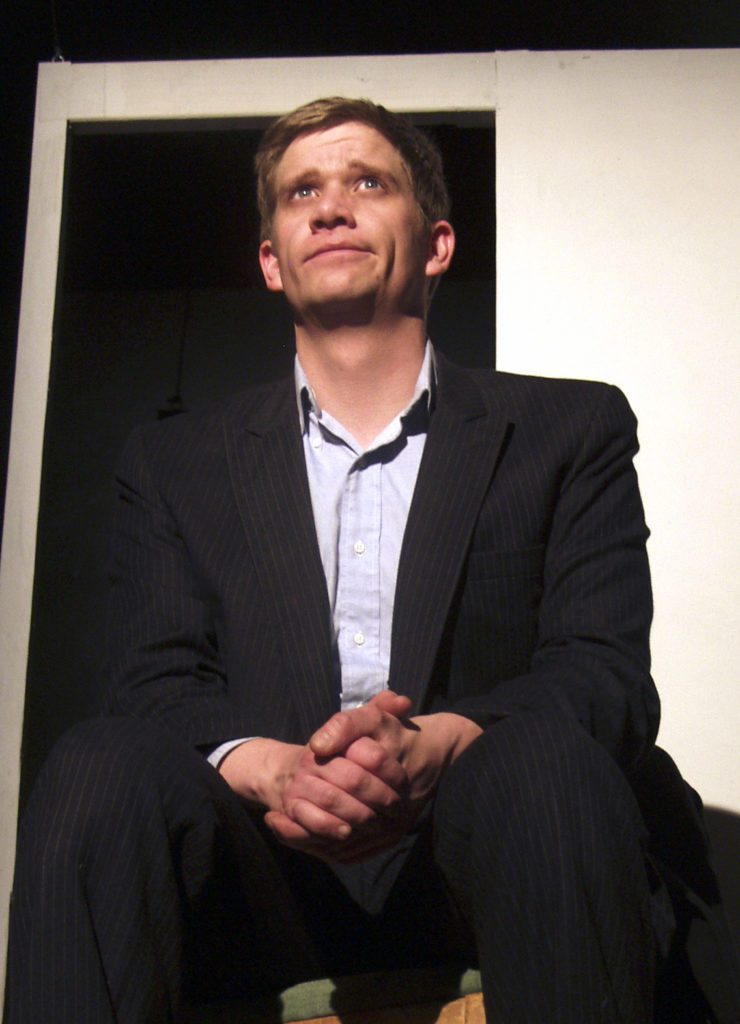
A man in a pinstriped suit clasps his hands in his lap, staring out wistfully.

Westword- Winter in Graupel Bay • Our Town meets our town in Buntport’s latest

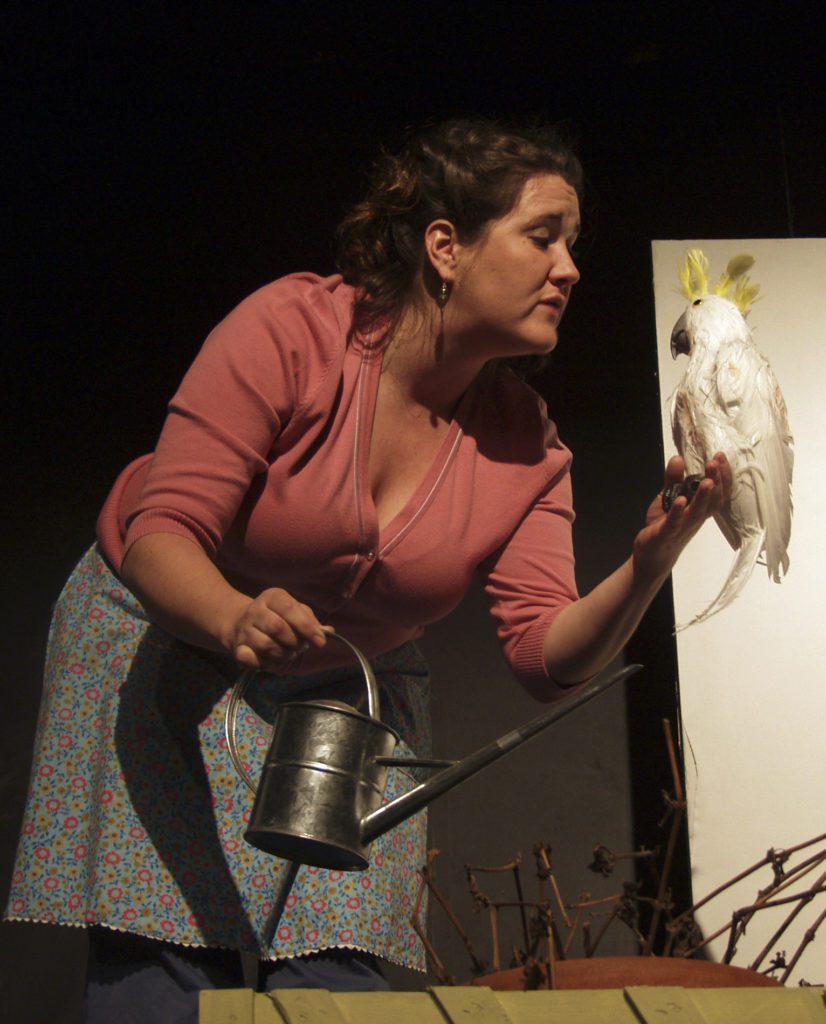
When you enter Buntport Theater, you find yourself facing what looks like the front of a long, low, open dollhouse with rooms on two floors. These spaces are inhabited by various eccentric characters. There’s Polly, the little girl who serves as narrator; a pair of gossiping old crones;

the hapless and perennially unemployed Andrew Fromer, with his dreams about a vaudevillian grandfather who played the rear end of a horse and longed to play the front. Bruce Bentley is a man with a single passion, photographing snowflakes; the town drunk, Toothy Bill, has the soul of a poet; the proprietor of the local shop fondles an imaginary pet – Snowflake, her deceased and beloved cat. And we also meet Lady Fergus, a delusional elderly woman who believes she’s an aristocrat and has persuaded the local banker to serve as her butler.

The day is the winter solstice, and the tone of Winter in Graupel Bay nostalgic and tinged with melancholy. There’s a touch of Thornton Wilder’s Our Town, or such pastiche, multi-voice pieces as Dylan Thomas’s Under Milkwood and Edgar Lee Masters’s Spoon River Anthology. Polly grieves for the lengthening nights and shortening days; later, we learn that it’s possible to celebrate darkness.

With each of the five Buntport actors playing more than one role, the action flows easily from space to space. Some of the characters are more convincing than others. Erin Rollman is charming as the precocious Polly; her shop proprietor and befuddled Lady Fergus are funny but less grounded. You feel for Hannah Duggan’s lovestruck Peg Muford and Brian Colonna’s sad-sack Andrew Fromer. Erik Edborg’s Toothy Bill, with his kick-stamp walk and wolfish grin, is quite wonderful – as is the enigmatic persona Edborg presents at the play’s end, despite the fact that I never figured out who he was supposed to be or what he represented. Something to do with the moon, I think.

Winter at Graupel Bay contains so many of the elements I love about Buntport – the humor, intelligence and originality; the ingenious use of space; the lively, expressive music and appealing performances – that I hate to say it doesn’t quite work. But alas, it doesn’t. While the production is pleasant to watch and often humorous, it’s neither consistently comic nor consistently evocative. A lot of the dialogue is literate and interesting, but other parts are flat. The character of Bruce Bentley, for example, is clearly based on nineteenth-century naturalist Wilson Bentley. According to Kay Redfield Jamison’s wonderful book, Exuberance, Bentley brought such passion to the photographing of snowflakes that he mourned for years over one crystal, broken while being transferred to a slide. Evan Weissman renders Bentley’s quiet depth perfectly. But the script calls for Bentley, frustrated by a dry spell, to simulate a snowstorm with flour, creating a model of the town and deploying a large sifter. The result is clever, but the entire concept struck me as too self consciously whimsical. As did the ever-present dead cat, although Rollman’s mime as she stroked and cuddled it, and at one point tried to avoid being scratched, was very amusing.

Like all of Buntport’s plays, Winter in Graupel Bay was developed entirely by the seven-person company. (In addition to the on-stage actors, Matt Petraglia and SamAnTha Schmitz contribute their creativity and expertise.) What they’ve created here is charming and soulful, but it needs more work and a stronger, clearer contour.

-Juliet Wittman, December 14th, 2006, Westword

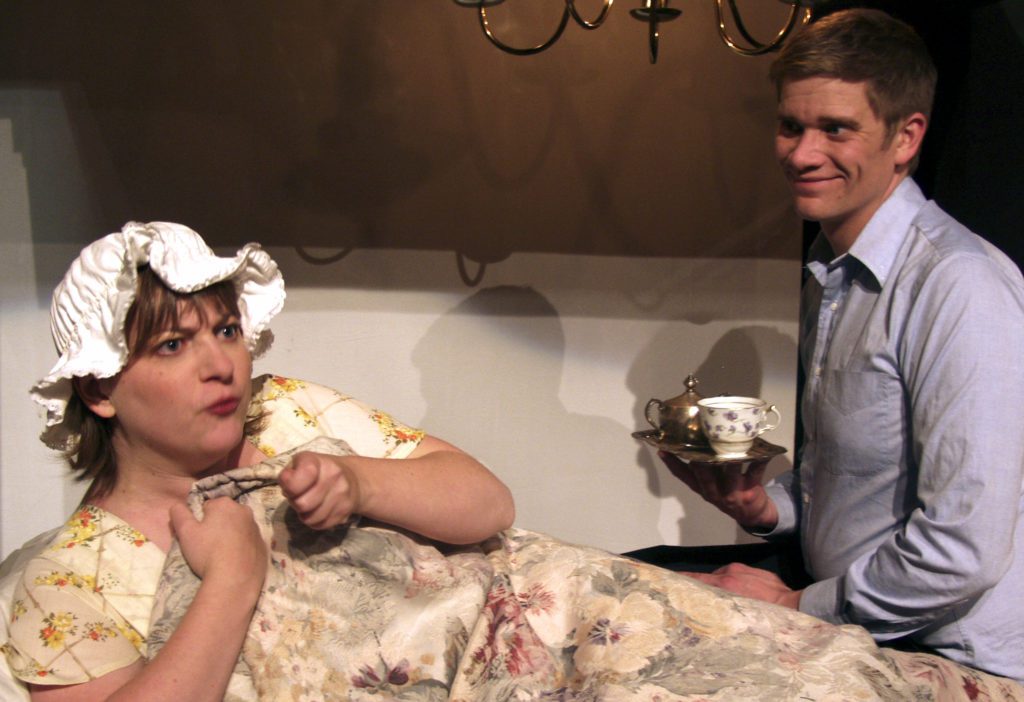
An annoyed woman in a sleeping cap clutches her bed covers as a smiling man sits on the edge of her bed, holding a small tray with a teacup and sugar bowl on it.

Denver Post- Buntport stitches life of a town into holiday quilt

To answer the perennially perplexing question – “What to perform during the holidays?” – Denver’s perpetually innovative Buntport Theater has created “Winter in Graupel Bay,” a poignant and witty snapshot of the residents of a small town on the shortest day of the year.

The company’s evolving proficiency in collaborative theater – this is its 20th original production – expresses itself in a delightfully complex and interwoven storyline and a poetic script that conjures a neighborhood somewhere in the vicinity of Thornton Wilder’s “Our Town” and Dylan Thomas’ “Under Milk Wood.”

A spare but multifaceted set offers us a cutaway of the residents’ living quarters and entry into their intimate behavior. The jazzy sound design that accompanies the scenic interludes of the burghers scurrying to and fro sets an up-tempo pace for the proceedings.

Above all, Graupel Bay is inhabited by a collection of quintessential characters; company members play multiple roles. Precocious Polly Soldonovich (Erin Rollman) serves as the narrator, setting the stage and filling us in on the locals’ eccentricities. Dressed in a jumper and accompanied by only a small rubber ball, Rollman skips from one abode to the next, inviting us to join her as she makes her inquisitive rounds.

First, there’s Mrs. Green, an elderly gossip who trades barbs with Mrs. Walsper at tea every day, where they perform their version of Russian roulette, each trying to poison the other when she’s not looking. In an ongoing series of vignettes, Hannah Duggan and Rollman switch cups with elaborate hand choreography, orchestrated to a riot of vocal gymnastics that air the neighborhood’s dirty laundry.

Every town needs a loser, and in Graupel Bay that’s Andrew Fromer, who for the life of him can’t seem to land a job. Morose from head to toe with a face nearly as long, Brian Colonna’s Andrew mopes around town when he’s not seeking solace in sleep. We learn he’s inherited his karma from Great-Grandfather Fromer (Evan Weissman), who spent his whole career in show biz as the rear end of a horse.

Weissman sends us to a bygone era with his melodramatic flair for vaudevillian song and dance numbers – first a soft-shoe solo and then a spin around the stage with Duggan’s Peg Mulord.

Erik Edborg, as the local drunk, Toothy Bill, cleverly avoids overdoing the stereotypical indications of inebriation, painting a souse worthy of the best fools: silly one moment, astute the next.

As the day unfolds, we meet the rest of the townfolk, including the irrepressible Rollman’s Miss Perkins, the terminally cheery shop owner; Lady Fergus, a pretentious bed-bound grand dame of operatic proportions; Colonna and Duggan’s Bob and Addy Hooks, he obsessed with the obits and she with her cockatoo; Weissman’s Clark Walters, a couch potato with a penchant for old movies; Bruce Bentley, whose daily purchase of flour is a local mystery; and Edborg’s William and Larry Lunelia, a lonely banker and a stargazing dreamer.

If you’re burned out on the Sugarplum Fairy’s magic and Ebenezer Scrooge’s miraculous transformation, perhaps a day in Graupel Bay is just the ticket to lift your holiday spirits and bring home your everyday blessings.

-Bob Bows, December 8th, 2006, Denver Post

Shoulders down image of a man in a brown suit, he has one sock on his foot and one sock on his hand. He is resting on a leather suitcase.

Rocky Mountain News- ‘Rotten’ socks it to audience Puppets pile on plenty of parody in Buntport’s ‘Hamlet’

It all began with a lost sock at a laundromat in Texas. Eventually, the sock returned, ghostlike, pale and floating.

“Looks it not like my sock? Mark it, Harold. Speak to it,” said the sock’s owner, Julius.

So begins Something Is Rotten, a rendition of Hamlet that is ludicrous even by Buntport Theater standards. And while the company’s creative standards have prevailed in recent serious fare, it’s a joy to see this group of seven return to high comic form.

Julius (Evan Weissman) and Harold (Erik Edborg) have teamed up with a narcoleptic thespian, George (Brian Colonna) after that sock convinces them to stage a production of Hamlet. The problem: Harold and Julius aren’t actors, and George can’t stay awake long enough to make it through his own soliloquies.

The result may be the best bad theater you ever see.

What makes this more than just a parody of bad theater are the carefully drawn characterizations. Some of the funniest moments come in the first 10 minutes, as Julius and Harold awkwardly try to set up their performance. In black pants and a turtleneck, Harold tries – and fails – to be commanding and professional. Both are tense, trying to forge ahead while George lies unconscious on the floor.

In his tassel loafers, tennis socks, fanny pack and shorts, Weissman makes a visual punch line, increased as his character preens in the light of newfound fame.

They forge ahead, trying to present the show while George naps, a show that would be much better, Harold says, “under normal circumstances, which are rare.”

Buntport’s normal ingenuity – supplemented offstage by Samantha Schmitz, Matt Petraglia and Erin Rollman – makes itself evident in this production, where puppetry is extended beyond just a sock puppet as Hamlet’s father. A Teddy Ruxpin doll with pre-recorded tapes plays Polonius; Laertes is a toy truck; Ophelia is a live goldfish. For the two-faced Gertrude and Claudius, Edborg dons a double-sided costume, one half a giant mask of the king that flips over to become Gertrude’s flowing locks while her body spills out of a tiny suitcase.

Colonna fades in and out of narcoleptic attacks to take on the role of Hamlet (it seems this was supposed to be a one-man show), pouring himself into the role until the actor and the character are equally unstrung.

Two-thirds through, the jest loses some momentum, but it’s a brief fade until the show comes bounding back to a bloody finish.

The evening’s frivolity is introduced by Hannah Duggan as Janice Haversham, “local” performer here to prepare us for the tale of Hamlet. With appalling folk songs and the quality of a local public radio personality, she moves from a desperation to be liked to just plain desperation in a well written and performed curtain opener.

-Lisa Bornstein, September 22, 2006, Rocky Mountain News

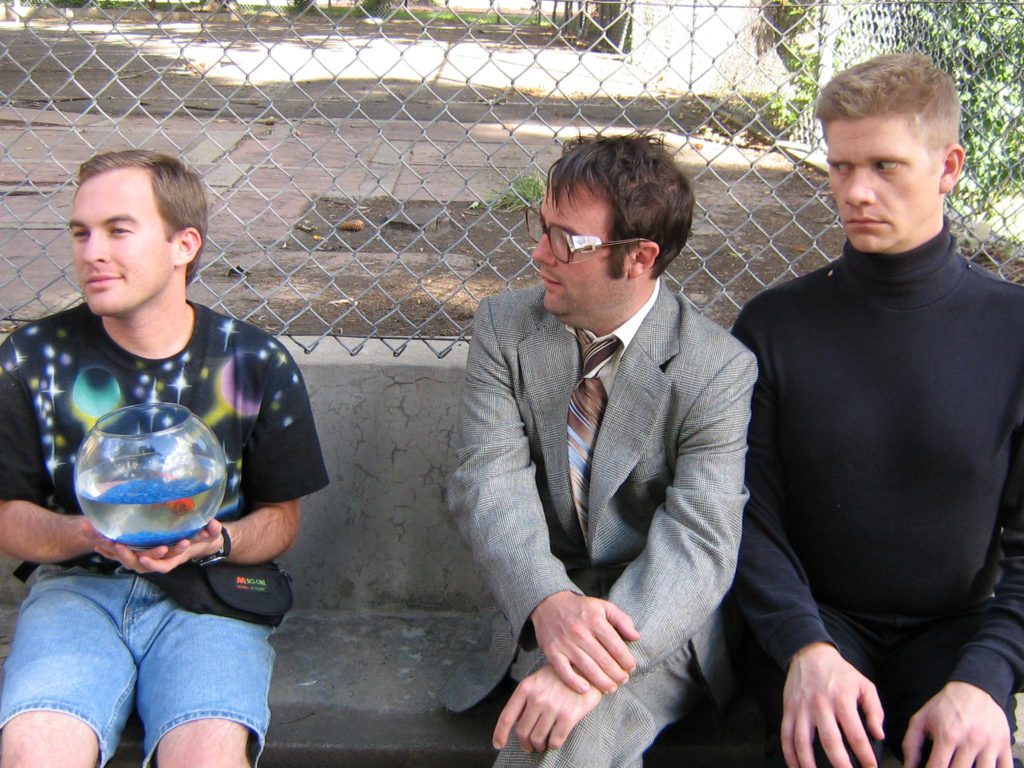
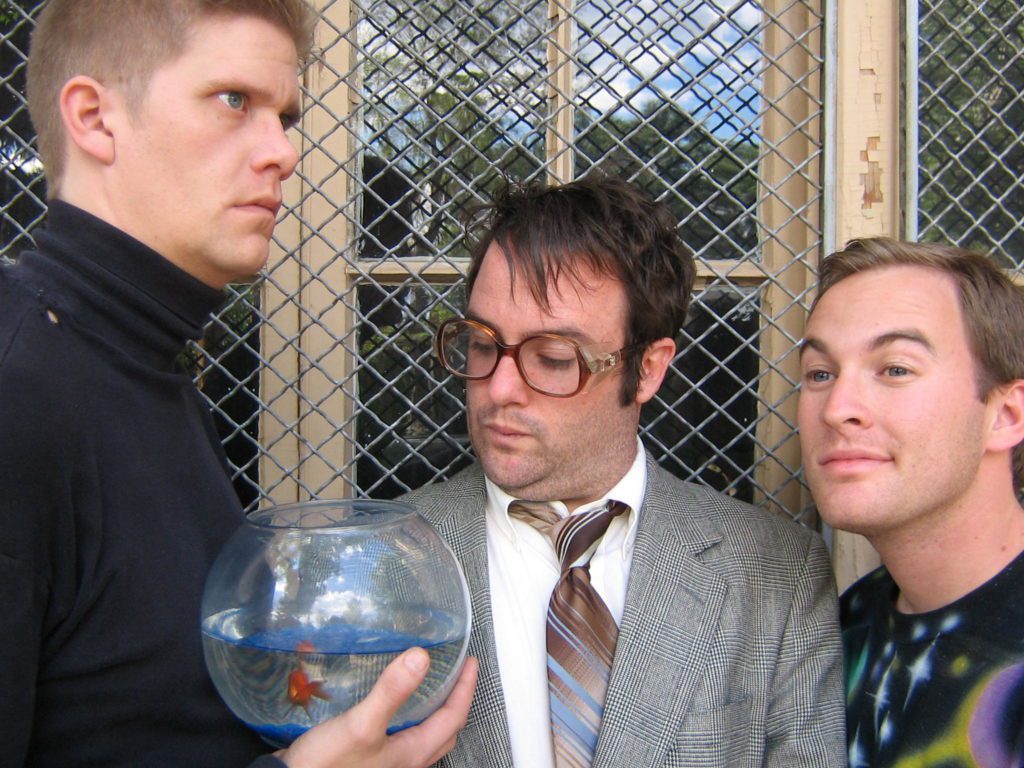
Three awkward men sit in front of a chainlink fence. On the left is a smiling man with a space t-shirt on he is holding a fish bowl with a goldfish. In the center, a man in a suit and large glasses purses his lips. On the right is an intense man with a buzz cut and black turtleneck.

Denver Post- A “Rotten” good time

Imagine a kid, 16, sitting in a theater – a live theater – guffawing, thoroughly engaged, leaping up at curtain call. And it’s Shakespeare, even. Kind of.

That Laertes is played by a remote-controlled toy bulldozer may have had something to do with it. Or Ophelia as a live goldfish (wait, can a goldfish drown?). Or Polonius as a Teddy Ruxpin doll, his “to thine own self be true” speech recorded on the cassette in his back. Or the gravedigger sampling Justin Timberlake’s “I’m Bringing Sexy Back.” Or Horatio as a marionette with Irish actor Geoffrey Toone’s face taped over his.

OK, maybe the 16-year-old missed that one. I know I did.

That doesn’t begin to explain the appeal of Buntport’s 16th original creation, “Something is Rotten,” featuring “Hamlet” – as a sock puppet.

There have been plenty of stabs at dumbing down the Bard (“The Complete Shakespeare Abridged”). “Rotten” is silly, but hardly dumb. Just the opposite.

“Rotten” is a ripe introduction to Shakespeare. But what that kid won’t even realize is that “Rotten” is a pretty accessible introduction to Samuel Beckett as well.

Three inexplicably, inextricably tied pals, only one an actor, have been compelled to perform “Hamlet.” By whom? The ghost of one’s long-lost sock, of course. No other context or explanation, no sense of time, place or greater purpose. Buntport doesn’t play by those rules. It’s absurdly Beckett.

Julius (Evan Weissman) enters preening and shy, a hint of an actor begging to break out from within him. Harold (Erik Edborg) is dressed in black, stern but trepidatious. He’s a ’50s-looking combination of Michael Douglas in “Falling Down” and Dieter (“Vould you like to touch my monkey?”). Sprawled between them is George (Brian Colonna) an intense “thee-a-tah” actor and narcoleptic.

With a trunk, a few cases and a coat rack, they embark on a fearful demonstration of the power and humor in transformative theater.

Harold, for example, portrays Claudius and Gertrude at once. As the foul king, he has an oversized mask over his head. To become Gertrude, he flings the mask back to reveal his wigged face. Simultaneously he unclasps a bowling bag, unfurling the queen’s dress before him. Brilliant.

The three oddballs bicker and banter as they go about their existential task, never questioning the necessity of its completion. But only George takes the actual art of the presentation all that seriously. His sleepy bouts allow his pals to skip ahead.

Julius is insistent on just two things: the safety of his beloved fish, and that the famous “play within the play” be a cutting from “Death of a Salesman.” As you can imagine, that slightly mucks up eliciting a guilty reaction from the king.

Does “Rotten” mean anything intellectuallly? Who knows. But the writing is absurdly clever, the performances sublime.

The pre-show amusement is an enormous treat; Hannah Duggan performs an endearing new-age folkster’s intro to Shakespeare. Duggan is funny from her first word to her final eyebrow twitch – better than anything “SNL” has done in a decade.

It was obvious the grandparents nearby loved “Rotten” as much as that 16 year old.

Imagine again: Buntport fans new and old walking out buzzing. Just another night at Buntport, where the only comfort zone here is entering a creative danger zone.

-John Moore, September 15, 2006, Denver Post

Three awkward men in front of a window grate. On the left is an intense man with a buzz cut and black turtleneck, holding a fish bowl with a goldfish in it. In the center, a man in a suit and large glasses purses his lips. On the right is a smiling man with a space t-shirt on

Westword- That’s Entertainment • Buntport makes magic with something is rotten

The action of Hamlet all hinges on an injunction by the ghost of Hamlet’s father, who appears on a bitter cold night to tell the prince he must kill his murderous and usurping uncle. Everything that happens in Something Is Rotten is also set in motion by a ghost — in this case, the ghost of a pink striped sock that insists the three performers mount a production of the Shakespeare play.

Julius, the weirdly smiling, dim-witted but steel-willed owner of the sock, who’s played by Evan Weissman, bullies two friends, Harold and George, into fulfilling the command. But Harold is doubtful. Erik Edborg gives Harold the stern expression and deep, haunted eyes of Samuel Beckett, though not the intellect. He’s basically puzzled and resentful through the entire evening. The cast is rounded out by the star of the play, Brian Colonna’s George, a temperamental, hypermanic Hamlet whose approach offers a telling contrast to the subdued — though very different — performances of the other two. That is, when he’s not dropping into sudden narcoleptic trances.

We never really know exactly who these men are or why they’re on stage. George is clearly an actor – or at least someone who wants to act — but Julius and Harold are stumbling amateurs. They discuss their roles and argue about how to act them, bicker, shush each other and improvise when panicked.

Since this is a Buntport Theater production, the show is as ingenious as it is low-tech, and a lot of intensely clever and hilarious things happen. Edborg plays both King Claudius and Queen Gertrude, often at the same time. For the king, he wears a huge mask, the mouth of which he’s forced to manipulate with his hands. This means that Weissman has to provide his gestures, pulling on a pair of elbow-length gloves to do it. For the queen, Edborg undergoes a costume change that you simply have to see for yourself.

Ophelia is played by a goldfish — a real goldfish in a bowl — which makes the queen’s line “Your sister’s drowned, Laertes” particularly poignant. Ophelia’s father, Polonius, is a Teddy Ruxpin bear with a tape of the lines in his furry back. The family scenes can get tricky. “Sometimes the fish doesn’t look at the bear,” one of the actors complains, and for the next several minutes, we in the audience twist our necks to see which way Ophelia is facing. This is hard to do, since she’s quite a small fish and does a lot of aimless circling.

Laertes is a Tonka truck. A bright-yellow Tonka truck. There’s a forklift in the front that comes in handy when Laertes is forced into a duel with Hamlet.

Though only three Buntporters appear on stage, Something Is Rotten was written by all seven company members — Matt Petraglia, Erin Rollman, Hannah Duggan and SamAnTha Schmitz, as well as Edborg, Weissman and Colonna — and they are as agile with words as with their visual jokes. There’s also a pre-play warmup by Janice Haversham, who looks and sounds exactly like Hannah Duggan but cannot, in fact, be Duggan, because we all know she left for New York some months ago. Haversham shows off her musical instruments, which include a tambourine and a triangle, and provides smooth, folksy singing and an introduction to Shakespeare for those of us who have trouble understanding his work — an introduction that includes the information that ants are known to count their steps and it’s hard to make a pie crust.

You’ll be reassured to know that the requisite catharsis-providing pity and terror aren’t absent from this interpretation. The shrieks of grief and rage that rend the final scene would move a statue to tears — albeit tears of laughter.

Thaddeus Phillips of Lucidity Suitcase, who trained at Colorado College with the Buntporters and shares their anarchic humor and innovative relationship with objects, has also tackled Shakespeare, but took a different approach. Phillips used his versions of King Lear, The Tempest and Henry V to illuminate cultural or political issues or to tell us something we might not have thought of about the play itself (although in a strange, eccentric and sideways manner). In earlier seasons, Buntport staged Titus Andronicus and Macbeth with the primary goal of provoking laughter, and they do it again here, sending waves of giggles and belly laughs rippling through the house, punctuated by the occasional surprised snort.

But Something Is Rotten isn’t just great entertainment. It also tells us something about the process of making theater. The Buntporters go about their work in the same way that a four-year-old creates a game — focused, intense, playful, pursuing an idea until it dead-ends, then making a swift turn and dashing off down another pathway. Or just hanging on and babbling until something new springs to mind. Except that these players are highly sophisticated, and the apparent artlessness of the production masks the meticulous work that shaped the final version.

There’s not a boring moment in Something Is Rotten, even though the company is unconcerned with narrative and forward momentum, at least in a conventional sense. The play mocks these elements. An actor stands on the stage and stares at us as he tries to figure out what to do next. Two of the performers rush off stage to buy ice cream. It’s clear from the pace of the show the relaxed tension of the actors that Buntport has mastered its medium. These guys don’t have to hit you over the head with what they’re doing, get loud and jittery, try to underline the cleverness of their inventions. They’re not worried about losing the audience. They take their time, and they know exactly what they’re doing. On an almost empty stage, using nothing but their minds, voices, bodies and a few props, they’re making theater magic right in front of your eyes.

-Juliet Wittman, September 14th, 2006, Westword

North Denver Tribune- Brilliant creativity abounds in Buntport’s new “Something is Rotten”

The 2006 Boulder International Fringe Festival, which ran August 17-28 in (not surprisingly) Boulder, featured a diverse collection of performing, visual, and cinematic art from Colorado and around the world. It also provided an opportunity to see local grous in an alternate venue, including Denver favorites Buntport Theatre and A.C.E. Comedy. I was able to attend Buntport’s new spoof of Shakespeare’s Hamlet entitled Something is Rotten, which will have a full run at Buntport in September.

The Boulder International Fringe Festival is a phenomenon unlike any other in the Colorado performing arts world, a “12-day un-juried arts event packed with live theatre, dance, circus art, media art, cinema, visual art, spoken word, puppetry, workshops, and storytelling.” The result is an eclectic mix of the bizarre and the conventional, comedy and drama, plays, dance, and film.

Something is Rotten is the latest original cration by the comic guniuses at Buntport. While many in theatre create spoofs and send-ups of classics, Buntport adds another dimension by building a story with idiosyncratic characters around Shakespeare’s play. It is not so much a spoof as it is a comedy built upon another play. And the Buntport gang (Evan Weissman, SamAnTha Schmitz, Erin Rollman, Hannah Duggan, Erik Edborg, and Brian Colonna) have outdone themselves, giving their three main characters the most bizarre, unpredictable, and brilliantly creative set of devices to present the cast of Hamlet that have ever been conceived.

The basic “story” of Something is Rotten is that three contemporary men are about to perform a somewhat unorthodox Hamlet, having been charged to do so by an unusual apparition (and “we take our apparitions very seriously”). But unfortunately, one of the three (George) is sound asleep as they arrive about to perform. This is apparently not uncommon, and gives Julius and Harold a chance to give some context and background. Since George continues to snooze, his compatriots decide to start the show without him. Of course, while George is an experienced actor, Julius and Harold (the characters, no the real actors) are not actually actors, so it is with great relief that George eventually wakes up, and immediately joins the others in the performance of Hamlet (as Hamlet). The rest of the characters are performed by an indescribably eclectic, creative, and hilarious mixture of puppets, mechanical devices, costume/mask combinations, and a pet fish, just to name a few. To mention more of the devices they’ve come up with would be to spoil the delightful surprise you’ll experience when you see the show.

The three actors (the real actors, not the characters that are also actors) are superb. Evan Weissman as Julius delivers his patented endearing awkwardness seen in other Buntport shows, but adds multiple levels including a steadfast determination and fierce affection for his pet fish. Erik Edborg is charming as Harold, and switches adeptyl between characters throughout. Brian Colonna has the most difficult task as George, for in addition to having to spend a good part of the show asleep, he bounces back and forth between funny bits and delivering many of Hamlet’s meaty lines seriously, creating another level of complexity and making the comedy even funnier. One of the biggest strengths of all three actors is their ability to turn on a dime, going from character to character and from slapstick to intellectual comedy to mock seriousness in the wink of an eye.

If you like Shakespeare and know and love Hamlet (as I do), you’ll love this show. If you don’t understand what the big deal is about Shakespeare and you hate Hamlet, you’ll erally love this show. Audience members that saw it at the Fringe rated it very highly and chose it as one of the “Picks of the Fringe.” If you want to see an amazing display of creativity and fall-off-your-chair-laughing comedy, head down to Buntport to see Something is Rotten as quickly as you can.

-Craig Williamson, September 7, 2006, North Denver Tribune

A down shot of a woman and three men all dressed in black and grey 1800s funeral attire are looking up and out seriously while standing on a wooden floor. Behind is a red curtain. To the right of them, in the shadows, is small side table with a glass and gold tray next to a wooden chair.

Westword- A Cut Above • Buntport reaches new heights with A Synopsis of Butchery.

To be buried while alive is, beyond question, the most terrific of these extremes which has ever fallen to the lot of mere mortality. That it has frequently, very frequently, so fallen will scarcely be denied by those who think. The boundaries which divide Life from Death are at best shadowy and vague. Who shall say where the one ends, and where the other begins? We know that there are diseases in which occur total cessations of all the apparent functions of vitality, and yet in which these cessations are merely suspensions, properly so called. They are only temporary pauses in the incomprehensible mechanism. A certain period elapses, and some unseen mysterious principle again sets in motion the magic pinions and the wizard wheels. The silver cord was not for ever loosed, nor the golden bowl irreparably broken. But where, meantime, was the soul?
— Edgar Allan Poe, “The Premature Burial”

The Victorians’ fascination with death — their spiritualist groups and seances, their widespread fear of being buried alive — seems quaint to us now, when medicine and technology provide fairly clear markers of the end of brain activity. But have we really come so far? While her doctors and husband believed that poor Terry Schiavo was functionally dead, thousands of Americans — including Senate Majority Leader Bill Frist — insisted she was fully conscious, trapped in her rigid, comatose body. This is surely a nightmare as ugly as anything Poe could have imagined. Some years ago, a spate of newspaper articles told of patients who had been too lightly anesthetized and awoke in the middle of surgery, paralyzed and unable to alert the surgeon to the terrible pain they were suffering. There may be truth to these fears — we still don’t completely understand comas — but they are also expressions of something primal, something we experience in those nightmares where we’re desperate to escape an engulfing danger but are unable to cry out or move.

Like Poe’s prose style, the Victorian attitude toward these terrors has a certain dark gorgeousness, and Buntport Theater captures it brilliantly in A Synopsis of Butchery, an elegant production that manages to be lush and spare at the same time. Buntport’s home base is a cavernous warehouse, but for this play, the acting area has been reduced to a lighted box representing an ornate, old-fashioned, steeply raked stage. The story concerns Washington Irving Bishop, a mentalist who was subject to fits of catalepsy during which his body became rigid and his breathing seemed to stop. He collapsed after a strenuous New York performance, and two men — a doctor and a shoemaker — promptly performed an autopsy on him. Bishop’s mother, Eleanor Fletcher Bishop, was convinced that her son had been cut up while still alive, murdered by the doctor’s curiosity about his brain. She wrote a book called A Synopsis of Butchery of the Late Sir Washington Irving Bishop (Kamilimilianalani) a Most Worthy Mason of the Thirty-Second Degree, the Mind Reader, and Philanthropist by Eleanor Fletcher Bishop, His Broken-Hearted Mother, and dedicated her life to the search for justice and the prevention of similar catastrophes in the future. (There is only one certain proof of death, she informs us sternly in the play: putrescence.)

Buntport’s production is based on Eleanor Fletcher Bishop’s book and other sources. In this version — and I don’t know how much of it is historically accurate — Eleanor has hired three actors and taken her account of events on the road. The piece is an amalgam of her observations and outbursts; tantalizing historical tidbits, such as the description of the breathing tubes and signaling devices placed in some nineteenth-century coffins; scenes from the trial of the doctor — not as they actually occurred, but as Eleanor thinks they should have; and re-enactments of the fatal autopsy itself.

Erin Rollman gives a tour de force performance as Eleanor. Sometimes she’s squeaky and absurd, sometimes full of matronly dignity, but at every moment she’s deeply immersed in the part. She makes Eleanor’s arguments, her warnings that any one of us could end up buried alive, so forceful and heartfelt that we almost believe them, as well as the spiritual powers she ascribes to herself and her son — who was, in fact, a bit of a fraud. It’s clear that Eleanor was one of those engulfing, child devouring mothers, and Rollman fully communicates both her bullying and her hucksterism (at one point, the actors take collection baskets into the audience). But she also reveals the woman’s profound sorrow.

Brian Colonna, Erik Edborg and Evan Weissman each play several roles. The script veers from funny to disturbing, and one of this production’s most impressive features is the entire cast’s control of the tone. The first time the autopsy is mimed, it’s cartoonish. But the final, equally stylized re enactment approaches real horror, as Washington Irving (played by Weissman) rises three times from the slab, crying out, “Mother!”

Last year, Buntport experimented with two forms it had never tried before, realism and horror — not as splattershock, but as a way of examining the world. While last season’s offerings worked well enough, A Synopsis of Butchery seems a large step forward. It retains the sense of play and experimentation we expect of Buntport, but the work is more unified, with a heightened sense of artistic control.

-Juliet Wittman, May 18, 2006, Westword

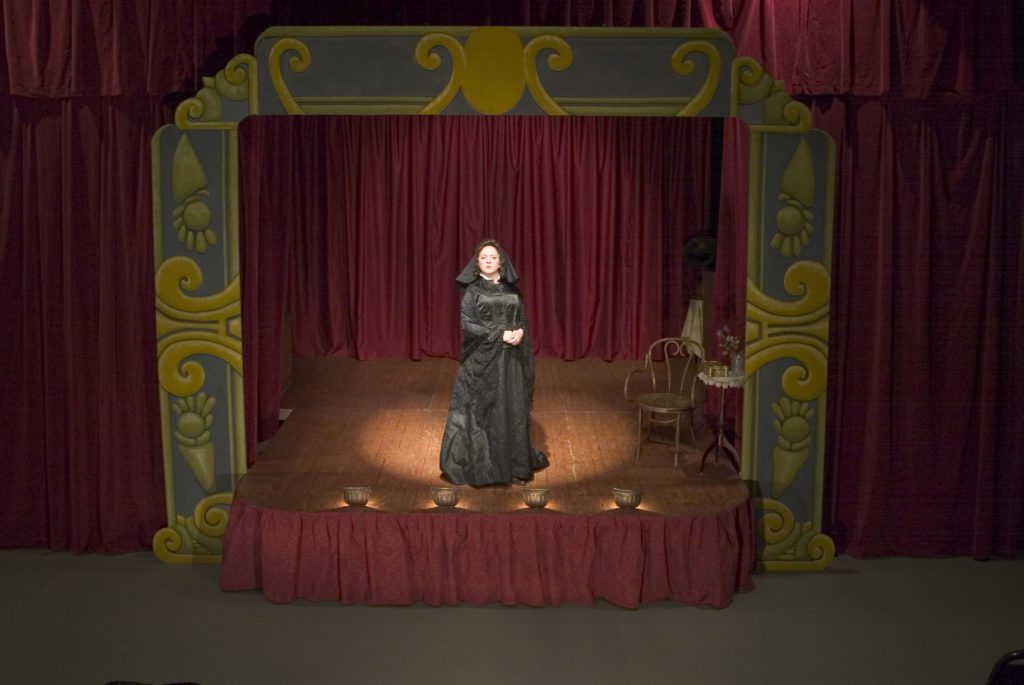
A woman in 1800s black funeral dress stands in a spotlight on a wooden stage framed by a yellow and grey decorated proscenium. The stage has four footlights and red curtains.

Rocky Mountain News- ‘Butchery’ spares no details

A Synopsis of Butchery is a production after a con man’s heart, a strange little Victorian knick-knack of a play.

The collaborative Buntport Theater company was considering three play premises when audiences voted on this one, resulting in the story of Eleanor Fletcher Bishop, an obsessed and melodramatic grieving mother with a flair for performance.

Bishop was a real woman. Her son, Washington Irving Bishop, was a popular 19th-century mentalist known to fall spontaneously into a catatonic state. In 1889, he collapsed during one performance and was pronounced dead. An autopsy was quicky performed, and Eleanor Bishop was convinced that it was the autopsy, not the coma, that had killed her son. She spent the rest of her life traveling the country to stir up public sentiment against the doctors involved.

The title of the book she wrote is nearly irresistible: A Mother’s Life Dedicated and an Appeal for Justice to All Brother Masons and the Generous Public – A Synopsis of the Butchery of the Late Sir Washington Irving Bishop (Kamilimilianalani) A Most Worthy Mason of the Thirty-Second Degree, the Mind Reader, and Philanthropist By Eleanor Fletcher Bishop, His Broken-Hearted Mother.

Erin Rollman plays Eleanor with just that mix of fervor, self-absorption and 19th-century style. She treats the audience as her audience, here to listen to her tragic tale and exhortations for justice. In her attempt, she re-creates the death of her son and the trial of the doctors.

Her performance takes place on a wonderful approximation of a Victorian lecture hall, with the Buntport warehouse turned into a tiny, square, dramatically raked proscenium stage. The production is wholly invested in its period details, from the rolling painted scenery to the disturbingly accurate muttonchops on Brian Colonna.

Colonna, Erik Edborg and Evan Weissman play the surrounding characters, including Colonna and Edborg as the doctors and Weissman as the lost son. Colonna presents a smug, beady-eyed M.D. on trial, while Edborg has a delightfully old-fashioned nature about him and Weissman brings forth a judge describing the proceedings in the style of Walter Winchell.

But Eleanor is the center of the piece, just as her son is the center of her world. Her tragic tale is peppered with name-dropping asides and conspiracy theories. Most of all, Rollman brings us into the Victorian lecture as entertainment, where warnings of gore are actually meant to entice and integrity is a fluid concept.

Somewhere in the middle, as the trial is re-enacted, the play begins to stretch its premise, but makes up for it with a head-spinner of an ending. Too bad there’s no show on Sunday – this could be a fine Mother’s Day outing for those with a dark sense of gratitude.

-Lisa Bornstein, May 12, 2006, Rocky Mountain News

A man is lying on his back on a wooden table with a man standing on either side of him. They are all dressed in 1800s black and grey suits. The dark-haired man on the left is holding a hammer and chisel as if about to strike the chest of the man lying on the table. The other man is pulling out a long strand of red fabric pieces tied together from the abdomen of the man on the table.

Backstage.com- Review: ‘A Synopsis of Butchery’

Adorned in morning coats and black crepe, framed by red velvet curtains, their pale faces illuminated by the footlights, members of Denver’s amazing Buntport Theater Company solemnly pass through their mirthfully macabre piece of Grand Guignol, A Synopsis of Butchery.

How do they do it? This collective of seven began working together in 1998 and has created 18 shows to date. Their skills encompass all aspects of production, from design and tech to script and direction. The result is a body of work that’s remarkably diverse, save perhaps for a thread of melancholic whimsy.

A Synopsis of Butchery is ostensibly a meditation on untimely death, injustice, and the paralyzing agonies of grief. Surely not subjects to wring laughs from, yet Buntport does so by piercing the conceits of Victorian theatre, the self-righteousness of 19th-century reformers, and the suffocation of mother love.

The company’s capacious warehouse space has been cut down into a small proscenium, with a raked stage and a back wall of scrims and backdrops painted in wan period style. It resembles nothing so much as a torch-lit carnival sideshow. The gruesome tale that unfolds is part diatribe, part shocker — but ultimately a portrait of a psyche shattered by reality’s vicissitudes.

At the center of the play is Eleanor Bishop, played by the brilliant Erin Rollman. She is best known for her comic turns not because she is inherently funny, but because she invests herself so thoroughly in her characters that we can perceive their sweet foolishness from a mile away.

As Bishop, Rollman inveighs against the late-19th-century medical and legal professions with regard to the death of her only and overly beloved son, a fictional mentalist named Washington Irving Bishop (Evan Weissman). Prone to catalepsy, her son, she claims, was killed by a premature autopsy despite a note in his breast pocket asserting, “I am not dead, but in a state that defies human explanation.”

Grief-stricken, she harangues the audience with her diatribe, aided by other members of the troupe (Brian Colonna, Erik Edborg, and Weissman, doing double duty) and by backstage magic provided by Matt Petraglia and Samantha Schmitz (there are trapdoors, a coffin frame that rises around her son’s body, and an eerie Victrola-driven soundtrack).

Rollman strikes any number of tragic and extravagant poses; her research into the acting style of the era is impeccable. As the show progresses, it becomes more and more apparent that Bishop is lavishly living a kind of surrogate martyrdom: She demands meaning in (and income from) her son’s demise. The support of the other characters begins to break down, and in the end she takes her son’s place on the slab. What was polemic becomes pathos.

After 90 unrelenting minutes, we are released. We have laughed and we have sat agape. Like many of Buntport’s creations, the show challenges as much as it entertains. For those looking for laughs or pause, A Synopsis of Butchery is another unforgettable accomplishment by the company.

-Brad Weisman, May 09, 2006, www.backstage.com

A man in a black 1800s suit is seated in a wooden chair facing forward with his head looking to his left at a woman in a black funeral dress. they are on a wood planked floor with foot lights and a red curtain behind in the distance. Between them stands another man in dramatic overhead light.

Variety- A Synopsis of Butchery

The master of terror himself, Edgar Allan Poe, could not have written a more chilling account of catalepsy mistaken for rigor mortis than Eleanor Fletcher Bishop’s real-life, 19th-Century tale of her then famous mind-reading son’s demise. Adapted for the stage by Denver’s ever-unpredictable and resourceful Buntport Theatre Company as its 18th world premiere (not including 65 “sit-com” episodes) since the company’s inception in May of 2001, A Synopsis of Butchery explores Mrs. Bishop’s gruesome contention that two doctors, one of whom was unlicensed, performed a illegal autopsy on her son while he was still alive, but in a trance-like state that only resembled death.

As befitting the setting, the story is told in melodramatic style dressed in delightful period costumes on a heavily-raked proscenium-wrapped stage, replete with footlights and a Victrola that provides pieces of the soundtrack.

Additional throwback effects include a trapdoor and a moving backdrop to simulate motion during a carriage ride.

Despite her son’s renown, it is the former actress, Mrs. Bishop, that is the center of attention, recounting the events and casting herself as the revenging angel. Erin Rollman, who edits the original scripts developed by the company, displays her considerable emotional and vocal range as the irrepressible and doting mother who campaigns for justice against what she sees as the corrupt medical and legal establishments that have conspired to cover up her son’s murder.

The details of Ms. Rollman’s curtain-to-curtain performance-her plaintive eyes, hand fluttering, calculated and finessed modulations, and unflinching insistence on her character’s version of events-bring the narrative structure alive and carry it for the entire 83-minute act.

Her Mrs. Bishop is aided in the cause by three actors she employs to help recreate the crime and the trial that followed: the mad-cap Brian Colonna inhabits villain number one, Dr. John A. Irwin, with furtive glances, vain self-possession, and duplicitous insinuations, as well as adding a hilarious send up of a monocled-challenged witness; understated Erik Edborg smiles and holds his tongue as the evasive villain number two, Dr. Frank Ferguson, an ex-shoe repairman, and contributes a comical turn as a flaming theatrical agent with an obsession for his walking stick; and the pesky Evan Weissman conjures further off-beat shtick as the mostly-dead famous mentalist and a mocking judge.

As Mrs. Bishop builds her case for malpractice and malfeasance against two professions that to this day retain control over critical forensic reviews (e.g., JFK’s autopsy), we discover her credentials as one of the leading spiritualists of her day, who carried on a correspondence with Harry Houdini and held séances for notables, including Washington Irving (for whom her son was named). Using every theatrical device at her disposal, including patriotic music and graphic dramatizations, she plays the audience like mesmerized subjects, plying them for donations and calling them to action. Though her genre is a far cry from Molière’s comedies that attacked the same targets, Rollman’s Mrs. Bishop nevertheless lands her jabs with equally-pointed satirical punch.

-Bob Bows, May 7th,2006, Variety