Buntport Theater

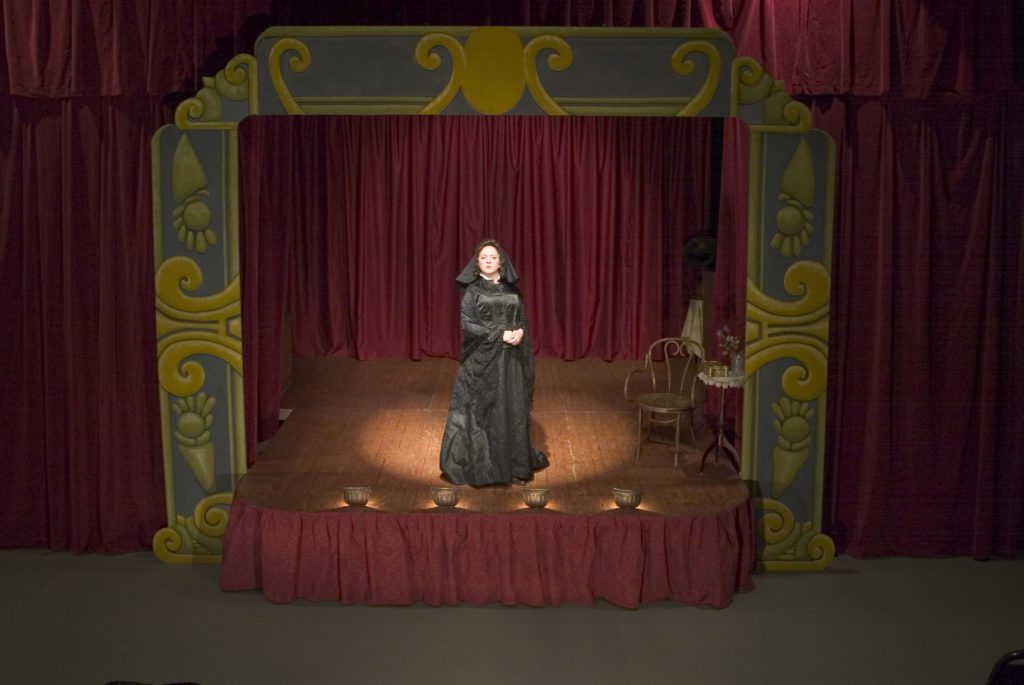
A woman in 1800s black funeral dress stands in a spotlight on a wooden stage framed by a yellow and grey decorated proscenium. The stage has four footlights and red curtains.

Denver Post- “Butchery” carves out a bold tale

“Well, that was different,” a titillated woman said leaving Buntport’s 18th original production, “A Synopsis of Butchery.”

Of course, saying something is “different” at Buntport is like saying something is “just what you expected” anywhere else. When the lights go down, you never know where you are going to be when they come back up.

Buntport is an experimental, collaborative theater company whose youngsters take novel theatrical concepts and make them accessible, understandable and even fun for audiences. Talk about avant garde.

“Butchery” does not rely on visual trickery. This is something far more magical and unexpected. It’s a bona-fide character study that proves “terrific acting” belongs on the long list of accolades used to describe this spellbinding troupe.

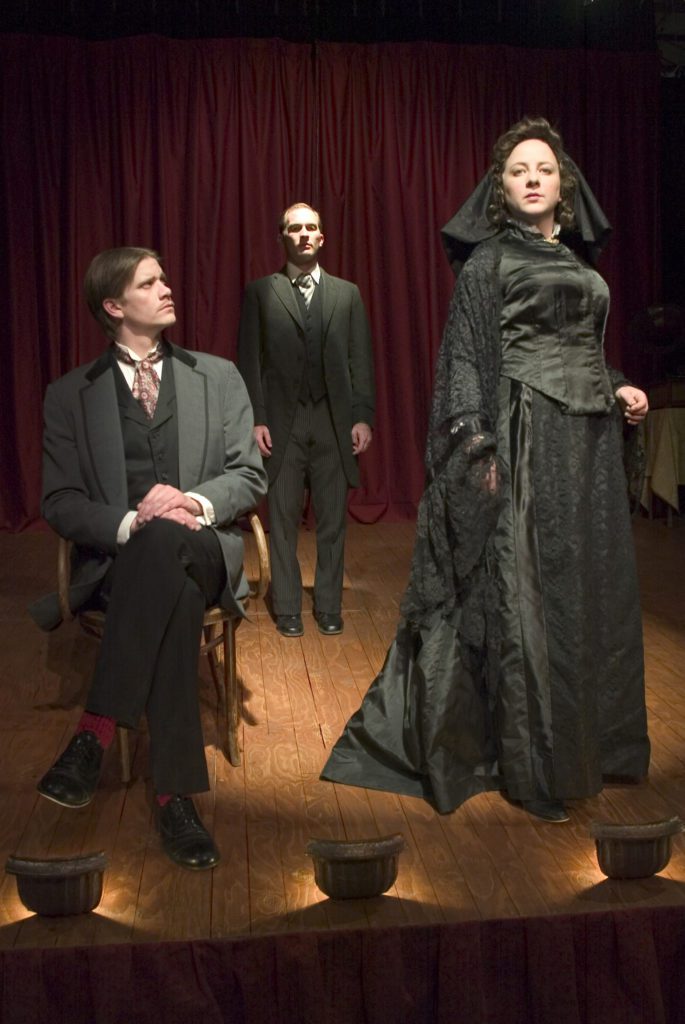
The great Erin Rollman plays Eleanor Fletcher Bishop, aggrieved mother of celebrated mentalist Washington Irving Bishop. He was prone to fits of extreme catalepsy – long, death-like trances. Two doctors, perhaps believing Bishop to be dead (or perhaps not caring), were curious whether anything was unusual about his brain, so they performed an unauthorized autopsy on him in 1889. Eleanor was convinced her son was alive at the time, and therefore was murdered by autopsy. A court disagreed.

In “Butchery,” Eleanor takes her case to the people, as victims of ghastly true crimes often do today. But in the absence of TV, what better audience for this freak show than a carnival? Eleanor narrates her biased tale as hired actors re-enact events.

This premise, while provocative, never could carry 90 minutes. I thought the Buntporters might take us into the actual world of telepathy, or explore the shadowy boundaries of where life ends and death begins. Instead, the focus turns to this embittered, lost mother unraveling before our eyes. That’s not a bad alternative.

“Butchery” is not as funny or engaging as previous Buntport efforts; the writing not as profound. But it’s a delight to simply watch Rollman at work.

In demonstrating Eleanor’s palpable grief, she also unknowingly communicates what a delusional, insufferable mama she must have been. Eleanor was a failed stage diva, and it’s easy to see why. She wants justice, yes, but one can’t help but wonder if she’s not also an opportunist whose tragic tale has punched her ticket back to a sorry stage.

“Butchery” came from Buntport’s loyal audiences, who were gathered last summer and offered three possible show concepts to choose from.

It’s power to the people at Buntport. But the juice comes from the players’ bold, ongoing experimentation with craft.

-John Moore, April 28, 2006, Denver Post

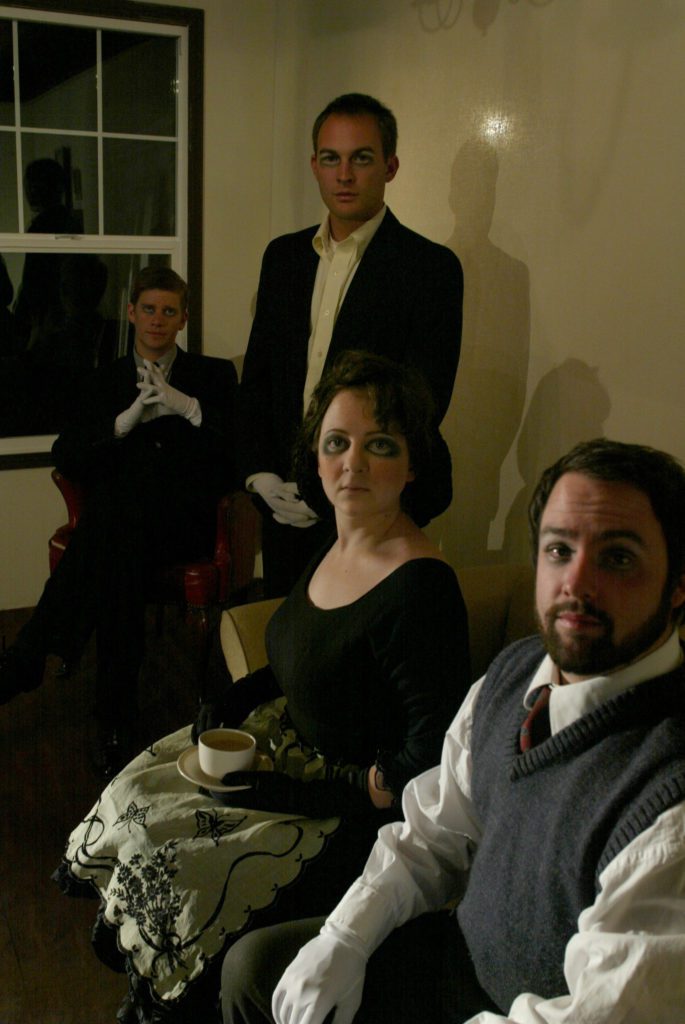
A strange portrait of four emotionless people. They all wear gloves and dark clothes. They have a lot of eye make-up, giving a sunken eye effect. In the background is a window.

Rocky Mountain News- ‘Transformation’ sets stage for fright

Scary on stage is a hard trick to pull off.

It’s more difficult to lose yourself in a room where you know that the actors are actors and that the lights and sound are being manipulated.

Which makes Buntport’s first foray into the realm of terror an impressive undertaking. Because, above all, Horror: The Transformation is scary.

Not in a deep, psychological way, but in the more visceral, trying-to-prepare-yourself-for-the-next jolt manner.

Based on an 18th-century story, The Transformation’s basic story is that of a man who heard voices telling him to kill his family. But the plot is both less thrilling and less involving than the general atmosphere Buntport creates.

From the beginning, all is unsettling. First, there’s the set: a life-size, two-story dollhouse with a cutaway front wall that reveals the family inside. That house contains mysteries, revealed with an impressive showmanship and creativity that shows theater can equal or surpass CGI effects.

The house is furnished, but not quite comfortable. There are signs of life within, but not enough to make it homey. And the dim lights cast on the stage set an audience on edge waiting for the shocks.

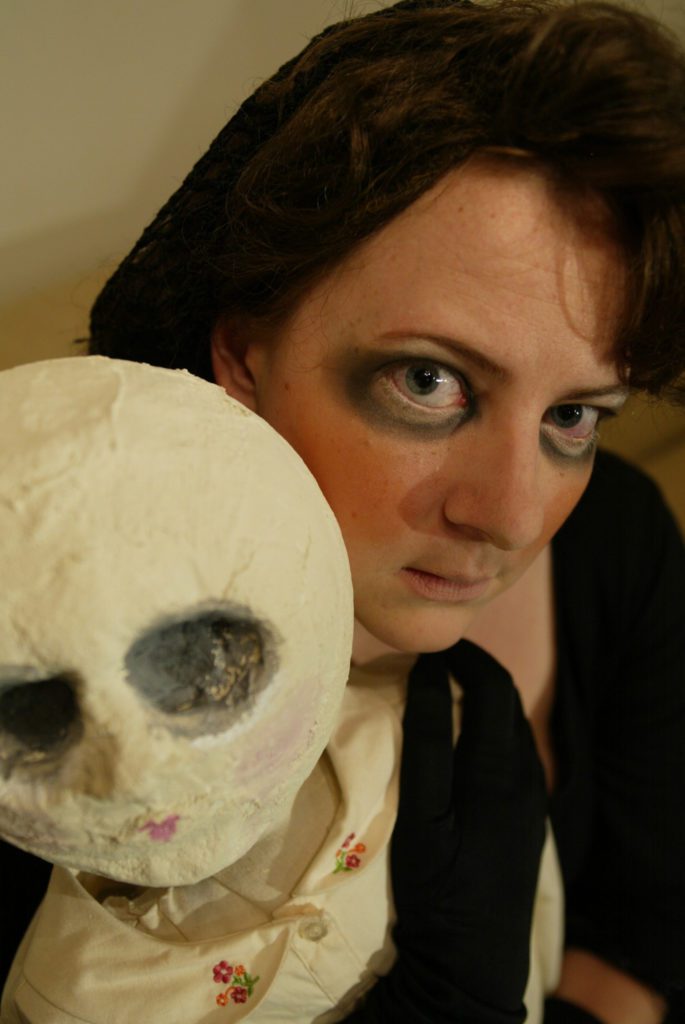
Within that house gathers the family: pleasant parents Theodore (Brian Colonna) and Catherine (Erin Rollman), his sister and her brother (Hannah Duggan and Evan Weissman) and Theodore and Catherine’s children, represented by hollow-eyed puppets that are passed off and portrayed by the entire cast.

Enter a mysterious stranger, Carwin (Erik Edborg), a magician who is in fact less threatening than what the house itself contains. Soon Theodore is hearing disembodied voices, leading to the play’s denouement.

It’s not the story; it’s the style. Scenes are punctuated by blackouts that threaten sudden shocks. Walls move and bleed. The family itself comes from no realistic period: they speak in a kind of heightened Edwardian style but dress in a contemporary manner and live in a contemporary home. Between the words are spaces, filled with foreboding.

The story needs some work – some propulsion, and coherency. And the puppets are nifty, but not given as much character as they could be.

Combine those two facets with the atmosphere, though, and The Transformation could be a horror of the best kind.

-Lisa Bornstein, November 25, 2005, Rocky Mountain News

Close-up of a woman's face. Her eyes look sunken in, thanks to heavy makeup. Next to her face is a large creepy doll's face. Its eye sockets are empty in its white round head.

Westword- Mind Puppetry • Horror: The Transformation, though flawed is still moving

Buntport’s Horror: The Transformation is based on Charles Brockden Brown’s Wieland, a novel published in 1798, and inspired by the true story of a farmer who killed his wife and children. It’s not done as a period piece, though the clothes and setting aren’t strictly modern, either; At one point, a character puts a record on a turntable, which would set the date somewhere in the mid twentieth century. A lot of the dialogue retains Wieland‘s eighteenth-century focus and rhythm.

Although the acting is somewhat naturalistic – at least in spots – the production has many stylized elements. The actors all wear gloves; their eyes are heavily shadowed. Two children are represented by ingeniously-constructed puppets. There are long periods during which we, the audience, sit in absolute darkness, and often the theatre is filled with odd and insinuating sounds; Music. Panting. A low, breastbone-vibrating rumble. Footsteps. Instrumental shrieks.

It’s difficult to scare audiences these days, with films routinely providing rivers of blood, grotesquely splintered bodies and realistic brain splatters. It’s particularly hard for a theater group that lacks the technical resources of, say, the Denver Center. In addition, the plot of Brown’s novel doesn’t entirely hold together, and concepts that would have spooked people a couple of centuries ago – ventriloquism, the practice of magic, spontaneous combustion – don’t have the same impact today.

The play’s ending left me confused. It wasn’t just that I couldn’t figure out whether the impulse that drove the protagonist, Theodore, to murder was supernatural or only the workings of his own religion-maddened mind – that ambiguity was obviously intended. It was that I wasn’t sure what had actually happened until I got home later and Googled: “Brown. Wieland. Plot.”

Despite this, the Buntport production does succeed, both as an extended rumination on the first Gothic novel ever published in America, and in creating a real sense of fear and unease in a contemporary audience.

Theodore is forever talking with the members of his family – his sister Clara and her friend Henry, his wife Catherine and their two children – about science and belief and the role of God in human affairs. Those who lack belief, the play suggests, also lack any reason for action in the world. But those who do believe risk illusion, illogic and even madness.

Theodore and Clara’s father was a highly religious man who built a temple where he worshiped alone. One night he was found there, naked, bruised and burned; the play suggests that he had spontaneously burst into flame. This man’s own father had thrown himself over a cliff. Somehow, these deaths seem to pre-ordain Theodore’s murders. Buntport communicates all this in a series of scenes that move backwards and forwards in time and are punctuated by flashes of light, periods of darkness and retina-teasing images.

The violence, when it finally comes, is well-staged and -acted, but also almost anti-climactic, far less troubling than the thoughts and feelings the production has already aroused. We know that children are killed by parents who think they’ve heard voices far more often than most of us like to think about; we know also that these horrors are ultimately incomprehensible. Yet I couldn’t help wanting more coherence between the evening’s earlier hints and portents and the actual murders, and a greater understanding of the link between Theodore’s religiosity and his killings.

There are elements I just didn’t get. Whenever someone on stage performs – a child dances for the adults or the magician, Carwin, shows off his tricks – the other actors turn and stare at the audience, instead of watching the performer. Why? And the phrase “When people come to look at something, there must be something there for them to look at” is frequently repeated, but I have no idea what it’s supposed to mean.

Yet many of the tricks are brilliant. At one point, Carwin magically creates a pretty, oval image of a garden against the back wall. When Clara approaches to examine it…well, you’ll have to see for yourself. And although the moment doesn’t quite work, I was impressed by the conceptual daring of having the two children play with dolls representing their grandparents, so that what you see is puppets manipulating smaller puppets. The puppet-children are eerily effective throughout. Kate, the little girl, says several times that she’s afraid monsters will suck out her life force through her fingertips. At the moment when she’s about to be killed, the Kate-puppet stretches out her arms to her murderous father. As she does, you see the white gloved hands of the puppeteer above her. It’s a moment of genuine sadness.

Horror: The Transformation places us inside a disintegrating mind. It creates the sense of dislocation you feel waking up in the gray, predawn light, utterly alone, divorced from the habits and distractions that steady your daylight hours, aware that death has stepped one increment nearer and that if your mind starts sliding into oblivion, there’s nothing in the wide, empty universe to stop it.

-Juliet Wittman, November, 3, 2005, Westword

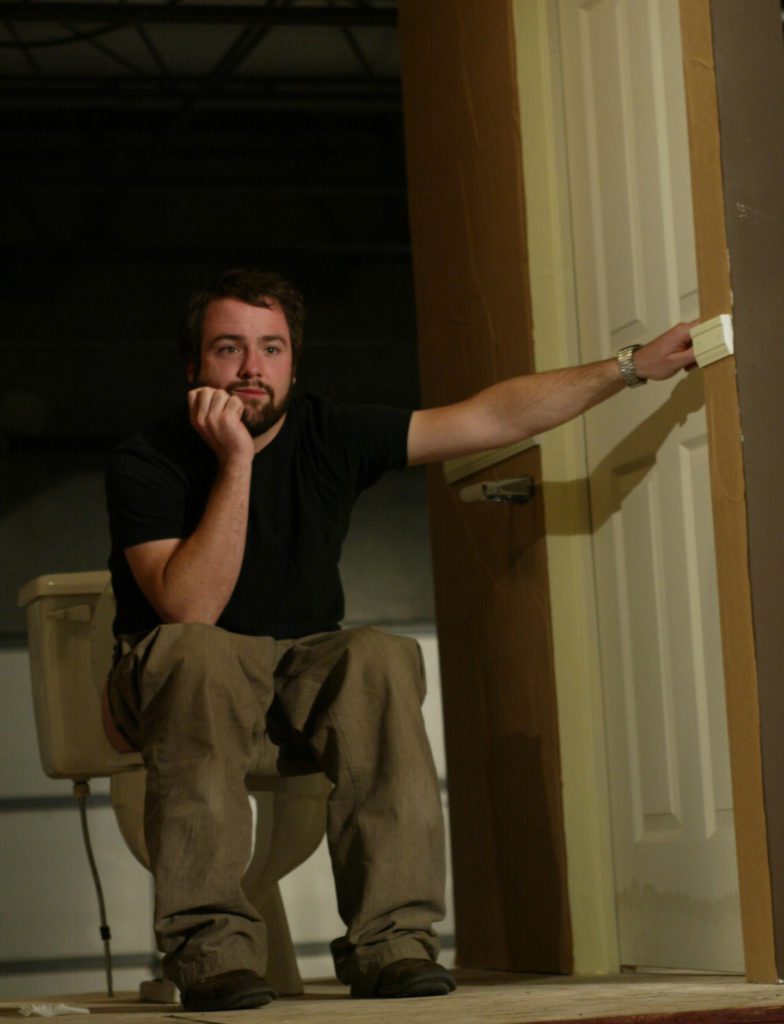
A man with a beard sits on a toilet. He is holding the bathroom door shut and has a defeated expression on his face.

Denver Post- Twin leaps of faith

If you have followed the evolution of Buntport Theater’s collaborative ensemble pieces, all you may recognize in its two mind-expanding new offerings are the faces. That and the familiar feeling of being seduced into unfamiliar worlds.

Buntport never takes the easy way out, nor does it fall back on previous formulas. So simply going along for the ride can be as nerve-wracking for audiences as for the gang of seven who create and perform there. But audiences do so, enthusiastically, because the company has a track record that makes taking the leap of faith asked feel safe.

Leaps of faith are at the core of Buntport’s 16th and 17th creations, the melancholy, fact-based dramas “Realism: The Mythical Brontosaurus,” and the meditative but bloody “Horror: The Transformation,” running in repertory through Dec. 10. The former, more accessible piece follows a young man who has locked himself in his bedroom. The latter, more unsettling tale is a modern take on the farmer who in 1760 listened to voices telling him to kill his family.

Both challenge how it is we come to believe whatever it is we believe to be true. That may mean science, God, evolution, ghosts or even the validity of the love we feel for one another. In the end, we choose the truth that brings us the most comfort. Belief is a leap of faith.

“Realism”

How might it change your perception of reality to learn that scientists have had something wrong all along? Might that cause you to question everything else you have accepted as true? In “Realism,” that’s the plight of Jack, who locks himself safely away after he learns the scientific community has issued a mea culpa: The Brontosaurus never existed. The so-called “nice” dinosaur was discovered and classified in 1879 but later determined to be synonymous with the previously documented Apatosaurus. So in 1974, in a bit of scientific housekeeping, the term “brontosaurus” was formally removed from the scientific record.

Jack, a thoughtful and psychologically fragile young man (Evan Weissman), is now experiencing a profound sense of groundlessness. His isolation has deeply upset his sister Fiona (Erin Rollman), her fiancé, Michael (Brian Colonna) and Jack’s roommate Ben (Erik Edborg), a gay Christian. Far from an absurd comedy, “Realism” is a doleful character study that examines the damage a slight tilt in one person’s axis of reality can have on everyone around him.

There is both a deep sadness and an odd tenderness at the core of “Realism,” Buntport’s first straightforward script. Fiona and Jack share an abusive childhood, and she harbors guilt for fleeing home and leaving him behind. Michael’s homophobia manifests itself against Ben.

This kind of regular acting is new for this extraordinary ensemble – which is why they are trying it now. While Weissman is remarkably natural in the task, the others seem tentative at first. But by the end, Colonna and Edborg have etched complex characterizations, and Rollman emerges as a woman eviscerated in 75 minutes of slow, Beckettesque waiting.

That’s the great irony of “Realism”: This is really pure existentialism, an attempt to portray a convincing illusion of a reality. The play is set on an impressive, two-level house where all the walls have been removed, allowing the audience to see in from both sides. In this story about barriers, the only actual physical barricade is this meager bedroom door. And ultimately, it’s not this door that’s separating these two damaged souls from making a human connection.

“Horror”

The more visually stimulating “Horror” is more recognizable as an experimental Buntport piece. It’s based on the Gothic 1798 novel “Wieland; or The Transformation” by Charles Brockden Brown, generally considered America’s first professional fiction writer. It’s the politely brutal tale of a decent husband and father who is led to destroying his wife and kids by a mysterious agent that may be “ruffian or devil,
black as hell or bright as angels.”

Onstage, the actors all don blackened eyes, as if already dead. Ghosts and memories reveal themselves and, in the coolest twist, the (restored) walls both breathe and bleed. The actors take turns operating puppets representing the two doomed children, both as physical extensions of themselves and later as marionettes. In this story of personal accountability, this is in many ways a puppet show within a puppet show.

Despite its magic, “Horror” is a bit more stilted and likely will be inscrutable to audiences unfamiliar with the source story. Catherine (Rollman) and Colonna (Theodore) are parents who dote on their children and entertain philosophical parlor discussions on skepticism, Socrates, God and reason. But the driving agent here must be the mysterious Carwin (Edborg), who has renounced his birth country and religion. He’s portrayed here as a mere magician and a voice-thrower, not a supernatural force personified capable of driving a man to kill his family. This inevitabile bit of business instead comes along so abruptly it seems more of a tangent than an effective climax.

In this one, backstage wonder Matt Petraglia is the star of the show, navigating more than 100 disturbing sound, light and special-effects cues.

-John Moore, October 28, 2005, Denver Post


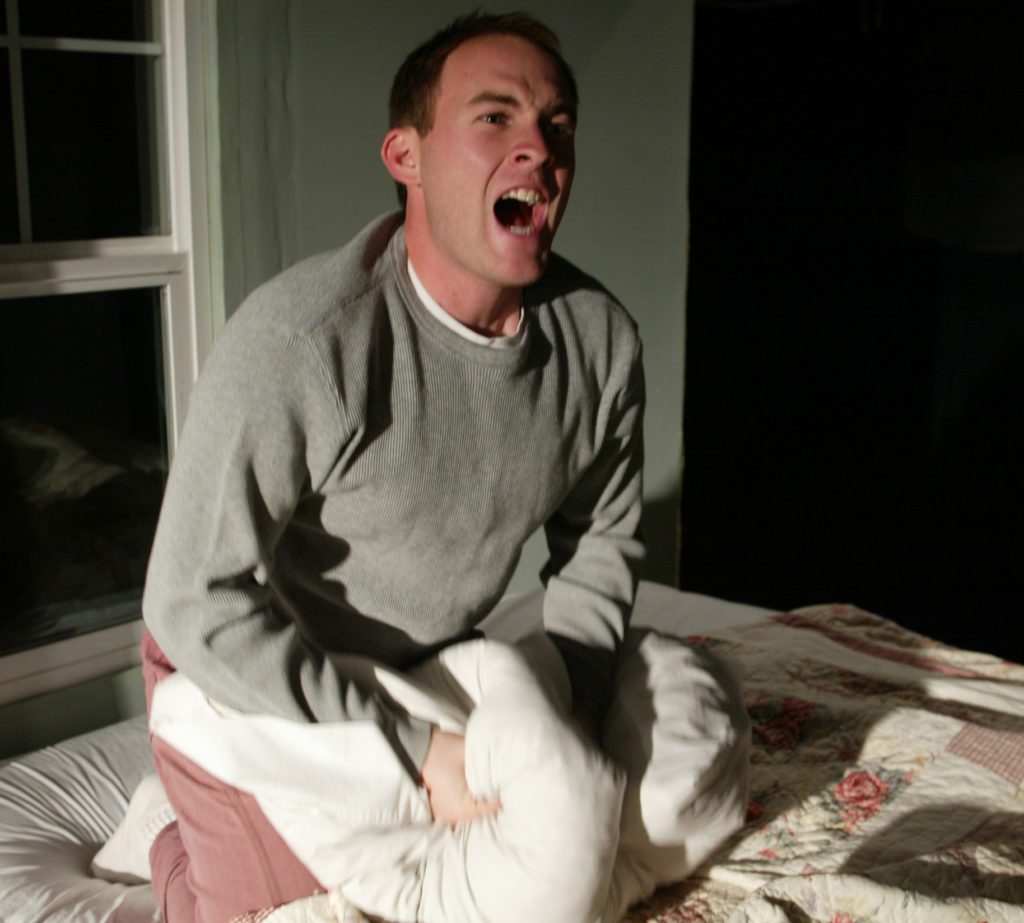
A blonde man in a grey sweatshirt, white socks and purple pajama bottoms is sitting up on his knees on a bed and yelling angrily outward and to the right. He is clenching in front of his lap a white flower-patterned blanket. Behind him is a white wall with a partially open double-hung window.

Westword- Beyond Belief

Buntport’s Realism: The Mythical Brontosaurus teases out the truth

The seven founders — and also writer-designer-director-performers — of Buntport Theater are exploring new territory. Known for a prankish and highly literate experimentalism, the team is currently showing Realism: The Mythical Brontosaurus, which, as the title suggests, is pretty much a realistic play. There are no lopped-off limbs here or absurdist twists of plot. No one bursts into song. You won’t see anyone skating on artificial ice. Unlike Buntport’s previous pieces, Realism, though communally written, could be performed by a completely different group of actors.

As always at Buntport, the set is ingenious. The audience is seated on two sides of the cavernous theater space. Between the groups, there’s a structure showing the first and second floors of a house. You can see right through it, and into all the rooms at once — a living room and kitchen on the bottom floor, two bedrooms with a bathroom between them above. It feels a little like peering into a backless dollhouse. When one of the characters opens the kitchen’s gleaming refrigerator, you see that it’s a clutter of cartons, bottles and containers, just like your own and everyone else’s.

On the upper floor, Jack lies on his bed, alternately reading and staring into space. Although he seems calm enough, we soon learn that he’s suffering a crisis of faith centered on the status of the brontosaurus. Jack has just learned that “brontosaurus” isn’t the creature’s rightful scientific name — though brontosauri do, in fact, exist as a taxon, or species group. Furthermore, scientists have been screwing up museum reconstructions of brontosauri for over a century, equipping them with heads far larger than we now believe they possessed. Or would have possessed, if they existed.

Okay, I said Buntport was assaying realism; I didn’t say they were completely abandoning their off kilter worldview.

Into Jack’s house blunders his sister Fiona, with her fiancé, Michael. Once she realizes that Jack is closed in his room, Fiona tries everything in her power to get him out. Michael, meanwhile, just wants to take a dump and is interested only in some quiet time alone in the bathroom. As the play progresses, we begin to understand Fiona’s desperation. She and Jack used to hide from their abusive father together until Fiona, the older of the two, left home, forcing Jack to face the violence alone. She’s particularly concerned because Jack has been suicidal in the past.

Jack isn’t keen on Fiona’s explanation; he finds it intrusive.

His feelings and thoughts, he insists, are his own. Poor Michael is left squirming, and the tension between the siblings threatens to destabilize his relationship with Fiona.

The quartet of performers is rounded out by Ben, Jack’s calm and commonsensical lover, who is far more willing than Fiona to allow Jack to untangle his skein of twisted emotional and philosophical speculation on his own. Ben relaxes with the newspaper and periodically slips tortillas under Jack’s door.

The play touches on heavy themes, but the writing is light, deft, witty and completely lacking in sentimentality. And it turns out the Buntporters are skilled and appealing straight actors. Erin Rollman is just as absorbing to watch as Fiona as when she’s inhabiting the bratty teenage personae that routinely leave Buntport audiences in stitches. She’s very funny here, but she also does full justice to the sadder moments. I’ve always been a fan of Evan Weissman, and his Jack has a dotty, blandly underplayed sincerity that works perfectly. Who’d have guessed how effective Brian Colonna could be as a regular guy? And the usually hyperkinetic Erik Edborg displays his range, too, with a Ben who’s calm, strong and rather kindly.

Of course, Realism boasts moments of complete insanity. This wouldn’t be Buntport otherwise. There’s a running joke about the objects slipped under Jack’s door, which finds its apotheosis when Jack agrees to pass Michael a roll of toilet paper. You really have to see for yourself the touching earnestness and concentration with which the two actors manage this feat.

The question of what’s real and what isn’t keeps raising its non-brontosauran head. Fiona finds her own yearbook picture unrecognizable; her childhood memories differ from Jack’s. There’s talk about the Shroud of Turin, and we learn that Ben is a practicing Christian. Finally, one of the characters arrives at a solution to a world of uncertainty: “I have to believe that what I believe is what I believe.”

-Juliet Wittman, October 20, 2005, Westword

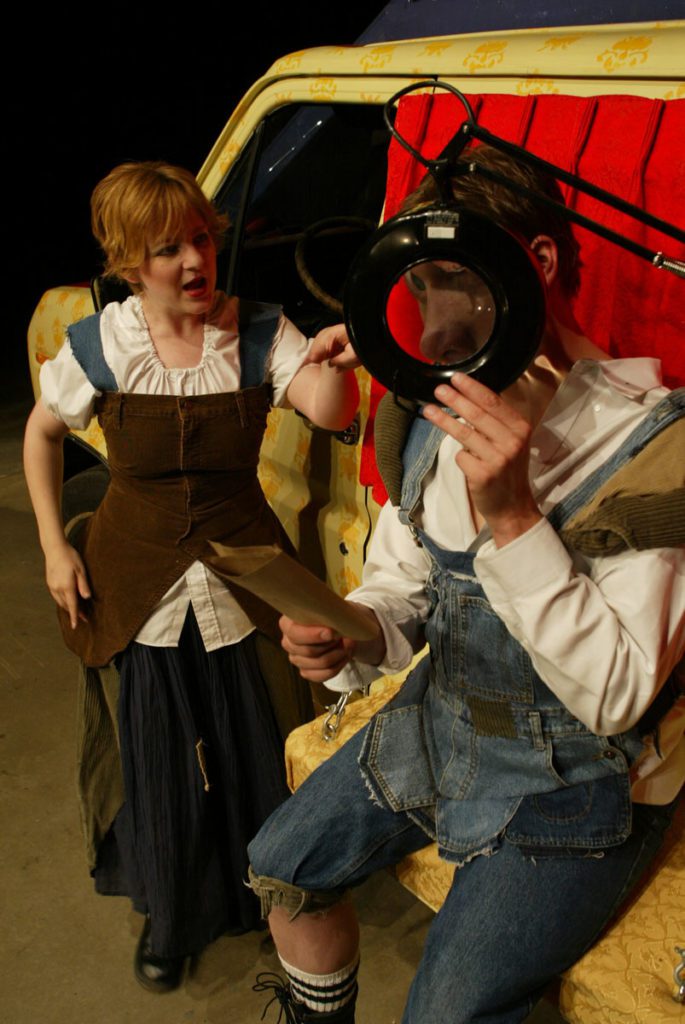
A man in makeshift Shakespearean clothes looks at a piece of paper through a large magnifying glass. In the glass, his nose and eye are large. A woman is pointing and talking to him.

TheaterMania- Titus Andronicus! The Musical

If your aim is to poke fun at Will Shakespeare, why not start with Titus Andronicus? This early work masks young Will’s yet-to-ripen greenery as a playwright with buckets worth of stage blood, quenching the thirst for carnage that preceded his shift to an emphasis on character. And if a playful swipe at the Bard is on the bill, it helps to have the wit and resourcefulness of Buntport Theater, which in Titus Andronicus! The Musical stabs at the play’s thinly stretched canvass and runs the characters through with makeshift swords in the form of everything from trombones to dipsticks.

The award-winning, Denver-based theater company takes on the guise of a traveling band of thespians, prepared to perform any play wherever they pull up; P.S. McGoldstein carts his five member company and their wares in an old van. “We are few in number, but we are resourceful,” McGoldstein confides to the audience in a huge understatement as the play begins. The actors take on anywhere from three roles each to upwards of a dozen in the case of Evan Weismann, who plays the company musician as well as a parade of characters identified as “Someone Who Will Probably Die.” To help the audience up with the shifts between characters, the players operate a light board with a rendering of each actor and a series of bulbs below each rendering, one for each character they play. Next to this is a chalkboard on which to tally the ever mounting death toll. At times, the lights are flicked on and off as quick as the parries in a sword fight — most notably in a scene during which two of Erik Edborg’s characters, Saturninus and Lucius, engage in mortal combat.

The van is the play’s central set piece, epitomizing Buntport’s knack for turning seemingly insurmountable production challenges into jaw-dropping creativity. As the play-within-the-play commences, the van doors are opened to reveal a backdrop painted across the insides of the doors and a screen that rolls down, blocking the interior of the van and setting the scene with an image of ancient Rome’s famous Eiffel Tower — which, upon discovery, is quickly covered with another pull down screen depicting the more geographically correct Coliseum. The van is used to great comic effect throughout the show — e.g., the carriage rocks when Saturninus and Tamara consummate their marriage in the back of the vehicle. As for depiction of the play’s horribly tragic events, blood spurts out of the roof when a victim is hacked up inside, and the big picture window on the side of the van offers a view of the carnage that occurs after Aaron traps Titus’s sons in the forest.

Then there are the show’s musical moments; the company members perform several production numbers with macabre hilarity. I particularly enjoyed Edborg’s Frankensteinish dance moves as the rhythmically-challenged Saturninus in the opening number — a foreshadowing of the grand finale, when all of the corpses sing and twitch, whether marinating in a pool of their own blood or, in the case of Tamora’s two puppet sons, baked into pies for mother. There’s also a cha-cha version of “I Love You For Sentimental Reasons,” with the newly crowned Saturninus and the captured Goth queen Tamora dancing on the roof of the van before slipping inside for their honeymoon. And there’s a wonderfully romantic “montage” when Lavinia sneaks off to be with Bassianus (Saturninus’ brother). As The Carpenters’ “Close to You” plays on the van stereo, the two fall in love. But then the vengeful Tamora arranges for her sons — the car stereo and the gas can — to kill Bassianus and to maim Lavinia, cutting off her hands and tongue. This doesn’t keep Lavinia from singing an incomprehensible lament as blood drips out of her tongueless mouth. “You see ladies and gentleman, we handle violence with grace and delicacy,” McGoldstein remarks to the audience as his cast slips and splashes across the blood-slick stage, heading toward intermission with a lively hand jive (and paying no heed to the fact that Titus and Lavinia have only one hand to jive with between them).

Buntport’s decision to season this savage play with comedy and music makes for a riveting two hours’ traffic on the stage. For all the jesting and poking, Titus Andronicus! The Musical succeeds in praising Shakespeare, not burying him. The original play isn’t beyond redemption. And though the characters are razor-thin compared to the Bard’s later, fleshed-out figures, Titus himself is a fascinating study for an actor, moving from relentless barbarism to a strangely sympathetic victimization. Add a cha-cha here, an ash-mouthed puppet there, bloody dipsticks everywhere, and you’ve got the raw materials for an inventive, accessible evening of entertainment in the hands of a company firing on all cylinders.

-Owen Perkins, January 25,2005, www.theatermania.com


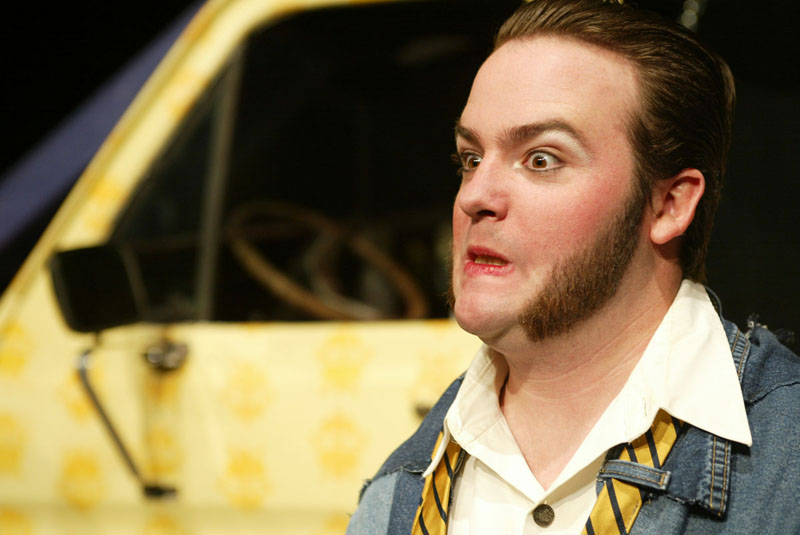
Close-up of a man with large sideburns. He is bug-eyed and grimacing. In the background, out of focus, in the front of a yellow van.

North Denver Tribune- Buntport musically spoofs bard’s bloodiest tragedy

Buntport Theater delivers another original and creative comic gem in their musical send-up of Shakespeare’s Titus Andronicus. Buntport dismembers (pun intended) the Bard’s bloodiest and most brutal tragedy, filling the evening with slapstick humor, creative devices to help the audience follow the complex plot, bad puns, cliché musical numbers, and Monty Pythonesque blood and gore.

The production opens with a traveling troupe of actors (the “van-o-players”) that will be performing Shakespeare’s Titus Andronicus. Even a brief summary of the plot would take far too long for this review, and have little value. Suffice to say that Titus is a bloody story of war, deceit, revenge, rape, murder, and limb removal, set against the backdrop ancient Rome. This production may be the most understandable rendition of this play you will every see, using a clever visual device to identify characters and filling gaps with occasional narration.

The seven members of Buntport, Brian Colonna, Erik Edborg, Hannah Duggan, Erin Rollman, Evan Weissman, Matt Petraglia, and Samantha Schmitz “adapted, produced, designed, directed, and built” this production as a collaboration. This group has developed an original, integrated piece of comic theatre. While the performances are very good, the careful construction of a complete package, including context, design concept and supporting devices, is excellent. The script itself is funny, but adding in the character identification board, the scenic element of the versatile beat-up old van, the creative puppets, the anachronistic musical numbers, and the eclectic costumes makes the whole exceed the sum of the parts.

As actors, five members of the Buntport ensemble shine as well. All five create multiple unique, recognizable characters, in some cases in rapid succession with only minor costume changes. Hannah Duggan is probably the strongest in the cast, transforming herself from the pathetic Levinia to the delightfully evil Aaron with the application of a fake mustache. As Levinia, after loosing her hands and tongue, she is hilariously ineffective as she tries to communicate what has befallen her and attempts to perform the most basic tasks. Evan Weissman shows amazing versatility, playing many characters, most of them (as aptly described on the character board) “someone who will probably die.” His bizarre facial gymnastics as Aemilius are particularly entertaining.

Ron Wilkenson vamps as the Emperor Saturninus, plays Titus’s son and grandson (both named Lucius), and controls the puppets representing Tamora’s sons Demetrius and Chiron. The choreography of the interaction of the puppets and the live actors on stage is interesting and effective. Brian Colonna opens the evening as the leader of the traveling troupe, and provides an anchor for the show as Titus, as well as covering the emperor’s brother Bassianus. Erin Rollman changes gender frequently, bouncing back and forth between the initially tragic and later cruel Tamora, and Marcus, brother of Titus, giving both characters depth and variety.

One thing that makes this show work so well is the integrated overall visual package. The design concept is reminiscent of Italian Commedia Dell’Arte, updated to modern times. The set has two elements, a character board and a modified old van, set against the backdrop of the exposed empty warehouse that is the Buntport Theater. The character board is a clever and effective device, serving two main purposes. It indicates which characters each actor is playing at any given time, and provides a running death toll, for which this play seems to cry out. Initially, the van seems benign – an offstage space for the performers to transform themselves, and a backdrop. But it is rolled (pushed by human power – by actors, no less) to expose four different sides, with each providing creative and bizarre props and set pieces, all of which nonetheless fit in the context of the overall production. And rounding out the visual impact of the play are the costumes. Difficult to describe, they are patchworks, cut and pieced together thrift store outcasts, fitting perfectly the idea of modern Commedia clowns. These are not circus clowns, but unique characters evoking the many dimensions of comedy.

This show is a hoot. It combines irreverence and skill, originality and tight execution, and cheap sight gags and cleverness. After seeing this show, I actually looked up Titus in my anthology of Shakespeare to check, and found that indeed, all the murder, mayhem, and dismemberment are right there in the script. It is no surprise that “straight” productions of Titus are rare – I can’t imagine a modern theatre company pulling off a sincere production. This is just one more reason to head to Buntport and see this much more entertaining version.

-Craig Williamson, January 20, 2005, North Denver Tribune

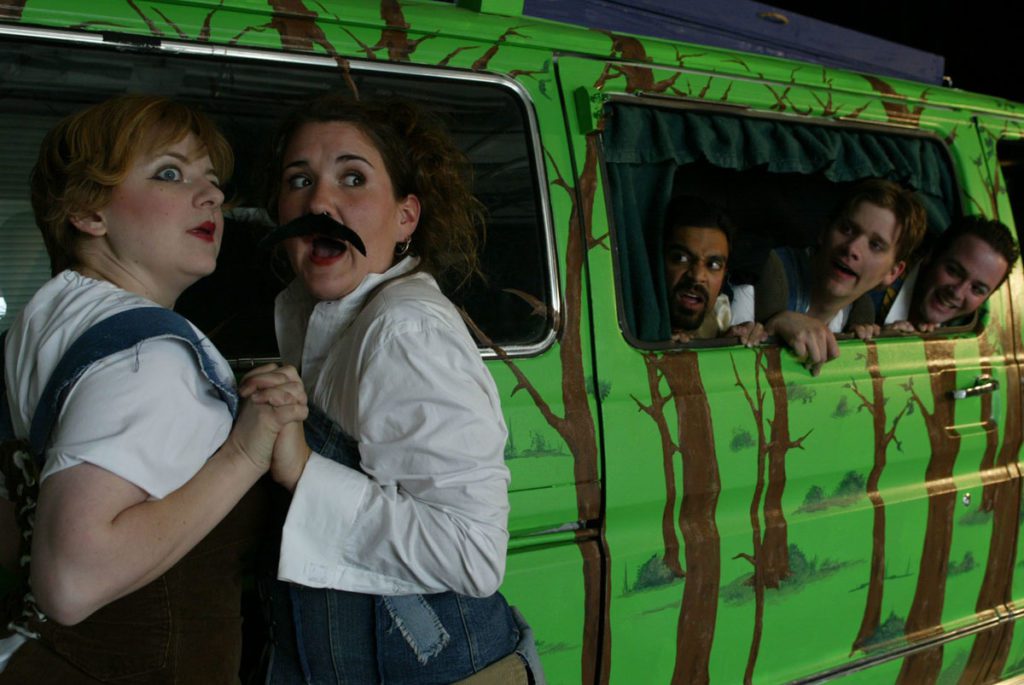
Two women clasp hands as they look out, wide-eyed. One of the women wears a fake mustache. Behind them, peaking out of the window of a van that has been painted like a forest, three men are watching.

The Metropolitan- The Buntport Theatre Presents: Titus Andronicus: The Musical!

Imagine, if you will, theatre that blends the irreverent energy of Monty Python and Kids in the Hall, the decorous poetry of Shakespeare, the absurdist zeal of French playwright Eugene Ionesco and the toe-tapping, finger snapping rhythms of your best off-Broadway show. These disparate dramatic elements come together in “Titus Andronicus: The Musical,” a liberal interpretation of Shakespeare’s bloodiest tragedy currently enjoying a revival at Denver’s Buntport Theatre.

The Denver-based theatre company has devoted itself to pushing the boundaries of comedy and dramatic convention since 1998, with plays and skits that are rooted simultaneously in a highbrow literary tradition and an uninhibited silliness. The Buntport’s productions have incorporated subjects ranging from the angst-ridden German novelist Franz Kafka to the Greek epic poet Homer.

For those who have had an aversion to Shakespeare’s lofty language and long-winded intrigue, the Buntport Theatre’s impertinent spin on one of the Bard’s most melodramatic plots is both refreshing and redemptive. The witty asides, striking sight gags, and brilliant feats of physical comedy breathe life into what is traditionally viewed as Shakespeare’s most unoriginal tragedy. The five players display a consummate energy and enthusiasm as they take on multiple roles and laboriously move their one piece of scenery, a converted Econoline van that serves as the center of action. This creativity and endless innovation render the unlikely parody entirely natural, as if Shakespeare had rewritten the ancient Roman drama specifically as a comedic vehicle.

And, of course, there’s the music. The play’s constant violence and high death toll make the original score all the more inappropriate and effective in its irreverence. In one of the drama’s most traditionally taut and disturbing moments, the title character must have his hand amputated in order to appease the emperor. In the Buntport’s send up, the tension is broken as the characters break into a tweaked version of “Somewhere Beyond the Sea.”

The troupe works out of a transformed warehouse, and the players expertly manipulate the intimate space to engage the audience. The viewers are exhorted to participate by the sheer immediacy of the action. When the music sounds, it is as if one is at a casual concert at a comfortable club. When the pitch of the players’ voices hit their heights, the onlookers are a forcible part of the action by their very proximity. Finally, when the comedy finds its stride, creating a deft balance between the high minded and the profanely wacky, one cannot help but become immersed in the lunacy of it all.

It is in their expert fusion of high drama and sheer silliness, their uncanny ability to reconcile the polar opposites of the stage that the Buntport troupe distinguishes itself as a group of comedians. This subtle and elusive equilibrium is what marks the best comedy and the best comedians. The skill the Buntport players display in walking the line distinguish them not only as local notables, but as comedic performers worthy of national attention.

-Adam H. Goldstein, January 20, 2005, The Metropolitan

Five people are draped on and around a painted van. They all wear makeshift Shakespearean clothing. In front is a smiling man with his hands out. The hood of the van has a large smiling portrait of him. One smiling man is draped across the hood. Sitting on top of the van are three more people holding a banner that says “van-o-players”.

Westword- Bloody Good Fun

Buntport’s Titus Andronicus! The Musical still kills.

Going to the theater alone is depressing, so part of my job as a reviewer involves coaxing, bribing and seducing friends and family members into accompanying me. Over the years, I’ve come to rely on these companions — wise and perspicacious people all — even when their opinions clash with mine. They provide a sorely needed outside perspective, moments of insight, a salutary reminder that not everyone sees the world in the same way that I do.

It takes some thought, figuring out who should be invited to what. So-and-so likes big musicals; someone else is drawn to British comedy; this friend is in love with language; this one admires spectacle. If a friend has seen too many clunkers in a row, I try to sweeten the pot with a production I expect to be excellent (though predicting excellence is harder than you might think). Then again, many of my friends don’t mind a bad show, because we have so much fun slicing and dicing it afterward.

It’s telling that everyone who’s ever accompanied me to Buntport wants to go again. For Titus Andronicus! The Musical — a restaging of the hilarious production the Buntporters mounted a couple of years ago — I invited Linda, who had never before visited this cavernous theater warehouse space on the outskirts of town. Within minutes of our being seated, amid the general cachinnation of the audience, I heard her low, musical peals of laughter. “They’re really clever,” she murmured.

Titus Andronicus is a Shakespeare play so awful that for centuries, many scholars refused to believe that Shakespeare had actually written it. Forced to concede the point, they scrambled for explanations. It was co-written with someone else. It’s not really that bad. It’s a parody.

The plot alone is a howler. It involves the Roman conqueror, Titus, and his captive, Tamora, Queen of the Goths. There are lots of sons — Titus’s, Tamora’s, the sons of Saturninus, himself son of the Emperor. You also get lust, hate, revenge, rape, murder, mutilation and rivers of blood. Each unbelievable plot twist seems to exist solely for the purpose of ushering in more mayhem.

In the Buntport version, five actors play all of the characters, using minimal costumes and scenery. There’s a board to one side of the stage adorned with caricatures of the actors’ faces. Beneath each face is a list of names, and above each name is a lightbulb. At the beginning of every scene, someone runs to the board and rapidly illuminates the relevant bulbs so you know which character the actor is supposed to be at that moment. Some characters, like Tamora’s sons, are represented by objects — in this case, a gas can and a radio. Evan Weissman plays only one role throughout — actually, multiple roles wrapped into one. This guy is called Someone Who Will Probably Die. Like Kenny in South Park, Weissman gets knocked off over and over again; unlike Kenny, he does it with a certain sneering élan.

In addition to the helpful character board and a second board on which the corpse score is noted in chalk, there’s a van in the middle of the space, painted to represent a house on one side and a forest on the other. This van is rolled from place to place by the actors as needed, while Brian Colonna, who plays Titus with insane energy, urges the audience to help by yelling, “Push, push.” Pretty soon it sounds as if you’re in an obstetrics ward with a horde of prospective fathers. And, yes, we do ultimately get a newborn on stage — Tamora’s son, who, because of his resemblance to her evil Moor lover, Aaron, she — Lady Macbeth-like — wants killed. (Aaron isn’t a Moor in the Buntport version; what gives away the child’s paternity is the fact that he’s inherited his father’s black mustache.)

The action is punctuated by song. At one point, Titus is convinced that he can save his two kidnapped sons by cutting off his hand. He, his brother and a third son compete for the honor of mutilation in a warbling trio. There’s also cheerful singing as Tamora instructs her sons in how to rape and mutilate Titus’s daughter Lavinia, played by Hannah Duggan.

The acting is frantically funny. Erik Edborg prances and weaves about the stage like an animated cartoon figure; Erin Rollman is a smoothly evil Tamora. No one can do silent exasperation better than Hannah Duggan: Her expression when Titus asks her to reveal the name of her assailants after the rape — she’s dripping blood and supposedly missing both hands and tongue — is priceless.

There’s no attempt to make a statement here, just a fast, effervescent evening of fun. “You’ll let me know when these guys do another production?” asked Linda as we left.

-Juliet Wittman, January 27, 2005, Westword

Rocky Mountain News- Dare we say it? ‘Macblank’ rocks

This is totally inappropriate.

I should not be laughing this loud. That snort probably wasn’t very attractive, either. It’s also very hard to sit like a lady while you’re emitting nasal honks of delight.

But it’s a new work by Buntport Theater, a bare-bones production called Macblank that’s running in repertory and in the shadow of Kafka on Ice. Well, Macblank may be an afterthought, but then it’s dizzying what Buntport must do on full brain power.

And there is no good reason a play with such a basic, even uninspired, premise should be so blissful except for the manic energy of the five onstage performers, abetted by the two offstage members of the ensemble.

The enjoyment is abetted by knowledge of reality television, Shakespeare’s Macbeth or the style of Buntport, a democratic ensemble that produces only original work in its particular style.

In Macblank, members of a theatrical ensemble are being filmed for reality TV as they stage their newest production, Macbeth. It is a play beleaguered by history, with centuries of tragedies befalling those who attempt it, marked by the 19th-century Astor Place riots – perhaps the last time in history hundreds of Americans showed interest in Shakespearean actors.

As a result of the mishaps and conflagrations, actors are traditionally terrified of uttering the name “Macbeth” in a theater.

So you know where this is going. From the start, skeptics in the ensemble bandy the name around like rubber swords while the superstitious go through increasingly absurd antidotal rituals. Erik Edborg plays Ryan, cast in the lead because of his height and his pompous British accent, acquired during a visit to Stratford – “So I think I know a little something,” he preens.

Beth, the most passionate, superstitious of the lot, feels that she was the natural Macbeth (the thane and his wife are being played by one actor, an in-joke from Buntport’s Cinderella last season). Erin Rollman plays Beth like a grown-up version of her Capitalist Girl Scout character, an obsessive control geek.

She’s trailed around the theater by the lovelorn Greg, Evan Weissman’s most distinctive character yet. Stupid yet thinking he’s cool, Weissman has a childlike idiocy and tendency to spout clichés while making air quotes with eight fingers.

The troupe is rounded out by Hannah Duggan as Miranda, a woman whose life mirrors Shakespearean plots, and Brian Colonna as an overworked actor working at six part-time jobs and the end of his rope.

Because of the show’s repertory schedule with Kafka, it lacks the outlandish costumes and magical sets of most Buntport productions. Rather than a failing, though, it focuses on the script and the delirious wordplay these writers both concoct and embody.

-Lisa Bornstein, October 15, 2004, Rocky Mountain News