Buntport Theater

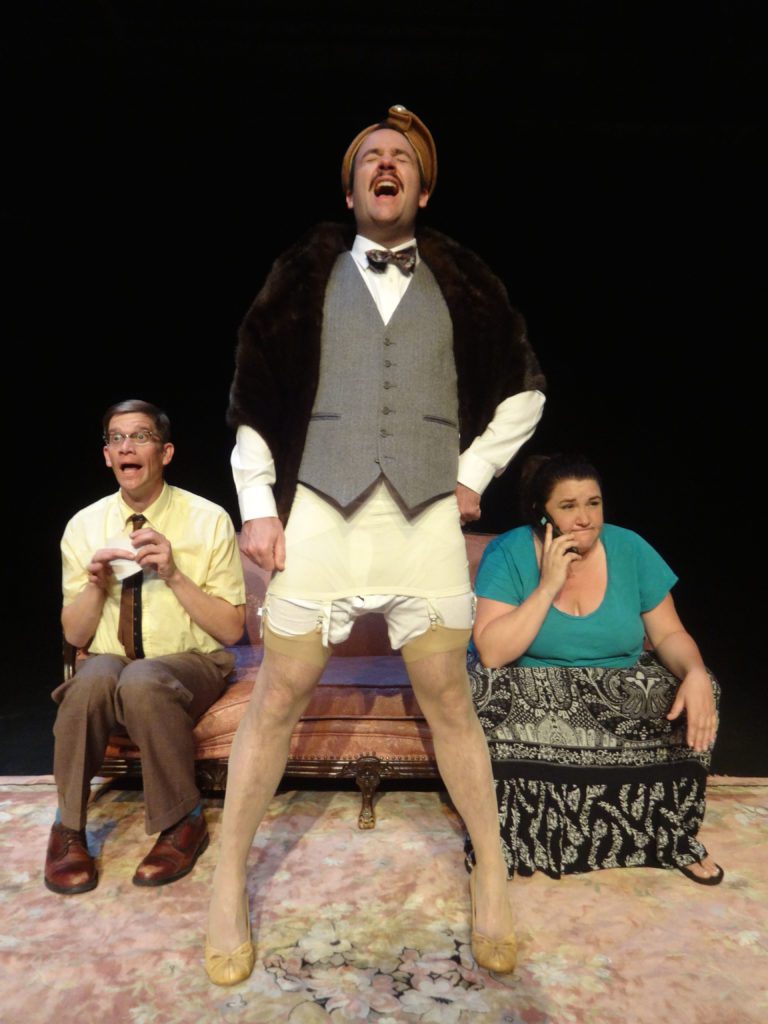
A man stands with his head back singing or yelling, perhaps. He wears a suit on the top and stockings and high heels on the bottom. Behind him, two people are seated on a pink couch. One is a man in a yellow shirt talking excitedly. The other is a woman in a blue t-shirt looking on a cell phone looking annoyed.

Denver Post- Frisky business afoot in Buntport’s “Naughty Bits”

The Buntport Theater Company’s erudite cut-ups are at it again. And nearly at their best with their latest, collaboratively wrought play, “Naughty Bits,” running through Oct. 4.

Aided by an Art Historian, a Romance Novelist and a well-to-do couple straight out of an F. Scott Fitzgerald novel, this nimble comedy ponders bodies and their parts, gender and class, and, most pointedly, the disappearance of a certain appendage from the Lansdowne Herakles.

That’s Hercules to you.

For more than a century, the Roman homage to the Greek hero resided at the Lansdowne House in London. In 1951, J. Paul Getty bought the stone demigod — lion skin hanging by his side, club resting on his shoulder. It holds a prominent place at the Getty Villa in Malibu, Calif.

You’ll learn much of this as the play’s distinct characters begin to inch toward one another across eras.

The laughs can be brainy and broad, physically deft and metaphysically agile. Think Lucille Ball by way of Jacques Derrida — after a chocolate edible.

Wait, did the Romance Novelist just mention Marcel Duchamp? Of course she did.

Erin Rollman and Brian Colonna are terrific as Jenny and Harry, the 1920s couple, more insouciant and frisky than roaring.

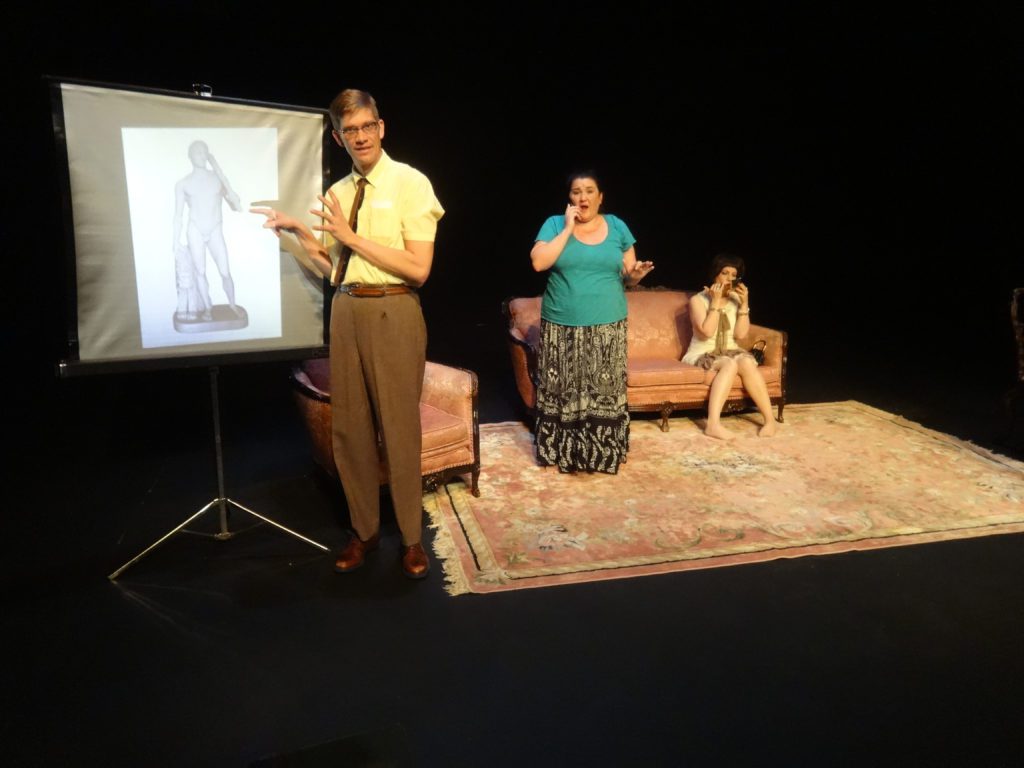
As the Art Historian, Erik Edborg allows his hands to flit and his voice to flutter as he projects slides of the sculpture in question.

“He’s got magnetism, even for marble,” he says nervously.

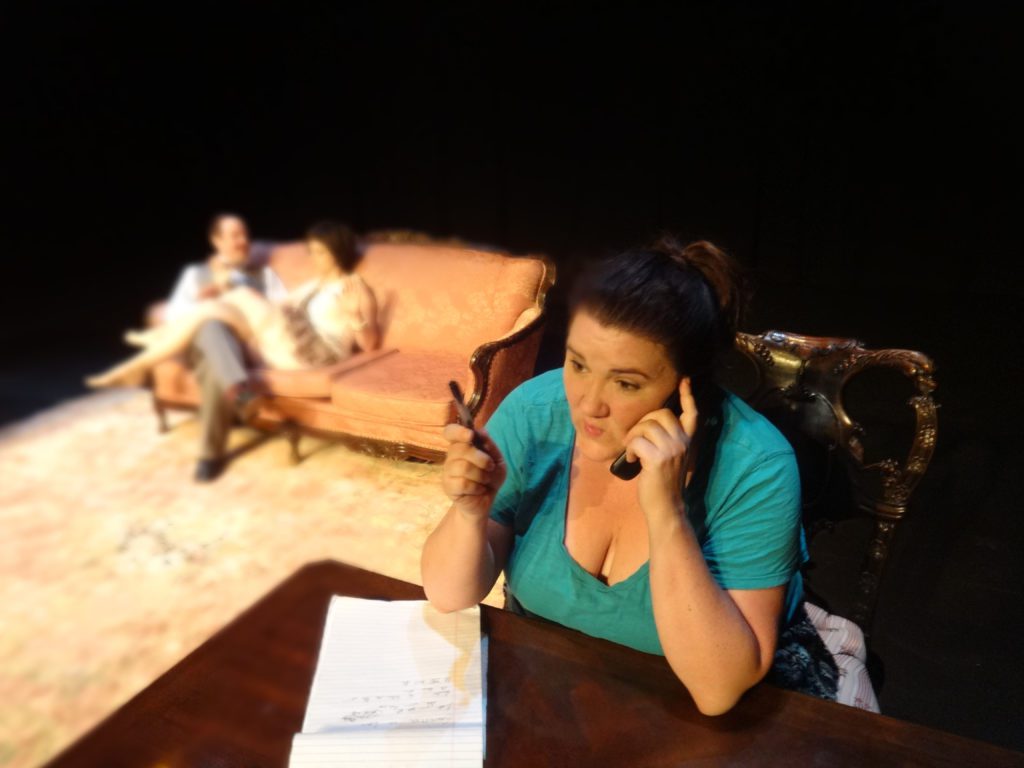
Hannah Duggan’s turn as the Romance Novelist on a writing vacation — and often on the phone to her editor — hits heady and populist notes.

About the company’s fifth member: SamAnTha Schmitz. Much like the Herakles’ missing part — the cause of so much contemplation — her absence is potent.

Operating lights and sound, she cues actors and audience to shifts in time and mood. We have her to thank as the action nails an absurdly touching (and groping) vibe, reminiscent of Studio 54 during its heyday.

-Lisa Kennedy, September 27, 2014, Denver Post

A man from the 1950's stands at a projector screen gesturing to an image of a statue of Herakles. Behind him, a woman from today stands on a pink carpet talking on a cell phone. Behind her, a woman from the 1920's sit on a couch looking into a cosmetic mirror.

Westword- Buntport’s New Show Is Naughty But Very Nice

When the members of Buntport Theater Company are at the top of their form, wonderful things happen. And with Naughty Bits, they’re at their peak both in terms of performance and — since this company creates all its plays collaboratively — in terms of the humor, flow and inventiveness of the script, which happens to focus on a missing member.

Naughty Bits tells three related stories, all surrounding the figure of the famous Landsdowne Hercules, or Heracles, a Roman statue of the mythic hero holding a club over his left shoulder and the skin of the Nemean Lion he killed as his first great labor in his right hand. The statue was restored in the eighteenth century — except for its broken-off penis. In one of the three stories, set in the 1920s, an inconceivably wealthy fellow called Harry conducts an extended flirtation with his witty and seductive mistress, Jenny. She’s teasingly scornful of the Hercules statue — which he’s purchased — and all the other great artworks on his English estate, also recently purchased. Then there’s the 1950s Art Historian, insanely passionate about his work, fumbling with his slides and projector as he expatiates on the wonders of the statue, its missing part and his thoughts about art in general to us, the audience. The contemporary Romance Novelist, meanwhile, having done some research into the Landsdowne Hercules, is pitching a book proposal to her editor. She wants to put the statue in the home of one Lady Louisa, who will fall in love with it, missing genitalia and all. As she munches on hot dogs and spins her torrid, silly, soulful plot, the Novelist’s relationship with the distant male editor is revealed as more and more complicated.

The three segments may be separate, with each protagonist in his or her own reality, but they gradually come together over the course of the evening, and the last line of dialogue in almost every scene leads suggestively into the next, until the ideas meld together to form a kind of whole, a meditation on love, sex, art, history, power, money and gender that ends with a fleshy (sort of), outrageous and snortingly funny climax. Naughty Bits illustrates the way a work of art travels through time, changing both physically and in the way it’s interpreted, taking on different colorations and significances in different eras and in individual imaginations. This Hercules is a paradox — a hero, a love god, the epitome of male beauty — but lacking the essential male appendage. So he represents — at least to the Novelist — both male and female or neither, a kind of coming together in peace and mutual understanding.

Naughty Bits also plays with the assumed gulf between high and low art. Of course a connoisseur’s interest in a naked statue has a touch of low prurience, and this is certainly true of the Art Historian, who both thrills to the statue’s aesthetics and is rendered inarticulate by his distress and excitement at the whole genital issue. Meanwhile the Romance Novelist, while conceding her usual work is smut, is clearly reaching for something new here; she’s in the puzzled, open and exploratory state of anyone absorbed in genuine artistic creation. Buntport has illustrated this dichotomy in previous work, demystifying high art and taking down artistic pretension while still treating great works with profound respect. In Tommy Lee Jones Goes to Opera Alone, for example, a waitress beefs up the plot for La Boheme and sings happily along with the arias. (Tommy Lee Jones will return in January.)

Erin Rollman’s Jenny is a comic masterpiece, elegantly slutty, a parody of a 1920s movie siren. Brian Colonna is crazy funny as her suave lover, Harry. Erik Edborg has made a practice of creating outlandish characters and inhabiting them so fully that you absolutely believe in them, and he does it here with the deliciously mannered Art Historian. The inimitable Hannah Duggan brings all kinds of passionate, angry, vulnerable conviction to the Romance Novelist, along with a strong dash of feminist rage.

But Naughty Bits is anything but dense or polemical. It’s a dazzling, skillfully structured, swift-moving and original comedy, filled with insane imaginings, daring bits and hilarious bons mots. And when those deeper currents surface, they sparkle and flash, too.

-Juliet Wittman, September 24, 2014, Westword

A down shot of a woman sitting at a desk, talking on the phone. She has a pad of paper in front of her. Behind, out-of-focus, in the distance, a woman and a man sit on a pink couch. She has her legs crossed over his.

North Denver Tribune- Buntport blends tapestry of stories in comic Naughty Bits

Several times a year, the five members of Buntport Theater embark on a creative process that results in a new, unique, frequently brilliant, usually hilarious, and always completely original production. Their latest offering is Naughty Bits, inspired by the conspicuously missing penis on the otherwise fully restored Roman statue known as the Lansdowne Hercules. Brian Colonna, Erin Rollman, Erik Edborg, Hannah Duggan, and SamAnTha Schmitz of Buntport could not resist creating a play based on this curious situation. Their comedy is an intertwining of three separate storylines from three separate time periods, all related to the statue, that blend and interact in clever and very funny ways, then finally boil over into hilarious craziness.

The three storylines include a couple in the 1920s who acquire the statue when they purchase an English manor home; an Art Historian making a presentation about the statue in the 1950s; and a present day Romance Novelist trying to write a story involving the statue. The writing is clever and funny, filled with many double entendres (natch), perfectly timed transitions between the stories, visual sight gags, and suggestions of connections left partially to imagination. The construction of the play is intricate and brilliant — the three stories start separate, then begin to blend and merge, finally colliding together in a verbal and visual cacophony.

With Buntport, it is difficult to separate out “direction” from playwriting and acting, but there are elements worth noting. The instantaneous transitions between the storylines are clear and sharp, with the scene being left continuing without sound. All three are simultaneously going on for nearly all of the play, with the characters moving in and out of each other’s space in a carefully choreographed dance. This approach allows for contrasting the three stories, clearly illustrating the commonalities and the differences, and enables some incredibly funny bits.

As actors, the Buntporters are at their best with comedy, but also able to add an edge of meaning. Erik Edborg is hilariously idiosyncratic as the Art Historian, with wonderful expressiveness and great mannerisms. Hannah Duggan is the brusque and forthright Romance Novelist, explicitly describing things in her story, as well as ridiculing herself and romance novels in general. As the couple, Brian Colonna and Erin Rollman seem comfortable together, and surprisingly natural as they begin cross-dressing in their 1920s costumes. The four work in tight coordination throughout, and especially as the stories begin to blend and merge, and finally in the climactic conclusion.

The set is simple, with elegant Victorian furniture appropriate for Lansdowne House, and a nice 1950s-era slide projector and screen. The lighting is a key element to this production, with different colors for each of the three stories helping to highlight the transitions, without sacrificing the basic need for illumination of the scenes. The control and coordination tying the light cues to the dialogue is notable. The costumes were spot on, placing the characters in their appropriate time frames, and near the end, adding an over-the-top comic element as well.

After some more serious productions recently, with Naughty Bits, Buntport returns their focus to comedy. There are some bits of social commentary here, but mostly, this is pure comedy, clever and creative, done as only Buntport can. They have pushed themselves beyond their own comfort zones in some ways, and in doing so, will challenge your expectations. Finally, they will surprise you with a hilarious and remarkably consistent ending to a clever, interesting, and funny play.

-Craig Williamson, September 18, 2014, North Denver Tribune

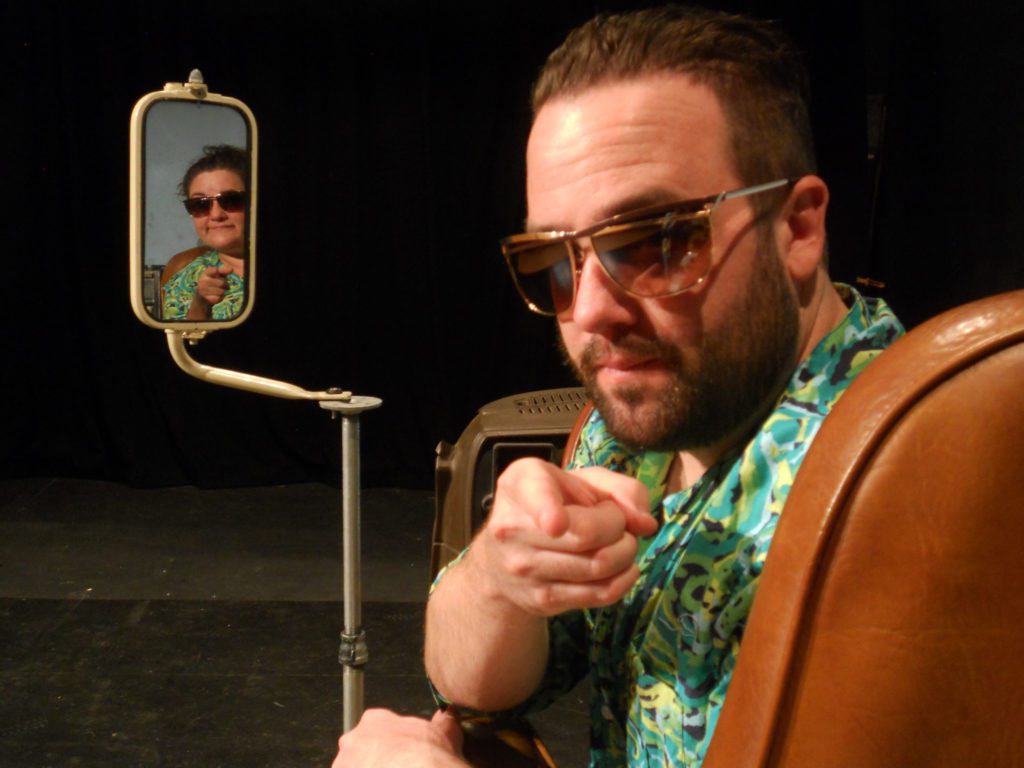
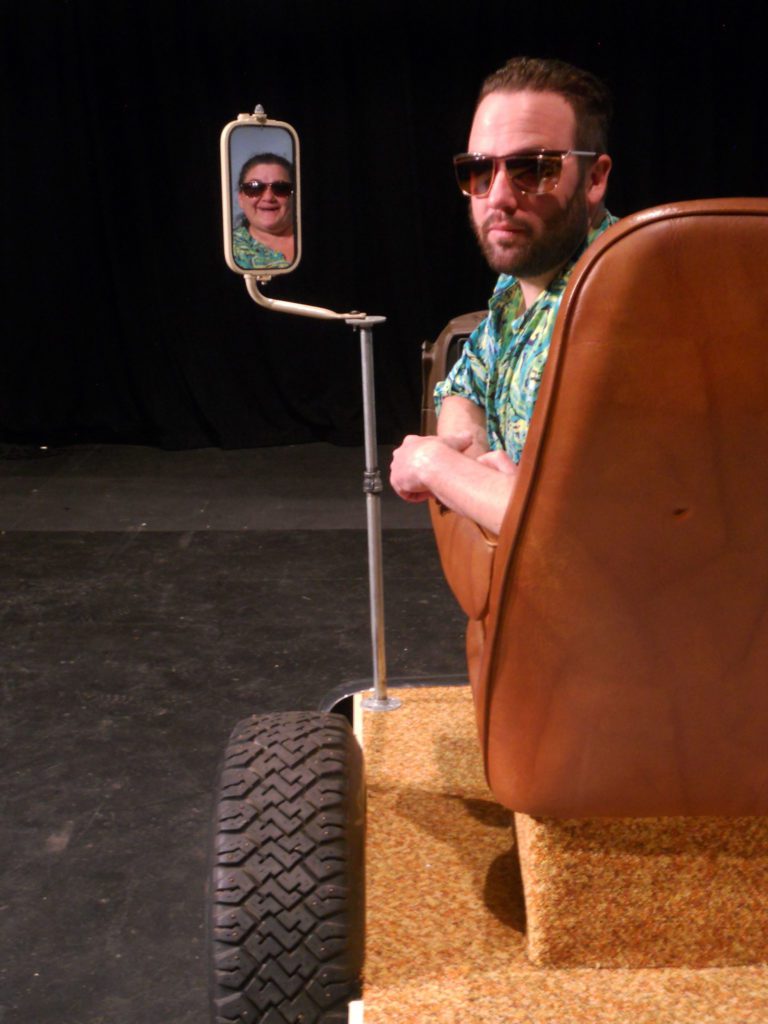
A man with sunglasses and a brightly colored shirt sits in a brown driver's seat, twisting to stare seriously at the camera. Next to him, in a driver's side mirror, is a woman in the same sunglasses. Both are pointing

Boulder Weekly- Letting Peggy Jo take the wheel A not-so-classic bank robber story in ‘Peggy Jo and the Desolate Nothing’

Most of what follows is true — the true story of a woman too big for her own life. Peggy Jo Tallas was mired in the post-women’s-liberation problem that faces so many women: If you didn’t grow up to be a wife and a mother, what did you grow up to be? And is it just a whole lot of nothing?

Peggy Jo started robbing banks in the 1990s. Maybe it was because she needed money for her mother’s medical expenses. Maybe it was because she was bored.

For years, law enforcement searched for this calm, collected, seemingly professional bank robber, but she’d always worn a beard, cowboy hat and sunglasses – they were searching for a man. That’s just a punch line in a much longer, funnier story that ends with more punch than you might expect in Peggy Jo and the Desolate Nothing, a collaboration by square product theatre and Buntport Theater Company.

Emily Harrison, founder of Boulder’s square product theatre and a general theatre powerhouse, knew the story of her fellow Texan, Peggy Jo Tallas, and approached Denver-based Buntport Theater Company with the threads of a story they could take to the stage.

The original, single-act, fulllength production that approaches Peggy’s story through the framework of the FBI agent trying to piece together the how and why. To help him out, he consults 20-years-worth of Peggy Jos: 40-something Peggy Jo by Harrison, two at or near 60-something Peggy Jos by Hannah Duggan and Erin Rollman, and one of her as “Cowboy Bob,” the bank robber disguise, played by Brian Colonna. Erik Edborg plays FBI Agent Steve Powell, who is both reading from and taking notes in his file about Ms. Tallas.

Nobody leaves the stage for the duration of the performance.

When they introduce Agent Steve to their tale, they have a cautionary note: Most of what follows is true. Because, as they say, showing is better than telling, he gets to witness her playing out her own life, even talking herself into her first bank robbery as the Peggy Jos huddle and assure one another they’ve got what it takes. As needed, they step into auxiliary roles: bank tellers, a fast-talking RV salesman, her deadbeat brother and their ailing mother.

“The story is true even if the telling of it is a little bit loosey-goosey,” Duggan’s version of Peggy Jo tells the FBI agent. She’s the most forthcoming of the Peggy Jos, caught in the middle of the other two, it seems, in a place that has her looking both forward and back and realizing how little we can tell of either place – where it was we came from that led us here and what exactly lies ahead.

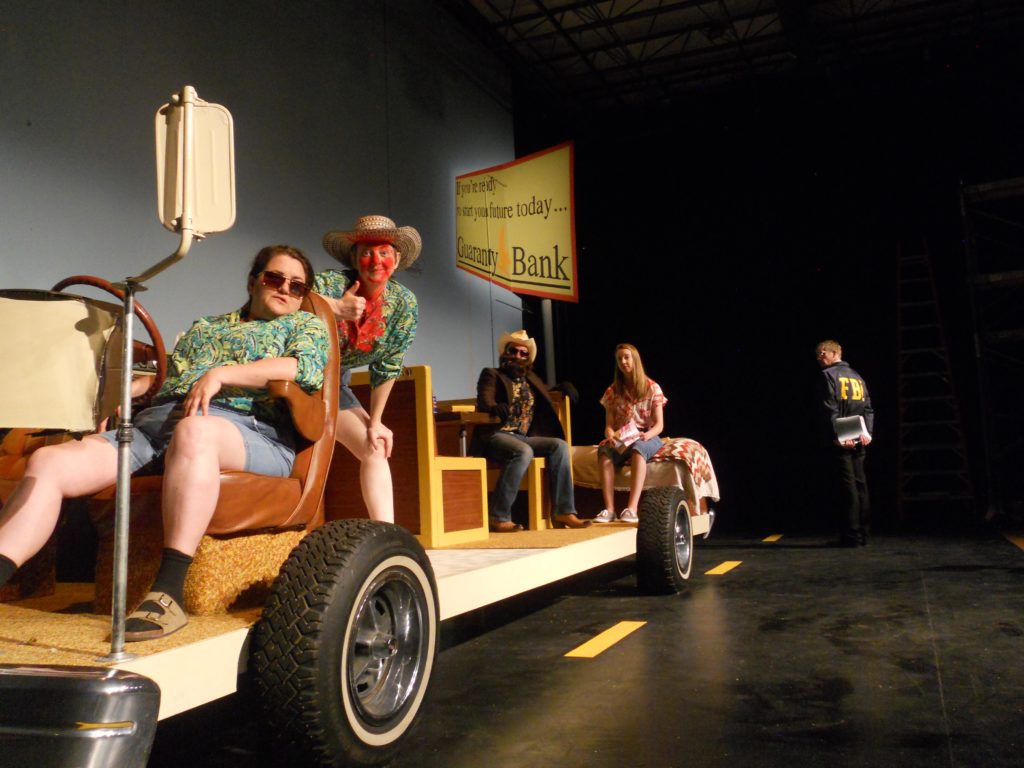
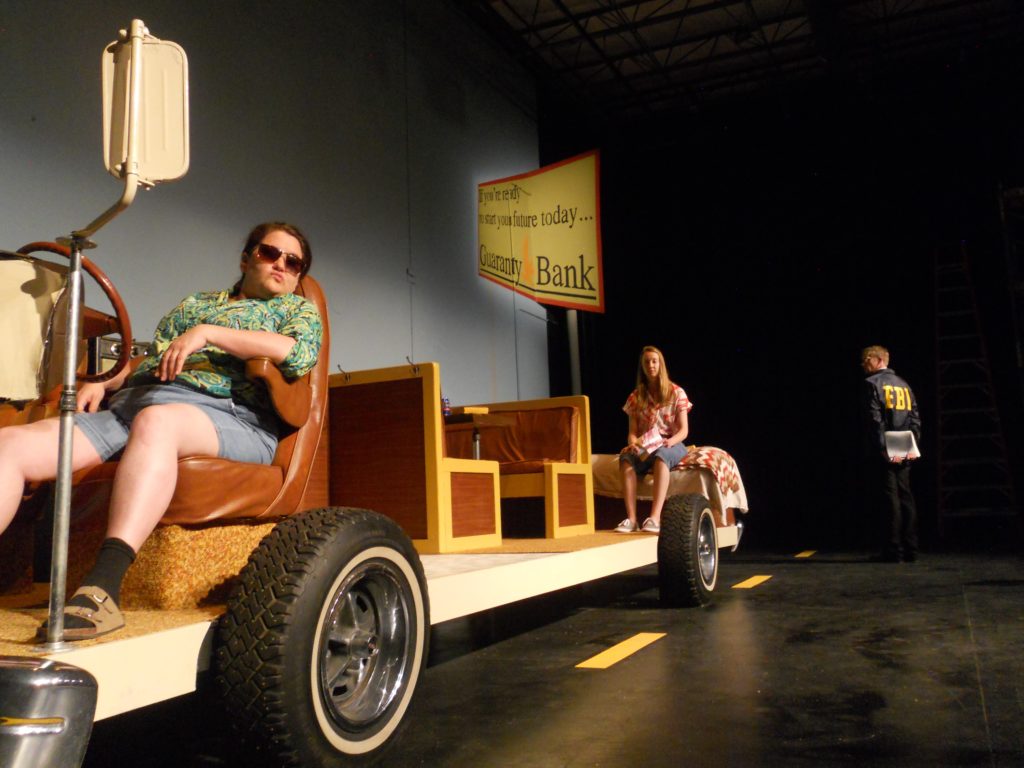
We do know how she’s going to get there – because all great Buntport shows seem to involve a set piece with tires, there’s an RV on stage, built just to the floor and furniture without so much as a door or windshield. They do, however, have a sink, kitchen table and bed, and at the front, a steering wheel and a rear view mirror, all in a caramel brown and mustard yellow that recalls the ’70s. It’s always one Peggy Jo or another at the wheel.

A billboard that would be in the rearview mirror of the RV reads “If you’re ready to start your future today… Guaranty Bank” and becomes a device the script uses to give the Peggy Jos a chance to insert more commentary about the events than her generally reticent nature would allow – not to say that she’s not outspoken Just to say, she’s the kind of personality that uses boisterousness and bravado to obscure most chances for personal insights.

It’s a decidedly funny ride, punctuated with moments of physical comedy, absurdity and self-conscious humor. But it also reads a little bit like being invited to find someone else’s inside jokes funny when you’ve just hopped on board with a decidedly unreliable source. It’s tough to know whether audiences appear lukewarm on that plan because it’s like a panty-grab on the first date, or if, even when you get the joke, someone else’s inside jokes just have a hard time making it to the laugh-out-loud level of funny.

But. If you’re ready to go all in on the ride… Guaranty Bank.

Elizabeth Miller, June 12, 2014, Boulder Weekly

Just the insides of an RV sit on a platform with wheels. Sitting in the RV are two people, one lounging in the driver's seat, the other sitting in the back on the bed. In the background in a road sign for a bank and an FBI officer with his back turned.

Denver Post- What becomes a legend? asks poignant “Peggy Jo”

It’s OK if you detect a trace of Walter White and a touch of “American Hustle ” in “Peggy Jo and the Desolate Nothing,” onstage at Bunport though June 21.

After all the tale of Peggy Jo Tallas, who in the early 1990s was one of Texas’ more vexing bankrobbers, is surely one of reinvention and of a quasi-accidental life of crime embraced.

“Most of what follows is true,” cautions one of the four actors playing the title character. Three are women: Hannah Duggan, Erin Rollman and Emily Harrison. Brian Colonna completes the quartet, wearing a bushy beard seemingly borrowed from Yukon Jack or, closer to home, Colorado Rockie Charlie Blackmon.

His character is credited as “Peggy Jo Tallas as Cowboy Bob.” Erik Edborg plays FBI agent Steve Powell, who tries to get Peggy Jo to open up after she is first apprehended.

In 2005, Texas Monthly published “The Last Ride of Cowboy Bob,” by Skip Hollandsworth. The play’s go-to source, it begins benignly enough: “Peggy Jo Tallas was, by all accounts, the classic good-hearted Texas woman. For much of her adult life, she lived with her ailing mother in a small apartment in the Dallas suburbs.”

The rub? Peggy would don male attire, glue on facial hair, pull a cowboy hat down over her wig, walk into banks in towns like Irving, Garland, and fatefully, Tyler, hand the teller a note and walk out with cash.

When she was arrested in 1992, family and friends were gobsmacked by her exploits, according to the article. And Agent Powell, who’d been bedeviled by a robber he dubbed Cowboy Bob, was just as astonished to learn the true identity of his quarry.

Of course, true identities are a complicated notion. What truths does the story of a tight-lipped, cross-dressing (for the purposes of heists) bank robber actually reveal? That is the quandary at the heart of “Peggy Jo and the Desolate Nothing.”

How do yarns get spun? How do they figure in and entwine with popular and the broader culture? For instance, a friend of Peggy Jo said Peggy’s favorite movie was 1969’s outlaw gem “Butch Cassidy and the Sundance Kid,” starring – all the Peggys seem to agree – “two of the prettiest men” ever. The iconic scene of Paul Newman riding a bike with Katharine Ross set to “Raindrops Keep Fallin’ on My Head,” becomes fodder for debates about the merits of B.J. Thomas’ No. 1 hit.

Still there’s more here than easy winks. According to other not-quite-reliable sources, Peggy was fond of cooking up “fajita meat.” Who calls it “fajita meat” for goodness sake? Yet that phrase becomes a staple of the legend. So does her drinking Pepsi out of a coffee mug.

When we can’t (or don’t want to) get at the roots of a tall tale, little details are treated as huge clues. The idea that Peggy started robbing banks to pay for her mother’s medication is touched on but never exploited. Remember, it didn’t take long into “Breaking Bad” to sense Walter’s cancer was not the only reason he plunged deeper and deeper into the meth biz.

Smart, poignant, this adventure in story-telling – and story-withholding – is the work of Buntport and Boulder’s Square Product Theatre. This is their first collaboration, though neither is stranger to putting its big brain together with another troupe and seeing what happens.

What happens here is at once funny and sad and thought-provoking – often simultaneously. The four Buntport performers – Edborg, Duggan, Rollman and Colonna – bring their typically deft comedic timing to the show. Square Product’s Harrison injects a tempering vulnerability.

The scenic design – chiefly the chassis of a RV – sets the tone for themes about escape and home and, yes, America.

The script is careful to hew to the facts – details – as learned mostly through Hollandsworth’s article. I can imagine some might have wished for more artistic license.

Instead “Peggy Jo and the Desolate Nothing” feels respectful – of Peggy Jo’s silences, yes, but also the audience’s ability to consider deeper questions while knowing some answers are never fully forthcoming.

As Agent Powell says “There’s more than one way to choke a dog with pudding.” Right. Uh, we think.

-Lisa Kennedy, June 7, 2014, Denver Post

A man with sunglasses and a brightly colored shirt sits in a brown driver's seat, twisting to stare seriously at the camera. Next to him, in a driver's side mirror, a woman in the same sunglasses and shirt is smiling.

GetBoulder.com- Peggy Jo and the Desolate Nothing

As we have come to expect, Buntport has taken a relatively simple story about a female bank robber who disguises herself as a man and turns it on its ear. For instance, instead of one Peggy Jo, there are four – three female and one male. Two of them represent Peggy Jo early in her robbery career and two twenty years later. The fifth character is Steve, an FBI agent who pulls the story together and tracks her down

Part of the set is a giant billboard that proclaims “If you’re ready to start your future today, Guaranty Bank!” With hilarious variations, this became the clarion call of the group in a manner similar to Jeff Foxworthy’s multiple riffs on “You might be a redneck.” The set consists of a huge motor home stripped of its outer shell in which getaways are made and life is lived between robberies. Grandma highlights the smutty parts of romance novels; corn nuts are consumed and explanations made to the tag-along FBI agent. A sixth character in the production is a pet duck included because of Peggy Jo’s real job in a petting zoo. When asked after the show “Which came first, the story or the duck?” the unanimous response was “the duck.”

It is so hard to explain the threads of humor that wend through any Buntport production and the inventiveness with which they tackle their chosen subject matter. The emphasis may vary from one company member to another from production to production, but the creativity and unity of the group is always of the highest caliber. For instance, usual Buntporter Evan was missing from this show, but Emily K. Harrison from Boulder’s Square Product Company stepped in to become one of the Peggy’s. Most of the story was moved forward this time by company member Hannah Duggan until the last five minutes when Erin Rollman stepped forward to take the final spotlight. But all along the way, they were united by the work of Erik Edborg as the FBI agent/used car salesman and Brian Colonna as the one male Peggy (i.e., Cowboy Bob, her alias).

These shows sell out. Sometimes they come back to be revisited; sometimes they don’t. So your best idea is to see them the first time when you can.

A WOW factor of 8.5!

-Beki Pineda, June 7, 2014, GetBoulder.com

Just the insides of an RV sit on a platform with wheels. Sitting in the RV are two people, one lounging in the driver's seat, the other sitting in the back on the bed. In the background in a road sign for a bank and an FBI officer with his back turned.

North Denver Tribune- Fascinating story of Peggy Jo and the Desolate Nothing

“Most of what follows is true.” This declaration, made several times by each of the four actors playing the title character in the joint Buntport Theater/square product theatre production of Peggy Jo and the Desolate Nothing, frames the evening perfectly at the start. Not surprisingly, it is difficult to tell what is true and what is not. Since, as noted in the play “all storytelling is selective,” and as Buntport has argued many times in the past, most articulately in their 2008 production of Musketeer, art not only allows us to go beyond literal truth, it demands it. Telling a story is a creative process – it may start with something that “really happened,” but to stay tied to that is to limit the expression of creativity. Buntport understands this “truth,” never flinching as they frequently remind the audience watching not to believe everything, but entice us to enjoy the story and its telling for what they are: good theater.

The story of Peggy Jo and the Desolate Nothing is fascinating. Without the convention of mundane sequential time, the play tells us of Peggy Jo Tallas, a woman who robbed several banks in Texas wearing a fake beard, sunglasses, and a cowboy hat. We learn who she is, a few highlights of her life, and also explore some of the reasons that she may have done what she did. Four actors play Peggy Jo, each capturing different aspects of the character, with the fifth actor playing Agent Steve Powell. Throughout the play, the actors each take on additional roles but do so in character, which adds another layer of storytelling. There are also diverse, unique, and sometimes hilarious elements woven throughout, including most notably a pet duck, a billboard quote, and references to the movie Butch Cassidy and the Sundance Kid. All of this makes for a script with depth, meaning, comedy, intrigue, entertainment, and even some suspense.

All elements of the show, including creating, directing, and designing, are done collaboratively at Buntport, this time with Emily K. Harrison of square product theatre added in. The direction of the show is tight, using the wide stage well, staging scenes across in front of and on the clever representation of an RV that dominates the stage. The insertion of an unexpected dance number near the end was a pleasant surprise, adding yet another dimension to the storytelling.

Buntport’s actors have a way of concealing their acting talent with outrageousness, letting the audience think they are just being silly, when there is really much more substance and skill there. Each of the four title characters captures a different aspect of Peggy Jo. Hannah Duggan delivers much of the narrative content, revealing much about the character, both in the exposition, in the way she tells the story, and the way she interacts with others. Emily K. Harrison is the younger, quirky Peggy Jo, also capturing Peggy Jo’s mother well. Brian Colonna (who has a lot of fun playing a woman disguised as a man without affectation) is the bold, bank robbing Peggy Jo. Colonna also is notable with his exceptional hip action in the dance sequence. Erin Rollman is the more intense, serious, and even audacious Peggy Jo, silent throughout most of the show, but compelling us to listen when she does speak. Rollman covers the more serious material very well, and brings the comedy back to reality at the conclusion of the show. The only actor not playing Peggy Jo is Erik Edborg, as FBI Agent Steve Powell, trying to present himself as the objective factual source, but never able to separate himself from the story, especially when uncomfortably confronted with his own inconsistencies.

The set design is wonderful, tightly integrated with the production due to the collaborative nature of its creation. The chassis of an RV sits on a road going across the stage, “heading towards nothing, coming from nothing”. A single billboard emerges out of the back wall, creating an interesting visual perspective. The lighting enhances things nicely, including the outline of the RV on the back wall during the night scene. The costumes meet the needs of each character well, helping to selectively connect the different personas of Peggy Jo, and adding simple elements such as a jacket or a pair of glasses to transform characters temporarily.

Peggy Jo and the Desolate Nothing is quintessential Buntport. An interesting story is told, with the storytelling is as important as the story – the two are integrated and inseparable. This production is new, fresh, and unlike anything else you will see anywhere else. So give yourself a treat and head down to Buntport for an evening with Peggy Jo.

-Craig Williamson, June 6, 2014, North Denver Tribune

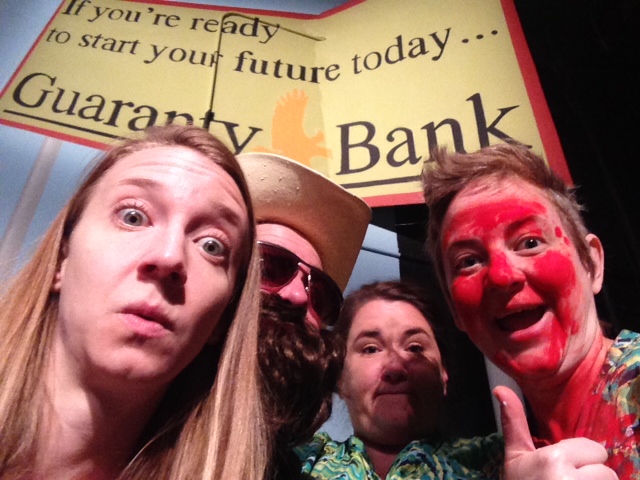
Four motley people squeeze their faces into the frame. Behind them is a road sign for Guaranty Bank

Colorado Drama- Peggy Jo and the Desolate Nothing

The bearded bank robber in the cowboy hat was a pro. He would walk calmly into a bank, hand the teller a note, wait for his bag to be filled from the cash drawer, walk out, and disappear, without ever brandishing a weapon. For years, the FBI couldn’t track him down. Then, one day, “Cowboy Bob,” as the agents called him, changed his modus operandi and, lo and behold, he turned out to be a she.

So goes the true story of Peggy Jo Tallas, a polite, fun-loving dame from the suburbs of Dallas, who spent much of her adult life working odd jobs and taking care of her mother, who suffered from a degenerative bone disease. When Peggy Jo got caught the first time, none of her family or friends could believe she was robbing banks.

In its 35th original production in 13 years, Buntport Theater Company, in conjunction with Square Product Theatre, pulls another wild hare out of their collective magicians’ hats, splitting the different faces of Peggy Jo between Emily K. Harrision, Hannah Duggan, Erin Rollman, and Brian Colonna, while Erik Edborg weighs in as FBI Agent Steve Powell, Peggy Jo’s relentless, but good-natured, pursuer.

Like a Greek drama performed in masks with a time-lapse twist, each of the faces of Peggy Jo represents a different moment in her journey, with Harrison, Duggan, and Rollman as her 40, 50, and 60 something year-old self, and Colonna as her Cowboy Bob alter ego; yet, they are all there at once, in the present; and like the Greeks, we know what’s going to happen, yet that does not diminish the humor or the catharsis.

The Buntporters and Harrison, each in their own inimitable fashion, bring out the weird convolutions of Peggy Jo’s mind, which she insisted, not without good reason, were normal. I mean, lots of people have watched Butch Cassidy and the Sundance Kid multiple times, and some of them have even read Ferlinghetti’s A Coney Island of the Mind. That one such person would take these artistic achievements to heart and put his or her life on the line for such a way of being is to be expected, isn’t it?

Taken together, the performances define a fascinating woman who understood what it was to live and not let the banksters get in the way of having a good time.

-Bob Bows, June 5, 2014, ColoradoDrama.com

Two people in matching outfits stand next to a pile of money. One holds a small wooden duck, the other has bright red powder covering her face and shirt. In the background, on a painted road, is the insides of an RV sitting on a platform with wheels.

Westword- Peggy Jo and the Desolate Nothing is nothing much

Peggy Jo Tallas was an outwardly conventional, quiet-spoken Texas woman who, after a mildly adventurous youth, lived with her mother for many years. Starting at the age of forty, she also robbed banks – perhaps because she was bored, perhaps because she was seeking a fuller and more interesting life, perhaps because she just needed some cash. Although she never scored a huge amount of money, she was extremely competent at her job. Her robberies were accomplished swiftly, bloodlessly, and with a minimum of fuss. And she so successfully disguised herself as a man that for a long time, FBI agents – perhaps aided by the kind of masculine myopia that believes no woman could possibly accomplish anything as tough as a bank robbery – were looking for a culprit they dubbed Cowboy Bob.

It’s an intriguing story with several questions at its core: Who was Peggy Jo Tallas, and why did she do what she did? And, by extension, what do her activities say about the culture she lived in? In taking on these questions with Peggy Jo, Buntport Theater Company partnered for Peggy Jo and the Desolate Nothing with Boulder’s Square Product Theatre and its director, Emily K. Harrison.

Buntport has divided the role of Peggy Jo four ways. All three of the women play her – Harrison at the age of forty, and Hannah Duggan and Erin Rollman at sixty, when Tallas’s career came to an end; they play a handful of ancillary characters, too. Brian Colonna also plays Tallas at forty – or, rather, her alter-ego, Cowboy Bob. None of the portrayals is particularly specific, nor do the actors seem to represent different facets of Tallas’s personality so that when you take all of their efforts together it adds up to some kind of whole. Which means you leave with no more understanding of this woman than you had on first taking your seat. Throughout, Erik Edborg plays patient, baffled FBI agent Steve Powell.

Metaphor is good and repetition a time-honored theatrical device, but these things don’t substitute for action and character. The actors have seized on pieces of Peggy Jo’s biography that might explain something about her psyche or universalize her story. Phrases from Ferlinghetti recur – “slippery gibbets,” “carnivorous cocks,” “false windmills and demented roosters” – all because Tallas once visited San Francisco and gave Ferlinghetti’s work to a friend. Tallas also liked Butch Cassidy and the Sundance Kid, and the featured song from that movie, “Raindrops Keep Fallin’ on My Head,” plays again and again until its bouncy rhythms become vaguely threatening. But it doesn’t help anything that after a while you know exactly what you’ll hear if anyone on stage touches the radio knob.

There are several comments about narrative and myth-making: “All storytelling is selective, Steve” and “We’re creating a mythology based on bits and pieces.” But there is no myth about Peggy Jo Tallas to be debunked, filled out, simplified or complexified, because few people know enough about her to have a story in mind. What this blended company needed to do was create that story. Or – had the crew wanted to go further – create and then deconstruct it.

What’s odd is how understated Tallas’s robberies seem to have been, particularly in comparison with highly romanticized movies like Butch Cassidy or Bonnie and Clyde, which is also mentioned here. There’s no sex or romance, no great gouts of blood, no missing millions or decades-long disappearances to exotic lands – just a vague dream about a beach in Mexico. And, of course, that’s the point. That, and the ennui of Tallas’s long road journeys. The actors try valiantly to insert a sense of existential despair, but it doesn’t mitigate the show’s static feel. Peggy Jo isn’t boring, but it isn’t involving, either.

There are moments in which Buntport’s originality and eccentricity come through, though, and some performances that work, including Colonna playing it humorously straight as Cowboy Bob and Edborg’s low-key Agent Powell. Duggan’s very presence communicates a comic sense of existential worry mixed with slight annoyance, and one of the evening’s high points is her passionate assertion that since baby ducks imprint on the first moving creature they see, the pull-toy duck she takes everywhere “knows it’s human. It knows I’m its momma.”

This company is always worth watching. But by the end of Peggy Jo, you’re left with pretty much nothing. And not even a desolate nothing at that.

-Juliet Wittman, June 5, 2014, Westword

A man with a fake beard and sunglasses holds piles of cash. Behind him two people sit in an RV without walls. Next to them stands an FBI officer holding some files.

ARTICLE Denver Post- “Peggy Jo and the Desolate Nothing,” tale of a cross-dressing bank robber Buntport and Square Product Theater team up to tell tale of Peggy Jo Tal

Buntport theater company is no stranger to the inventive. If you’re not familiar with the Denver-based group’s original shows, here’s a taste.

“Tommy Lee Jones Goes to the Opera Alone” was a riff on celebrity done with life-size puppets. The musical “Sweet Tooth” told of an exacting aesthete who would not leave her home — nope, not even for an agonizing tooth ache — because she could not control the look of the world. “Jugged Rabbit Stew” featured an embittered and talented magician’s rabbit.

As for Square Product Theatre, Boulder’s edgiest troupe’s most recent show — “5 Lesbians Eating Quiche,” written by Evan Linder and Andrew Hobgood — was set in 1956 midst the Susan B. Anthony Society for the Sisters of Gertrude Stein.

For four weekends, the companies have joined forces to consider the tale of cross-dressing bank robber Peggy Jo Tallas, as only two of the area’s most creatively headstrong theater groups might in “Peggy Jo and the Desolate Nothing.” (May 30-June 21.)

The poetic, melancholy title came by way of Square Product’s Emily Harrison. “She thinks about America a lot (in this case the American Dream) and it just came to her…” Buntport’s Brian Colonna says. “I guess, she’s good like that.”

Trying to keep her daughter connected to her Lone Star State roots, Harrison’s mother gave her a subscription to “Texas Monthly,” an award-garnering mag.

In his 2005 article, “The Last Ride of Cowboy Bob,” Skip Hollandsworth recounts the story of Tallas, by most accounts a kind-hearted woman who took care of her ailing mother and also had a successful and wild ride as a bank robber.

“But Peggy Jo didn’t just rob a bank,” writes Hollandsworth. “According to the FBI, she was one of the most unusual bank robbers of her generation, a modern-day Bonnie without a Clyde who always worked alone…. She was also a master of disguise, her cross-dressing outfits so carefully designed that law enforcement officials, studying bank surveillance tapes, had no idea they were chasing a woman.”

If Hollandsworth’s byline rings a bell it might be because he also penned Texas Monthy’s “Midnight in the Garden of East Texas,” about a kindly mortician and the widow he befriended, then shot. The yarn became the basis for the Richard Linklater’s 2012 dramedy “Bernie,” starring Jack Black and Shirley MacLaine.

Harrison, who teaches theater at the University of Colorado at Boulder, was working toward her MFA at Savannah College of Art & Design in Georgia when Tallas had her showdown with the FBI and police.

“I remembered the story from Texas Monthly and pitched it to Buntport, and they were interested.” says Harrison.

“Basically that magazine story is the primary source for the show,” says Colonna.

When it comes to collaboration, “Peggy Jo” isn’t Buntport’s or Square Product’s first rodeo.

“We do it all the time,” said Harrison, sitting in the bungalow that houses Buntport’s costumes and props.

Square Product’s regional premiere of Johnna Adams’ drama about a child’s suicide, “Gidion’s Knot,” was done in association with Goddess Here Productions.

Both Buntport musicals relied on the equally ambitious skills of lyricist/composer Adam Stone, whose own company, Screw Tooth, is now housed at Buntport’s space.

In addition to working with Stone, Buntport has established ties to the Denver Art Museum. They recently did “Captured in Film,” a delightfully playful one-off show done with the Augustana Arts that combined lush orchestration with performance and a silent movie comedy.

Tag-teaming a production keeps the company composed of Colorado College friends engaged, says Colonna. “For us it’s a way to keep the ensemble fresh and challenge yourself. You get another opinion. You get a different point of view.”

It will be intriguing to see what Buntport and Square Product make of Peggy Jo’s saga of wildness and sorrow. After all, even when productions have been slightly off the mark, the shows remains stubbornly vivid, engaged, and intellectually fearless.

-Lisa Kennedy, May 29, 2014, Denver Post